Introduction: How many people are familiar with Psalm 23? I am old enough that I grew up amidst a culture that was at least culturally Christian. Many in my extended family knew the Bible quite well. Both my maternal and paternal grandfathers were pastors and labored in Christian ministry as their vocations. So the Scriptures were not far from our reach, so to speak. And at funerals especially, it was not uncommon to hear Psalm 23 read or referenced. With good reason. It is arguably the most powerful poem in the Psalms about God’s providence. It is about how God is the shepherd of his people, about how he is with his people. He is near.
We so seldom want to admit that our spiritual lives ebb and flow, that sometimes we don’t feel the closeness and fellowship with God the good shepherd as we ought to. We might act super pious, as if we are above such matters. But that is clearly Pharisaical. It is revealing of spiritual pride. If we are honest, we do walk through valleys. We do battle doubts. We do feel plagued by questions at times. We do shake our heads at the world, and at ourselves, and cry out in anguish, “How long, O Lord?” That refrain runs throughout the Scriptures.
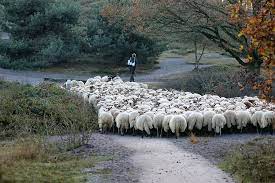
Connections: This coming Sunday, I will be with my fellow Christian pilgrims. And I will open the Scriptures before them and with them. And we will look at Psalm 23 and explore one crucial question: Consider the alternative to having no shepherd; how awful must be that alternative.
Psalm 23 reads this way:
A Psalm of David.
23 The Lord is my shepherd; I shall not want.
2 He makes me lie down in green pastures.
He leads me beside still waters.
3 He restores my soul.
He leads me in paths of righteousness
for his name’s sake.
4 Even though I walk through the valley of the shadow of death,
I will fear no evil,
for you are with me;
your rod and your staff,
they comfort me.
5 You prepare a table before me
in the presence of my enemies;
you anoint my head with oil;
my cup overflows.
6 Surely goodness and mercy shall follow me
all the days of my life,
and I shall dwell in the house of the Lord
forever. (Psalm 23, ESV)
And if there’s one thing the Scriptures so clearly do, it is this: they cohere. They hold together. They tell a unified story. They have a controlling idea, in sum.
NT Connection: When Jesus discourses in the New Testament, John records how overt Jesus was in his clarifying of his identity. The setting was one in which Jesus was again calling out the spiritual hypocrisy and spiritual pride of the Pharisees–and to all those who put on a face of being above others, of being more spiritual, of being holier than thou, of being sanctimonious.
Jesus’ words are blunt:
11 I am the good shepherd. The good shepherd lays down his life for the sheep. 12 He who is a hired hand and not a shepherd, who does not own the sheep, sees the wolf coming and leaves the sheep and flees, and the wolf snatches them and scatters them. 13 He flees because he is a hired hand and cares nothing for the sheep. 14 I am the good shepherd. I know my own and my own know me, 15 just as the Father knows me and I know the Father; and I lay down my life for the sheep. 16 And I have other sheep that are not of this fold. I must bring them also, and they will listen to my voice. So there will be one flock, one shepherd. 17 For this reason the Father loves me, because I lay down my life that I may take it up again. 18 No one takes it from me, but I lay it down of my own accord. I have authority to lay it down, and I have authority to take it up again. This charge I have received from my Father. (John 10:11-18, ESV)
Teaching: It is so clear. Jesus taught that he was and is the good shepherd to his people. To all who are “in Christ,” to use biblical language. Jesus Christ–the one who was and is the good shepherd–the one who was slain for sinners, is also the risen lamb to whom the whole cosmos will pay tribute, either in adoration or condemnation.
He is the shepherding God, you see. And he is good. Completely good. Holy. And he walks with the hurting through the valleys of this life. He restores them. He prapares tables for them. He anoints. This is the nature of the good shepherd. And Jesus said that he was and is that good shepherd, the one David wrote about in Psalm 23.
Encouragement: Consider the alternative. What if there were no shepherd? What if your sufferings are only yours alone? What if they had no purpose? What if there was no one to care? What if you are just so much cosmic dust, dust in the wind, as Kansas sang about? There would be no reason for you to whine or complain. Why? Because you don’t matter in that worldview. Nothing matters in that worldview. You’re just a speck of dust in an unguided biological machine that cannot account for itself, for mind, or for why anything should matter.
But in the biblical worldview, it all makes sense. You do matter. Your suffering does matter. And there is a good shepherd who offers himself to you in the gospel that runs throughout the Bible. There is an alternative to materialism and despair, dear one, and it comes by fleeing to the good shepherd. He is the wise and saving alternative. He has sustained others, and he can and will sustain you, too.
 MIND & MATTERS