What Does It Mean to “Cast Your Burden”?

Last evening amidst the gloaming I took to the hills after work. I walked some of my favorite paths. I had a novel with me, too, and I paused a while at Reader’s Rock where I sat and read more of McCarthy’s Blood Meridian yet again. Then I walked some more. And finally I returned home.

When I entered the house, my wife and I spoke for a while and talked of our son’s recent trip to the beach with some of his friends. It was a pretty normal evening. But I had a heaviness of heart I could not seem to shake.

My wife sat down at her keyboard and began playing a hymn from Sovereign Grace entitled “From Everlasting (Psalm 90).” And everything changed in my spirit. I stood behind her as she sat on her piano stool and played the keys and sang. And again, my heart changed.

As the words from Psalm 90:2 filled the house, my heart changed. “[F]rom everlasting to everlasting you are God” (Ps 90:2b). She continued through the song, her long pianist fingers coming down upon keys of white and black, and the words continued: “[F]rom everlasting to everlasting you are God.”

I finally turned away when she finished playing, went and brushed my teeth, and prepared for bed. I reflected on words from Psalm 55 from some of my recent studies in Scripture:

My companion stretched out his hand against his friends;
    he violated his covenant.
21 His speech was smooth as butter,
    yet war was in his heart;
his words were softer than oil,
    yet they were drawn swords.

22 Cast your burden on the Lord,
    and he will sustain you;
he will never permit
    the righteous to be moved.

23 But you, O God, will cast them down
    into the pit of destruction;
men of blood and treachery
    shall not live out half their days.
But I will trust in you.
(Ps 55:20-23)

David penned Psalm 55 and Moses penned Psalm 90. Two men that God used from everlasting to everlasting. David wrote in verse 22 of Psalm 55 that the believer is to cast his burden on the Lord. And the result of that trust? God will sustain him. He will not permit the righteous person to be moved (v. 22). What’s more, God will cast down the wicked “into the pit of destruction” (v. 23).

Peter picks up on that image in his letters: “casting all your anxieties on him, because he cares for you” (1 Pt 5:7). Casting one’s heavy heart–casting one’s burden–casting one’s load of anxieties upon the Lord is the posture of the Christian because it entails looking away from ourselves and unto the Lord, a posture of trust. And assurance.


The Secret Heart

In Hebrew the word for heart is “Levav” (לֵבָב). It connotes the inner man, the character of the person.

Psalm 51 is my wife’s favorite of the 150 psalms from Scripture. It is of course one of David’s penitential psalms. In it he confesses. His sins with Bathsheba and his staged murder of her husband Uriah are front and center. In short, David does not hide from God. He owns his sin and goes to God with it. And God hears and forgives him. That’s the pattern of the believer and that’s the pattern of God. David does not attempt to justify his sin. He owns it. He confesses it to God. And God restores him. The temporal consequences of the sin often remain but the ultimate spiritual balm remains. David is saved.

For all his faults, David remained God’s man. David had a resume you’d not wish to compete against–a poet, a musician, a shepherd, the greatest king national Israel ever had, the son who prefigured the Christ to come, a warrior, a man of means. The list could go on.

What set David apart was his heart for God. Though a sinner, he was God’s man. His heart, his nature, his character—they were Godward. He longed to please God.

Did he fail as a father to Absalom? Yes, clearly. Did he have a “woman problem” at times? Again, yes. But did David repent? Again, yes. Psalm 51 is an obvious example of this character of genuine repentance, of turning away from sin and to God.

In this psalm, David writes that the Lord delights “in truth in the inward being” (v. 6a) and that the Lord teaches “wisdom in the secret heart” (v. 6b). That’s what is meant by Levav–the character, the affections, the true nature of the man, who the man really is at his core.

I’m about to walk the hills that I have walked for years now. I know where the roots are, where the rocks are, what timber is fallen, and where I’m likely to see deer foraging. I know when I’ll hear the creeks flow and when this evening’s sun will disappear behind the western ridge.

As intimately as I know all these things, the Lord knows more. He knows why these passions for his creation consume me. He knows where I’ll step before I extend my legs. He knows the taxonomy of the rocks, the temperature of the creek’s waters, and where those waters will end. He knows the pace of my walk, the trees that tower above me, and how long my shadow is upon the forest floor.

In sum, God knows my character. Indeed, he knows all things. And he has told me in his Word that he delights “in truth in the inward being.”

It is presumptuous to speak for others, but as for me, this breaks me. It reminds me that I’m not my own, that I’ve been bought with a price, that I will answer, and this changes me.

Very Present

Text: “God is our refuge and strength, a very present help in trouble” (Ps 46:1).

Context, Context, Context: Psalm 46 is a song/psalm of celebration penned by some of the Old Testament hymn writers of people in covenant relationship with the Lord. The 11 verses of Psalm 46 are words of praise to the present-tense God. That is crucial to understand. God is in covenant relationship with his people. He does not abandon them or forsake them. He is ever present with them.

Teaching: Focus for a moment on just verse 1. Does it say that God was or that God will perhaps be? No, it doesn’t. It says that God is, that God is very present. A temptation that we may feel at times is to think or feel as if God is not aware of our troubles, that God doesn’t care. That’s one of the great encouragements of psalms like Psalm 46. It teaches that the Lord is in intimate relationship with his covenant people. He is our refuge and strength because he is “very present.” Our feelings can and will betray us. It is unwise to live by feelings. They can and often do lead us into unwise relationships. Verse 5 of Psalm 46 reminds us that God is “in the midst.” That is, God is present. He is very present. He sees all. He knows all. He knows where you are and what you’re going through. Therefore, go to him. Verse 11 again teaches the same principle, namely, that the “LORD of hosts is with us.”

Encouragement: This past Sunday at church, I told the saints again and again the same doctrine, that God is present, that God is near, that no one escapes God. You can ignore reality, but reality still exists. Your suppression of it does not change the truth of the way things are. God is a covenant-making, covenant-keeping God. People will let you down; they will disappoint you; they will betray you. But God is faithful and will not—indeed cannot—lie. And that truth, dear ones, is encouraging. God is very present and is a refuge and strength to all who are in him.

Chaplain Daily Touchpoint #435: The Beginning of Wisdom

Text:

19 Arise, O Lord! Let not man prevail;
    let the nations be judged before you!
20 Put them in fear, O Lord!
    Let the nations know that they are but men! Selah

Context, Context, Context: David, the shepherd/poet/king, wrote Psalm 9. Psalm 9 is sometimes categorized as a psalm or confidence or a psalm of thanksgiving. The reasons are straightforward: David recognizes and rejoices in the fact that God is the one most worthy of praise. He is the one from whom all blessings flow. He is to be the believer’s focus. Through most of the poem, David employs language of God as king, as ruler, as supreme. And when we get to lines 19-20, David is speaking of nations hostile to God and to God’s truth.

Teaching: David focuses on the theological posture of nations and people who oppose God. David prays that the nations would be judged before the holy judgment seat of God (v. 19), that they might learn to fear the Lord (v. 20a), and they would be humbled before God (v. 20b).

Encouragement: Throughout Scripture, God’s Word teaches that humility precedes honor, that pride is abominable before God. “God opposes the proud but gives grace to the humble” (James 4:6). “Humble yourselves before the Lord, and he will exalt you” (James 4:10). Satan is the one who opposed the King of kings; he demanded the spotlight; he wanted to be the Most High. But God will not share his glory with another. God is the Creator and we are his creatures. And David, because he understands the times and what God’s people are to do, calls the nations (i.e., people) to humility before God so that, at the proper time and in the proper way, God might raise them up.

Chaplain Daily Touchpoint #333: The Faithfulness of God

Bottom line up front: The Faithfulness of God

Questions: Have you ever felt like you prayed lead balloon prayers? Have you ever felt like your prayers went no farther than the nearest ceiling? Have you ever felt like your petitions fell on deaf ears? Because of pride, many folks would be reluctant to admit they have felt that way, but I’d wager that many people have experienced those emotions, sometimes profoundly.

Take Comfort in Fellow Believers from History: In the 94th psalm, the writer laments the seeming triumphs of wicked people. The speaker in the poem cries out in verse 3, “O LORD, how long shall the wicked,/how long shall the wicked exult?” That’s a cry of anguish at an existential level. The speaker is in anguish because things seem upside down from the way they ought to be. The innocent are seemingly forsaken and the guilty people prosper.

It reminds one of the 73rd psalm where Asaph writes, “For I was envious of the arrogant/when I saw the prosperity of the wicked” (Ps 73:4) and later that “pride is their necklace” (Ps 73:6a) and again, “And they [the wicked] say, “How can God know?/Is there knowledge in the Most High?” (Ps 73:11). Short answer: Yes. There is perfect, 100% knowledge with the Most High. Omniscience. That’s an eternal attribute of the true and living God.

So, if you and I have ever battled those seasons where it seems the wicked prosper and the godly suffer; if we battle seeing duplicity rewarded and integrity banished; if we feel like our prayers to the Lord bounce back to us unheard and unheeded, we need only turn to Scripture to see that we’re not to live via our feelings but to live according to the Word of God. We’re not to look unto ourselves but to God. We’re to trust the Lord, knowing that He does what is best. Don’t we remember the words God spoke to the father of the faith, Abraham: “Shall not the Judge of all the earth do what is just?” (Gen 18:25).

Encouragement: Through this continuing government shutdown, I am learning—once again—that God will provide. He is faithful. He allows suffering and scarcity at times, yes. He allows the wicked to prosper for seasons, yes. He allows the crafty to slither their ways into positions, yes. But we need to focus on how those stories ended: Herod was eaten by worms; Nebuchadnezzar was turned into a bestial bovine-like man; and Satan was crushed by the risen Christ. God is indeed faithful, and He sees you and sees me, and He (unlike His adversaries) is altogether good.

Chaplain Daily Touchpoint #300: Implied and Specific Tasks

Bottom line up front: Implied and Specifics

Intro: It was a long time ago now, but it was my first semester in seminary. One of my first classes was Spiritual Disciplines. After class began the first day, the professor who was to become a mentor to me, spoke some of many words that I still carry with me. “I teach several other courses, but this is my favorite one. ‘Why?’ you might ask. Because you can learn a great deal of theology but lose your first love, why you’re here, and why God called you to serve.” Bam! It was a mic drop moment for me. He then assigned us the 6-7 books we had to read for that term—some great stuff from John Owen, Richard Baxter, J.I. Packer, and more. I devoured that stuff. It’s still on my shelves in my library at home today.

That professor has since gone on to be with the Lord, but I want to share a story about the first exam he gave us in that course. He told us how he memorized Scripture and walked us through his method. One of first pieces he memorized was Psalm 19. So, here’s how this relates to the exam: “I want you to use the English translation of your choice, memorize Psalm 19, then write it out word-for-word on a piece of paper. Then, grade yourself via the honor code by opening your copy of the actual text, and mark down any/all errors. The point is not to be pedantic; the point is for us all to remember the lessons of Psalm 19. Theologically speaking, it’s about general and special revelation. But in plain terms, it’s about why I’ve designed this course. Because you can learn a great deal of theology but lose your first love—about why you’re here, and why God called you to serve.”

Until that term, I had not memorized Psalm 19, but I did then. And it’s still with me today. Sometimes when I don’t know how to pray as I ought, or when I’ve blown it spiritually, or if I’m angry, sad, or depressed, Psalm 19 washes over me. I see God’s general revelation in nature but then His special revelation in Scripture. In Army parlance, we might term them implied and specified tasks. That is, there’s the big picture evidence of what to do vis-à-vis the mission. And then there are all the associated tasks that are linked to that to be successful. Here’s Psalm 19 (ESV):

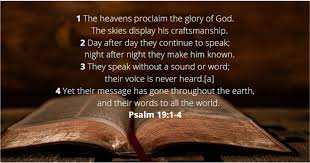
1 The heavens declare the glory of God,
and the sky above proclaims his handiwork.
2 Day to day pours out speech,
and night to night reveals knowledge.
3 There is no speech, nor are there words,
whose voice is not heard.
4 Their voice goes out through all the earth,
and their words to the end of the world.
In them he has set a tent for the sun,
5 which comes out like a bridegroom leaving his chamber,
and, like a strong man, runs its course with joy.
6 Its rising is from the end of the heavens,
and its circuit to the end of them,
and there is nothing hidden from its heat.

7 The law of the Lord is perfect,
reviving the soul;
the testimony of the Lord is sure,
making wise the simple;
8 the precepts of the Lord are right,
rejoicing the heart;
the commandment of the Lord is pure,
enlightening the eyes;
9 the fear of the Lord is clean,
enduring forever;
the rules of the Lord are true,
and righteous altogether.
10 More to be desired are they than gold,
even much fine gold;
sweeter also than honey
and drippings of the honeycomb.
11 Moreover, by them is your servant warned;
in keeping them there is great reward.

12 Who can discern his errors?
Declare me innocent from hidden faults.
13 Keep back your servant also from presumptuous sins;
let them not have dominion over me!
Then I shall be blameless,
and innocent of great transgression.

14 Let the words of my mouth and the meditation of my heart
be acceptable in your sight,
O Lord, my rock and my redeemer.

Encouragement/takeaway: Those first (6) verses are what we call in theology general revelation. They say, in short, that God has revealed Himself to all men, everywhere. There is no “innocent man on a remote island,” etc. And then the following verses are special revelation; they unpack the specifics of Scripture, God’s revealed will, the posture of humility before the holy, what discipleship looks like, the requirements of the gospel, etc. Specified tasks and implied tasks, in other words.

My professor was teaching me and those other men all those many nights ago in the lecture hall, about how to keep the main thing the main thing, how to not lose focus, how to persevere in the faith, but it all goes back to maintaining that first love, that call to love God and those He puts in our path. I miss you, Dr. C. I truly do. And one of my goals is to see you again one day, and say, “Thank you.”

Trusting God in the Darkness

Introduction: Perhaps what I love most about the Psalms is their visceral honesty. When David wrote, he laid it all out on the line. With gut-wrenching honesty that goes right to the heart of the matter, David and the other psalmists wrote about times of joy, times of lamentation, times on the mountain, times in the valley, and myriad poems and songs about times that felt like evil was winning, that light and truth were being eclipsed by the machinations of evil.

This morning, for example, I was reading Psalm 4 over and over. It is a short prayer, so I have included it here for you to follow along:

1 Answer me when I call, O God of my righteousness!
    You have given me relief when I was in distress.
    Be gracious to me and hear my prayer!

O men, how long shall my honor be turned into shame?
    How long will you love vain words and seek after lies? Selah
But know that the Lord has set apart the godly for himself;
    the Lord hears when I call to him.

Be angry, and do not sin;
    ponder in your own hearts on your beds, and be silent. Selah
Offer right sacrifices,
    and put your trust in the Lord.

There are many who say, “Who will show us some good?
    Lift up the light of your face upon us, O Lord!”
You have put more joy in my heart
    than they have when their grain and wine abound.

In peace I will both lie down and sleep;
    for you alone, O Lord, make me dwell in safety. (Psalm 4, ESV)

Questions for Reflection: First, do we notice how David begins his prayer in verse 1 by remembering God’s faithfulness to him in the past? That’s crucial.

Second, do we notice how in verse 2 David tells God (it’s not as if God is anything less than omniscient) that sinful men “love vain words and seek after lies”? That is the pattern of unregenrate people; they love lies rather than the truth.

Third, will you notice how in verses 3-8, David again returns to his confidence in the Lord? His confidence is not in man. That is double-edged in its implications. Why? Because it is not good for man to be alone (Gen 2:18). People need others. Godly people need co-laborers and friends in the faith. But ultimately, the Christian must love his Redeemer above all, because crowds are notoriously fickle and faithless.

Fourth, the Lord is sovereign through it all. Verse 8 reminds us via David’s pen: God alone makes His people dwell in safety. Through it all God is there–constant, steadfast, and sure.

Thoughts upon “Dashing Them In Pieces”

This morning I was up earlier than usual and was reading Psalms 1 and 2. They are bookends for the Book of Psalms. Plsalm 1 opens with the unforgettable contrast between the two types of people. One man is blessed because he delights in the law of Lord; he is God’s man. The other man is cursed by God because he is the wicked man, a scoffer, a self-absorbed man.

Then comes Psalm 2. It is a foretelling of the Lord’s Anointed, the Christ. David writes of how the wicked rage and plot in vain (v. 1). David writes of how kings of the earth “take counsel together, against the LORD and against his Anointed” (v. 2).

If you did not continue reading, you might think that all is lost, that evil wins, that darkness prevails.

But the turn comes in verse 4: “He who sits in the heavens laughs.” Please don’t miss that turn. That’s the key.

God has His Anointed. That’s what Christ means.

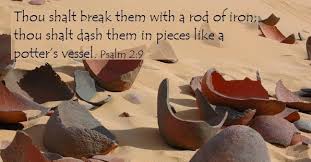
Encouragement: Satan does, let us freely admit, win some battles. But the ultimate war is won by God and His Anointed. God dashes evil like a potter’s vessel (Psalm 2:9b, ESV). Evil men go on and on plotting and scheming for now, but their destruction was written long ago, and their end is active wrath, unless and until they are reconciled unto God via the Anointed.

I do not know where you are today spiritually, but let me encourage you with this from sacred Scripture: God sees the nations raging; God sees how the wicked set themselves up as kings who shake their fists at the Holy One, and care only about themselves; God sees and God laughs (Psalm 2:4). Let us do good, trust the Lord, and be found faithful. God will set all things to rights. We need only have courage and trust the Lord.

One on Either Side of the Cross

Nothing teaches quite like an image.

Think with me for a moment about very familiar terrain. Specifically, let’s think about Psalm 1 and then the two criminals crucified on either side of Jesus in Jerusalem on that Friday at Calvary (Luke 23:39-43).

You remember the contrast that runs through Psalm 1, right? It is the contrast between two types. The first type is the person characterized by pursuing God, and the path of righteousness, which leads to blessing. The second type is the person characterized by pursuing the wicked, ungodly things and ways, ways that bewitch and lead to ultimate judgment and condemnation.

Blessed is the man
    who walks not in the counsel of the wicked,
nor stands in the way of sinners,
    nor sits in the seat of scoffers
;
2 but his delight is in the law of the Lord,
    and on his law he meditates day and nigh
t.

He is like a tree
    planted by streams of water
that yields its fruit in its season,
    and its leaf does not wither.
In all that he does, he prospers
.
The wicked are not so,
    but are like chaff that the wind drives away.

Therefore the wicked will not stand in the judgment,
    nor sinners in the congregation of the righteous
;
for the Lord knows the way of the righteous,
    but the way of the wicked will perish
.

The imagery is so clear, as are the contrasts:

  • One eschews wickedness vs. One pursues wickedness
  • One is rooted in God vs. One scoffs at God
  • One is pictured as a tree of blessing vs. One is pictured as chaff, the cast-off part of wheat
  • One is ultimately blessed vs. One is ultimately condemned

Segue to the Crucifixion of God:

In Luke 23, a conversation is recorded. It is the conversation of two criminals, crucified on either side of Jesus. Both were guilty men. But one of them repented. One remained a scoffer and unbeliever. One was the picture of ultimate blessing; one was the picture of ultimate condemnation.

The Conversation:

39 One of the criminals who were hanged railed at him, saying, “Are you not the Christ? Save yourself and us!” But the other rebuked him, saying, “Do you not fear God, since you are under the same sentence of condemnation? 41 And we indeed justly, for we are receiving the due reward of our deeds; but this man has done nothing wrong.” 42 And he said, “Jesus, remember me when you come into your kingdom.” 43 And he said to him, “Truly, I say to you, today you will be with me in paradise.”

The Good News:

It’s not an image of how one man was good and one was bad. No; both men were bad. It’s the man in the middle that matters most. He was the lone good man who was made bad in order that we bad might be reckoned as good.

One criminal repented and believed and was thereby redeemed. The other criminal remained in disbelief and was, like the chaff from the picture in Psalm 1, cast away.

But everything hinged on the man in the middle. He’s the one with whom we must come to grips. That is why he matters most. That is what we need to think upon when we picture those on either side of the cross. We need to think upon the man in the middle.