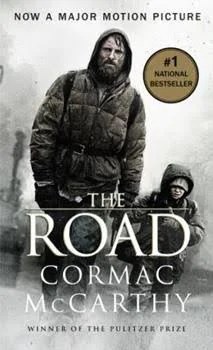
One of the Most Haunting, Powerful, Portentous Openings:
When he woke in the woods in the dark and the cold of the night he’d reach out to touch the child sleeping beside him. Nights dark beyond darkness and the days more gray each one than what had gone before. Like the onset of some cold glaucoma dimming away the world. His hand rose and fell softly with each precious breath. He pushed away the plastic tarpaulin and raised himself in the stinking robes and blankets and looked toward the east for any light but there was none. In the dream from which he’d wakened he had wandered in a cave where the child led him by the hand. Their light playing over the wet flowstone walls. Like pilgrims in a fable swallowed up and lost among the inward parts of some granitic beast (Cormac McCarthy, The Road, New York: Vintage International, 2006), 3.
I have read the novel as many times as I have my favorite pieces from the classics. I think I’ve only read Hamlet, Macbeth, King Lear, and Othello more often than I’ve read The Road. Why? Well, so much is put before the informed reader amidst McCarthy’s minimalism in language.
In the first lines alone we have so much with which to grapple. The imagery is haunting. It’s night when the story opens but it’s one of many nights that is “beyond darkness,” suggesting ominousness. There are laden portents of dark forces at play from the very first paragraph. Vision, the ability to see clearly, is obscured. McCarthy writes that it is like “the onset of some cold glaucoma” and that the world is “dimming away.”
The figurative language kicks with feet in the womb of meaning. The world darkens. Evil forces work, but the remedy (remote though it may seem at the moment) is in connection–in love, in the reaching out to touch the son. That’s the image in the very first lines of the novel. When all is dark, cold, gray, blasted apart, the hope is connection. And that connection is seen in the bonds of love. And that love is seen from the very genesis of the story in the relationship of the father and the son, and the sacrifice for and from love.
Connection to the Contemporary: When I listen to the cultural din that characterizes much of contemporary media, it can be depressing. Why? Because one could come to believe that man really is a useless passion, as Sartre wrote. It just appears that critical thinking has been abandoned. It appears that kindness has been abandoned. It appears we have grown so used to lies now that we don’t even expect to be told the truth. We just assume we’re being lied to. It’s a time where there is a death of trust. And when you have a culture that does not trust itself, you get dissolution and death. And that’s precisely what we are seeing. So, folks retreat into their bubbles of Netflix and YouTube and endless mindless distractions rather than going to battle against the lies and the father of lies.
That’s one more reason I think The Road is especially poignant. McCarthy saw, at least in my view, where we were. He saw that the center was not holding and that mere anarchy was being loosed upon the world, a la Yeats’ “The Second Coming.” And he wrote this profound novel to show that devastation was not just possible but rather likely. But he also wrote this profound novel to show the means by which hope is enkindled and life is redeemed. It hinges upon the father, the son, and the light that is carried. Folks who have any semblance of a biblical worldview should perk up when such terms are used in a novel.
I don’t know if McCarthy was a Christian. He certainly knew about the gospel, but that is not the same as being a Christian–actually being in Christ. But like the motif of light in The Road, I tend to look for “the good guys,” for the light, and see the love that exists between a father, a son, and the spirit that causes connection and light amidst all that darkness.
 MIND & MATTERS