It is no secret to anyone who knows me well that one of my enduring favorite writers is Cormac McCarthy. He died this year, and I already miss the prospect that we might be blessed via more from his pen. But he left us an awful lot of profound literature. I read his works again and again. And each time the works are better.
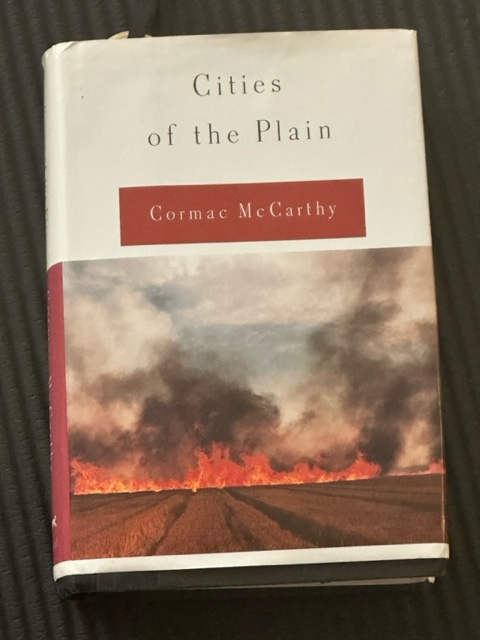
Recently I finished The Border Trilogy again. The Border Trilogy is comprised of All the Pretty Horses, The Crossing, and Cities of the Plain. I have written before on All the Pretty Horses and The Crossing.
In the Border Trilogy, I think All the Pretty Horses is the most cohesive plot, The Crossing is the most beautifully written (accompanied by heavy profound philosophical musings), but Cities of the Plain, upon this most recent re-reading, continues to grow in my estimation for three reasons.
Fist, McCarthy is a master of masculine friendship and love. There is never anything homoerotic in these novels; it is nothing like that. For anyone versed in Scripture, a fitting comparison is the deep friendship between David and Jonathan. You never once see anything homoerotic in the relationship between David and Jonathan. What you do find is men who understand that true friendship is built upon trust and confidence in one another. You see them value the friendship and consistently act in ways aimed at shepherding, honoring, and trying to protect it. The relationship between Billy Parham and John Grady Cole in Cities of the Plain is just that. And the fact that so much of the novel is set in Mexico and Texas, and amidst the harshness, the desert stars, the red mountains, the arroyos, and grottoes of the region makes their adventures (and John Grady’s misadventures) still more compelling.
Second, Cities of the Plain contains passages that are so typical of McCarthy’s tropes in his novels, especially the wise wanderer who dialogues with the protagonist. Here’s one example from Cities of the Plain from near the end of the novel:
You call forth the world which God has formed and that world only. Nor is this life of yours by which you set such store your doing, however you may choose to tell it. Its shape was forced in the void at the onset and all talk of what might otherwise have been is senseless for there is no otherwise. Of what could it be made? Where be hid? Or how make its appearance? The probability of the actual is absolute. That we have no power to guess it out beforehand makes it no less certain. That we may imagine alternate histories means nothing at all (285).
You won’t find that level of poetic prose anywhere I am aware of except in possibly Faulkner and/or Flannery O’Connor. But I would argue McCarthy’s is more powerful, and that is quite a claim.
Third, no one writes landscapes better than McCarthy. What Melville and Conrad wrote of the sea, what Dickens wrote of all-things-London, especially prisons and tanneries and child labor conditions, what Faulkner wrote about the rage and endurance and suffering of both loving your area and simultaneously despising its worst characteristics, McCarthy writes best when he writes of landscapes and of how he uses them literarily to teach those who are able to hear and understand:
They sat against a rock bluff high in the Franklins with a fire before them that heeled in the wind and their figures cast up upon the rocks behind them enshadowed the petroglyphs carved there by other hunters a thousand years before. They could hear the dogs running far below them. Their cries trailed off down the side of the mountain and sounded again more faintly and then faded away where they coursed out along some rocky draw in the dark. To the south the distant lights of the city lay strewn across the desert floor like a tiara laid out upon a jeweler’s blackcloth. Archer had stood and turned toward the running dogs the better to listen and after a while he squatted again an spat into the fire (88).
The reading of beautiful language is a mysterious joy. I don’t understand how it does not move many souls. But for those whose souls rise upon waves of linguistic beauty, to those whose spirits fill when words are zephyrs, to those whose spirits press in to to hear souls speaking secrets of the deep, McCarthy’s words and worlds transport to depths unlike anyone else’s I know.
 MIND & MATTERS