Introduction: A few years ago, I was attending a conference in metro Atlanta. The main speaker at the event was a retired Army officer who had spent the bulk of his military career as an engineer in support of the Special Operations community. He was a skilled mathematician and engineer. He was clearly a cerebral fellow, and he wanted us to know his academic resume, and that he was inveterately wargaming how problems (especially logistical ones) might be solved. I do not remember much of his speech that day, I confess. But I do remember one thing he said: “You can learn from anyone’s example, especially bad ones.” Bam! That’s what I term a zinger.
Segue: I do not purport to speak for others, but I will say this as a matter of transparency: I seek out good role models. I think we are more mimetic than we wish to admit. As a chaplain, I am very much in the business of people and their worldviews. Fads come and go; trends are just that; but steadfast, enduring, faithful leaders are a special breed, and if they’re good people, so much greater their value to me. When I reflect upon my role models, a handful of remarkable leaders come to mind. I can picture their faces in my mind, even though I have not been around some of them in quite some time, as our paths have diverged. Several were my Commanders; several were my Command Sergeants Major. One was a SSG from my days stationed in Germany and on a deployment to Bosnia. Another was one of my seminary professors. There are many others. But I continue to learn from what they taught me. This is what brings me to the connection between Marcus Aurelius and the speaker at that conference in metro Atlanta.
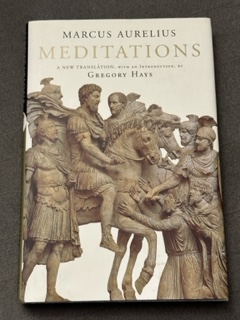
I have a copy of Aurelius’ Meditations that is well-worn. One reason is because of gems like this: “Do external things distract you? Then make time for yourself to learn something worthwhile; stop letting yourself be pulled in all directions. But make sure you guard against the other kind of confusion. People who labor all their lives but have no purpose to direct every thought and impulse toward are wasting their time–even when hard at work” (19).
That last sentence gets me every time. If we are not careful, we can be ostensibly “hard at work” but in reality, be squandering the time we’ve been granted. In my faith tradition, we are told in Scripture, “So teach us to number our days that we may get a heart of wisdom” (Psalm 90:12, ESV).
Encouragement: The reality is that in many seasons, we may suffer a dearth of good examples. But we can still redeem these seasons. How? Be learning from the bad examples, too. By seeing how the good and great examples we have had stand in stark relief via contrast. By learning not to be pulled in all directions and succumbing to confusion. By focusing our giftings to their maximum good effect in support of the right ends. A heart of wisdom is one that recognizes our brevity and redeems the time. It’s recognizing and practicing Aurelius’ counsel of using our time well by emulating the right leaders, and having the wisdom to distinguish between enduring value and mere busyness.
 MIND & MATTERS