Introduction: I am on a Don DeLillo kick again. The DeLillo bug bites me at intervals and thus return to his oeuvre repeatedly. Why do I do it? I think it is because DeLillo has understood and written about what so many in the world refuse to see and/or grapple with until it is too late: terrorism is normal now.
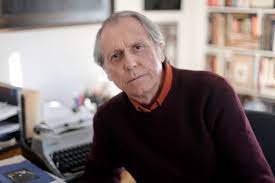
I am currently completing my reading of DeLillo’s novel The Names. Though not my favorite of DeLillo’s works, it is essentialist DeLillo territory in that it focuses on the power language, cults, and the dark underworld (forgive the overt DeLillo allusion). When I was reading these passages over recent days, especially in light of the terrorist attack today at the border crossing between New York and Canada, DeLillo’s work again struck me with a blast.
After I read about the terrorism at the New York-Canada border, I then read a healine where a man in California beheaded his ex-girlfriend with a sword in broad daylight. Yes, you read that correctly. Here’s the article: https://www.foxnews.com/us/california-man-guilty-beheading-mother-samurai-sword-broad-daylight-jury-rules
Then I read of how thugs looted a Nike store. Yup, nothing to see here. Just another day in the West in 2023: https://www.foxnews.com/us/flash-mob-ransacks-nike-store-los-angeles-steals-12000-merch-police

This is what DeLillo understands and probes–the wickedness of the human heart when it is unrestrained by the grace of God. One way to think of DeLillo’s writing is as an exploration of what a culture looks like when God has given it over.
Quote 1: “It was the nightmare of real things, the fallen wonder of the world,” (339).
Quote 2: “Air travel reminds us who we are. It’s the means by which we recognize ourselves as modern. The process removes us from the world and sets us apart from each other. We wander in the ambient noise, checking one more time for the flight coupon, the boarding pass, the visa. The process convinces us that at any moment we may have to submit to the force that is implied in all this, the unknown authority behind it, behind the categories, the languages we don’t understand. This vast terminal has been erected to examie souls.
It is not surprising, therefore, to see men with submachine guns, to see vultures squatting on the baggage vehicles set at the end of the tarmac in the airport in bombay when one arrives after a night flight from Athens.
All of this we choose to forget. We devise a counter-system of elaborate forgetfulness. We agree on this together. And out in the street we see how easy it is, once we’re immersed in the thick crowded paint of things, the bright clothers and massed brown faces. But the experience is no less deep because we’ve agreed to forget it” (254).
Like the writing of Cormac McCarthy and William Gay, Don DeLillo’s writing is not for the weakminded or callow. It is, however, important and beautiful, and full of warning for those who will hear and attend.
P.S. In some reading I am doing on the ascension of socialism and the Nazis in Germany in the 20th century, I came across this in Funder’s excellent book All That I Am:
“The most civilized nations are as close to barbarity as the most polished iron is close to rust. Nations, like metals, shine only on the surface” (Antoine de Rivarol).
 MIND & MATTERS