In the following installments I explore some nonnegotiables of faithful Christian witness and some of the results one should anticipate. The nonnegotiables and expectations are both rooted in the historical account of Paul’s reasoned defense of the Christian faith in Acts 17 when he welcomed any and all skeptics, naysayers, intellectually honest, and others to deal with the facts.
It should go without saying but I will write it nevertheless. We are living in a largely post-truth era. The ultimate reason is simple. We have jettisoned God, the author of truth, and God’s revelation. We have done exactly what David in Psalms poetically reveals is the folly of the foolish:
The fool says in his heart, “There is no God” (Psalm 14:1).
Paul teaches the exact same principle in the New Testament:
For although they knew God, they did not honor him as God or give thanks to him, but they became futile in their thinking, and their foolish hearts were darkened. Claiming to be wise, they became fools, and exchanged the glory of the immortal God for images resembling mortal man and birds and animals and creeping things . . . . because they exchanged the truth about God for a lie and worshiped and served the creature rather than the Creator, who is blessed forever! Amen. (Romans 1:21-23, 25)
Three principles leap out at all with ears to hear and eyes to see:
- The folly of the fool
- The fool’s suppression of truth
- The pride of the fool
The very nature of the fool is his folly. He refuses to acknowledge truth, even to his own destruction. It’s not that he does not see; it’s that he refuses to see. It’s a spiritual hardness, not a physical hardness. He suppresses what is clear and obvious. But not only does he persist in his folly by way of suppressing what he knows to be true, but he boasts in his arrogance, deeming himself wise.
I remember watching countless boxing matches with my stepfather as a boy. And every once in a while we would witness a boxer who was over-the-top brash, full of himself, hubris in boxing shorts, etc. He’d preen for the cameras, flex his muscles for the crowds, and appear to be invincible. And I’ve lost count of how many times that young man was flat on his face on the canvas a few minutes or even seconds later, unconscious, because his opponent had the power of reality and truth. That’s the way truth works. You can deny it but it hits you in the face nonetheless.
Nonnegotiable # 1:
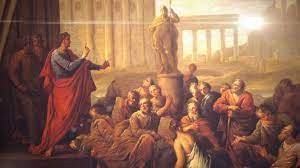
In Acts 17 when Paul was in Athens, Greece, he was bearing witness to the Christian faith in a culture replete with pagan idolatry. I have walked and stood in the same places Paul walked on trips to Athens. It is still moving when you feel the weight of history and precedent wash over you.
But here’s all I want to leave you with today (this is just installment one of perhaps five, after all): Expect resistance.
That sounds simple but I, for one, have underestimated it in my ministry. There is no paucity of resistance to truth. So, be patient. Expect tribulation. Expect folks to scoff, to mock. But just give it time. Time has a way of revealing things.
Here’s the way Luke describes Paul in Acts 17:
Now while Paul was waiting for them in Athens, his spirit was provoked within him as he saw that the city was full of idols (Acts 17:16).
Paul, the super-credentialed Pharisee of Pharisees, a man of staggering intellect and personal testimony, was nonetheless provoked. Why? Because he cared? Yes. Because he saw the folly of the Greek culture? Yes. But most of all, I think, it was because he knew what he was up against. He was up against lies and the father of lies. He expected the resistance.
Encouragement: I am certainly no apostle Paul. But I do try to reach those who will listen. But if we underestimate the vitriol of the enemies of truth, we can grow weary in doing good (Galatians 6:9). Be encouraged, pilgrim. Expect resistance. But remember who sustains you and that even the grave could not suppress the truth that triumphs.
 MIND & MATTERS