Have you ever watched a movie or read a book or seen a play and come away with this thought: O my goodness! That is exactly the way I feel. It’s like the person knows me!
I certainly have. I’ve seen The Shawshank Redemption, Cool Hand Luke, Death of a Salesman, and a few other films so often that I can just about quote every line. (Most of today’s movies just don’t have the caliber of storyline and character development that older ones do, in my view. I mean, after you’ve seen 666 explosions and car chases, you grow bored rather easily. At least I do.)
What does this have to do with Acts 17 and nonnegotiables and expectations for Christians who are trying to bear faithful witness to the truth in a culture that is drunk on lies and stupidity?
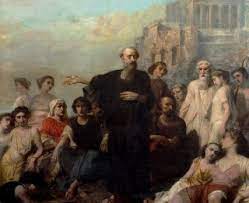
Notice was Paul did. In Acts 17 as Paul was in Athens, Greece, he knew the stories the culture had imbibed. That is, he knew what they were filling their time with. My all-time favorite quote from folksy wisdom is this: What’s down in the well comes up in the bucket.
Yes and amen. What does that mean? It means that a person will show you what he/she is made of by way of his/her behavior and speech.
When Paul began to argue for the Christian faith, he let his hearers know that he understood them: “Men of Athens, I perceive that in every way you are very religious. For as I passed along and observed the objects of your worship, I found also an altar with this inscription, “To the unknown god.’ What therefore you worshp as unknown, this I proclaim to you” (Acts 17:22-23).
Here’s the nonnegotiable: It is not hard to discern people’s “god of the system.” Look what they fill their time with. Look what stirs their emotions. Look how they spend their money. Do they read books or do they only watch videos on their gadgets? Do they take their worldview from social media? Do they think or only emote? The questions could go on.
Encouragement: Paul studied and knew his audience. He knew their assumptions. He saw their religiosity. Oh, they were very religious, be assured of that. They simply worshiped false gods, which is to say, they worshiped idols. But Paul “got them,” to use saccharine Super Bowl-laden sentimentality to dupe the vulnerable.
Paul got them, to be sure, but he let them know that he got them in order that he might love them enough to tell them the truth. We don’t need more entertainment, folks; we need wisdom and the courage to herald it.
 MIND & MATTERS