Intro: If we are myopic in our understanding, we can tend to think things have never been as difficult when trying to bear witness to the truth, as stacked against Christian witness, as biased against any biblical witness towards culture as what we are seeing nowadays.
Things are, one must admit, devolving rapidly. I read yesterday Massachusetts may activate the National Guard to go to high schools in order to establish some measure of law, order, and safety. The students, far from learning English, math, and history, are instead making a mockery of what government schools were ostensibly created for, namely, a very basic education in civics, self-discipline, and some grasp that the world has in fact before Taylor Swift and Instagram. But the students are having sex, running amok, ordering DoorDash to the school, are often truant, and the teachers have long lost control and hope. Things are continuing to spiral out of control, of course, but what invariably happens is order will be established but it will involve violence and/or the threat of it. When you have a culture that cannot control itself, a means of control will step in and assume control. When God’s common grace is thwarted, jettisoned, mocked, and rejected, in other words, chaos ensues because everyone does what is right in his/her own eyes. There is no transcendent unifying anchor to which all are subject, in other words, so pandemonium is the result. This is what we see unfolding on a daily basis. At its root is the abandonment of God.
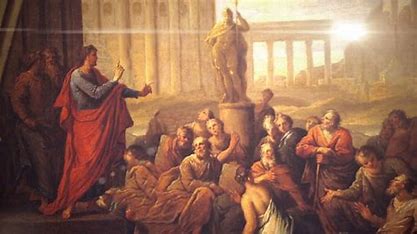
Connection to Scripture: In Acts 17 Paul, too, understood this. He tries to reason with the people in Athens:
Paul Addresses the Areopagus
So Paul, standing in the midst of the Areopagus, said: “Men of Athens, I perceive that in every way you are very religious. For as I passed along and observed the objects of your worship, I found also an altar with this inscription: ‘To the unknown god.’ What therefore you worship as unknown, this I proclaim to you. The God who made the world and everything in it, being Lord of heaven and earth, does not live in temples made by man, nor is he served by human hands, as though he needed anything, since he himself gives to all mankind life and breath and everything. And he made from one man every nation of mankind to live on all the face of the earth, having determined allotted periods and the boundaries of their dwelling place, that they should seek God, and perhaps feel their way toward him and find him. Yet he is actually not far from each one of us, for “‘In him we live and move and have our being’; as even some of your own poets have said, “‘For we are indeed his offspring.’ Being then God’s offspring, we ought not to think that the divine being is like gold or silver or stone, an image formed by the art and imagination of man. The times of ignorance God overlooked, but now he commands all people everywhere to repent, because he has fixed a day on which he will judge the world in righteousness by a man whom he has appointed; and of this he has given assurance to all by raising him from the dead.” Now when they heard of the resurrection of the dead, some mocked. But others said, “We will hear you again about this.” So Paul went out from their midst. But some men joined him and believed, among whom also were Dionysius the Areopagite and a woman named Damaris and others with them. (Acts 17:-22-34)
Encouragement & Application: Paul’s nonnegotiable remained the historical bodily resurrection of Jesus from the dead. And the responses to Paul’s trying to reason with the people are exactly the same ones we see today. Some mocked (Acts 17:32). Others said, “We will hear you again about this” (Acts 17:32). And some believed and were saved (Acts 17:34).
Pagan chaos brought civilizations to their knees before; empires thinking the sun would never set upon them due to their expansiveness have come and gone, Rome is now a footnote in most people’s history textbooks; Athens, Greece’s money comes from tourism of their once great culture, the Third Reich is just a historical shame which gets brought up in arguments when the other side cannot think of a greater insult than to call someone a Nazi; and on and on it goes.
But if we truly care about people, we will try to tell them the truth. And when we do that, some will mock; others may give us a second hearing; and, to God be the glory, some will believe and be saved. Our job is to be faithful.
 MIND & MATTERS