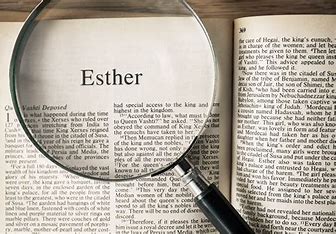
Leadership Lessons in Esther:
What does the history of Esther (and the book that bears her name in the Bible) have to do with history, with leadership, and with the true church? A lot. Follow me: It was the late 400s B.C. in Persia (present-day Iran). Many Jews were dispersed due to persecution under the pagan empires of Assyria and Babylon. Two characters figure prominently in the book of Esther, Hadassah (Esther) and her uncle, Mordecai. Esther was an orphan and Mordecai essentially stepped in as a father-like figure and raised her. Esther was physically striking, i.e., beautiful. And God would eventually use both Mordecai and Esther as examples of how Godly courage, Godly conviction, and faithfulness to God were used by God for purposes of judgment against sinners and redemption of believers.
Every Good Story Has Conflict: The villain in the book of Esther is Haman. He plots a holocaust in the 5th century B.C. against the Jews. His plan is simple: kill them (Est 3:6, 9). Haman was about as dark and villainous as anyone in history. He was the consummate narcissist, a grifter, a politician, and utterly shameless.
And yet God was going to use Jewish captives, those with seemingly no worldly power, as types to both thwart the evil plans of Haman but also as types and shadows of how God uses His people to judge evil and defeat Satan. But what is called for is Godly courage, Godly conviction, and faithfulness to God.
Mordecai fasted, prayed, and eventually prevailed over Esther’s initial reluctance to confront the king over Haman’s wicked machinations. Mordecai’s words to his niece are famous: “And who knows whether you have not come to the kingdom for such a time as this?” (Est 4:14).
And Esther’s response is likewise famous: “Then I will go to the king, though it is against the law, and if I perish, I perish” (Est 4:16).
Encouragement: I will continue the story in the next installment, but here’s the rub: God does not necessarily use those with the most brawn or the best looks or the most connections. God instead uses His people because they live out Godly courage, Godly conviction, and faithfulness to His revealed will. More to follow.
 MIND & MATTERS