When I fly I love to read on the plane. Most folks in my experience prefer to pop in ear buds and watch movie after movie, or pay for internet and scroll, scroll, scroll. Image after image, video after video, till the plane lands. But so it goes.
This week during work and plane trips I read a short book entitled Leaning Into the Liminal. By liminal, the author means threshold, rite of passage, or phase. Limen in Latin means “threshold.”
The book is written for those of us in pastoral care who are charged oftentimes with shepherding people through spiritual thresholds in their lives due to, for example, death of a loved one, illness, separation, financial change, combat/war, or trauma in its myriad manifestations.
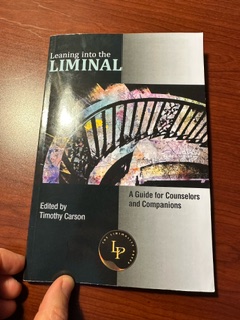
Here are a few nuggets I found helpful in the book:
“Liminality is about ambiguity, transition, and transformation. Death (in all forms) embodies these elements. It marks the end of life as we know it and the beginning of something different and unknown. Like other liminal experiences, death compels us to confront our mortality and question the nature of our existence” (p. 69).
“The archetypal symbol of a healing passage is the pilgrimage. The notion of spiritual pilgrimage takes on great iportance as one figuratively moves from one state of being to another. In pilgrimage, an extended and often difficult journey becomes a process of separating from the given, everyday world. Pilgrimage entails stepping away from daily routines and expectations and moving with special deliberateness toward a place where one might be changed . . . . Movement away from the given world and toward a distant goal can create a wide threshold of transition and transformation” (p. 60).

“One of the fundamentals of narrative theory is the idea that people have many interacting narratives that constitute their sense of self, and that the problem story they bring to therapy is not limited to this sense of self but is influenced and shaped by cultural and contextual discourses about identity and power” (pp. 9-10).
As one who believes fully that stories are soul food, I find the last quote quite moving. The stories by which we live and are informed shape and reshape our lives as long we tell them and carry them, or to use my favorite writer’s words, as long as we continue to carry the fire.
 MIND & MATTERS