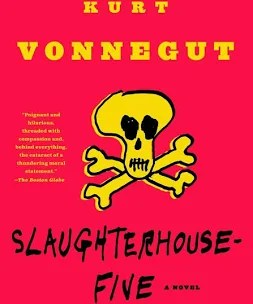
I have read Vonnegut for 40 years now. And I still learn from him. Like Twain, to whom his dark satirical pen is often favorably compared, Vonnegut is pretty dark stuff. This week I reread Slaughterhouse-Five. I am not sure how many times I have read it now. But I still learn from it. So it goes. The mark of excellent literature.
Billy, the divided protagonist–the war veteran, the kind-hearted, misanthropic, romantic, sad idealist, etc. is an Everyman. He’s John Lennon’s “Nowhere Man” and Camus’s Mersault and Sisyphus, and Faulkner’s Benjy from The Sound and the Fury, and Shakespeare’s sundry fools. Who isn’t Billy?
I was so struck tonight as I reread this passage from S-Five:
There are no telegrams on Tralfamadore. But you’re right: each clump of symbols is a brief, urgent message–describing a situation, a scene. We Tralfamadorians read them all at once, not one after the other. There isn’t any particular relationship between all the messages, except that the author has chosen them carefully, so that, when seen all at once, they produce an image of life that is beautiful and surprising and deep. There is no beginning, no middle, no end, no suspense, no moral, no causes, no effects. What we love in our books are the depths of many marvelous moments seen all at one time (215).
 MIND & MATTERS