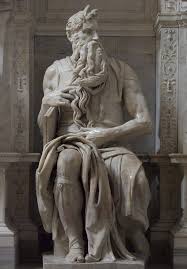
(Michelangelo’s Moses)
Bottom line up front: Is there not a cost? Yes, more than one, in fact.
Historical context: Deuteronomy was penned by Moses as the last book of the Torah. It’s the last of the five books (the Pentateuch). Its name means essential the second (deutero)heralding of the law (nomos). In short, it’s Moses restating the law to Israel. But it’s replete with foreshadowings of the New Testament and for Christians of all ages.
The Matter of Disobedience: Moses reminds his hearers of God’s faithfulness but also of their duty to obey via action, not just words. In the first chapter, Moses is so clear with the people about the issue:
“Then we set out from Horeb and went through all that great and terrifying wilderness that you saw, on the way to the hill country of the Amorites, as the Lord our God commanded us. And we came to Kadesh-barnea. 20 And I said to you, ‘You have come to the hill country of the Amorites, which the Lord our God is giving us. 21 See, the Lord your God has set the land before you. Go up, take possession, as the Lord, the God of your fathers, has told you. Do not fear or be dismayed.’ 22 Then all of you came near me and said, ‘Let us send men before us, that they may explore the land for us and bring us word again of the way by which we must go up and the cities into which we shall come.’ 23 The thing seemed good to me, and I took twelve men from you, one man from each tribe. 24 And they turned and went up into the hill country, and came to the Valley of Eshcol and spied it out. 25 And they took in their hands some of the fruit of the land and brought it down to us, and brought us word again and said, ‘It is a good land that the Lord our God is giving us.’ (Dt 1:19-25, ESV)
In sum, Moses reminded them of their history. The goal? To remind them of God’s trustworthiness and faithfulness as reasons to trust Him going forward. They were to go in and possess the land promised to the forefathers. But you know what happened, right? They failed to believe God and failed to obey via action.
Here’s the way Moses phrased it to them:
“Yet you would not go up, but rebelled against the command of the Lord your God. 27 And you murmured in your tents and said, ‘Because the Lord hated us he has brought us out of the land of Egypt, to give us into the hand of the Amorites, to destroy us. 28 Where are we going up? Our brothers have made our hearts melt, saying, “The people are greater and taller than we. The cities are great and fortified up to heaven. And besides, we have seen the sons of the Anakim there.”’ 29 Then I said to you, ‘Do not be in dread or afraid of them. 30 The Lord your God who goes before you will himself fight for you, just as he did for you in Egypt before your eyes, 31 and in the wilderness, where you have seen how the Lord your God carried you, as a man carries his son, all the way that you went until you came to this place.’ 32 Yet in spite of this word you did not believe the Lord your God, 33 who went before you in the way to seek you out a place to pitch your tents, in fire by night and in the cloud by day, to show you by what way you should go. (Dt 26-33, ESV).
Moses rebukes them for their fear. They were intimidated; they didn’t trust the Lord; they feared man; and thus, they were judged by God for their disobedience. Verse 35 is tragic: “Not one of these men of this evil generation shall see the good land that I swore to give to your fathers, except Caleb the son of Jephunneh.”
God was looking for faithfulness from His people, and the people had failed. How would the covenant promises ever be fulfilled? Who would be the faithful one? Is there not a cost to fearing man and not trusting God?
God judged them by saying via Moses, “But as for you, turn, and journey into the wilderness in the direction of the Red Sea” (v. 40, ESV). In other words, you’re going to wander in the recesses of the desert because of your fear of man and failures to trust God.
Encouragement: I do not know where my readers are spiritually; that’s not wisdom I have. But I do know this: It is so easy to fear people and not fear the Lord as we ought. We tend to think too highly of people and too little of Yahweh. When we fear men, we reveal a failure to trust the Lord. One of my heroes penned this in one of his many volumes: “When you go through a trial, the sovereignty of God is the pillow upon which you lay your head” (Spurgeon). Be of good courage, Christian; the Lord sees.
 MIND & MATTERS