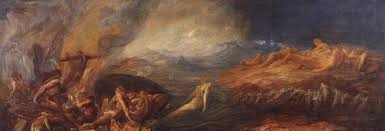
Introduction: When I was in graduate school in English, one term I took an entire semester in the poetry of William Butler Yeats. It was one of the most revealing courses I ever took. Revealing in the sense that we students had to learn the intellectual and spiritual wells from which Yeats drank, in addition to learning Yeats’ body of work. We studied not only Yeats’ poetry and other writings, but also the writers that Yeats read and the ideas he imbibed. Even those who may be largely unfamiliar with Yeats may have at least some relationship with Yeats’ oft-anthologized poem, “The Second Coming.”
Text:
Turning and turning in the widening gyre
The falcon cannot hear the falconer;
Things fall apart; the centre cannot hold;
Mere anarchy is loosed upon the world,
The blood-dimmed tide is loosed, and everywhere
The ceremony of innocence is drowned;
The best lack all conviction, while the worst
Are full of passionate intensity.
Surely some revelation is at hand;
Surely the Second Coming is at hand.
The Second Coming! Hardly are those words out
When a vast image out of Spiritus Mundi
Troubles my sight: somewhere in sands of the desert
A shape with lion body and the head of a man,
A gaze blank and pitiless as the sun,
Is moving its slow thighs, while all about it
Reel shadows of the indignant desert birds.
The darkness drops again; but now I know
That twenty centuries of stony sleep
Were vexed to nightmare by a rocking cradle,
And what rough beast, its hour come round at last,
Slouches towards Bethlehem to be born?
Context:
Why do I share all this? Because even as unorthodox and convoluted as Yeats’ intellectual moorings were, his best poems (“The Second Coming” is surely one of those) do portend important themes. When I look around at all the violence being perpetrated in America’s cities by unhinged mobs, it grieves me. How does one reason with a mob? Obviously, one cannot reason with a mob, as they’ve foregone reason and descended into terror. This is what got me again thinking about Yeats’ poem.
Imagery:
The images are striking, are they not?
- There’s a schism between the falcon and falconer.
- A “rough beast” is slouching in pregnant terror, like a foretaste of what’s coming in formidable violence.
- A “blood-dimmed tide” is washing over the shores.
On and on the images of madness and violence are put forth. Why? I would argue, to get us to see. Sometimes folks will refuse to see reality until it literally hits them in the face. It takes that for some people. When you have an undiscerning people, evil rides roughshod over the sheeple. Or as Yeats so beautifully phrased it, “the centre cannot hold” and “The ceremony of innocence is drowned.”
Takeaway:
When you study Yeats’ theological and philosophical moorings, he was awash in mysticism, the occult, some teachings of Roman Catholicism, and loads of Oneist paganism. His fractured worldview is instructive for us, though, in this regard. He understood that men can easily become beasts if and when they abandon truth and embrace the lie. This is the way Scripture teaches it:
18 I said in my heart with regard to the children of man that God is testing them that they may see that they themselves are but beasts. 19 For what happens to the children of man and what happens to the beasts is the same; as one dies, so dies the other. They all have the same breath, and man has no advantage over the beasts, for all is vanity. 20 All go to one place. All are from the dust, and to dust all return. 21 Who knows whether the spirit of man goes upward and the spirit of the beast goes down into the earth?” (Eccl 3:18-21, ESV).
Solomon’s point in Ecclesiastes is to teach that when we embrace paganism, we actually end up empty. It is when we listen to and obey God that benediction comes. That’s sounds saccharine and anemic to a world that doesn’t want to hear.
But the question remains: How’s the lie working out in the world system? How’s secularism playing out? How’s cognitive dissonance working out in L.A. right now? Why are politicians protected by men with guns, by walls around their estates, and personal bodyguards, but the mobs simultaneously decry walls and borders and law and order? As Yeats would remind us, “The best lack all conviction, while the worst/Are full of passionate intensity.” Would that we learn from Yeats and Solomon. I am weary of the blood-dimmed tide.
 MIND & MATTERS