Bottom line up front: “The end depends upon the beginning.” Not necessarily.
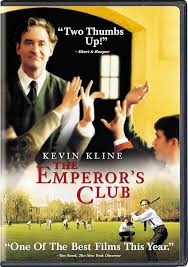
Introduction: One of my all-time favorite movies is The Emperor’s Club. Why? Well, it strikes a lot of my bells. Mr. Hundert is a classics teacher. He’s steeped in Plato, Aristotle, Cicero, Sophocles, Homer, Shakespeare, Dickens, and more. He loves teaching. He loves the best ideas of history. He loves precise language. He’s the stereotype of an old-school English/classics teacher.
And Mr. Hundert teaches his heart out–to young men, young men filled with ambition. A question pervading the film is, How will the students use and employ that ambition? Will they do it with honor? Will they turn out to be good men? Or will they turn out to be evil men? Will they grow to live lives of integrity? Will Mr. Hundert’s labors bear any fruit via the lives of his students as they go on to make a mark with their lives?
Kevin Kline is the actor who portrays Mr. Hundert. And one of the lines I remember as if etched upon my skeleton is this: “The end depends upon the beginning.”
Scripture’s Connecting Tissue: In Paul’s second letter to the saints of Corinth, he writes, “For the weapons of our warfare are not of the flesh but have divine power to destroy strongholds. We destroy arguments and every lofty opinion raised against the knowledge of God, and take every thought captive to obey Christ” (2 Cor 10:4-5).
That’s strong language, is it not? Warfare, divine power, destroying strongholds, destroying arguments, and taking thoughts captive. That’s about as militaristic as you can get linguistically.
Teaching: But here’s the great irony. In The Emperor’s Club, the issue is integrity and honor, and how our beginning shapes and/or determines our ends. Does the beginning determine our end? Thanks to God, no; not necessarily. Paul’s beginning and early life were consumed by Judaism, law observance, spiritual pride, legalism, and putting Christians to death. But God. Christ gripped him and redeemed him. And Paul was utterly changed, redeemed, ransomed, and equipped to be the Christian church’s greatest evangelist, discipler, missionary, church planter, pastor, and theologian. Saul of Tarsus became the apostle Paul. His beginning did not determine his end. His end did not depend upon his beginning. Why? Because of God’s grace towards him.
Encouragement: I think I am going to see if I can stream The Emperor’s Club tonight in order to watch it again, to be reminded that sometimes folks turn out worse than we’d hoped, sometimes better than we’d believed, and sometimes, thanks to God, they turn out as vessels of redemption. Because of the gospel, we don’t have to be determined by our beginnings. We can overcome them via the gospel. And the ends are so much greater. We see that God uses even our crooked timber to build straight lines. And we can go back and thank the Mr. Hunderts of the world for sowing seeds of wisdom even when we were unwilling or stubborn recipients.
 MIND & MATTERS