
“For secularism, all life, every human value, every human activity must be understood in light of this present time. . . . What matters is now and only now. All access to the above and the beyond is blocked. There is no exit from the confines of this present world” (R.C. Sproul).
That is truly a sad reality. You came from nothing; you’re a cosmic accident; you’ve no transcendent purpose; solipsism is your worldview; and extinction is your destiny. But that’s what secularism rests upon. Christianity, on the other hand, reveals the emptiness of secularism, and explains origins, meaning, morality, and destiny. That’s what Sproul and Boice spent their ministries doing, namely, trying to shine the light of truth on the utter emptiness, contradictions, and sadness that are inextricable from secularism in contrast to the redemptive, transcendent, coherent worldview of biblical Christianity.
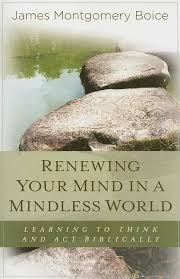
I was reading a book recently by James Montgomery Boice. The title was Renewing Your Mind In a Mindless World. Like Boice’s other books, it was a rock-solid read. The issue Boice explored in this particular volume were the first two verses of Romans 12. They read as follows:
I appeal to you therefore, brothers, by the mercies of God, to present your bodies as a living sacrifice, holy and acceptable to God, which is your spiritual worship. Do not be conformed to this world, but be transformed by the renewal of your mind, that by testing you may discern what is the will of God, what is good and acceptable and perfect. (Rom 12:1-2, ESV)
In my circles, those verses are so familiar I don’t think I could ever forget them. I have read them and heard them so often, they’re ingrained in my intellectual DNA.
In the atheist Richard Dawkins’ book River Out of Eden: A Darwinian View of Life, the author writes:
The total amount of suffering per year in the natural world is beyond all decent contemplation. During the minute that it takes me to compose this sentence, thousands of animals are being eaten alive, many others are running for their lives, whimpering with fear, others are slowly being devoured from within by rasping parasites, thousands of all kinds are dying of starvation, thirst, and disease. It must be so. If there ever is a time of plenty, this very fact will automatically lead to an increase in the population until the natural state of starvation and misery is restored. In a universe of electrons and selfish genes, blind physical forces and genetic replication, some people are going to get hurt, other people are going to get lucky, and you won’t find any rhyme or reason in it, nor any justice. The universe that we observe has precisely the properties we should expect if there is, at bottom, no design, no purpose, no evil, no good, nothing but pitiless indifference.
Questions: No design? No purpose? No evil? No good? Nothing but pitiless indifference? Think about that, will you. Do you honestly look at anything and think to yourself, “Yup, no design to that BMW. Those gears just happened to be assembled like that”? or “I sure do love my children, but I know they’re actually just cosmic accidents, just grown-up pond scum in sneakers”?
No sane person thinks that way. Why write a book trying to convince others of truth claims in a worldview where there’s only pitiless indifference? On what basis should we esteem Dawkins’ thoughts? After all, thoughts are just molecules in motion, physical brain fizz bubbling on the surface. Effluvia.
Encouragement/takeaway: In the biblical worldview, however, man is not a cosmic accident. He is the creation of the infinite-personal Creator God who forms all people in their mothers’ wombs (Psalm 139:13). We were made for God. God “put eternity into man’s heart” (Ecclesiastes 3:11). Why? So that we would go to God. As a contemporary Christian hymn expresses it, “You were made for more.” He who has ears to hear, let him hear.
 MIND & MATTERS