It was a day where I was physically spent but could not shut off my mind. I completed my time in Joshua and then turned to the Book of Proverbs. Specifically, I turned to Proverbs 30, as it corresponded with today’s date.
Again I read words beyond familiar:
Two things I ask of you [Lord]; deny them not to me before I die: Remove far from me falsehood and lying; give me neither poverty nor riches; feed me with the food that is needful for me, lest I be full and deny you and say, “Who is the LORD?” or lest I be poor and steal and profane the name of my God. (Pr 30:7-9, ESV)
Two things:
Separate me from lying & liars
Provide what I need, not necessarily what I sometimes want
These words from the pen of Agur are beyond wise; they’re (to use trendy parlance) meta-wise. They’re super-wisdom, meta-wisdom.
Reasons why:
The ruin that comes by way of lies & liars
The false promises of stuff to satisfy our deepest needs
It’s such a short & fundamental thing, really, when I step back and think about it: Don’t fall for the lies or liars; and cultivate what you truly need, not what appears appealing or flashes before the eyes of the undiscerning/gullible.
So basic, but so wise. Kind of like Proverbs–wisdom for daily living in this fallen world.
My inarticulate prayer: Lord, Enable your people to hear what your Spirit says. Crush the heads of the serpents that slither in the halls of religiosity. Raise up warriors for truth and shepherding. For Your great name’s sake. Amen.
There is an Austrailian historian and thinker from whom I continue to learn a great deal. His name is John Anderson. In the following video (less than 3 minutes long) he discusses how many Brits gathered for prayer during the WWII Battle of Dunkirk from late May to early June of 1940, and of how Christians assembled to pray for their troops amidst Germany’s seemingly formidable forces.
Questions:
How is this relevant for us? Well, it is so easy and tempting to give in to despair, if you have a certain theology. If you’re convinced that things are only going to get worse, your prayer life will evaporate. Why? Well, because you’ve convinced yourself that it’s all downhill, so why bother.
But is that view biblical?
Per Scripture, we are to pray because of who God is.
We tend to underestimate God and likewise underestimate the power of prayer. I have certainly been guilty of that.
Here are just some of the obvious reminders from Scripture about our duty to pray:
“pray without ceasing,” (1 Thess. 5:17, ESV)
And when you pray, you must not be like the hypocrites. For they love to stand and pray in the synagogues and at the street corners, that they may be seen by others. Truly, I say to you, they have received their reward. But when you pray, go into your room and shut the door and pray to your Father who is in secret. And your Father who sees in secret will reward you. And when you pray, do not heap up empty phrases as the Gentiles do, for they think that they will be heard for their many words. Do not be like them, for your Father knows what you need before you ask him. Pray then like this: “Our Father in heaven, hallowed be your name. Your kingdom come, your will be done on earth as it is in heaven. Give us this day our daily bread, and forgive us our debts,as we also have forgiven our debtors. And lead us not into temptation, but deliver us from evil. (Mt 6:5-13, ESV)
“The prayer of a righteous person has great power as it is working” (Jas. 5:16b, ESV).
“And whatever you ask in prayer, you will receive, if you have faith” (Mt 21:22, ESV)
Encouragement: Again, it’s just a 2.5 minute video, but it touches on how soldiers and civilians, believers from a across a land, gathered and prayed, and of what happened. Real history, real prayers, and the real God.
Context: Before, during, and after battle (spiritual, physical, emotional, or otherwise), God’s Word is non-negotiably central.
Overview: Currently I’m again reading through the book of Joshua. It is a book replete with conquests, battles, ambushes, skirmishes, routs, defeats, and victories.
And there is a pattern I see again and again in the historical record. The Word of God was central in the lives of God’s people, especially leadership.
Example:
In Joshua 9:30-35, after God had given Ai into Israel’s hands, the text records that Joshua read the Book of the Law in the hearing of the entire assembly. Why? To remind them of who they were, yes, but more importantly, of who God was. The Word was to be central.
Verse 35 is explicit: “There was not a word of all that Moses commanded that Joshua did not read before all the assembly of Israel, and the women, and the little ones, and the sojourners who lived among them.”
Catch that? No segregating age demographics or guests or sojourners off in separate places. None of that silliness. The Word was central and primary. Faith came by hearing the Word heralded.
Takeaway: I do not know if we will ever recover from the sub-literate levels to which we have sunk in so much of the West. There seems to be a meme or silly video for everything, but where are the Word-centric people? I know a very few. But for the Christian, he/she is told again and again in Scripture (the Book of all books) that it is the Word that is central (John 15:7-11; Romans 10:17). Let the true church be a people of the Word.
“As the Christian consensus fades into the shadows, the stage is set for a global sea change of unprecedented magnitude” (Patrick M. Wood, Technocracy Rising).
“Western civilization without Christianity is like a beef broth without beef” (Robert Wi. Keyserlingk, Unfinished History, p. 175).
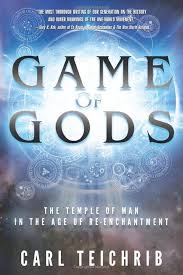
Those two quotes are just a couple of references in Carl Teichrib’s spectacular tome, Game of Gods.
Teichrib’s thesis is that playing God is not a game at all, of course. It’s the heart of idolatry that was addressed in Genesis 3, again at the Tower of Babel, at Calvary, and by the Apostle Paul in Romans 1–just to name a few times.
The reason I thought it fitting to write on Teichrib’s book is because it catalogues man’s design to deny the Creator, man’s inveterate efforts to artificially design a Oneist cosmogony and anthropology.
It is truly a wonderful book that is terrifying in its truth about how far down the rabbit hole of Oneism we’ve burrowed.
Oneism, per its subject matter expert, Peter Jones, is “the worship of creation where all is one when creation is worshipped and served as divine. In Oneism all distinctions are eliminated and through enlightenment Oneism proclaims that man also is divine. Twoism is defined as the worship of the divine Creator. All is two because we worship and serve the eternal, personal Creator of all things. In Twoism God alone is divine and is distinct from His creation; yet through His Son Jesus, God is in loving communion with His creation.”
So many folks are squirreling out over artificial intelligence. I think its downfall will be found in its root meaning–art and artifice. Its root meanings are “to craft” or “to put together.”
When we create, we work with existing material. And human pride makes it so easy to assume we’ve made the material. But we, too, are creatures, fashioned by the One who created all things but who Himself is uncreated.
We might look to Genesis 11 for a review and perspective. When we purport to put ourselves atop the Creator, ironies result–and they can be spectacular in their fallout. Why? Well, there is an Author who will not share His glory with another.
Context: God had revealed to Israel’s leader, Joshua, that the future conquest of Jericho was already planned (Joshua 6:2); it would be conquered by the Lord via His servant. God commanded Joshua to be strong and courageous (Joshua 1:18). Would Joshua do it? Would he be faithful to God’s revealed will? It’s easy for us, thousands of years removed from the directives given by God to Joshua, to nod and smile, as if it were all no big deal. But it was a huge deal. The people of Canaan were vicious pagans, given over largely to deviance, child sacrifice, and abominations that you still find today in come countries. Anybody who thinks depravity was confined to 1400s Palestine needs to travel a bit and/or read actual history. These people were wicked, vile, and given over to the forces of darkness. Yet God was on the move through a remnant of believers.
God’s Divine Battle Tactic: You remember the plan, right? March around Jericho. Do it for (6) days, in fact. On day (7), march around the city (7) times and have the priests blow their trumpets and blast the ram’s horn and then shout (cf. Joshua 6:3-5). Huh? Really? You’ve got to be kidding. This is a battle tactic? Those are natural, doubting, sinful reactions. Why? Because they doubt God’s power to do things God’s way via obedience. The point was that God was and is the greater Joshua. Victory comes through the divine Warrior, the Lord Himself. The believer’s duty is the faithful discharge of his lawful orders.
Encouragement: Joshua and his people obeyed; the army marched and carried out the mission; the walls of Jericho fell. Rahab and her family were saved (Joshua 6:22-23), demonstrating God’s covenantal faithfulness and Rahab’s true faith in the Lord. I love the way Joshua 6 ends: “So the LORD was with Joshua, and his fame was in all the land” (Joshua 6:27, ESV).
The divine battle tactic hinges on that precept: the Lord is with His people; He is the sole 100% faithful covenant-keeper. There would be times when Joshua would doubt; there would be times Gideon would doubt; there would be times when Solomon would blow it, just like his father, David. There are times when all of us fall short; that is why we are taught again and again to look to the holy Commander and His divine battle tactics. “Some trust in chariots and some in horses, but we trust in the name of the Lord our God” (Psalm 20:7, ESV).
Question: Is it possible to trust the Lord when most others seem to have rejected Him?
Context: In the Old Testament book of Joshua, the commanding general of Israel’s forces, Joshua, sent two of his men to spy out the land of promise. It was filled with largely unregenerate pagans. Surely, this could not be the land promised, right? This place? 1400s B.C. in the land of ancient Canaan? There’s no way God could or would grip anyone in this place, right?
Joshua’s command: And Joshua the son of Nun sent two men secretly from Shittim as spies, saying, “Go, view the land, especially Jericho.” And they went and came into the house of a prostitute whose name was Rahab and lodged there. And it was told to the king of Jericho, “Behold, men of Israel have come here tonight to search out the land” (Joshua 1:1-2, ESV).
A few important details are here:
First, Joshua believed the Lord. He was living out his name, which means “The Lord saves,” or “The Lord is salvation.”
Second, human depravity was on display, but God was very much at work amidst the spiritual darkness.
Rahab, after all, was a prostitute, but her heart had been opened by the Lord. She told the two Israeli spies, “And as soon as we heard it [of God’s previous works of providence and judgment on behalf of His people], our hearts melted, and there was no spirit left in any man because of you, for the LORD your God, he is God in the heavens above and on the earth beneath. Now then, please swear to me by the Lord that, as I have dealt kindly with you, you also will deal kindly with my father’s house, and give me a sure sign that you will save alive my father and mother, my brothers and sisters, and all who belong to them, and deliver our lives from death.” 14 And the men said to her, “Our life for yours even to death! If you do not tell this business of ours, then when the Lord gives us the land we will deal kindly and faithfully with you.” (Joshua 2:11-14, ESV)
Third, obedience to God was rewarded, but it entailed many painful trials. “Behold, when we come into the land, you shall tie this scarlet cord in the window through which you let us down, and you shall gather into your house your father and mother, your brothers, and all your father’s household” (Joshua 2:18, ESV).
Encouragement: Just as Noah and his family were saved when the rest of the world perished. Rahab and her family were saved, but judgment fell upon the other Canaanites. The same pattern, you see. Faithfulness and obedience are commanded by the Lord because He is so eager to pardon repentant sinners and show mercy rather than judgment. Rahab, this Canaanite prostitute, is commended in the New Testament. How encouraging should that be for you and me. Why was she commended? Because of her faith, because of her turning to the Lord, while most around her remained recalcitrant.
“By faith Rahab the prostitute did not perish with those who were disobedient, because she had been given a friendly welcome to the spies” (Hebrews 11:31, ESV).
Rahab did not perish. She displayed the scarlet cord of belief in the covenant-keeping God, and was saved both temporally and eternally. This, dear reader, is good news.
Context: It was the 1440s B.C. in the plains of Moab outside Canaan. Moses, Israel’s great human mediatorial leader during the exodus from Egypt, had died. God took his life when he (Moses) was 120 years old at Mount Nebo (Deut. 34). Now, this rebellious people (Israel) had a new leader after the many years of largely faithful service under Moses. How would Joshua lead? What counsel should Joshua embrace? What principles should guide Joshua? What sort of character should Joshua have? Many more crucial questions could be asked, of course, but the heart of them all is, “Well, what are non-negotiables of a godly leader?”
Text:
“No man shall be able to stand before you all the days of your life. Just as I was with Moses, so I will be with you. I will not leave you or forsake you. 6 Be strong and courageous, for you shall cause this people to inherit the land that I swore to their fathers to give them. 7 Only be strong and very courageous, being careful to do according to all the law that Moses my servant commanded you. Do not turn from it to the right hand or to the left, that you may have good success wherever you go. 8 This Book of the Law shall not depart from your mouth, but you shall meditate on it day and night, so that you may be careful to do according to all that is written in it. For then you will make your way prosperous, and then you will have good success. 9 Have I not commanded you? Be strong and courageous. Do not be frightened, and do not be dismayed, for the Lord your God is with you wherever you go.” (Joshua 1:5-9, ESV)
Encouragement: As a military chaplain, we Soldiers love the book of Joshua. After all, it’s a book about the ultimate divine Warrior, the Lord Himself. But it’s also replete with military battles, with combat, with trauma, with victories and defeats, etc. The book revolves in so many ways around the issue of steadfastness in leadership. There are many ugly, just downright horrific events, in fact, in the book of Joshua, too. Why? For us to learn. Folks respond well to steadfastness, to faithfulness, to those who are consistent. Why? Because those characteristics reflect God Himself.
As Joshua took command after a long time of leadership under Moses, God reminded Joshua of a few fundamentals about steadfastness: 1) God does not quit on his people (v. 5); 2) Godly leadership demands courage (vv. 6-9); and 3) Godly leadership will be judged for its adherence (or lack thereof) to God’s revealed will (v. 8). “Leadership is influence,” is the familiar maxim from a popular leadership personality. But steadfastness is a fundamental building block of good and godly leadership.
I was out of my favorite electrolyte drink mix, so I made a Target run for some more. I found the aisle and grabbed a box of what I needed and turned to the self-checkout scanner aisle. As I scanned my item and then paid and was waiting for the receipt to print out, a man came up to me and extended his hand.
“Thank you for your service, sir,” he said.
I could tell right away he was prior service.
“Thank you, sir,” I replied.
“I did 33 years, myself,” he said.
A conversation ensued. He had served 33 years, most of it in the special operations community. He filled me in on some of his years at Bragg, at Benning, and other locations.
He retired as a Command Sergeant Major (CSM).
He saw the cross on my uniform and said, “Can I tell you one more story?”
“Of course, sir,” I said. People in Target were now interested in our conversation, and were looking our way and listening to him speak.
“Whenever we prepped to roll out, our chaplain would come pray Psalm 91 over our guys. Every time. Then I would go to our guys and say, ‘I’m a Christian, boys; but listen to what the Chaplain said. We’ve trained you, but may God equip you.'”
He stuck his hand out again and said, “Appreciate you, Chaplain.”
Intro: For as long as I can remember, Deuteronomy has been my wife’s favorite book of the Old Testament. It is undoubtedly filled with profound moments in its second giving of the Law, if you will. But I would like to take just a moment to remind us of some profound words of encouragement that are found towards the end of Deuteronomy. They are from Deuteronomy 31:6-8:
Be strong and courageous. Do not fear or be in dread of them, for it is the Lord your God who goes with you. He will not leave you or forsake you.”
Then Moses summoned Joshua and said to him in the sight of all Israel, “Be strong and courageous, for you shall go with this people into the land that the Lord has sworn to their fathers to give them, and you shall put them in possession of it. It is the Lord who goes before you. He will be with you; he will not leave you or forsake you. Do not fear or be dismayed.” (Dt 31:6-8, ESV)
Why So Important?
They are important because we creatures so easily underestimate God and overestimate fellow sinners.
They are important becase God is with His people. Period. Don’t mistake ethnicity and nations and cultures for being God’s people. Whether you’re in Christ, that’s the issue–always.
They are important because God goes before his people and does not quit on them.
Be encouraged, Christian pilgrim. God sees, God knows, God goes before you, and God is faithful to His covenant.
Moses reminded the people yet again. And yet again, they remained largely blind and deaf:
And Moses summoned all Israel and said to them: “You have seen all that the Lord did before your eyes in the land of Egypt, to Pharaoh and to all his servants and to all his land, the great trials that your eyes saw, the signs, and those great wonders. But to this day the Lord has not given you a heart to understand or eyes to see or ears to hear” (Deuteronomy 29:2-4, ESV).
In spite of historical experiences of God’s provision, deliverance, and sundry miracles, the people remained largely spiritually blind, deaf, and ignorant. No “eyes to see or ears to hear,” per Moses in Dt. 29:4.
The more things change, the more they remain the same. Spiritual blindess & deafness are God’s judgments upon people. And as much as Moses loved the people, it was not in his power to make them see and hear. It had to be God to do it, if it was going to be done.
For folks who can see and hear, this is a lesson that comes as a hard schoolmaster. That is, we long for folks to see and hear, and yet they remain duped by the duplicitous. They become prey for the roaring lions who steal, kill, and destroy.
But this is the testimony of Scripture: God alone has the power to open blind eyes and grant hearing where there is spiritual deafness. Our duty is to plead with the Lord to do just that.




 MIND & MATTERS