Chaplain Daily Touchpoint #221: Constancy/Immutability

Introduction: Among the greatest of themes is the theme of appearance vs. reality. Think of this line from Iago, one of Shakespeare’s vilest villains, in Othello: “I am not what I am.” That is, of course, a perversion of how God spoke to Moses in Exodus: “I AM WHO I AM” (Ex 3:14a, ESV). 

Man is capable of doing something God is not: lying. God cannot lie. Think of that. If God could lie, he would be capable of change and capable of being unholy. Those are clearly not possible for the true and living God: “For I the Lord do not change; therefore you, O children of Jacob, are not consumed” (Malachi 3:6, ESV) and “Holy, holy, holy, is the Lord God Almighty, who was and is and is to come” (Revelation 4:8b, ESV). 

Encouragement: Do you have folks in your life that you can count on for consistency in truth? Do you have those you count on to consistently tell you the truth and live as people of the truth? Are you and I people like that? 

In the Christian worldview alone, you have the revelation of the God who is truth incarnate. He is utterly holy, holy, holy. He does and cannot change to be anything other than consistently holy and truthful. He tells Thomas in John 14, “I am the way, and the truth, and the life” (Jn 14:6a, ESV).

He calls our focus to himself, his character, his consistency as the only God of unchanging constancy and steadfastness and truth.

In a culture with its feet firmly planted in midair, it encourages the Christian to know the anchor, the steadfast One, the immovable, the consistent Rock of Ages, the truth incarnate. 
Like Ray Charles Sang …

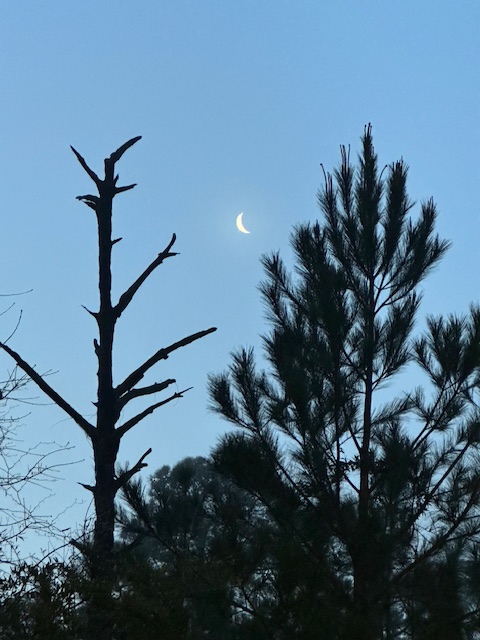
“Moonlight through the pines.” I think that’s the phrase from the classic song by Ray Charles, “Georgia On My Mind.”

On the trail this morning, no clouds. Just lots of humidity, the sounds of birds, the mechanical buzz and hum of vehicular wheels on asphalt, a very slight breeze, and moonlight through the pines.

My legs ached, my lungs were burning, and I found myself longing to be a younger man when hills and sprints didn’t hurt so much. Alas, time runs one way and my knees know it.

But I do not think I could improve upon Spring, as fecund soils erupt in colors, and turkeys descend from their roosts and dig in the dirt, and the deer forage in the open areas, alert to us soldiers long before we spot them.

The sun will be visible in a few moments now and the sounds of business will remove these images and sounds from our attention, and be replaced with protocol, but this snatch of time will sustain some souls’ desire for aesthetics amidst it all.

Chaplain Daily Touchpoint #219

Intro: When I was a boy, I cannot remember where I first saw it, but I memorized it years and years ago and have been unable to forget it. It is commonly known as the “Serenity Prayer.” The title says it all, doesn’t it? It goes something like this: “Lord, grant me the serenity to change the things I can, accept the things I cannot change, and the wisdom to know the difference.” I’ve heard variations of it my entire life, but you get the gist of it. That’s not too shabby. It’s a call to wisdom.  

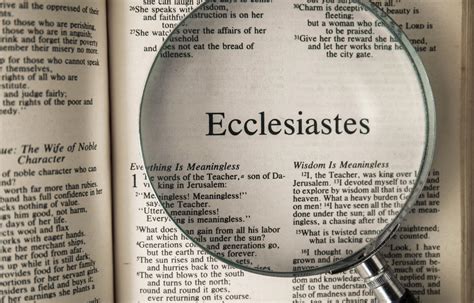
Connection to Scripture: Hebel/hevel is the Hebrew term for what is often translated into English as “vanity” in Ecclesiastes. Why is that significant for us? Well, it’s to teach us to learn how to accept some measure of futility in things we cannot change. For as long as I can remember, Ecclesiastes has remained my favorite book of Scripture. I think it’s because Solomon is so interesting to me. He’s a textbook case of gaining the whole world and losing his soul, and then (finally) regaining it. He was a deeply flawed man in many ways. He was also a profoundly wise man. The label of “Solomonic wisdom” endures for a reason. He was brilliant at times.

In Ecclesiastes 2 Solomon wrote this:

24 There is nothing better for a person than that he should eat and drink and find enjoyment[c] in his toil. This also, I saw, is from the hand of God, 25 for apart from him[d] who can eat or who can have enjoyment? 26 For to the one who pleases him God has given wisdom and knowledge and joy, but to the sinner he has given the business of gathering and collecting, only to give to one who pleases God. This also is vanity and a striving after wind. (Eccl 2:24-26, ESV)

There’s that word again: vanity or hebel/hevel. Its closest synonyms are breath/vapor/mist. The idea seems to be the temporariness of human endeavors, whether joyful or sorrowful. A New Testament parallel is found in James’ letter: “yet you do not know what tomorrow will bring. What is your life? For you are a mist that appears for a little time and then vanishes” (James 4:14, ESV).

The more I study Ecclesiastes, the more profound I discover it to be. The short book is to drive us to wisdom. Its theme is found overtly stated in its last two verses: “The end of the matter; all has been heard. Fear God and keep his commandments, for this is the whole duty of man. For God will bring every deed into judgment, with every secret thing, whether good or evil” (Eccl 12:13-14, ESV).

Encouragement/takeaway: I don’t purport to speak for others, just for myself here, but when I survey the current climate of what could be dialogue and wisdom, it is very often something quite different—a great deal of squawking, bromides, cognitive dissonance, and slander. Not a great deal of wisdom. That’s where Ecclesiastes’ wisdom is enduringly germane. Will we get back to basics, to fundamentals, to reasonableness? Or will we continue down the slope of outrage and the Jerry Springerdom of Dumbville? Scripture calls out to us to be a people of wisdom rather than folly. We can learn a great deal from Solomon’s pen, if we but pay attention.

Arrested Pre-dawn

I had done a couple of miles on the treadmill, and then my favorite time of day was coming. Clear sky, low winds, and cool temps. It was time to leave the gym and run outside. So I hopped off the treadmill, put on my reflective belt (fellow soldiers will understand and laugh here), and took off to the trail.

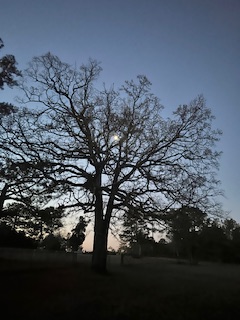
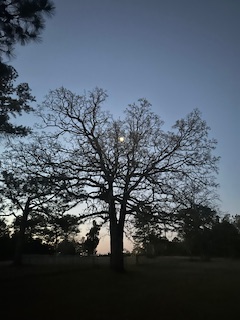
As I reached my turnaround point and made the turn, when I was running back, it was one of those moments that invariably makes me pause and utter thanks to God for such beauty. The oak was already showing shoots of green (as Spring is upon us), the sky was clear, and the moon was visible through the limbs from the spot where I had stopped running in order to capture this moment.

Some might scoff, “Really? That? Moonlight through the limbs of a tree?” Yes, indeed. Who made it? You? Me? Random chance? No, no, and no.

God, high and mighty, made it–just like he made us creatures capable of appreciating his creation and stewarding it. As the kiddos are wont to say nowadays, “Just sayin’.

When Sleep Won’t Come

It was a bit after 3 a.m. and I was weary from fighting to sleep … and losing the fight. I rolled over and switched on the lamp. The Hemingway story, “A Clean, Well-Lighted Place,” ended with the great lines, “After all, he said to himself, it’s only insomnia. Many must have it.” I have taught that story again and again to students, but this night I felt like the student rather than the professor.

I picked up my laptop to prepare for teaching fellow soldiers today. I made a cup of coffee. I checked my email. In my email inbox, one in particular stood out. It was from my friend D. He had written a tender email about Hannah’s prayer from 1 Samuel 2. As usual, he wrote of longing to have a heart for God the way that Hannah did. I wrote him back and commended his words and theology. Indeed, Hannah’s prayer is one of the most beautiful and stirring prayers in Scripture.

I went to my desk and opened my Bible to 1 Samuel 2, and read Hannah’s prayer. It has so many memorable lines like this one: “He [the LORD] will guard the feet of his faithful ones, but the wicked shall be cut off in darkness, for not by might shall man prevail” (1 Samuel 2:9, ESV).

I read the prayer again. And again. And again.

I resolved to stay up. There was no need to try to wrestle among the sheets any longer this night. Just embrace the reality that it’s not meant for me to rest this night. Perhaps it’s because I was to read that email from my friend D. Perhaps it was to drive me to Hannah’s prayer, too, in order to have a heart like Hannah and like Samuel, her child of promise, a type of the Christ who would come in the New Testament era. Perhaps it was to prepare me for teaching my fellow soldiers in a few hours.

Perhaps it was just to have me quiet, with my face in my Bible, listening to God’s words inscripturated there. “For whatever was written in former days was written for our instruction, that through endurance and through the encouragement of the Scriptures we might have hope” (Romans 15:4, ESV).

Composure

Theme: Folksy wisdom is rooted in biblical wisdomAn Anecdote on Composure

I remember a conversation I had with my mom when I was a boy. I had returned from fishing one of my favorite fishing spots (we called them honey holes) and it had been one of those long sunny Spring days on the water replete with many of my favorite smells–jasmine, honeysuckle, fish on the bed, the pungent smell of the banks of a pond in Spring, where the skinny-legged herons stand like white bobbing cranes, plucking shad from the shallows, and bass roll and send that shiver up every eager angler’s spine, and you feel it in your whole being that Spring is here, the fish are moving, the dogwoods are blooming, and hope springs eternal, as the poet quipped.

I was telling Mom about the day on the water we’d had when we returned home, and I told her how much I respected a certain man. He’s so calm about it all, I told her; he’s retired from the military and has done so much. She just looked at me and said, “Still waters run deep.” I love that metaphor. Anything to do with water seems to bathe my imagination in meaning. And the idea of composure being like the surface of calm waters spoke volumes to me.

Connection: That folksy wisdom is rooted in biblical wisdom. Proverbs 17:1 (ESV) says, “Better is a dry morsel with quiet than a house full of feasting with strife.” That’s so vivid, isn’t it? Peace/tranquility/composure is preferable to drama, in other words, because it’s rooted in wisdom. Better is a small simple pleasure (like fishing with one’s stepdad at a beloved honey hole), than a palace infected by drama and upheaval. Indeed those still waters run deep.

After the Storm

We have probably all been there–the morning after the storm. Violent weather moved through our area last night. It seemed to last all night. Lightning, thunder, strong winds, the sounds of wood bending and sometimes breaking, the rushing of waters in the creeks.

The lightning is invariably the part that scares me most. I feel my finitude when lightning flashes. The cracks of whiplashing electricity, and the webbing of light in the night sky, it’s all sufficient to scare me. Even our Cavalier King Charles stood up on the bed when she’d normally be sleeping, looking at us, as if to say, “When will this pass?”

CJ and I were up almost all of the night with the storms. But we made it safely through.

When I left to teach this morning, as I was leaving our neighborhood, I crossed the water and had to pause. Beauty arrested me, even and especially after the storm.

Thoughts upon Loyalty

Bottom line up front: Loyalty Is a Fundamental

Intro: “Solomonic wisdom” is a phrase for good reason. Solomon prayed for wisdom, and God graciously gifted Solomon with wisdom: “O LORD God, let your word to David my father be now fulfilled, for you have made me king over a people as numerous as the dust of the earth. Give me now wisdom and knowledge to go out and come in before this people . . .” (2 Chronicles 1:9-10, ESV). That is a beautiful prayer. Just let that sink in. Here was David’s son, a man who was going to lead the people of Israel into a time of blessing and opportunity unlike any they’d ever had, and Solomon prayed to God for wisdom. And God granted it.

Encouragement: In the Army Values, the very first one listed of the 7 Army Values is loyalty. When you have loyal and trustworthy people to your left and right, your effectiveness in the mission increases exponentially. Solomon, known for his wisdom, wrote the following: “A servant who deals wisely has the king’s favor, but his wrath falls on one who acts shamefully” (Proverbs 14:35, ESV). In other words, loyalty to our leadership is fundamental. We are not to betray a trust. And Solomon even tells us, the king’s wrath falls on one who acts shamefully. That is, disloyalty is a betrayal of confidence and poisons the formation. As Soldiers and Veterans, one of our core tenets must be loyalty. We must be found faithful to steward well the opportunities we’ve been granted by the king, so to speak. Loyalty reflects the wisdom of the king (leader), proves the fidelity of the Soldier/Veteran, and undergirds the accomplishment of the missions set before us.

Ouch!

My elders were right. “Don’t laugh; you’ll be there one day.”

That was their retort when we kids chortled at their “Ah!” and their “Ooooh!” when they’d crouch down and stand up, exhale loudly, and furrow their brows.

This evening after work, I overheard myself: “Ah!” and “Ooooh!” several times, in fact, as I drank glass after glass of water, downed a few aspirin, put compression sleeves on both knees, took a hot shower, sat in the sauna, and thought, “How’d this happen so quickly?”

Indeed. I have discovered the forewarned ‘one day.’

It all came faster than I thought. Lots of miles on these knees and joints now. Lots. But as Frost penned, I’ve miles to go (I hope) before I sleep.

***Looking forward to being with the saints Saturday for fellowship, food, and fun, and then, of course, class Sunday as we return to Matthew 16 for studies in Christ’s admonitions regarding discernment and why to ‘beware’ of posers.

Press on, knee pain and all, and we’ll make it.