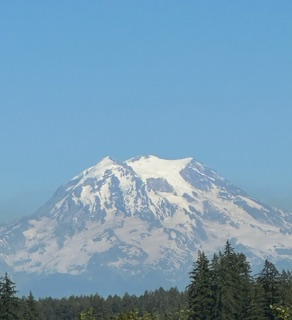
Am grateful to be able to train with fellow chaplains out West. Mt. Rainier towers over us with its rugged rocky snowy presence. The meadows below burst summertime colors like something out of an e.e. cummings poem. The Ponderosa pines stand majestic and straight with bark so large its layers appear like vertical rivers.
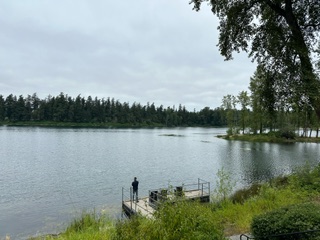
Was able to read some Flannery O’Connor stories during lunch break by a lake where soldiers and families can relish the joys of creation.
Enjoyed a great steak dinner tonight with peers who have similar callings in ministry. Thankful for these guys and for the opportunities we have to reach those who might not otherwise hear the gospel.
On the way to the track, this is the view (not too shabby):
On the flight in:
When I was walking last evening, this was a view from near the aviation unit:
I am in love with the trees out here:
Am headed to hike part of Mt. Rainier some tomorrow with buddies after class. More pictures to come.
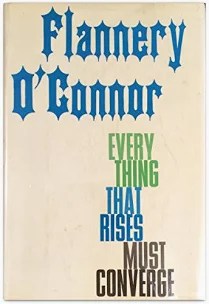
On a flight out West I had opportunity to again dare to immerse my soul in the gut-wrenching blood sacrifices that pierce O’Connor’s masterful short stories.
For much of my time, I focused relentlessly upon “Greenleaf,” a situationally ironic surname if ever there was one. Mrs. May, the protagonist, has a low view of most everyone outside of herself and her imagined importance. She looks down upon Mrs. Greenleaf, who prays and prostrates herself on the dirt out in the woods, petitioning the heavens over her own sinful condition, and she pleads for God’s wrath to pass her by.
But not Mrs. May. She’s got it all together. Or so she thinks.
Until a blood sacrifice occurs; until she is pierced by the bull; until she’s bloodied and broken. Then, in the unbearable light, she understands what she’s hated and resisted all along.
*I do not know how one reads O’Connor without coming away in spiritual sackcloth and ashes; she’s that biblical and piercing.
Illustration: Recently I read a book by James K.A. Smith entitled You Are What You Love. In it, Smith penned more than a few zingers, one of which follows: “I cannot answer the question, ‘What ought I to do?’ unless I first answer the question, ‘Of which story am I a part?’” (p. 89).
Connection to Daily Life: Today is a milestone in the military unit I am blessed to serve as chaplain. A great deal of ceremony and speeches will occur; VIPs and dignitaries will be present; cameras will be rolling; and a new chapter of one part of the Army’s continued importance will have its first pages written. It is exciting to be part of it, and to celebrate the achievements and hard work of these men and women. But here’s the thing. It would not have happened without focus and determination. The centrality of knowing one’s ultimate provides the range fans—the left and right limits, if you will—of one’s mission.
Why do we do what we do? Why does anyone do what he/she does? Because each of us is living a narrative—a story—wherein our love has an object. For some, the object of that love is self; for others, it’s recognition; for some, it is stability and structure; for some, it is the glory of God and faithfulness. But each of us is living out a story based upon our ultimate.
Encouragement: When we come to answer honestly the question, ‘Of which story am I a part?’ we can begin to orient ourselves to true north, the unmoving point of reference, whose Word is truth because he is truth himself (John 14:6).
While teaching college undergraduates English literature and writing, I discovered the literary works of Mark Helprin. I owe a debt of gratitude to Hillsdale College. Their English and History professors continue to bless me.
If you love language–especially beautiful language–or if you have ever lost yourself in a Thomas Hardy novel on a rainy Saturday, or read Hemingway’s stories through the night, or wandered your own imaginary heath with Cathy and Heathcliff, or felt P. Caputo or Tim O’Brien in your reading boot soles, Helprin’s words may reach you.
BLUF: Seemingly ‘small,’ steady steps in the right direction pay dividends.
In a book I read recently, the authors shared the following story:
Charles Francis Adams, nineteenth-century political figure and diplomat, kept a diary. One day he entered, “Went fishing with my son today—a day wasted.” His son, Brook Adams, also kept a diary that is still in existence. On the same day he made this entry: “Went fishing with my father—the most wonderful day of my life!” (Making Sense of Your World, W. Gary Phillips, William E. Brown, John Stonestreet, p. 234).
There are few things I enjoy more than fishing (okay, catching), but you get the idea. So, this illustration hits home with me. When I reflect upon my fondest memories of boyhood, many of them involve time with my stepfather and fishing together. We’ve caught hundreds together. He taught me from my earliest cane poles, then on to Zebco-33 reels, then on to open face/spinning reels, then on to bait casters, etc. I’m sure he grew frustrated with me more than a few times when I was a little fellow, and he’d have to help me. But I’d give anything to recapture those times. On the ponds, rivers, and lakes, it was heaven to me. He probably had no idea how much all those times would shape me for life.
Encouragement: If you are battling discouragement or think and feel that your efforts are for naught, remember the diary entry from the son in the opening illustration. You are making a difference; let’s just aim for it to be a good and wise difference.
Some time ago I read By What Standard? The men whose writings comprise the book are warriors for truth. I have had some of them as professors, and they are as solid in person as they are on the page.
One of the zingers from this book still sticks with me.
It is from Thomas Sowell: “When you want to help people, you tell them the truth. When you want to help yourself, you tell them what they want to hear.”
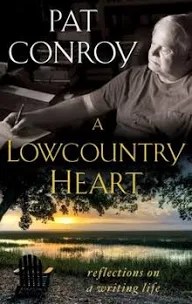
Conroy’s early books were my threshold into a lifetime of voracious reading. Here’s one example from one of his last works of why he’ll always remain special to me:
Here’s what I know: If a story is not told, it’s the silence around that untold story that ends up killing people. The story can open a secret up to the light (Pat Conroy, A Lowcountry Heart, p. 238).
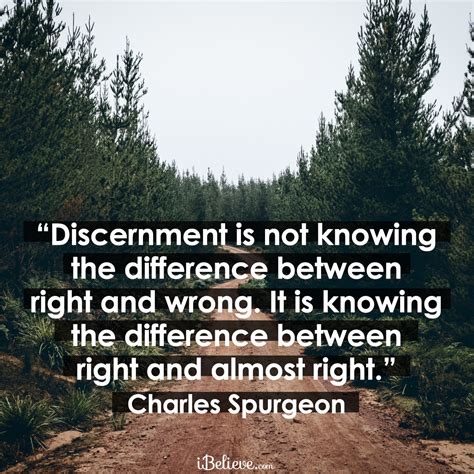
Discern: (verb) To perceive or recognize the difference or distinction between (two or more things); also “distinguish (an object) with the eyes, see distinctly, behold;” also “perceive rationally, understand;” late 14c., from Old French discerner (13c.) “distinguish (between), separate” (by sifting), and directly from Latin discernere “to separate, set apart, divide, distribute; distinguish, perceive,” from dis- “off, away” (see dis-) + cernere “distinguish, separate, sift” (from PIE root *krei- “to sieve,” thus “discriminate, distinguish”).
Illustration: About 10 years ago, I had to get prescription glasses. I have been a voracious reader since my late teenage years, and I had finally crossed that middle-aged threshold when the looming optometry appointment comes and you hear the now familiar questions, “Better or worse? Better or worse?” Through one lens, the picture is blurry. Through the other lens, ah! You can see.
I remember the first set of glasses I got; the optometrist said, “You’ve read your eyes out. Welcome to glasses.” But it has been worth it. With the correct lenses, it’s such a blessing. I can see from Tampa to Toledo without glasses, but when it comes to close distances, to see what is right in front of me, I need the spectacles.
Connection: Since this is true in the physical world, how much more important is it for us in the spiritual world? We need to be able to see what is there. To change to a shooting analogy, we need an accurate sight picture.
One of my favorite Christian ministries is Ligonier Ministries. They took the name of their teaching broadcast from Romans 12:2. “Renewing Your Mind” is the broadcast. Here are God’s words to his people via the pen of the apostle Paul:
Do not be conformed to this world, but be transformed by the renewal of your mind, that by testing you may discern what is the will of God, what is good and acceptable and perfect (Romans 12:2 ESV).
Renewing your mind? Yes. Why? In order to discern.
It’s a command directly from God for his people.
Questions: How are we faring? Does the evidence reveal we are renewing our minds? Are we being a discerning people? To ask the question is to answer it. Where is the prophetic vision, a la Proverbs 29:18? The Lord has called his people to feast upon the deep things of God and his revealed Word, and instead, the masses have chosen to eat cereal and watch cartoons.
A Prayer: ‘Speak, LORD, for your servant hears’, Samuel said. Give your people a heart of wisdom, discernment, and courage. James tells us to ask for wisdom and you, Lord, will grant it. But we know that we must long for it, so will you grant that hunger? Hear the prayer, Lord, for Christ’s great name. Amen.
BLUF: Trust the wisdom of God rather than the lies of men.
Scripture: “The lot is cast into the lap, but its every decision is from the LORD” (Proverbs 16:33).
Contemporary Life: If you are at all like I am, you may have grown doubtful and/or even skeptical about being able to get the truth about much of anything lately, especially politics. It seems a lot of folks just go into their preferred echo chambers and listen to those with whom they already agree. Meanwhile, the world appears to be unraveling. Political parties are sniping at each other. Political fratricide is occurring. I read a headline recently that referred to it as ‘frenemies’ running the show. It is a scary time, if you think that the cosmos is being run by politicians. But as for the Christian, he knows better. The metaphor in Proverbs 16:33 is of an ancient custom of discerning the will of the Lord in matters, but Solomon puts a wise spin on it, namely, that every ultimate outcome is from God. That is, the cosmos is not ultimately run by those for sale to the highest bidder, or by those whose god is themselves, or by those who foolishly are modern-day Nebuchadnezzars, who think that they’re not going to be humbled and replaced by the God who rules all nations and all things.
Encouragement: Yes, we are in crazy times, that much is certain, but God will be glorified via the outcome. His way invariably involves judgment of sin, and that is what we are seeing in our day. May we trust the Lord and live in such a way as to reach as many as possible with the good news.
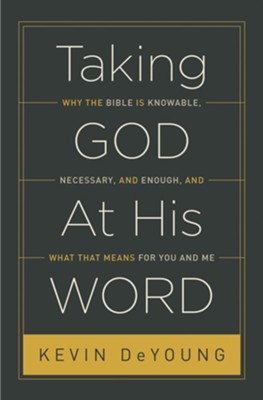
Recently I had another birthday and some friends gave me DeYoung’s Taking God as His Word as a present. I devoured the slim volume. There were several reasons why.
For one, the small book is rich with gems regarding the literariness of the Bible, especially the Psams. The Bible reveals the historical and narrative true story of what God has done to redeem a people for himself. It tells the story of creation, redemption, fall, and restoration. It is the grand narrative that tells the story of why the world is the way it is, why people are the way we are, what God has done to redeem a remnant of people, and of how all humanity will answer to God in Christ.
Second, DeYoung’s volume stresses the fact that the Bible is the standard of truth, because it is authored by the unchanging holy God himself. Those who long for truth, therefore, will long for the 66 books of sacred Scripture, because God is the God of truth.
Third, the book focuses on the sufficiency and authority of Scripture. I appreciated this quote from chapter 2:
You do not need another special revelation from God outside the Bible. You can listen to the voice of God every day. Christ still speaks, because the Spirit has already spoken. If you want to hear from God, go to the book that records only what he has said. Immerse yourself in the word of God. You will not find anything more sure (p. 42).
*A sincere thank you to our friends for this volume. It focused my attention where it should be, and reminds me of the good ways God continually brings joys into my life–through friendship, through books, and through the Author of life and his gospel. I do not think I will read Psalm 119 the same way again, thanks to this volume.













 MIND & MATTERS