Principle: Some will depart. Departure may be a blessing for the health of the genuine body.
Text: Now the Spirit expressly says that in later times some will depart from the faith by devoting themselves to deceitful spirits and teachings of demons, through the insincerity of liars whose consciences are seared, who forbid marriage and require abstinence from foods that God created to be received with thanksgiving by those who believe and know the truth (1 Timothy 4:1-3, ESV).
Context: Paul wrote to his child in the faith (Timothy) in the mid-60s A.D. Why? To mentor him, to advise him, to impart wisdom in order to shepherd the congregation at Ephesus well. That was the immediate context. Why? Because shepherding the true sheep involves recognizing and guarding against the false believers (wolves).
Application & Encouragement: Nothing has changed. Tares still reside right alongside the wheat. Why do false converts remain and sow seeds of false doctrine? Because their “consciences are seared” (v. 2). Because their commander is satanic/demonic (v. 1).
But there remains a blessing in all this. What is it? A sifting of the genuine from the false. There are those “who believe and know the truth” (v. 3). The wise shepherd is to train himself for godliness (v. 7). That training hinges upon discernment and spiritual courage.
I was reading a book recently on a rainy evening. I think I could just about read forever when the rain is slow and steady outside and coffee is beside me, and the story grasps me.
But this was not a narrative like I usually enjoy on a rainy evening. This was a read on practical theology and Christian living. But what the author wrote has remained with me:
Sin will always cost you, but sometimes purity can cost you, too. But that’s a price that strong finishers are always willing to pay.
The cost of the book was worth it, just for that nugget.
When I look back over the men and women I most respect, those I hold up as heroes for one reason or another, they do share that character trait: they were willing to pay the price, and their reasons were rooted not in vainglory or personal ambition but in goodness and truth and beauty.
And what they paid, they paid in service of and because of that goodness, truth, and beauty.
“Beware of no man more than yourself; we carry our worst enemies within us,” wrote the powerful Baptist preacher/pastor/soldier for the Christian worldview, Charles Haddon Spurgeon.
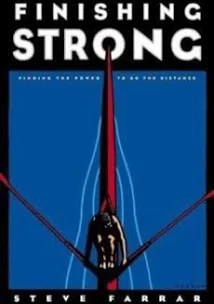
I came across this Spurgeon zinger in a book recommended to me by a former pastor of mine. The book, a simple but not simplistic book, is Farrar’s Finishing Strong.
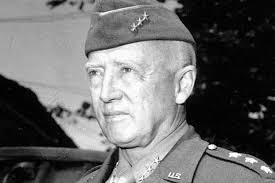
Another zinger from the book is this one from the great American military officer George S. Patton, Jr. Patton wrote, “Untutored courage is useless in the face of educated bullets.”
Satan is wickedly smart. Crafty is the better adjective. He is crafty and wicked. His motives are demonic and he is a liar and thief by nature. He knows how to sabotage us and is determined to shipwreck God’s people. Therefore, God’s people must do battle with the wicked one but by fighting the wise and right way. That wise and right way, of course, is God’s way:
Some trust in chariots and some in horses, but we trust in the name of the LORD our God (Psalm 20:7, ESV).
It was not David’s wisdom and strength that slew Goliath, after all, but God’s. David, after all, went from hero to zero, in many ways. He was anointed king but when he should have been a wise and humble king, he made shipwreck of his testimony in many ways via his sins against Uriah, Bathsheba, his own nation’s armies, and most fundamentally, against God.
In Psalm 51, we see David’s brokenness:
Against you, you only, have I sinned and done what is evil in your sight, so that you may be justified in your words and blameless in your judgment (Psalm 51:4, ESV).
Recently I came through a process where I was highly emotionally invested. I had written papers, studied, read dozens of books, taught scores of students, etc. but I was being questioned by a panel of people who held the exact opposite worldview as I. I believe the God of the Bible. I believe that people bear the imago Dei (the image of God), as recorded in Scripture. I believe that we are created either male or female. I believe marriage is a covenant between one man and one woman for life. I believe we’re to marry and raise children in the discipline and instruction of the Lord.
All of these things are so fundamental, so overt in Scripture, so self-evidently wise that it’s pure folly to kick against their wisdom. But the panel was peopled by three-out-of-four who denied those truths. They rejected the biblical worldview and me as a follower of that worldview.
And I had to come to terms with my rejection. I held a view that simply cannot be tolerated by the secular Left. There’s to be no tolerance for those with biblical values. And this is yet another example of what the Bible means when the 66 books of Scripture illustrate and teach on spiritual warfare.
Believers are told up front that we will be hated:
If the world hates you, know that it has hated me before it hated you. If you were of the world, the world would love you as its own; but because you are not of the world, but I chose you out of the world, therefore the world hates you. Remember the word that I said to you: ‘A servant is not greater than his master.’ If they persecuted me, they will also persecute you. If they kept my word, they will also keep yours. But all these things they will do to you on account of my name, because they do not know him who sent me. If I had not come and spoken to them, they would not have been guilty of sin, but now they have no excuse for their sin. Whoever hates me hates my Father also. If I had not done among them the works that no one else did, they would not be guilty of sin, but now they have seen and hated both me and my Father. But the word that is written in their Law must be fulfilled: ‘They hated me without a cause.’ (John 15:18-25, ESV).
But we’re also told to rejoice:
Blessed are you when people hate you and when they exclude you and revile you and spurn your name as evil, on account of the Son of Man! Rejoice in that day, and leap for joy, for behold, your reward is great in heaven; for so their father did to the prophets (Luke 6:22-23, ESV).
Encouragement: We were told up front, fellow pilgrim; we were told we should not be surprised (1 Peter 4:12). So let us be faithful, trust the Lord, and know that ultimately truth wins.
When the plane lifted off from Atlanta, the humidity hung in the GA sky like a formidable force. The firmament’s colors changed in the course of seconds to hues of orange, tangerine, coral, and peach. I looked through the window on my left and snapped a picture with my old iPhone.
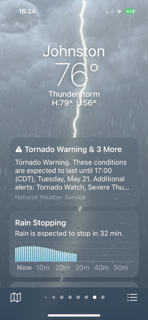
I was headed to Iowa again to minister to soldiers there. The weather forecasters were saying we might see some violent storms over the coming days.
I landed in Iowa fine, grabbed a bite to eat, checked in at my lodging, changed out of my civilian clothes and into my military uniform, called the commander, told him I’d arrived, and he invited me to come on in to report. Shortly thereafter, I was at his unit, and we caught up, and we chatted about the next day’s PT test his unit had scheduled. (I’d brought my PTs in order to test with the unit here.)
That night I went to bed early in order to be rested for the PT test the next morning. When I woke early and got warmed up and drove to the field house on post for the first events of the PT test, the skies looked pretty threatening. The sky was spitting rain and the clouds reminded me of the imagery from Bronte’s Wuthering Heights. Dark, foreboding, intimidating.
But we all knocked out our first three events: deadlifts, standing power throws, and hand-release pushups. We were picking up our kettlebells and weight plates for the sprint-drag-carry event when the Command Post (CP) loudspeaker blared: Attention, take shelter immediately! And the sirens blared that tornadoes were all around us. So we had to index the PT test and shuffle to the nearest shelter.
Later we thought the storms had passed, at least this front, so I was able to conduct my lane of training for the soldiers here. Training went well; the soldiers enjoyed it. I was able to have lunch brought in for them from a local bbq eatery they enjoy.
After that, I linked up with the commander and deputy commander again, and we planned future iterations of training. I went back to my lodging that evening and was reading a book on the Protestant Reformation called Reformation 500 when sirens began blaring. Then the electricity went off and I heard generators kick on. Tornadoes were all around the area. I looked out of the window of my lodging quarters. The flags on the poles out front were whipping and thrashing like so much thread in a gale. Semi-trucks were pulling off the interstate and onto the sides of the roads and/or under underpasses. The sirens continued to wail.
The skies went from blue, to ashen, to gray, to steel, to almost black. Rain blew sideways. Cars began pulling off the roadways and under concrete awnings of hotels and lodging businesses.
I wish I could say that I prayed highly sophisticated, articulate prayers. I didn’t. I seemed to hear myself mumble like a child: O God. Please. I have so much I still need to do. Lord, watch over my family. But, please, make this pass over me.
Nothing sophisticated about my mutterings, that was for sure. I was simply scared. I felt my finitude. I understood viscerally what Scripture means when it says “you are a mist that appears for a little time and then vanishes” (James 4:14, ESV). That’s what I knew in my bones. I was nothing compared to this. A drop, a fearful drop, amidst this massive storm above and around me. I was utterly at the mercy of the storm and the God of the storm.
Illustration: In a book I recently reread, the author penned this zinger:
In courtrooms, classrooms, operating rooms, board rooms, churches, and even airplanes, Americans no longer talk to each other, they entertain each other. They do not exchange ideas; they exchange images. They do not argue with propositions; they argue with good looks, celebrities, and commercials (Neil Postman, Amusing Ourselves to Death, pp. 92-93).
Postman’s right of course. We’re living amidst idiot culture wherein the instancy and pervasiveness of images flows incessantly from every social media portal imaginable and reasoned dialogue is largely overrun by ad hominem attacks, shallow talking points, and barbed labels aimed at humiliating the enemies of one’s position. Kindness and common courtesy have been replaced by shock jocks and over-the-top antics. One of the most obvious effects is a coarsening of the culture and loss of respect and respectfulness. But there is another way.
Encouragement and Application: In the Christian worldview, however, we see the alternative:
Walk in wisdom toward outsiders, making the best use of the time. Let your speech always be gracious, seasoned with salt, so that you may know how you ought to answer each person (Colossians 4:5-6, ESV).
We cannot fully escape the endless rivers of images and videos assaulting our senses. But we can deal with one another respectfully and model what it means to be a people characterized by quality of speech and character rather than crudity and coarseness, but it will not happen from the top down but from the bottom up, with each of us in our daily obedience doing the small but right things towards each other and towards God.
Despite her mixed messaging regarding her theism (or denial thereof) I nonetheless adore Annie Dillard’s writing. After all, if one writes well, so be it. And she does more than write well.
Here’s just one illustration:
What blood was this, and what roses? It could have been the rose of union, the blood of murder, or the rose of beauty bare and the blood of some unspeakable sacrifice or birth. The sign on my body could have been an emblem or a stain, the keys to the kingdom or the mark of Cain (Dillard, Annie. Three by Annie Dillard. [New York: Harper Perennial, 2001], 9).
You’ve led a tinctured, word-bloody life, Annie; salute. May you be graced into the Word of all words.
Illustration: In some of the courses I teach students online, one of the models I use as an icebreaker each week as a kind of buddy check is the acronym P.I.E.S. I check to see how each student is doing P(hysically), I(ntellectually), E(motionally), and S(piritually) each week. It gets us all caught up with one another and I gain a reading of the room.
During a deployment in Iraq, my commander was among the finest leaders I’ve ever had. He was a bottom line, up front, no-nonsense, serious but personable commander. You never had to wonder where you stood with him. He was honest, consistent, and straightforward. I liked and respected him from day one. He used to tell us in staff meetings that each day he committed to feeding himself physically, spiritually, professionally, and emotionally. I have not forgotten that. I don’t know if he was familiar with P.I.E.S. in theological circles in which I traffic, but he was spot-on as usual.
Connection: In Scripture, God speaks to these same themes. In Army parlance, we might term it holistic fitness. But God is eternal and the fountain of all wisdom, and as much I love Army life, God’s ways predate the U.S. Army. Here’s what God says about each area:
Physically:Or do you not know that your body is a temple of the Holy Spirit within you, whom you have from God? You are not your own, for you were bought with a price. So glorify God in your body (1 Cor 9:19-20, ESV).
Intellectually: Do not be conformed to this world, but be transformed by the renewal of your mind, that by testing you may discern what is the will of God, what is good and acceptable and perfect (Rom 12:2, ESV).
Emotionally: Rejoice with those who rejoice, weep with those who weep (Rom 12:15, ESV).
Spiritually: Beloved, do not believe every spirit, but test the spirits to see whether they are from God, for many false prophets have gone out into the world (1 Jn 4:1, ESV).
Encouragement: The God who formed us knows what we need and what leads to human flourishing. May we have the wisdom and courage to follow His way.
Isaiah was God’s poet. When you slow down and focus on the formidable beauty of Isaiah’s lines, they’re rivers of honey and drippings of the honeycomb.
Hear the heart of God for redeeming people:
Come, everyone who thirsts, come to the waters; and he who has no money, come, buy and eat! Come, buy wine and milk without money and without price. Why do you spend your money for that which is not bread, and your labor for that which does not satisfy? Listen diligently to me, and eat what is good, and delight yourselves in rich food. Incline your ear, and come to me; hear, that your soul may live; and I will make with you an everlasting covenant, my steadfast, sure love for David (Isaiah 55:1-3, ESV).
What do you see here? Several things are overt; they leap off the page:
God’s seeking all who will come/His invitation
What’s needed is not stuff but simple repentance and faith in God
God’s delight in providing lavish blessings upon His people
God’s unending covenant/faithfulness
Again and again, God seeks sinners who will forsake their folly and flee to His good news. And it hinges upon God’s grace, God’s covenant faithfulness, and God’s love for repentant people.
Illustration: One of my favorite short stories is “The Egg” by Sherwood Anderson. It’s about the recurring failures of a ne’er-do-well father, a man who goes from chicken farming to restaurant proprietor, to a balding poor man married to a small-town schoolteacher, to ambitious but naif performer of tricks and gimmicks involving deformed chickens and eggs. It’s a 10-page gem of a story about one’s spiritual blindness. The father does not understand what his son does, namely, the folly of his (the father’s) silly undertakings and ambitions. The father’s hands of ambition far exceed their grasp. And what ensues is just one humiliation after another. The son, an astute observer and seer of ultimate matters, is embarrassed for his father. The son, in short, both loves his father and is embarrassed by him. The father is a fool. He tries to be something he is not and is thwarted at every turn by forces arrayed against him. He is a man who kicks against the goads of design that God has written into the world. Rather than embracing reality and recognizing reality, he tries again and again to live in a made-up world where he is the creator and has power over others and the world, but he is frustrated at every turn.
Text: It reminds me very much of Solomon’s words in Ecclesiastes:
Vanity of vanities, says the Preacher, vanity of vanities! All is vanity. What does man gain by all the toil at which he toils under the sun? A generation goes, and a generation comes, but the earth remains forever. The sun rises, and the sun goes down, and hastens to the place where it rises . . . What has been is what will be, and what has been done is what will be done, and there is nothing new under the sun (Eccl 1:2-5, 9 ESV).
Encouragement: When Paul was near concluding his letter to the Romans, he penned this:
For whatever was written in former days was written for our instruction, that through endurance and through the encouragement of the Scriptures we might have hope (Rom 15:4 ESV). Anderson’s masterful story “The Egg” is about those who refuse to admit the obvious and the tragedy that follows such refusal. There is, however, another way, but it calls for humility, repentance, and faith in the Father who knows best.









 MIND & MATTERS