Soul Food Saturday in April

Took to the hills today. Cerulean skies above. Trees are shooting forth buds. Flowers are opening. Bird sounds echoed in the hills. Butterflies fluttered hither and yon, their yellow and black-peppered wings floating in silent mad whisks on April’s winds. The creeks ran steady and cool over limestone and granite.

Spiritual Blindness

Text: 2 Corinthians 3:12-18

Question: Why the spiritual hardness & spiritual blindness of some people? 

Context: 2 Corinthians is one of the clearest examples of spiritual warfare in the entire Bible. Chapter 3-4 specifically deal with why some people respond to truth with humility and repentance vs. why others hate truth and respond to it via hostility and rejection. Of those who are hostile to truth, Paul says “their minds were hardened” (2 Cor 3:14) and in v. 15, he says “a veil lies over their hearts” (2 Cor 3:15). Specifically, he is addressing unsaved Jews overtly here in this passage, those who’ve been given formidable evidence that Christ is the Messiah, but still approved and even demanded His murder. There’s a hardening of their hearts and minds that is God’s means of judgment for their impenitence. 

But we see this pattern extrapolated to all who suppress truth and harden themselves against the truth. And it all comes down to a dirty 3-letter word the world hates but remains true nonetheless: sin.   

Encouragement & Application: It is not that there’s a paucity of evidence for the Christian faith; it’s that the world system, drunk on lies and moral rebellion, does not want the truth. Just like infamous atheist Richard Dawkins revealed this week, he wants to remain a ‘cultural Christian’ but reject the Christ who undergirds it all. He sees what’s coming, and he fears it, and well he should. He wants the fruit Christianity brings, but he thinks he can reject the root that is Christ. He cannot. No culture can. It will be Christ or chaos. It will be truth vs. the Lie. It will be the Lion of Judah or the roaring lion of Satan who comes only to steal, kill, and destroy. And what Paul is explaining to us in 2 Corinthians 3-4 is spiritual warfare. He lays out the reality of it and explains the consequences and characteristics of human sin but also the glorious forgiveness and restoration of redemption for all who will come in repentance and faith to the Christ of God. 

Letter of Recommendation

I was walking hills I have walked many times, but each spring the colors burst upon my eyes in purple, violet, every hue of green, and white. With the spring rains, the creeks run fast, too, and I can see shad dart to dark areas under rock overhangs when my shadow falls on the surface of the water. The laurel is soon to bloom and the scents of trees and flowers are everywhere if one only observes the testament revealed.

This evening I was reading Paul’s letter of 2 Corinthians. He writes of his love for his people in chapter 3: “You yourselves are our letter of recommendation, written on our hearts, to be known and read by all. And you show that you are a letter from Christ delivered by us, written not with ink but with the Spirit of the living God, not on tablets of stone but on tablets of human hearts” (2 Cor 3:2-3, ESV).

I was thinking of our group of saints from class, too, of how Paul’s ideas in the 1st century are being played out today, still, as the church–so threatened by false believers, government persecution, and cultural secular rot–still endures, just as Christ promised. And I know how Paul felt, I think, to pour oneself out for people, to plant gospel seeds in them, to pray for God to give the increase, and for the Spirit to deepen them in the great things of God.

Paul calls them nothing less than his “letter of recommendation” in 2 Corinthians. Why? Because he loved them, he labored for them, and longed for God to do in and through them what only He can and does do–fashion vessels of redemption, and bring theological spring in times of secular winter, and know that God always does what is right.

Shoulder to Shoulder

Principle: Shoulder to Shoulder

Context: It was news that we all hate: suicide. We’ve had a spate of suicides across Guard Nation lately. I’m not special, of course, but as a chaplain, suicides grieve me like few other things. We try to minister to the families and friends of the Soldiers that took their lives. We try to minister to the peers of the fallen Soldiers. We try to give wisdom to the command teams about indicators, cultural trends, and more. But the reality is that there is now a hole, a space, a void where once there was a Soldier.

Text:  In Ecclesiastes, Solomon writes, “Two are better than one, because they have a good reward for their toil. For if they fall, one will lift up his fellow. But woe to him who is alone when he falls and has not another to lift him up! Again, if two lie together, they keep warm, but how can one keep warm alone? And though a man might prevail against one who is alone, two will withstand him—a threefold cord is not quickly broken” (Eccl 4:9-12, ESV).

Encouragement & Application: I have to be careful here. I cannot force my worldview as a Christian upon Soldiers. We are free to believe as we will. But I do think it is quite worth asking, “How is secularism working out?” It seems that we’re more technologically connected than ever but yet more isolated than ever, at least at the levels it most counts—spiritually and theogically. I learn best via narratives and stories, so let me share a very short illustration:

This week on post, I am blessed to be able to watch some of the finest Soldiers do things that I could never do physically. They run almost non-stop; they set up mortar tubes; they fire them; they break them back down; they go on almost no rest; they land nav; they eat cold MREs; they ruck, and ruck, and ruck some more; they fast-rope from UH-60s; they work as teams in sniper competitions; they simulate MEDEVAC SOPs; they run, ruck, run, and ruck some more. And on and on it goes, and it’s fascinating to behold—to see what they can do together.

But that’s the key thing: they do it as teams. They’re literally shoulder to shoulder. That’s what Solomon is driving at in Ecclesiastes 4:9-12.

Why His Name Offends

Today I was again reading 2 Corinthians. It is a New Testament letter Paul wrote in the 1st century A.D. (probably 55/56), an early letter written while people who would have known Jesus the Messiah were still living and verified the letter’s contents.

But what I wanted to focus upon here is something I long for the Christian church to understand. And it’s found in verse 20 of 2 Corinthians 1. It reads, “For all the promises of God find their Yes in him [Jesus].”

How many of God’s promises? All.

In whom are they proven? Jesus.

Again, how many and in whom? All. And in Jesus.

Jesus, the Christ/Messiah/Anointed One, is the central figure in the Bible because He is God incarnate. All of the promises of God find their Yes in Him.

So when you read of the ram caught in the thicket when Abraham ascended Mount Moriah, the ram foreshadowed Jesus.

And when you read of the water from the rock at Meribah, the water foreshadowed Jesus.

And when you read of the manna/bread from heaven that fell miraculously to feed Israel for 40 years, it foreshadowed Jesus.

All of the promises of God find their Yes in Jesus.

This is why when actors curse in your Hollyweird films, it’s Jesus’ name they blaspheme.

This is why the one religion the pagan governments cannot abide is Christianity.

This is why the New Atheists and the secular pundits pick on one religion above all others–Christianity.

It’s because it’s the one they cannot keep down because its Hero walked out of a guarded tomb and was seen by hundreds, ate with them, spoke with them, and His followers laid down their lives for Him.

This explains so much. The world system hates it, just as predicted.

But He’ll not be conquered, because it’s all His anyway.

And even the stones will cry out the truth, on earth, under the earth, and in the firmament–that Jesus Christ is Lord.

Amusing Ourselves to Death (Warning from Isaiah)

Issue: False vs. Genuine Worship

Text: Isaiah 1:11-17 reads,  

What to me is the multitude of your sacrifices?
says the Lord;
I have had enough of burnt offerings of rams
and the fat of well-fed beasts;
I do not delight in the blood of bulls,
or of lambs, or of goats.

“When you come to appear before me,
who has required of you this trampling of my courts?

Bring no more vain offerings; incense is an abomination to me.
New moon and Sabbath and the calling of convocations—
I cannot endure iniquity and solemn assembly.
Your new moons and your appointed feasts my soul hates;
they have become a burden to me; I am weary of bearing them.
When you spread out your hands, I will hide my eyes from you;
even though you make many prayers, I will not listen; your hands are full of blood.
Wash yourselves; make yourselves clean;
remove the evil of your deeds from before my eyes;
cease to do evil, learn to do good; seek justice, correct oppression;
bring justice to the fatherless, plead the widow’s cause.

Context: God detests false worship. God’s people should, too. One of the saddest commentaries that believers may experience is “going to church” or “going to chapel” and just receiving spiritual cookies on the bottom shelf, where there’s no theological depth, no evidence of the preacher having a deep grasp of the metanarrative of redemptive history, of the God of Scripture, of the One who drowned the armies of Pharaoh, opened up the earth and swallowed sinners, drowned the globe but preserved only a remnant, and ordained Calvary and the cross of Christ, or of a clear call to regenerate church membership and kingdom work. Instead, what is often the experience is shallowness and vanilla, proffered like treats at summer camp for children. How can we read Isaiah 1:11-17 and be content? 

Application: In the New Testament, Jesus cited the above passage verbatim (see Matthew 15:8). Why? As a rebuke. To quicken us to the dangers of being cavalier about that which is to be sacred. There is a time to be serious, after all. How much mindless entertainment is ever sufficient? As Neil Postman observed, we’ve amused ourselves to death. And yet God’s warnings via the prophet Isaiah are on page after page of the most enduring and utterly serious Book. 

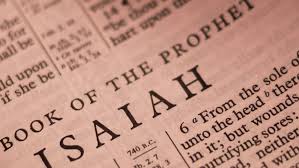
Isaiah for 2024

Text: Isaiah 1

Context: In church history, the book of Isaiah is sometimes referred to as “the Romans of the Old Testament.” Why? Because of its massive theological teaching about our sinfulness and of God’s salvation of his people. Isaiah was a staggeringly literary writer. His metaphors, images, diction, and poetry are simply unlike anyone else’s. In chapter one of his book, he begins in vv. 2-3 by comparing the people of Judah to beasts, recalcitrant beasts who refuse to hear and understand: “Children have I reared and brought up, but they have rebelled against me. The ox knows its owner, and the donkey its master’s crib, but Israel does not know, my people do not understand.”

Connection & Application: Isaiah wrote in the 700s B.C. to a nation and culture that knew the right things to do, but that largely refused to obey. Sound familiar? We are undergoing a cultural revolution in America and the West that is nothing short of spiritual, intellectual, and moral suicide. And yet God’s Word remains steadfast, constant, and sure. Hear again from Isaiah: “If you are willing and obedient, you shall eat the good of the land; but if you refuse and rebel, you shall be eaten by the sword; for the mouth of the LORD has spoken” (Isaiah 1:19-20).

Sycamores, Sunshine, & Grandparents

It is a mystery to me why exactly I have an infatuation with trees. But I do. And I just accept it. Today as I was out for some afternoon PT, one of my favorite species of trees was in bloom: sycamores. Their bark is the subject of treehounds and poets. Robert Frost wrote not only of birches in New England, you remember.

As I got the miles in, I stopped more than a few times under the sycamores that ran parallel to the stream. I smelled the meadow, too, freshly mowed by tractors. A hawk was in the middle of the meadow, wigs beating as he pierced his catch with his black aquiline beak in regular bloody dips, like a murderous pumpjack. I could see the bloody veined viscera of the field mouse.

When I gazed up again and again through the limbs of the sycamores and up into the sky, I was not an old man for a few moments but rather a boy again in my small town where I spent much of my adolescence, at Grandma and Granddaddy’s place, where a giant sycamore grew massive and seemingly forever, and where it was surrounded by azaleas and monkey grass Granddaddy had planted, and behind the house were his pear trees and the garden, and scuppernong vines, and a massive red oak under which he parked his 1968 shortbed Ford with a 3-speed on the column.

I was back there. All at once. Just by standing under the sycamore trees today that ran along the stream. Back to where it all began in so many ways–in ways that money cannot purchase, in ways where God speaks to tender-souled boys who love trees, those who planted them, and those who sowed seeds of love.

The Gospel in Esther

Principle: God delights in thwarting evil.

Context: Esther 7 is one of the most gospel-saturated chapters in the entire Bible. How? Well, the truth about Haman’s evil was made known to King Ahasuerus by Esther. She tells the king, “If I have found favor in your sight, O king, and if it please the king, let my life be granted me for my wish, and my people for my request. For we have been sold, I and my people, to be destroyed, to be killed, and to be annihilated” (Est 7:3-4).

King Ahasuerus demands to know how such a plan of a Jewish holocaust came to be, and Esther tells him: “A foe and enemy! This wicked Haman!” (Est 7:6).

The result? King Ahasuerus had Haman hanged. To add insult to injury, Haman was hanged upon the very gallows he’d had constructed to (he thought) have Mordecai executed. But it wasn’t to be. Haman received his comeuppance. Poetic justice.

Encouragement: I cannot speak for others, but there are many days when I can grow quite discouraged when I think about my country’s cultural trajectory. It’s impossible to trust politicians; it’s impossible to trust the news; it’s hard to find trustworthy people many days. But I encourage myself in this: God knows us; He knows us through and through. The Bible teaches that He knows our every thought and intention. We are exposed always before the eyes of the Almighty. And because He is good, and because His justice is unchangeable, God and God’s people win in the end. God delights in thwarting evil.

And if you ask, “How? How does God thwart evil?” The Hamans of this world; the Judas Iscariots of this world; the false; the tares; the God-haters have a season, but God and His people inherit the kingdom. Look to Calvary. Look to the cross of Christ. It is there that evil was conquered once and for all, but do more than just look to Christ’s work there: flee to Him and His finished work, and do so in repentance and total faith in Him. And then you will begin to understand the gospel.