Do We Really Want It?

Question: Do we really want God’s active presence?

Anecdote: This morning, I was again in Psalm 67. The first sentence in the poem reads, “May God be gracious to us and bless us/and make his face to shine upon us,/that your way may be known on earth, your saving power among all nations” (Ps 67:1-2, ESV).

Recently I was able to attend a prayer breakfast. 15 Soldiers out of hundreds were present. Some civilians came to provide music. And a dance team was used to artistically dramatize the gospel narrative. And I heard a fellow chaplain for whom I have a great deal of respect speak from Luke’s gospel on the ‘unnaturalness’ of prayer. His point was that the default humanistic position is to live and act in a “I’ve got this” posture. But the oh-so-obvious question one might ask the humanists is, “Well, how’s that working out for you?”

The chaplain was right. God breaks His people in order to restore them. The cross before a crown, if you will. Repentance precedes any restoration and redemption. Prayer is unnatural in that it assumes human weakness and the sovereignty of God. If we didn’t believe God is sovereign, why would we pray?

This all seems so basic, so foundational, that you’d think we all get it. But …

Contrast it with just this first sentence of Psalm 67 above. There we see the speaker in the poem cry out to God in prayer for His blessing, for His active presence, that His face might shine upon them, that His countenance of benediction superintend their ways. And yet when we look out at our culture, what do we see instead? The active suppression of God, the increasing hostility to any ability of heralds of the gospel to inform and shape culture. We have folks that’ll set themselves aflame in D.C. over political leanings while screaming talking points, but where do we see Christian soldiers praying for God’s presence?   

Again, the question: Do we really want God’s active presence? The chaplain was right. Believers need to pray more. We need to be broken and driven to our knees so that we call out for the one and only true God. We need to be brought to the place of the psalm writer when he writes in verse 3, “Let the peoples praise you, O God;/let all the people praise you!”

How are things working out via the humanistic and pagan way? The answer seems obvious. Psalm 67 is so straightforward and so powerful. May we have the wisdom that even the prodigal son eventually came to: humility precedes honor. We need to learn how much in the pigsty we really are as a culture. Because then we will see the Father, the more than willing Father, ready to clothe us in robes and celebrate, “Welcome home.”


(6) Books: (3) Recent, (3) Current

Life without great books would be worse than a tale told by an idiot, signifying nothing. It would remain untold and thereby unshared, which would be worse.

Pictured above are six books. I enjoyed them recently (the Franklin study; Crane’s stories; and Cheever’s masterful novel) and three I’m currently still reading (the Dickens bio; Herbert’s sci-fi tome; and another DeLillo gem).

The Kidd volume on Franklin I deeply enjoyed. I am a big fan of Kidd’s books, so I am biased in his favor, as his interests and mine intersect greatly.

Falconer was amazingly sad but so brilliantly written by the plagued John Cheever that I read it in a 12-hour sitting.

Crane was tough as nails, as ever. I don’t espouse his atheism, but he gets soldiers and military life, and is not afraid to portray the darker and more brutal sides of our nature, and (in his view) the indifference of heaven to our suffering.

For me, Dickens remains among my favorites. I’m going through this bio of him, and it is massively thick but worth every page.

Dune, though I’m not a science fiction guy, was recommended to me. So far, it is okay. I’m sure it will grow on me.

DeLillo’s Players is, true to DeLillo’s angle, his linguistic deftness, and his haunting timbre, right up my alley. I believe DeLillo was and is a prophet, just like Cormac McCarthy was. But so few listen. Again, just as both writers predicted.

The Power of ‘If’

The crucial thing: If

If is vital. It’s a conjunction. In logic, it’s what’s known as the grounds of a conditional statement. If this, then that, for example.

I think we all are mimetic by nature. That is, we try to emulate those we admire, whether they’re still with us or have passed on. Some of the men I’ve most admired are those who kept their cool when many others were squirreling out. It reminds me of one of Kipling’s most famous poems. “If” is the title. It is cute, but wise. Don’t let the light timbre fool you:

If you can dream—and not make dreams your master;   

    If you can think—and not make thoughts your aim;   

If you can meet with Triumph and Disaster

    And treat those two impostors just the same;   

If you can bear to hear the truth you’ve spoken

    Twisted by knaves to make a trap for fools,

Or watch the things you gave your life to, broken,

    And stoop and build ’em up with worn-out tools:

If you can make one heap of all your winnings

    And risk it on one turn of pitch-and-toss,

And lose, and start again at your beginnings

    And never breathe a word about your loss;

If you can force your heart and nerve and sinew

    To serve your turn long after they are gone,   

And so hold on when there is nothing in you

    Except the Will which says to them: ‘Hold on!’

If you can talk with crowds and keep your virtue,   

    Or walk with Kings—nor lose the common touch,

If neither foes nor loving friends can hurt you,

    If all men count with you, but none too much;

If you can fill the unforgiving minute

    With sixty seconds’ worth of distance run,   

Yours is the Earth and everything that’s in it,   

    And—which is more—you’ll be a Man, my son!

So very often the quality of an organization hinges upon the If-factor. That is, if the people are wise, if they are good, if they are faithful, if they demonstrate that calmness of spirit when the wheels are coming off the trains in so many other areas of life–a wise and calm perseverance of spirit and mind are not be underestimated. If is a condition, a crucial one. I’m grateful to have had a few such precious men in my life. May I do likewise and emulate well.

“Whoever restrains his words has knowledge, and he who has a cool spirit is a man of understanding” (Proverbs 27:17).

Not Whether but Which: Values

Introduction: I’ve been a Soldier long enough to have lived through multiple iterations of values the Army lauded. When I was in Basic and AIT at Ft. Knox, we had to memorize such things as the “Three General Orders,” which were:

  • I will guard everything within the limits of my post and quit my post only when properly relieved.
  • I will obey my special orders and perform all my duties in a military manner.
  • I will report violations of my special orders, emergencies, and anything not covered in my instructions to the commander of the relief.

Some lessons just stick with you, regardless of the passage of time.

I also remember vividly knocking out pullups before and after chow in those fun days when we’d shout, “Duty, Honor, Country … Hooah!” before the drill sergeants PTd us some more … just for grins and giggles.

But I look out today and sometimes wonder about my nation’s Army of the future. When I joined, I didn’t join for what the Army could do for me, as naïve as that may sound. I really did join because I wanted to be part of something noble, be part of a team, serve my country, travel the world (even the less-than-ideal locations), and be part of America’s history … but in a good and helpful way, not in a way to tear it down. To some that may sound sentimental, but that was me. I loved saying the pledge. I love standing for my country’s anthem. If not in uniform, I still put my hand over my heart. When in uniform, I of course, turn towards the nearest display of my country’s colors and render a salute.

The acronyms are legion in the Army. We have the Army VALUES: Loyalty, Duty, Respect, Selfless Service, Honor, Integrity, and Personal Courage.

As a chaplain, one of my favorites that’s ingrained in my heart of hearts is one we have in the Chaplain Corps: Nurture the living; Care for the wounded; Honor the fallen.

But as Dylan penned decades ago, the times, they are a-changing. The reasons young people join America’s Army are often quite different now. And ideas of selfless service have often fallen on hard times. Now, unless college, grad school, bonuses, and perks attend enlistment promises, our recruiters often find themselves nervous about making quotas.

Encouragement: But here’s the encouragement I try to give myself and others: Values are inescapable; it’s just a matter of which set of values a culture (and its individual members) follow. But there’s always a God of the system, a set of values recognized as the ones to follow.

I know we are a deeply troubled, divided, and politicized nation. Anyone who is honest recognizes that. But my prayer for my country (and your country) is that we recognize good values from bad ones, and have the humility to humble ourselves under the one true God who is truth Himself so that He might form America to what she can be and what her Founders intended.

Scriptural Foundations (Part 4/10)

Scriptural Foundations (Part 4/10): Chronological Snobbery

Introduction: In one of his many wise writings, G.K. Chesterton wrote, “Real development is not leaving things behind, as on a road, but drawing life from them, as from a root.” 

And C.S. Lewis penned this wisdom which runs in similar grooves: “It’s a good rule after reading a new book never to allow yourself another new one till you have read an old one in between. If that is too much for you, you should at least read one old one to three new ones . . . . Every age has its own outlook. It is especially good at seeing certain truths and especially liable to make certain mistakes. We all therefore need the books that will correct the characteristic mistakes of our own period . . . . None of us can fully escape this blindness, but we shall certainly increase it, and weaken our guard against it, if we read only modern books . . . . The only palliative is to keep the clean sea breeze of the centuries blowing through our minds and this can only be done by reading old books.”

Connection to Our Day: Sometimes I look around at churches and I am so encouraged because I see seasoned saints whose Bibles are worn out. Their pages are thin and supple from years and years of reading, writing, and the turning of their leaves. It is dangerous of course to assume that just because someone reads her Bible a lot that he/she has an accurate understanding of its contents. I grew up hearing “Where two or three are gathered in my name” passage was a palliative for slim attendance at Wednesday night prayer meeting. But of course that passage has nothing to do with that, but it is rather about church discipline (Mt 18:15-20). 

This is why it’s so important to keep the main things the main things. In other words, it’s the theme I’m laboring through this 10-part series on foundations. We need to get back to the basics and not get sidetracked and derailed via tangents. Wisdom demands discerning what’s most important and what is less important, and knowing how to divide one’s limited energies. 

Just two passages for today

First is Hebrews 6:17-18, “So when God desired to show more convincingly to the heirs of the promise the unchangeable character of his purpose, he guaranteed it with an oath, 18 so that by two unchangeable things, in which it is impossible for God to lie, we who have fled for refuge might have strong encouragement to hold fast to the hope set before us.”

Second is James 1:17, Every good gift and every perfect gift is from above, coming down from the Father of lights with whom there is no variation or shadow due to change.” 

Encouragement: An essential part of getting one’s worldview right is getting God right. There is—in every worldview—a God of the system. But in the biblical worldview alone, you have a God is both transcendent, holy, unchanging, and relational. He is both “holy, holy, holy,” steadfast, and is trinitarian/relational, not a God in need who has to create out of some want or lack. 

The fact that God who needs nothing, lacks nothing, and is nothing other than perfection in and of Himself, but has both made Himself known and has come to save sinners is inexhaustibly good news (εὐαγγέλιον, euaggelion). This is why we need to go back, read the old saints, learn the Patristics, study history, so that we don’t run afoul and become chronological snobs who neglect the wisdom of the past. God is unchangingly perfect and loving and just. He does not “evolve on any issue.” He is fixed, steadfast, and is the only Anchor for objective rationality and human flourishing. 

Scriptural Foundations (Part 3/10)

Few lessons I have learned remain as ingrained as lessons learned via construction. I remember watching Granddaddy (my stepfather’s father) known to most by his nickname ‘Frog’ (he was short and squat) and to us as Papa, lay block. He had arthritic but strong hands with large, sunburned knuckles. Though a small man by stature, he and his sons hefted cinder blocks like they were loaves of bread, right into place, as he’d eyeball the line, and we’d pop chalk lines and lay a 2X4 down and check for plumb, and he’d lay block till the sun set. I can still see him sitting on an upside-down 5-gallon bucket, chewing his Levi Garrett chewing tobacco, hefting silver concrete blocks with his short Popeye muscular arms with freckles on them from too much time laboring in Dixie’s relentless sun.

I never knew then that I was storing up backaches and blisters that I’d give anything now to recapture, because as he laid that block, and I hauled studs from the driveway to the foundation, and we built floor joists, and I imbibed the smells of pine and cedar, and learned about pine knots, and warped vs. straight boards, and learned how to hammer well, and how my stepfather seemed to understand wood craftsmanship in ways that were almost mystical to me, it was magical to me. I was enchanted. Because it enraptured the senses.

We’d peel off our shirts of the evening, and they’d be salty with sweat, and we’d sometimes get burgers from the Dairy Queen in the summer evenings, or we’d get a BBQ sandwich from Scott’s, our local BBQ place, and drink sweet tea amidst the evening abuzz with mosquitoes and fireflies.

But what was happening, I now see, was that a foundation was being laid. I learned the smell of toil, love, hard work, and of what it meant to craft a home from hands that cared. It was not secondhand life, but firsthand. And that made all the difference.

What does this have to do with Scriptural foundations? Much, at least in my view. In the biblical worldview, Scripture directs the people of God in how we are to glorify and enjoy God. (Matthew 19:4-5, Genesis 2:24; Luke 24:27, 44, and 1 Corinthians 2:13, and Deuteronomy 4:2, e.g. speak to this.)

Scripture, God’s words to His people, tells us not only what to believe (i.e., what is true) but what we’re to do:

(John 5:39 and 20:31, for example, speak to this, as does 2 Timothy 3:15. Deuteronomy 10:12-13 applies here, too.)

Encouragement: Foundations are just that–foundational. We are to build upon them. Why? Because they’re fixed. There’s a cornerstone. There’s ‘square’ and ‘plumb’ and ‘straight’–and all of it coheres to build the greatest of homes for those who know these are but foretastes.

But How Will I Know?

Like many believers through church history, I go through Scripture a couple of times each year. No matter how much one reads Scripture, one is always discovering the Bible’s endless riches. The reason is obvious: God is wisdom; ergo, His revealed Word is endlessly profitable. 

Some people may be intimidated by the prospect of the Bible, of reading Scripture’s sixty-six books, of trying to figure out what all the language about bloody sacrifices, days of purification, priests, tabernacles, holy and unholy places, love, biblical marriage, etc. is all about and how it coheres.

What does all that have to do with being a believer today? Must one be a historian first? Be encouraged; no, you don’t have to be a historian.

I thought it might be helpful to provide ten verses/passages (one a day) as an intro into the Christian worldview, followed by a very brief running commentary:

Question/Issue: Has God spoken? That is, does God leave His creation to guess/surmise/wonder around blindly, searching the creation for evidence of design or God’s will for our lives? 

Answer: No; God is not silent. Exactly the opposite. He has spoken creation into existence, formed man, then the woman from man, and has told them His will. In addition to that, He has superintended sixty-six authoritative books by which His people endlessly learn of Him, His wisdom, and His gospel of grace. 

Below are three fundamental passages for the people of God:

  1. Luke 24:27 & 44 read, “And beginning with Moses and all the Prophets, he interpreted to them in all the Scriptures the things concerning himself” and “Then he said to them, These are my words that I spoke to you while I was still with you, that everything written about me in the Law of Moses and the Prophets and the Psalms must be fulfilled.” 
  1. Psalm 19:7-11 reads, “The law of the Lord is perfect,/reviving the soul;/the testimony of the Lord is sure,/making wise the simple;/the precepts of the Lord are right,/rejoicing the heart;/the commandment of the Lord is pure,/enlightening the eyes;/the fear of the Lord is clean,/enduring forever;/the rules of the Lord are true,/and righteous altogether./More to be desired are they than gold,/even much fine gold;/sweeter also than honey/and drippings of the honeycomb./Moreover, by them is your servant warned;/in keeping them there is great reward.”
  1. Micah 6:8 reads, “He has told you, O man, what is good;/and what does the Lord require of you/but to do justice, and to love kindness,/and to walk humbly with your God?”

Encouragement: Be not discouraged, Christian. God is not silent. He has spoken—through creation, through conscience, through Christ, and through His sixty-six books of sacred Scripture. 

Nonnegotiables & Expectations (Part 4/4)

Intro: If we are myopic in our understanding, we can tend to think things have never been as difficult when trying to bear witness to the truth, as stacked against Christian witness, as biased against any biblical witness towards culture as what we are seeing nowadays. 

Things are, one must admit, devolving rapidly. I read yesterday Massachusetts may activate the National Guard to go to high schools in order to establish some measure of law, order, and safety. The students, far from learning English, math, and history, are instead making a mockery of what government schools were ostensibly created for, namely, a very basic education in civics, self-discipline, and some grasp that the world has in fact before Taylor Swift and Instagram. But the students are having sex, running amok, ordering DoorDash to the school, are often truant, and the teachers have long lost control and hope. Things are continuing to spiral out of control, of course, but what invariably happens is order will be established but it will involve violence and/or the threat of it. When you have a culture that cannot control itself, a means of control will step in and assume control. When God’s common grace is thwarted, jettisoned, mocked, and rejected, in other words, chaos ensues because everyone does what is right in his/her own eyes. There is no transcendent unifying anchor to which all are subject, in other words, so pandemonium is the result. This is what we see unfolding on a daily basis. At its root is the abandonment of God.

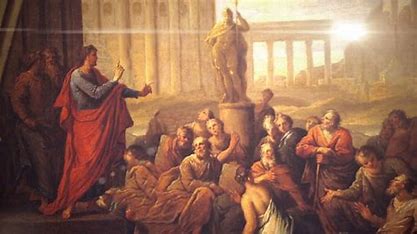
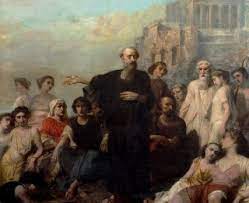
Connection to Scripture: In Acts 17 Paul, too, understood this. He tries to reason with the people in Athens: 

Paul Addresses the Areopagus

So Paul, standing in the midst of the Areopagus, said: “Men of Athens, I perceive that in every way you are very religious. For as I passed along and observed the objects of your worship, I found also an altar with this inscription: ‘To the unknown god.’ What therefore you worship as unknown, this I proclaim to you. The God who made the world and everything in it, being Lord of heaven and earth, does not live in temples made by man, nor is he served by human hands, as though he needed anything, since he himself gives to all mankind life and breath and everything. And he made from one man every nation of mankind to live on all the face of the earth, having determined allotted periods and the boundaries of their dwelling place, that they should seek God, and perhaps feel their way toward him and find him. Yet he is actually not far from each one of us, for “‘In him we live and move and have our being’; as even some of your own poets have said, “‘For we are indeed his offspring.’ Being then God’s offspring, we ought not to think that the divine being is like gold or silver or stone, an image formed by the art and imagination of man. The times of ignorance God overlooked, but now he commands all people everywhere to repent, because he has fixed a day on which he will judge the world in righteousness by a man whom he has appointed; and of this he has given assurance to all by raising him from the dead.” Now when they heard of the resurrection of the dead, some mocked. But others said, “We will hear you again about this.” So Paul went out from their midst. But some men joined him and believed, among whom also were Dionysius the Areopagite and a woman named Damaris and others with them. (Acts 17:-22-34)

Encouragement & Application: Paul’s nonnegotiable remained the historical bodily resurrection of Jesus from the dead. And the responses to Paul’s trying to reason with the people are exactly the same ones we see today. Some mocked (Acts 17:32). Others said, “We will hear you again about this” (Acts 17:32). And some believed and were saved (Acts 17:34).

Pagan chaos brought civilizations to their knees before; empires thinking the sun would never set upon them due to their expansiveness have come and gone, Rome is now a footnote in most people’s history textbooks; Athens, Greece’s money comes from tourism of their once great culture, the Third Reich is just a historical shame which gets brought up in arguments when the other side cannot think of a greater insult than to call someone a Nazi; and on and on it goes. 

But if we truly care about people, we will try to tell them the truth. And when we do that, some will mock; others may give us a second hearing; and, to God be the glory, some will believe and be saved. Our job is to be faithful. 

Nonnegotiables & Expectations (Part 3/4)

Have you ever watched a movie or read a book or seen a play and come away with this thought: O my goodness! That is exactly the way I feel. It’s like the person knows me!

I certainly have. I’ve seen The Shawshank Redemption, Cool Hand Luke, Death of a Salesman, and a few other films so often that I can just about quote every line. (Most of today’s movies just don’t have the caliber of storyline and character development that older ones do, in my view. I mean, after you’ve seen 666 explosions and car chases, you grow bored rather easily. At least I do.)

What does this have to do with Acts 17 and nonnegotiables and expectations for Christians who are trying to bear faithful witness to the truth in a culture that is drunk on lies and stupidity?

Notice was Paul did. In Acts 17 as Paul was in Athens, Greece, he knew the stories the culture had imbibed. That is, he knew what they were filling their time with. My all-time favorite quote from folksy wisdom is this: What’s down in the well comes up in the bucket.

Yes and amen. What does that mean? It means that a person will show you what he/she is made of by way of his/her behavior and speech.

When Paul began to argue for the Christian faith, he let his hearers know that he understood them: “Men of Athens, I perceive that in every way you are very religious. For as I passed along and observed the objects of your worship, I found also an altar with this inscription, “To the unknown god.’ What therefore you worshp as unknown, this I proclaim to you” (Acts 17:22-23).

Here’s the nonnegotiable: It is not hard to discern people’s “god of the system.” Look what they fill their time with. Look what stirs their emotions. Look how they spend their money. Do they read books or do they only watch videos on their gadgets? Do they take their worldview from social media? Do they think or only emote? The questions could go on.

Encouragement: Paul studied and knew his audience. He knew their assumptions. He saw their religiosity. Oh, they were very religious, be assured of that. They simply worshiped false gods, which is to say, they worshiped idols. But Paul “got them,” to use saccharine Super Bowl-laden sentimentality to dupe the vulnerable.

Paul got them, to be sure, but he let them know that he got them in order that he might love them enough to tell them the truth. We don’t need more entertainment, folks; we need wisdom and the courage to herald it.