Nonnegotiables & Expectations (Part 2/4)

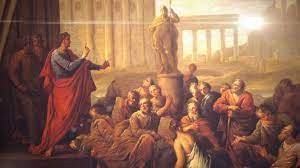
In Acts 17 as Paul entered Athens he was burdened by the formidable pagan idolatry assaulting his eyes. There were temples and statuary to gods and goddesses everywhere throughout the city. His spirit was “provoked.” That is, because he knew the damning results of lies and false worship, and because he loved the truth, his spirit was both tender towards those he longed to reach with the truth, but he was likewise saddened by the overwhelming nature of false religion.

But here was his nonnegotiable: Christ had been bodily raised from the dead. He had been seen for days and days post-resurrection by disciples, by skeptics, by women, etc. 1 Corinthians 15 and John 21 are historical accounts, among many others, of Jesus’ resurrection and post-resurrection appearances to both individuals and to crowds.

Because Christ had been bodily raised from the dead, it was proof of his divinity, of his power over the grave, of all his promises that he was who he said he was. All of the promises of God, in other words, found their Yes in Christ (2 Corinthians 1:20).

And here’s a second expectation that you and I can count on if we’re laboring to be faithful: Expect your bearing witness to the truth to be perverted and/or twisted in ways that distort its truth and your character.

In short, audiences will slander you as the messenger (they called Paul a ‘babbler’ in Acts 17:18, e.g.) and they scoffed at the message of the gospel as “some strange thing[s]” (Acts 17:20), as if it were something to be cavalierly tossed aside, something all but irrelevant. That is the nature of the scornful, of mockers, of fools professing that they’re wise (Romans 1:22).

Encouragement: Be of good courage, Christian soldier. Paul endured it. Peter endured it. John endured it. Esther endured it. Joseph endured it. David endured it. Elijah endured it. But most of all, the Lord Jesus endured it infinitely and fully.

Why? Not just to serve as the perfect example of faithfulness, but to encourage all who will hear and attend–to teach us that we might have hope, that we might press on, that we might not grow weary in doing good, that we might be made like him through the things we suffer for his glory.


You’re Following a Story … Always

Was doing some reading tonight and came across an arrestingly true sentence:

There have been great societies that did not use the wheel, but there have been no societies that did not tell stories (Ursula K. Le Guin, The Language of the Night: Essay on Fantasy and Science Fiction (London: Women’s Press, 1989), 25.

I was reading J. Chatraw’s Telling a Better Story (highly recommended) and am indebted to him for the reference.

Nonnegotiables & Expectations (Part 1/4)

In the following installments I explore some nonnegotiables of faithful Christian witness and some of the results one should anticipate. The nonnegotiables and expectations are both rooted in the historical account of Paul’s reasoned defense of the Christian faith in Acts 17 when he welcomed any and all skeptics, naysayers, intellectually honest, and others to deal with the facts.

It should go without saying but I will write it nevertheless. We are living in a largely post-truth era. The ultimate reason is simple. We have jettisoned God, the author of truth, and God’s revelation. We have done exactly what David in Psalms poetically reveals is the folly of the foolish:

The fool says in his heart, “There is no God” (Psalm 14:1).

Paul teaches the exact same principle in the New Testament:

For although they knew God, they did not honor him as God or give thanks to him, but they became futile in their thinking, and their foolish hearts were darkened. Claiming to be wise, they became fools, and exchanged the glory of the immortal God for images resembling mortal man and birds and animals and creeping things . . . . because they exchanged the truth about God for a lie and worshiped and served the creature rather than the Creator, who is blessed forever! Amen. (Romans 1:21-23, 25)

Three principles leap out at all with ears to hear and eyes to see:

  1. The folly of the fool
  2. The fool’s suppression of truth
  3. The pride of the fool

The very nature of the fool is his folly. He refuses to acknowledge truth, even to his own destruction. It’s not that he does not see; it’s that he refuses to see. It’s a spiritual hardness, not a physical hardness. He suppresses what is clear and obvious. But not only does he persist in his folly by way of suppressing what he knows to be true, but he boasts in his arrogance, deeming himself wise.

I remember watching countless boxing matches with my stepfather as a boy. And every once in a while we would witness a boxer who was over-the-top brash, full of himself, hubris in boxing shorts, etc. He’d preen for the cameras, flex his muscles for the crowds, and appear to be invincible. And I’ve lost count of how many times that young man was flat on his face on the canvas a few minutes or even seconds later, unconscious, because his opponent had the power of reality and truth. That’s the way truth works. You can deny it but it hits you in the face nonetheless.

Nonnegotiable # 1:

In Acts 17 when Paul was in Athens, Greece, he was bearing witness to the Christian faith in a culture replete with pagan idolatry. I have walked and stood in the same places Paul walked on trips to Athens. It is still moving when you feel the weight of history and precedent wash over you.

But here’s all I want to leave you with today (this is just installment one of perhaps five, after all): Expect resistance.

That sounds simple but I, for one, have underestimated it in my ministry. There is no paucity of resistance to truth. So, be patient. Expect tribulation. Expect folks to scoff, to mock. But just give it time. Time has a way of revealing things.

Here’s the way Luke describes Paul in Acts 17:

Now while Paul was waiting for them in Athens, his spirit was provoked within him as he saw that the city was full of idols (Acts 17:16).

Paul, the super-credentialed Pharisee of Pharisees, a man of staggering intellect and personal testimony, was nonetheless provoked. Why? Because he cared? Yes. Because he saw the folly of the Greek culture? Yes. But most of all, I think, it was because he knew what he was up against. He was up against lies and the father of lies. He expected the resistance.

Encouragement: I am certainly no apostle Paul. But I do try to reach those who will listen. But if we underestimate the vitriol of the enemies of truth, we can grow weary in doing good (Galatians 6:9). Be encouraged, pilgrim. Expect resistance. But remember who sustains you and that even the grave could not suppress the truth that triumphs.

(7) Pics

Thank you to my friend Justin for this picture. Justin gets what I mean by soul food:

Thanks to my buddy Jim for two pictures from his travels to the surf:

And just a few of mine from some of my time walking the hills and/or watching deer through the kitchen window:

A Reckoning for His Blood

Introduction: Like many students of Scripture I never tire of the Joseph story as found in Genesis. Joseph is a textbook case for what is known as typology—a foreshadowing, a forerunner, a hint, a type of the God-man Jesus, who was to come. 

In Genesis 42, the climax of the Joseph drama is nearing. Joseph had been abandoned by his brothers earlier and left for dead. Through a series of providential events Joseph not only survived but actually rose to a position of immense power in Egypt, the world power in the ancient Near East at the time. Meanwhile, Joseph’s brothers were going hungry, along with their (and Joseph’s) father, Jacob. The boys return to Egypt to petition for provisions from the hand of Joseph, second in charge under Pharaoh in Egypt. The brothers don’t know it’s their brother Joseph. Why? Because they thought their earlier schemes to rid themselves of their brother had succeeded. They were blind to the fact that the one they’d despised and rejected was actually the one who would be their savior. 

Text:  In order to test his brothers as they return again to Egypt from Canaan to petition for provisions, listen to how to the story unfolds:

On the third day Joseph said to them, “Do this and you will live, for I fear God: if you are honest men, let one of your brothers remain confined where you are in custody, and let the rest go and carry grain for the famine of your households, and bring your youngest brother to me. So your words will be verified, and you shall not die.” And they did so. Then they said to one another, “In truth we are guilty concerning our brother, in that we saw the distress of his soul, when he begged us and we did not listen. That is why this distress has come upon us.” And Reuben answered them, “Did I not tell you not to sin against the boy? But you did not listen. So now there comes a reckoning for his blood.” They did not know that Joseph understood them, for there was an interpreter between them. Then he turned away from them and wept. And he returned to them and spoke to them. And he took Simeon from them and bound him before their eyes. And Joseph gave orders to fill their bags with grain, and to replace every man’s money in his sack, and to give them provisions for the journey. This was done for them (Gen 42:18-25). 

Explanation/Principle: The brothers were finally humbled; they were brought low. They admitted their guilt (v. 21). Reuben asked one of the most profound typological questions in the whole Bible: “And Reuben answered them, “Did I not tell you not to sin against the boy? But you did not listen. So now there comes a reckoning for his blood.” 

But Joseph, a type of Christ who was to come, upon seeing repentance and faith, did not abandon them; he restored them: “And Joseph gave orders to fill their bags with grain, and to replace every man’s money in his sack, and to give them provisions for the journey” (Gen 42:25). 

Encouragement & Application: If you are like I am, most days I shake my head at what I see being done to my country, to the West, and especially towards any biblical Christian influence upon culture. It is easy to grow discouraged. But when you go through Scripture, again and again we find that God grips some people such that they eventually come to their senses. They repent. They return. They recognize that there is a reckoning for his blood, so to speak. 

A remnant of people is sober in their thinking such that they recognize where provision is rooted. It’s not in the wiles of men but in God and in God’s anointed. 

This is how Joseph is a type of Christ. He was abandoned and forsaken by his own. Yet he was preserved by God and rose to rule the nations as his inheritance. And he forgave all who came to him in repentance and faith in order to preserve them, in order to bless them, in order that they would be saved. 

More Violence, More Opportunity to Return

https://www.newsmax.com/newsfront/parade/2024/02/14/id/1153640

Slice of Life: Again we see violence erupt amidst ostensible celebration. This week, an innocent local woman of Kansas City, a local radio disc jockey, a mom of two, was shot in Kansas City amidst the crowds celebrating the Chiefs’ Super Bowl victory over the 49ers. But the celebrations are marred now by tragedy and politicization regarding guns, etc. 22 other people were injured, and a funeral is being planned instead of celebrating the hometown team. 22 other families are dealing with injuries. Still others have been exposed to potential moral injury and questions of violence and a seeming lack of self-control. I watched the video of the violence, the trashing of the city, the melee, and then the police and other agencies move in to try and bring order to horror and chaos. Things can change quickly, very quickly, especially when some people’s emotions run high and sound judgment wanes. 

Text: In Psalms the sons of Korah penned one of the most oft-quoted and powerful poems in the Old Testament book of poetry: “God is our refuge and strength,/a very present help in trouble./Therefore we will not fear though the/earth gives way,/though the mountains be moved into/the heart of the sea,/though its waters roar and foam,/though the mountains tremble at its swelling” (Ps 46:1-3). 

In one of his reflections, the American theologian and pastor Jonathan Edwards wrote, “The church makes her boast of God, not only as being her help, by defending her from the desolations and calamities in which the rest of the world were involved, but also by supplying her, as a never-failing river, with refreshment, comfort, and joy in the times of public calamities.” 

Explication: God can and does use evil to draw people’s attention to the bigger issues of light vs. darkness, order vs. chaos, and righteousness vs. rebellion. 

Encouragement & Application: Good and evil are not just theological bromides or intellectual categories. They are spiritual realities that are played out in actual history by actual men and women. And when our headlines are splattered with shell casings, gurneys, ambulances, and crowds staggering with rebellious hearts and hot tempers, we ought not be surprised at the tempests.

Psalm 46 again is precise: “The nations rage, the kingdoms totter;/he utters his voice, the earth melts./The LORD of hosts is with us;/the God of Jacob is our fortress” (Ps 46:6).

Secularism cannot redeem because it cannot be its own savior. Redemption comes only from without, i.e., from the transcendent God, who uses evil to get all who will listen to the One who overcomes it through the melee, through the madness of crowds, through the horrors of this Kansas City tragedy, through Gethsemane, through Calvary, and even from the guarded tomb. 

Examination?

Quote: In a book I was reading recently I came across a line that has remained with me: “So long as we live, we will live either the examined or the unexamined life.” The observation is straightforward enough. Either we’ll be thoughtful people, or we’ll be thoughtless. Either we’ll be characterized by wisdom, or we’ll be characterized by folly. Either we’ll walk circumspectly, or we’ll behave boorishly, leaving paths of destruction. 

Text: In the imperative sections of Paul’s letter to the Ephesians, he writes the following sentence towards the end of the epistle: “Look carefully then how you walk, not as unwise but as wise, making the best use of the time, because the days are evil. Therefore do not be foolish, but understand what the will of the Lord is” (Eph 5:15-17). 

Connections to Our Day: This morning I arose quite early and studied. I read the news from my computer. I was grieved by what I read. Regardless of one’s political leanings, I don’t see how any sensible person could think anything less than that the world is a mess. Many articles were about the deluge of unvetted illegals streaming into the U.S. America’s borders are wide open, and if one thinks evil people are not exploiting that avenue of invasion, one’s grasp of reality should be called into question. Another series of articles was of DHS Secretary Mayorkas’ being fired/impeached. And then of course was the cascade of articles about Mr. Biden’s cognitive inabilities, continued gaffes, and whether he will be allowed to speak in public or be seen in public at all anymore, especially as America’s election season nears. Then there was the usual series of budget-related articles about how the government is going to send billions more of U.S. dollars to Ukraine for its borders. Just as a reminder, America currently has $34 trillion of debt. In other words, we spend money we don’t have. $34,000,000,000,000. That’s 12 zeros.

Explanation: Then I went back to the New Testament text from Ephesians. Look carefully; be wise; make the best use of the time; the days are evil, etc. And Paul tells us who the fountain of wisdom is: the Lord. 

Encouragement/Application: In other words, the way to know how to walk circumspectly, wisely, and the way to know how to make the best use of our time during these evil days is rooted in God. Not in humanism, not in politics, not in spending money we don’t have, not in vanity of vanities, but in the Lord. When you study the history of civilizations, when “[e]veryone did what was right in his own eyes,” (Judges 21:25), it did not go well. But the encouragement for all who will heed God’s ways is this: “Turn to me and be saved, all the ends of the earth! For I am God, and there is no other” (Isaiah 45:22). 

On a Darkling Plain

In the poem “Dover Beach” by Matthew Arnold, it ends with haunting lines about how ignorance and the jettisoning of wisdom are omens of a growing spiritual darkness:

. . . The world, which seems/To lie before us like a land of dreams,/So various, so beautiful, so new,/Hath really neither joy, nor love, nor light,/And we are here as on a darkling plain/Swept with confused alarms of struggle and flight,/Where ignorant armies clash by night.

“[O]n a darkling plain” is filled with foreboding. “[C]onfused alarms of struggle and flight” portends melee and cultural chaos. And “ignorant armies clash[ing] by night” is imagery of darkness and violence.

The poem reminds me of Cormac McCarthy’s The Road, a novel often described as post-apocalyptic. I wrote my PhD dissertation on McCarthy’s biblical paradigm of anthropology as evidenced in his fiction because I think that McCarthy demonstrated in his works a hope that is rooted in the gospel. It is the hope of redemption and restoration. It is rooted in how redemption comes from outside of us through Christianity.

When you and I see a civilization being ripped apart at the seams the picture is like what Matthew Arnold describes—confused alarms of struggle, ignorant armies clashing, and a darkness that increasingly seems to overwhelm efforts at sanity, goodness, truth, and beauty.

But Christianity hinges on the fact that when the world system thinks it has killed the good news, Jesus rises from the grave. When the nations rage, scheme, and mock the holy, the Son makes the nations his heritage and the earth his footstool. When the accuser of the brethren takes captive the foolish, Christ crushes the head of the serpent. Just when all seems lost, behold, God’s truth abideth still and makes all things new.

Dumber by the Day: Discernment, Where Art Thou?

If there is one thing lacking in the supposed Christian church in the West, it is this: discernment.

Oft-quoted but seldom-employed apostolic wisdom goes like this per Romans 12:1-2: “I appeal to you therefore, brothers, by the mercies of God, to present your bodies as a living sacrifice, holy and acceptable to God, which is your spiritual worship. Do not be conformed to this world, but be transformed by the renewal of your mind, that by testing you may discern what is the will of God, what is good and acceptable and perfect.”

Did you catch that verb? You know, the one about what is required to know and do the will of the holy wise God? Discern. Just in case you missed it. Discern. Did I say discern?

But if you imbibe the talking points of pagan culture and Superbowl adverts about Jesus “getting you,” you’d come away believing there’s never any need to discern, to think, to distinguish God’s light from Satan’s darkness. Just embrace abomination. That’s what the dumb and dumber do. Come on, man. Get in line. Embrace the zeitgeist. Don’t be a stick in the mud. Be a tranny. Celebrate polyamory. Be a man in a dress. Have multiple partners and be ‘blessed’ by the pronoun-mafia critter with a stole and blue hair. That’s what progress is, don’t you know?

No discernment. That’s where we are. Critical thinking has been vanquished. The DEI-employed fools are flying the planes into the ground, but at least they checked all the blocks about group identity politics. It does not matter that your pilot cannot fly the aircraft; what matters is that (s)he had purple hair, identified as non-binary, dressed like a carnival employee, and posted about climate change.

Welcome to Clown World. Trannies shooting up the churches and schools, the pundits doubling down on victim status, the churches hiding their light under a basket, and the salt being trod upon by the growing darkness.

“From dumb to dumber” does not even begin to describe the state of affairs. Discernment is not a word the church appears to have ever even read, much less practiced. Enjoy the show. You’ve earned it.