

Made it home today. Finally. Laced up the new hiking boots (Christmas gift … yay!), took to the woods, and my, o my, the critters were out and about.
Linked up with the wifey, and grabbed a bite to eat, and walked for a bit and people-watched.
Thanks to the rain recently, the creeks were moving again.
Played with the dogs outside, too, and, well, it’s good to be home.

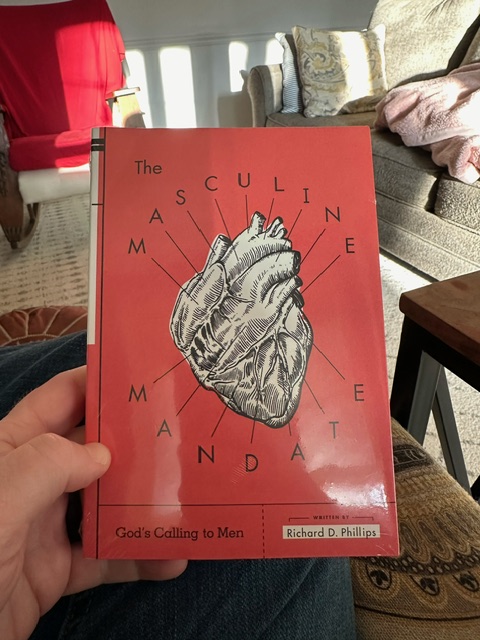
Thanks to my friend Justin for the Richard D. Phillips book, The Masculine Mandate. Throughly enjoying it.






Read Muggeridge’s talks artfully titled, The End of Christendom, again today. True to his nature, he taught with more wisdom in 60 pages than most people utter in a lifetime.

When you see the drivel that passes for intelligent conversation today, it is refreshing to see that the world has always hated Christ and the truth, but that Christ and the truth always and everywhere rise to outlive the morgues and gulags of the secularists.
Here are just two of Muggeridge’s zingers:
2. We look back on history, and what do we see? Empires rising and falling; revolutions and counter-revolutions succeeding one another; wealth accumulating and wealth dispersed; one nation dominant and then another. As Shakespeare’s King Lear puts it, “the rise and fall of great ones that ebb and flow with the moon.” In one lifetime I’ve seen my fellow countrymen ruling over a quarter of the world, and the great majority of them convinced – in the words of what is still a favorite song – that God has made them mighty and will make them mightier yet. I’ve heard a crazed Austrian announce the establishment of a German Reich that was to last for a thousand years; an Italian clown report that the calendar will begin again with his assumption of power; a murderous Georgian brigand in the Kremlin acclaimed by the intellectual elite as wiser than Solomon, more enlightened than Ashoka, more humane than Marcus Aurelius. I’ve seen America wealthier than all the rest of the world put together; and with the superiority of weaponry that would have enabled Americans, had they so wished, to outdo an Alexander or a Julius Caesar in the range and scale of conquest. All in one little lifetime – gone with the wind: England now part of an island off the coast of Europe, threatened with further dismemberment; Hitler and Mussolini seen as buffoons; Stalin a sinister name in the regime he helped to found and dominated totally for three decades; Americans haunted by fears of running out of the precious fluid that keeps their motorways roaring and the smog settling, by memories of a disastrous military campaign in Vietnam, and the windmills of Watergate. Can this really be what life is about – this worldwide soap opera going on from century to century, from era to era, as old discarded sets and props litter the earth? Surely not. Was it to provide a location for so repetitive and ribald a production as this that the universe was created and man, or homo sapiens as he likes to call himself – heaven knows why – came into existence? I can’t believe it. If this were all, then the cynics, the hedonists, and the suicides are right: the most we can hope for from life is amusement, gratification of our senses, and death. But it’s not all (49-51).

It was as a 17-year-old boy that I read Dostoyevsky for the first time. Crime and Punishment was the first of his novels I read, and I was hooked. I then read Notes from the Underground, The Brothers Karamazov, and The Idiot.
I know of many people who love to quote lines from The Brothers Karamazov, but I wonder how many of those people have actually read that novel or Dostoyevsky’s other writings. I am going through Notes form the Underground again over the last couple of days, and I am astonished–yet again–at Dostoyevsky’s prescience. Reading him now, he seems more than ever to have been a prophetic voice crying in the wilderness about what was coming if the world embraced materialism, secularism, and nihilism. It’s almost as if the horrors of the 20th century were written on the pages of Dostoyevsky’s works in the 1800s, but most did not have eyes to see or ears to hear.

Dostoyevsky is not light fare, but nothing enduring is. It takes commitment and diligence to read Karamazov, which runs just less than a 1,000 pages. But the invested hours are more than worth it because we glimpse truths about man’s nature, about God, about good and evil, about the horrors that result from rejecting Christ, from rejecting grace, from determining to go our own ways, and where those ways lead. Exhibit A: Just look at the unfolding suicide of Western civilization where Harvard presidents plagiarize their dissertations, but because the mobs of wokesters and Diversity, Equity, and Inclusion (DEI) minions are running the West’s colleges and universities, she laughs in the face of all who would call out her lies. She continues to get paid, and the kiddos still go to Ethics class, and no one sees there’s a problem. Um, Houston, we do indeed have a problem. Cognitive dissonance is in technicolor, and yet nothing happens.
Dostoyevsky wrote about the psychological derangement that would inevitably follow when truth is rejected, when the Author of truth was rejected, when secularism was imposed upon a people professing themselves wise, but who only demonstrated their folly.
Tolle lege, if you will, dear ones. There is wisdom to be gained in reading and heeding this Russian giant.

Earlier this year I purchased “The Collected Stories of Jean Stafford.” I had no idea what I was in for. As it turned out the first story I read from her oeuvre was “The Hope Chest.” The story is about a spinster in New England, a woman named Rhoda. She is feisty, proud, a snob, and suffering in unspeakable ways.
Miss Rhoda Bellamy lives on the capital of the past, is unwilling to love anyone, romanticizes her past memories to such an extent that she shuts out her contemporary life as being unworthy of her time and certainly her respect.
When a neighborhood boy comes to her door to she if she will purchase a Christmas ornament for twenty-five cents (the boy’s name is Ernest, by the way, a well-chosen name), Rhoda shuts him down, arguing over price and humiliating the boy.
But finally Rhoda, for unvoiced reasons of her own, finally gives in and says she’ll purchase the boy’s labor of love, but that Ernest must give lonely Rhoda a kiss. Rhoda pays the price agreed upon. The boy, too, keeps his side of the bargain. But rather than opening up to love, instead of loving another, she again retreats, and the story ends with one of the most heart-rending paragraphs I have read in a long time. The paragraph is sheer pathos, the last sentence ending with these words: “she [Rhoda] nursed her hurt like a baby at a milkless breast, with tearless eyes” (119).
If you have a heart, this short story will break it.

Mr. Golyadkin is a poor single man with an even poorer servant, Petrushka. Golyadkin lives a boring life of work-to-home, work-to-home, work-to-home. He envies the ostensibly happy, respected, and affluent that appear to have happiness and the respect which he covets. A doctor visits Golyadkin, encourages him to get out more, socialize, entertain, and to cultivate a visible hobnobbing life. Golyadkin takes the doctor’s prescription, and that’s where the horrow ensues. Golyadkin appears to go mad as his twin, (the double) with precisely the same name, torments him at every turn, by pointing out his masks.
For 150 pages, Dostoyevsky does what no writer does better. Like Kafka, he dramatizes the soul’s internal conflict and shows what it means to be a divided man. The metaphor running throughout is that of the mask–of its ubiquity and necessity–if one is to skate through life.
“The Double” is not as lauded as Crime and Punishment or The Brothers Karamazov but Dostoyevsky’s themes are all here. Great stuff for those who have the character to examine the darker spheres of our nature.
Due to having covid again I have had to isolate. I can only stay indoors by myself so long before my spirit kicks at the goads. I have long since reached that point. So I took time to relish my favorite time of the day from one of my favorite spots.
I have seen many much more ornate places in my life than a pond in south GA. I have skied steep slopes in Switzerland and Austria. I have enjoyed Florence and Venice, Italy on gondolas. I have gazed out upon Paris at night from the Eiffel Tower, etc.
But when I am on a pond an hour before the sun rises, and the ducks and cranes begin to rustle, and the temperature drops, and the fog hangs in an ethereal mist over the surface of the water like something out of a Poe story, and the sun’s first gold rises from behind the pines, it’s about as content as I can be in this world. I think nothing of politics or strife or covid or of the silliness of so much that fills our days. I think only that I am grateful for such moments, for the sky bathed in honeycomb light and the smell of the air in the morning and of how none of it is by accident.
Below are a few shots from my old iPhone from some of my early moments to just before the sun emerged from over the pines. I hope you enjoy, too.








Today I reread Christopher Marlowe’s play Dr. Faustus, followed the downward path of damnation with the hubris-drunk John Faustus, in his pursuit to be bigger and wiser and more powerful than God, wherein Faustus pursues “necromantic books” and the devils of hell to sound the depths of wisdom.
His end, of course, unlike Job’s, was not a blessed audience with God and a restoration of benediction. No. Faustus lost all because he, like the serpent of old, wanted to be like the Most High whose glory is not to be shared but only praised.
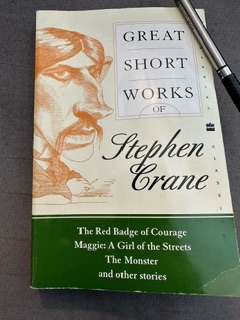
When I took my first literature course as an undergraduate, one of the writers who most affected me was Stephen Crane. His stories “The Blue Hotel,” “The Open Boat,” the Civil War-era novella The Red Badge of Courage, and the heart-rending “Maggie: A Girl of the Streets,” ripped through me with their literary quality and compassionate portrayals of human courage amidst greater human cruelty.
Due to being sick this week, I have had to isolate (‘quarters’ is what the military terms it) and thus have been able to read more than usual. I completed rereading many of Crane’s stories again and they again moved me deeply.
Here’s what I find so sad about Crane’s worldview, though. He accurately portrays human cruelty, and he clearly grieves its existence, but he seems determined to reject the possibility that there is a redeemer. That is, he senses that this is not the way things ought to be, but he denies the rationale leading to oughtness. Why? Because oughtness implies a transcendent standard and transcendent God.
And I think of my favorite of Crane’s pieces, “Maggie,” and of how she (Maggie) discovers too late how self-absorbed the apparently ‘successful’ (embodied in Pete) are, but this knowledge comes only too late, and Maggie dies (either by suicide or murder, we’re not told which).
Crane intimates that somehow the world is not what it ought to be, that it is depraved, cruel, and in need of restoration. I think, for example, of the men in the boat, struggling to be to shore, but who turn on one another instead, and lie.
In the biblical worldview, this is explainable. It’s explained via human sin (the Fall). But Scripture does not end with Genesis 3. No, redemptive history has a historical storyline where the triune God redeems a people for himself via the efficacious work of the suffering servant, Christ. Through the work of God, all things are made new, and the promise of forgiveness, restoration, and redemption are to be heralded because God’s nature is to redeem.
 MIND & MATTERS