The Matter of the Spiritual Anchor

Question: Who is/what is your spiritual anchor?

Intro: Recently my father-in-law died. He was, for me and others, one of the godliest people we have ever known. “Papa,” as we called him, was funny, self-effacing, humble, and the embodiment of a servant-leader. He led spiritually but he did not do so in an overbearing, ostentatious way. You just sensed when you were with him that he was a man comfortable in his own skin because he was anchored in someone and something greater than himself.

The Rubber Meeting the Road: When Papa died, I watched my wife’s prayer life deepen as never before. She has, ever since we’ve been married, been a stalwart woman of prayer. But when Papa was declining and eventually died, she turned ever more to the anchor of her soul: Christ. She would write down her prayers in a journal. She would list how they were answered. She was specific in her spiritual discipline. None of the vague spirituality you hear so much about which is often a pastiche of secular psychology, bubblegum bromides, and sentimentality. No amount of sloganeering is sufficient to speak to the deepest longings in our lives. We require answers. And who is sufficient to answer? Where, in other words, do we turn for our spiritual anchor?

Segue: Religious Support (RS) is what we call it in the Army. When GEN Washington stood up the Chaplain Corps immediately after the Infantry in our nation’s earliest days, he understood that a Soldier’s core, his soul, must be anchored to something steadfast and sure in order to endure and prevail. If he is unanchored, he will atrophy. Why? Because he is trying to build upon sand. And if you’ve watched the sands under your feet when you’re at the beach, you know why that image is so powerful. You put your toes in the sand one moment, and then that sand is replaced by other sand, and on and on continually. Flux amidst all the flotsam and jetsam.

Encouragement: In my faith and worldview, we are told throughout Scripture in whom we are to ultimately trust as our anchor: “The LORD is my rock and my fortress and my deliverer, my God, my rock, in whom I take refuge, my shield, and the horn of my salvation, my stronghold. I call upon the LORD, who is worthy to be praised, and I am saved from my enemies” (Psalm 18:2-3, ESV). And in the New Testament, we are again reminded of the same wisdom. Paul writes in 1 Corinthians 10:4 that it is none other than Christ Himself who was and is the “spiritual Rock.” Folks, I don’t know about you, but I want to rest on the immovable; I want an anchor for my soul, not shifting sands. Our prayers should be that we know the Rock, the anchor of the soul.


On the Reading of Good Books

Introduction: Ever heard the adage, “The pen is mightier than the sword”? I wager you probably have. But have you thought about the wisdom of that proverbial phrase? In other words, is it true? I contend that it certainly is true and the wise person will be known by the books he’s absorbed. Not just books for the sake of books, but wisdom gained from the wisdom of the ages. And that wisdom is largely conveyed via the written word. 

The Heart of the Issue: In his masterpiece, How to Read a Book, Mortimer Adler wrote the following:

There is some feeling nowadays that reading is not as necessary as it once was. Radio and especially television have taken over many of the functions once served by print, just as photography has taken over functions once served by painting and other graphic arts. Admittedly, television serves some of these functions extremely well; the visual communication of news events, for example, has enormous impact. The ability of radio to give us information while we are engaged in doing other things–for instance, driving a car–is remarkable, and a great saving of time. But it may be seriously questioned whether the advent of modern communications media has much enhanced our understanding of the world in which we live.

     Perhaps we know more about the world than we used to, and insofar as knowledge is prerequisite to understanding, that is all to the good. But knowledge is not as much a prerequisite to understanding as is commonly supposed. We do not have to know everything about something in order to understand it; too many facts are often as much of an obstacle to understanding as too few. There is a sense in which we moderns are inundated with facts to the detriment of understanding (3-4).

Adler penned that in 1972, but he originally penned the book in 1940. 1940! How much has changed since then. In our culture, social media is nearly inescapable. TVs are pervasive. TikTok, Facebook, Instagram, X, et al. The list continues to expand. Smartphones are part of people’s hands. Tablets, laptops, desktops, iPads, and on and on. Loads of info. Arguably too much info. De trop. But how often do we read deeply

Three Leaders on Reading: Napoleon Bonaparte is credited with penning, “Show me a family of readers, and I will show you the people who move the world.” 

Frederick Douglass wrote, “Once you learn to read, you will be forever free.”

Cicero wrote, “A room without books is like a body without a soul.” 

Encouragement: When I was a kid in high school, I stumbled across a couple of novels about soldiers. One was O’Brien’s Going After Cacciato. Another was Del Vecchio’s The 13th Valley. I was hooked–not just on reading about all-things-Vietnam-era, but on reading, on grasping the power of the pen to show forth the agonies and ecstasies of life. It’s cliche but true: leaders are readers. Reading, especially reading well, adds life to our years. 

Three of my favorites:

  1. Crime and Punishment
  2. Great Expectations
  3. The Lords of Discipline

Aurelius, Mimesis, and Wisdom to Distinguish

Introduction: A few years ago, I was attending a conference in metro Atlanta. The main speaker at the event was a retired Army officer who had spent the bulk of his military career as an engineer in support of the Special Operations community. He was a skilled mathematician and engineer. He was clearly a cerebral fellow, and he wanted us to know his academic resume, and that he was inveterately wargaming how problems (especially logistical ones) might be solved. I do not remember much of his speech that day, I confess. But I do remember one thing he said: “You can learn from anyone’s example, especially bad ones.” Bam! That’s what I term a zinger.

Segue: I do not purport to speak for others, but I will say this as a matter of transparency: I seek out good role models. I think we are more mimetic than we wish to admit. As a chaplain, I am very much in the business of people and their worldviews. Fads come and go; trends are just that; but steadfast, enduring, faithful leaders are a special breed, and if they’re good people, so much greater their value to me. When I reflect upon my role models, a handful of remarkable leaders come to mind. I can picture their faces in my mind, even though I have not been around some of them in quite some time, as our paths have diverged. Several were my Commanders; several were my Command Sergeants Major. One was a SSG from my days stationed in Germany and on a deployment to Bosnia. Another was one of my seminary professors. There are many others. But I continue to learn from what they taught me. This is what brings me to the connection between Marcus Aurelius and the speaker at that conference in metro Atlanta.

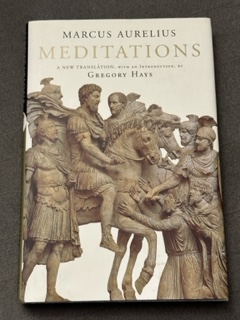
I have a copy of Aurelius’ Meditations that is well-worn. One reason is because of gems like this: “Do external things distract you? Then make time for yourself to learn something worthwhile; stop letting yourself be pulled in all directions. But make sure you guard against the other kind of confusion. People who labor all their lives but have no purpose to direct every thought and impulse toward are wasting their time–even when hard at work” (19).

That last sentence gets me every time. If we are not careful, we can be ostensibly “hard at work” but in reality, be squandering the time we’ve been granted. In my faith tradition, we are told in Scripture, “So teach us to number our days that we may get a heart of wisdom” (Psalm 90:12, ESV).

Encouragement: The reality is that in many seasons, we may suffer a dearth of good examples. But we can still redeem these seasons. How? Be learning from the bad examples, too. By seeing how the good and great examples we have had stand in stark relief via contrast. By learning not to be pulled in all directions and succumbing to confusion. By focusing our giftings to their maximum good effect in support of the right ends. A heart of wisdom is one that recognizes our brevity and redeems the time. It’s recognizing and practicing Aurelius’ counsel of using our time well by emulating the right leaders, and having the wisdom to distinguish between enduring value and mere busyness.

Musings in Matthew, Part 3

“We are still under his eye.”

Question: Have you ever experienced a day (or perhaps a season) when you think to yourself, “There’s just no way this is going to work out”? But then, it does. In a way whereby you realize God was working things out in a way better than you thought or imagined.

Christians will know the verses from Ephesians: “Now to him who is able to do far more abundantly than all that we ask or think, according to the power at work within us, to him be glory in the church and in Christ Jesus throughout all generations, forever and ever. Amen” (Ephesians 3:20-21, ESV).

I won’t bore you with the details. I just know that one cannot refute one’s own history. When such an event happens to you and your loved ones, its scars (good and bad) are now on you.

Connection to Matthew: Today I had the opportunity to spend a few precious moments with a man who is a force of nature. He is perhaps the most amazing leader I’ve ever known personally. His resourcefulness is staggering. He has affected me in ways I’m not sure I even fully understand. And after I left his office yet again, I was working on another project as part of my job, and I was also in Matthew 1:20. This is the section in Matthew’s gospel where Joseph is grappling with what to do after he is told that his betrothed (Mary) is carrying the Christ child:

“But as he [Joseph] considered these things, behold, an angel of the Lord appeared to him in a dream, saying, “Joseph, son of David, do not fear to take Mary as your wife, for that which is conceived in her is from the Holy Spirit” (Matthew 1:20, ESV).

About this verse, one theologian writes, “We see here how seasonably and, as we would say, at the very point, the Lord usually aids his people. Hence too we infer that, when he appears not to observe our cares and distresses, we are still under his eye.” Put plainly, most young Jewish men betrothed to a girl in the ancient Near East in Joseph’s day would arguably have said to themselves, There’s just no way this is going to work out. But it did, you see. Mary had been overshadowed by God; Joseph did carry through with his marital vows; Christ was born and raised a carpenter’s son; and redemptive history continued. Joseph and Mary had mulitple other children after Christ has been conceived by the Holy Spirit (Mt 12:46; 13:55; Mk 6:3; Jn 2:12; 7:3, 5, 10; Ac 1:14; 1 Cor 9:5; Gal 1:19).

Encouragement: We are still under His eye. That’s the nugget of wisdom. God, sometimes (or maybe especially) catches us short and demonstrates grace, overflowing grace and benediction, when we, in our short-sighted humanistic ways, see no way forward, we find that we’ve been under God’s eye, in His care, loved by the Creator of all things.

We are still under His eye. Thank God for that.

Musings in Matthew, Part 2

I knew a deacon in a former church who, when he prayed, he always stressed Jesus’ divinity by calling attention to the fact that Jesus took on flesh in His incarnation but that Jesus was and is eternal. Jesus is the eternal God the Son. There was never a time when the triune God was not. I used to think to myself sometimes when I heard this man pray, Why does he always stress this?

This morning as I was reading through Matthew’s gospel again as part of studying, Matthew 1:18 hit me like a splash of cold water: “Now the birth of Jesus Christ took place in this way. When his mother Mary had been betrothed to Joseph, before they came together she was found to be with child from the Holy Spirit” (Mt 1:18, ESV). Well, there it is, Jon, in black letters on white paper. That’s why the deacon prayed like he did.

Encouragement: The Trinity is eternal. Jesus is eternal. The Father is eternal. The Holy Spirit is eternal. One God in three Persons. The incarnation happened via God the Holy Spirit. It was God the Son condescending to take upon Himself human form, to come down as it were, to us sinners. In theological terms, it was part of Christ’s humiliation. Mary was “with child from the Holy Spirit” (Mt 1:18). The reason the deacon constantly stressed Jesus’ divinity is because the bloodline of sin was broken via the Holy Spirit’s overshadowing Mary. This was God the Son in eternity, and only Joseph’s son in the temporal. The incarnation was not a human work but a divine work. The work of the gospel is a divine miracle, not a human machination. Only God’s gospel is sufficient for these things, the coming of the God-man and the conversion of sinners.

Musings in Matthew, Part 1

Several of us have embarked upon a study in Matthew. There are several reasons I thought it wise to do this now. First, I sense that many people are consumed by concern, worry, fear, etc. about the war in Gaza, Israel, about how far it may spread, and what the end-goal is. Does any realistic person think Hamas and their ilk can ever be totally vanquished? Doesn’t each new generation reared in that worldview serve as a potential incubator for jihad and violence? These are basic questions that, surely, any thoughful person must think through in order to even begin approaching a coherent response. Matthew’s gospel says quite a bit about sinners’ responses to truth. And it also says quite a bit about how God reigns over and through evil actions of men in order to bring about His purposes of divine judgment and redemption.

A second reason we have embarked on a study of Matthew is that it’s clear that amidst horror, God’s ways still endure, even though they may appear weak at the time. I’m thinking of Matthew 2, for example. When Jesus took on flesh in the incarnation, the wicked Herod was in power over the region. He had all the male children in Bethlehem and that region who were two years old and under killed. Why? In an effort to prevent the plans of God. But Joseph, Mary, and the Christ child were in Egypt (Mt 2:13-18). Again, per the sovereign plan of God. Man’s evil, personified in the person of Herod, remained under the sovereign plan of God.

A third reason is that Matthew’s 28 chapters end on a high note. The Truth came, took on flesh, lived among us, was rejected and despised, was mocked and murdered. And yet the Truth, because you cannot kill it, triumphed over the plans of Satan and evil men. Christ rose again, just as He said. And amidst all the evil plans of men then, and amidst all the evil plans of men now, Christ still lives and intercedes and rules, and all His enemies are being made a footstool for His feet.

So I invite you to join us as we go through Matthew. I will labor not just to give you theological factoids in order to win an argument. No, my goals are simple: 1) faithfulness to the text; 2) enouragement of the saints; and 3) shepherding well. So, come and welcome.

Sunday’s Literary Gem

There’s always a remnant who “get it,” who read 14 lines of a Shakespearean sonnet and recognize therein the longing to capture in words what is invariably nearly beyond the scope of language. Nearly. But not always.

From Shakespeare’s Sonnets & Poems (Sonnet # 65):

Since brass, nor stone, nor earth, nor boundless sea

But sad mortality o’er-sways their power,

How with this rage shall beauty hold a plea,

Whose action is no stronger than a flower?

O, how shall summer’s honey breath hold out

Against the wrackful siege of batt’ring days,

When rocks impregnable are not so stout,

Nor gates of steel so strong, but time decays?

O fearful meditation! where, alack,

Shall time’s best jewel from time’s chest lie hid?

Or what strong hand can hold his swift foot back?

Or who his spoil of beauty can forbid?

   O, none, unless this miracle have might,

   That in black ink my love may still shine bright.

Soul Food Saturday in October

This morning as I drove home the moon poured moonwhite upon earth.

After the sun rose I went for a few miles in the hills.

I like to stop by what I have christened Reader’s Rock to rehydrate, take a knee, and read for a few moments from whatever book I’m in that given day. A little maple grows out of the middle of the rock.

My old iPhone camera did not do justice to how beautiful the colors of fall are.

Went down to the creeks some, too.

Had a buck behind the house, too.