“People had hoped to be caught up in something bigger than themselves,” he says. “They thought it would be a shared crisis. They would feel a sense of shared purpose, shared destiny. Like a snowstorm that blankets a large city–but lasting months, lasting years, carrying everyone along, creating fellow feeling where there was only suspicion and fear. Strangers talking to each other, meals by candlelight when the power fails. The war would ennoble everything we say and do. What was impersonal would become personal. What was solitary would be shared. But what happens when the sense of shared crisis begins to dwindle much sooner than anyone expected? We begin to think the feeling lasts longer in snowstorms.” (31)
Today I was on a very long Zoom call and had to sit inside in front of a computer in order to earn more professional learning credits. I am grateful for the training.
But as one who loves the outdoors, I admit to being restless. I longed to be outside in the sun, under the trees, and enjoying the sounds, feels, and sights of nature.
So tonight after supper, after having read some, I was able to go for a late-night walk. The moon was not quite full. It was, per my quick internet search, a waxing gibbous. And it was striking.
I don’t know how one who is intellectually honest can look at the night sky and not worship. God’s reality is overt.
Psalm 19 and Romans 1 were two of the first passages of Scripture I memorized. And with good reason.
I washed before the mirror in a daze, my twisted summer sleep still hung about me like sea kelp. What blood was this, and what roses? It could have been the rose of union, the blood of murder, or the rose of beauty bare and the blood of some unspeakable sacrifice or birth. The sign on my body could have been an emblem or a stain, the keys to the kingdom or the mark of Cain. I never knew. I never knew as I washed, and the blood streaked, faded, and finally disapproved, whether I’d purified myself or ruined the blood sign of the passover. We wake, if we ever wake at all, to mystery, rumors of death, beauty, violence. . . . (10)
Every system of thought begins with some ultimate principle. If it does not begin with God, it will begin with some dimension of creation–the material, the spiritual, the biological, the empirical, or whatever. Some aspect of created reality will be “absolutized” or put forth as the ground and source of everything else–-the uncaused cause, the self-existent. To use religious language, this ultimate principle functions as the divine, if we define that term to mean the one thing upon which all else depends for existence. This starting assumption has to be accepted by faith, not by prior reasoning. (Otherwise it is not really the ultimate starting point for all reasoning–something else is, and we have do dig deeper and start there instead.) (41)
This week I read Burgess’ A Clockwork Orange for my third time. It’s not because I particularly enjoy the novel. I just think it’s important. Below are three reasons I think it remains important, especially in current times.
First, Burgess saw big government for what it can be and often is–a vicious beast which hungers for nothing so much as feeding itself and growing its size, power, and control of the masses. The bigger the government, the smaller the citizen. Burgess saw this clearly.
Second, Burgess saw that the mass of people are easily led via false narratives. In the novel, after enough ‘experts’ weigh in on the efficacy of the ‘treatment’ (Trust the ‘experts’, right? Sound familar?) Alex is to receive for his misdeeds, and after the newspapers and TV pundits and media peddle the narrative, the masses of people just follow along like sheep. Burgess saw this clearly.
Third, Burgess saw that human depravity was real, not just a theological trope. That is, Burgess saw that we are all sinners in word and deed. Moral ‘progress’ in an illusion. We are just as wicked as we always were; only the means have changed. This month the focus of the puppet masters is on Hamas’ decapitating babies in Israel; last month, it was on Ukraine and Russian atrocities there. (For some reason not fully explained, Ukraine’s borders are vital, but America’s are not.) Burgess saw human depravity clearly. We’re more like Burgess’ droogs, little Alexes, if you will, than folks care to admit.
Gertrude Stein once said that the only thing that changes from generation to generation is what people are looking at. Every time I see someone tapping away at an iPhone, I think of Gertrude Stein. (49)
Decisions, especially bad decisions, are the lifeblood of narrative. (12)
The way a system chews up its individuals never quite goes out of style. It is still one of the great subjects for fiction and poetry. (57)
He thought that in the beauty of the world were hid a secret. He thought the world’s heart beat at some terrible cost and that the world’s pain and its beauty moved in a relationship of diverging equity and that in this headlong deficit the blood of multitudes might ultimately be exacted for the vision of a single flower. (282)
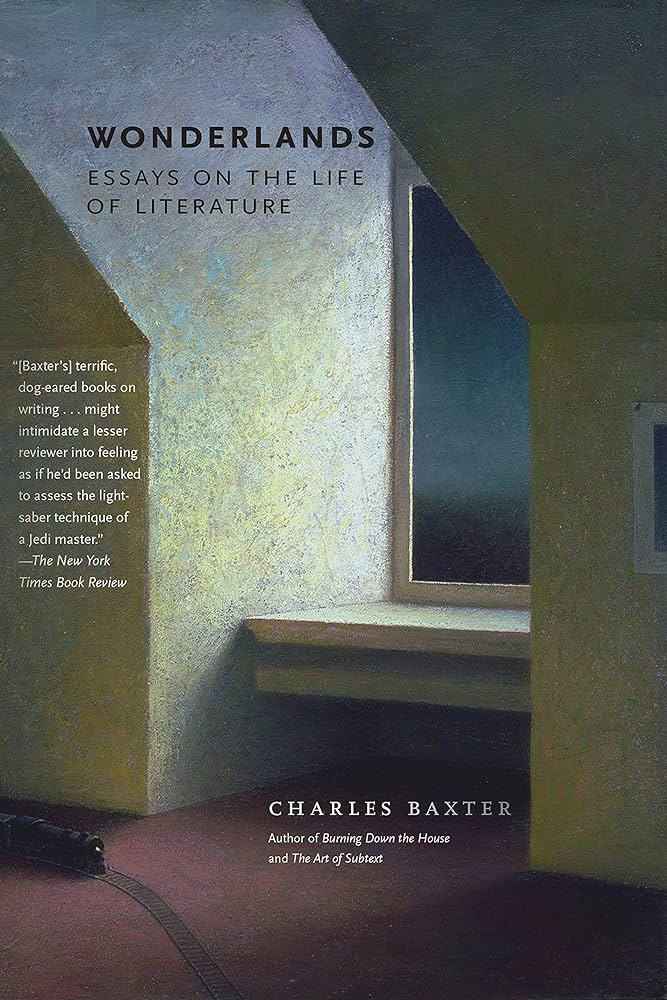
“Words are but the vague shadows of the volumes we mean. Little audible links, they are, chaining together great inaudible feelings and purposes” (Theodore Dreiser, Sister Carrie).
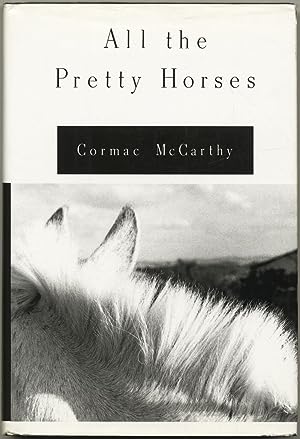
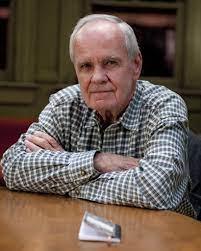
He Is Questioned about God: Recently I completed a biography of a man whose work I have studied for years and years. In an interview he granted John Jurgensen of the Wall Street Journal in 2009, he said the following when asked, “Is the God you grew up with in church every Sunday the same God that the man in The Road questions and curses?” McCarthy’s answer was revealing:
McCarthy’s Response: It may be. I have a great sympathy for the spiritual view of life, and I think that it’s meaningful. But am I a spiritual person? I would like to be. Not that I am thinking about some afterlife that I want to go to, but just in terms of being a better person. I have friends at the Institute. They’re just really bright guys who do really difficult work solving difficult problems, who say, “It’s really more important to be good that it is to be smart.” And I agreee it is more important to be good that it is to be smart. That is all I can offer you.”
Being Careful: If you have read The Road multiple times, you will understand and appreciate the journalist’s question to the author. I find it interesting that McCarthy did not exactly answer the man’s question straighforwardly. Instead he said he lauded “the spiritual view of life.” What exactly does that mean? Having studied The Road and McCarthy’s oeuvre for years, it did not take me by surprise that McCarthy was characteristically cryptic in his response. He said only that he “would like to be” a spiritual person. And he linked that longing to his fellow geniuses at the Sante Fe Institute who conceded that “it is more important to be good that it is to be smart.”
I can hear critics over my shoulder chomping at the bit, eager to shout, “See? Deeds, not creeds. Even McCarthy wanted us to be good people, not just wise seers!” But I wish to say, “Hold on a moment, please. Hear me out.”
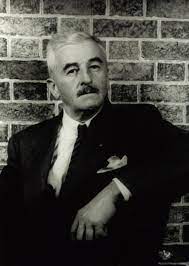
What I think McCarthy’s body of work evidences is that the battlefield remains the human heart. It’s what Faulkner called “the human heart in conflict with itself.” That phrase from Faulkner is so important that I think the speech in which he said it deserves careful attention:
Ladies and gentlemen,
I feel that this award was not made to me as a man, but to my work – a life’s work in the agony and sweat of the human spirit, not for glory and least of all for profit, but to create out of the materials of the human spirit something which did not exist before. So this award is only mine in trust. It will not be difficult to find a dedication for the money part of it commensurate with the purpose and significance of its origin. But I would like to do the same with the acclaim too, by using this moment as a pinnacle from which I might be listened to by the young men and women already dedicated to the same anguish and travail, among whom is already that one who will some day stand here where I am standing.
Our tragedy today is a general and universal physical fear so long sustained by now that we can even bear it. There are no longer problems of the spirit. There is only the question: When will I be blown up? Because of this, the young man or woman writing today has forgotten the problems of the human heart in conflict with itself which alone can make good writing because only that is worth writing about, worth the agony and the sweat.
He must learn them again. He must teach himself that the basest of all things is to be afraid; and, teaching himself that, forget it forever, leaving no room in his workshop for anything but the old verities and truths of the heart, the old universal truths lacking which any story is ephemeral and doomed – love and honor and pity and pride and compassion and sacrifice. Until he does so, he labors under a curse. He writes not of love but of lust, of defeats in which nobody loses anything of value, of victories without hope and, worst of all, without pity or compassion. His griefs grieve on no universal bones, leaving no scars. He writes not of the heart but of the glands.
Until he relearns these things, he will write as though he stood among and watched the end of man. I decline to accept the end of man. It is easy enough to say that man is immortal simply because he will endure: that when the last dingdong of doom has clanged and faded from the last worthless rock hanging tideless in the last red and dying evening, that even then there will still be one more sound: that of his puny inexhaustible voice, still talking.
I refuse to accept this. I believe that man will not merely endure: he will prevail. He is immortal, not because he alone among creatures has an inexhaustible voice, but because he has a soul, a spirit capable of compassion and sacrifice and endurance. The poet’s, the writer’s, duty is to write about these things. It is his privilege to help man endure by lifting his heart, by reminding him of the courage and honor and hope and pride and compassion and pity and sacrifice which have been the glory of his past. The poet’s voice need not merely be the record of man, it can be one of the props, the pillars to help him endure and prevail (William Faulkner’s Nobel Prize for Literature Acceptance Speech, 1950).
Being Careful (continued): In his book, The Death of Satan: How Americans Have Lost the Sense of Evil, Delbanco writes of our tendency to dismiss, diminish, and downplay the spiritual in favor of viewing all things via a lens of materialism:
The repertoire of evil has never been richer. Yet never have our responses been so weak. We have no language for connecting our inner lives with the horrors that pass before our eyes in the outer world.
I think this is key to understanding McCarthy’s response to queries about God and the problem of evil. In short, to posit that evil exists is to concede that good exists, and if good exists there is a distinction between good and evil. And if there is a distinction between good and evil, there must be a fixed standard and transcendent author of the good (God). And that is precisely what the biblical worldview teaches. Daniel’s words are helpful here:
20 Daniel answered and said:
“Blessed be the name of God forever and ever, to whom belong wisdom and might. 21 He changes times and seasons; he removes kings and sets up kings; he gives wisdom to the wise and knowledge to those who have understanding; 22 he reveals deep and hidden things; he knows what is in the darkness, and the light dwells with him. (Daniel 2:20-22, ESV)
Or as one of Christianity’s greatest confessions expresses it, “God, the great Creator of all things, doth uphold, direct, dispose and govern all creatures, actions, and things, from the greatest even to the least, by his most wise and holy providence, according to his infallible foreknowledge, and the free and immutable counsel of his own will, to the praise of the glory of his wisdom, power, justice, goodness, and mercy” (Westminster Confession of Faith 5.1).
McCarthy’s cryptic response to the question of God was not as abstruse or evasive as some object. McCarthy, I argue, sees evil as a symptom of man’s sin. Man is fallen. He is naturally hostile to God. Mark 7 is helpful here. It’s where Christ Himself teaches biblical anthropology:
20 And he said, “What comes out of a person is what defiles him. 21 For from within, out of the heart of man, come evil thoughts, sexual immorality, theft, murder, adultery, 22 coveting, wickedness, deceit, sensuality, envy, slander, pride, foolishness. 23 All these evil things come from within, and they defile a person.” (Mark 7:20-23, ESV)
Like Faulkner, like the biblical confession referenced above, like Daniel’s words from Babylon, like Jesus’ words in Mark’s gospel, McCarthy understood that God was and is real. It’s the human heart that’s the problem. When we see evil “out there,” whether it be Hamas’ latest terror or when we see women murder the tiny girls and boys in their wombs and have them chopped into tiny pieces and deposited behind the abortion factories in plastic bags to be buried in ground alonside the blood of Abel, or whether it’s the pagan indoctrination camps castrating boys and injecting hormones into your children and grandchildren, the problem is not a bound or limited God. The problem is the wicked human heart that refuses to repent and believe upon the truth. Because when we do that, it humbles us; it brings us under the control of God via His Spirit. And then you would see husbands and wives, children raised in the discipline and instruction of the Lord, and families who celebrated life rather than murdered it. You would see cultures of light rather than darkness. You would see design flourishing in accordance with the omniscient Architect rather than girls having their breasts removed and boys being castrated in the name of progressivism. McCarthy saw all this and wrote about it. Why? Because he, like Faulkner, like Shakespeare, like Flannery O’Connor, might serve as a prophet to tell all who can hear and understand that we sinners are fallen, but there remains the possibility of redemption and return.
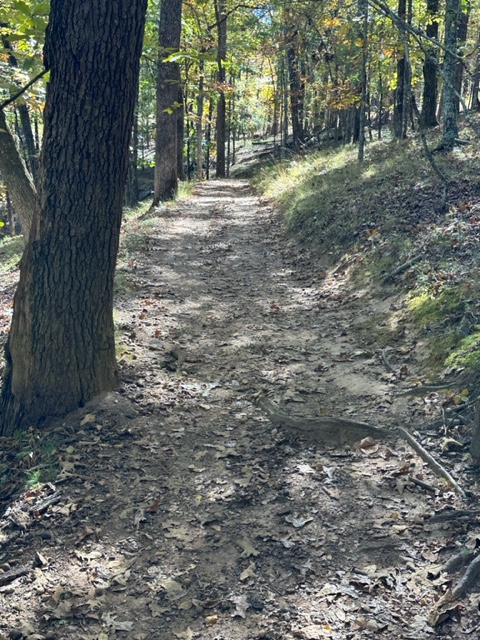
Was able to take to the trails today for some miles. The sky was clear. A slight breeze blew. Fellow hikers were friendly. The lake was peaceful. A few boaters were out and anglers too.
















 MIND & MATTERS