Context: I have a buddy who adores birds as much as I adore trees. I am grateful to him for sharing his pictures with me of his beloved birds. Here are a few of them:
Encouragement: When I slow down and concentrate on the intricacies and irreducible complexities of birds–large, small, or tiny ones–it staggers my little mind. And I revert to the comforts I find in language. It is language that reminds me of birds, yes, but more of their Creator.
I think of Exodus 19, for example, where God speaks to Moses on Sinai. Israel had just been miraculously delivered from Egyptian captivity: “You yourselves have seen what I did to the Egyptians, and how I bore you on eagles’ wings and brought you to myself. Now therefore, if you will indeed obey my voice and keep my covenant, you shall be my treasured possession among all peoples, for all the earth is mine; and you shall be to me a kingdom of priests and a holy nation” (Exodus 19:4-6a ESV).
God essentially paints Moses a linguistic picture, saying, Don’t forget that deliverance is like being borne upon eagles’ wings, Moses; so, don’t forget. Remember who the Deliverer is. Remember His power.
Introduction: I remember as a boy when I tried to read the Bible and struggled to remain interested when I got to the genealogies. The “begat passages,” as I used to call them, kind of lulled me to disinterest. I thought to myself, “Let’s get to the good stuff, the action, the story. What’s the point of all the passages about family lineage and all the begats?”
It’s Different Now: I was a child then and I thought as a child. Now I’m on the older side of the scale and have been through the Bible many times. I won’t say that the “begat passages” are by any means my favorite but I do think I have begun to understand a bit of what God is revealing to his body, the church, by way of the genealogies.
Today in Matthew: This morning I was reading in Matthew 1. It is, of course, one of the genealogies in the Bible. But Matthew 1 is the genealogy of the God-man, Jesus Christ. And here is something I hope encourages believers and challenges the skeptics out there: genealogies matter because they reveal how God keeps his promises.
Matthew 1’s first words are “The book of the genealogy of Jesus Christ, the son of David, the son of Abraham” (Matthew 1:1 ESV). For people who don’t have a proper hermeneutic (principle of interpretation), they might immediately put them off because they don’t understand what Matthew is laboring in chapter 1 to demonstrate.
The whole point of Matthew’s gospel is that Jesus (the Christ) is the promised Messiah. His human incarnation is demonstrated via the Holy Spirit and Mary. But Jesus did not have a divine origin because he is eternal. Jesus in his human incarnation has a birthday, if you will, but Jesus as God almighty does not have a divine birthday, because the triune God of Father, Son, and Holy Spirit is eternal. There never was a time when Jesus was not, in other words.
Names Matter: Jesus’ name matters because his office matters. That is, Matthew tells us “they shall call his name Immanuel” (Matthew 1:23b ESV) because of its meaning: God with us. See it? God has come. God has revealed himself by way of the incarnation. He has come to dwell among us in order that may behold via eyewitness accounts over the course of years, how Jesus/Immanuel/God with us, was and is God in the flesh. The Son took on flesh and fulfilled the promises of the Old Testament. The whole Bible and the whole storyline of the Bible was leading up to the God-man, Jesus the Anointed One, the true King, Immanuel.
Matthew stresses why this is so important: “All this took place to fulfill what the Lord had spoken by the prophet” (Matthew 1:22 ESV). See it? To fulfill.
Encouragement: To state the obvious, we live in a fallen world where promises made are seldom kept. But there is One who cannot lie because he is holy. He is holy, holy, holy (cf. Isaiah 6). Christ is the fulfillment of the promises of God (Luke 24). Look to him, because he is utterly and supremely trustworthy. He is the fulfillment of the true, the good, and the beautiful.
Introduction: I was able to get home and get on the bike with the bride. We rode for five hours in TN and north GA. ‘Twas a beautiful day. Lots of motorcyclists were doing the same thing. And Jeeps abounded, too. The bride saw her favorite car, a Corvette, and suddenly became an excited girl again. Amazing how the fascinations we develop as adolescents often remain with us. When I ride the hills and mountains of east Tennessee and north GA, something happens in my spirit. I find myself with the tenderness and wonder I had as a boy, before the world tried to steal the soul. Below is a video that lasts only a few seconds but I hope you too are encouraged.
Faithful (adj.): Early 14c., “sincerely religious, devout, pious,” especially in reference to Christian practice; mid-14c., “loyal (to a lord, friend, spouse, etc.); true; honest, trustworthy,” from faith + -ful. From late 14c. in reference to a tale, a report, etc., “accurate, reliable, true to the facts.” The noun sense of “true believer, one who is full of faith” is from late 14c. (Church Latin used fideles in same sense).
Connection: Near Paul’s very last words/letters/encouragement to all who will attend, as he continued to live rather than just talk faith:
Remember Jesus Christ, risen from the dead, the offspring of David, as preached in my gospel, for which I am suffering, bound with chains as a criminal. But the word of God is not bound! Therefore I endure everything for the sake of the elect, that they also may obtain the salvation that is in Christ Jesus with eternal glory.
The saying is trustworthy, for:
If we have died with him, we will also live with him; if we endure, we will also reign with him; if we deny him, he also will deny us; if we are faithless, he remains faithful
for he cannot deny himself (2 Timothy 2:8-13 ESV).
One of the most underrated novels in literature is McCarthy’s Suttree. It is certainly as difficult, abstruse, intellectual, and word-besotted of a narrative as you will read. It is Ulysses and Finnegan’s Wake with a Tennessee twist. Where Joyce followed the currents of the Liffey under Dublin’s bridges McCarthy documents the flotsam and jetsam of Knoxville’s filthy river of detritus where dead babies, prophylactics, and rogues float, bob, and abide.
It’s not an easy read to see what is.
But with each rereading I find that the right music enriches it. Mark Lanegan’s album Black Pudding captures it. One senses the damp granitic smells of Appalachian caves near Knoxville and can hear the accents of those who wear UT shirts as tourists but never spent nights on the river amongst Suttree’s kith.
Here’s Lanegan’s album. Gone too soon, Mark. Thanks for your appreciation of McCarthy, Suttree in particular, and to your faithfulness to singing the unspeakable but vital.
McCarthy, You lived a long life and wrote better than anyone since Shakespeare, to a world drunk on adolescent self-absorption and mimesis. Some of us are with you. May you reap your rewards. And may you find the faithful to sing your literary praises in the river’s hollers to all who sway to magical goblined linguistic waves.
Deep, dark, heavy rain clouds were moving in from the Gulf. The sky appeared to hold weight. With his backpack over his left shoulder, the soldier pulled open the heavy door of the bookstore, walked to the coffee shop, purchased a black coffee from the barista, and sat at a circular rust-colored Formica-laminated table by the window. He was looking forward to the rain moving in, as the region had been in a drought for nearly a year.
He slid the ladderback chair back on the white tile, sat, sipped his coffee, unzipped his backpack, and removed three books, a notebook, pen, and a laptop. He was about to resume his research from earlier in the morning when a woman appeared by the magazines. She was covered in tattoos. On her right thigh, a virago appeared with her tongue split into a Y like a serpent’s tongue. A horned creature in red appeared to the left of that one. Women in varying stages of undress enveloped the rest of her. Several flower petals covered her forearms and hands. HOLD FASTwas inked on her upper right arm. Hold fast to what? the soldier mused.
Looking through the bookstore window, the browning crepe myrtle leaves were moving in the winds as the rain clouds moved closer and the clouds slid darkly above. The soldier sipped at his black coffee. He tried to concentrate on his research. A man appeared next to the woman suddenly. He was showing her pictures from the magazine Tattoo. The man had a long red beard; it was braided at the bottom like a girl in pigtails. A sky-blue rubber band was tied about a quarter of an inch above the bottom of his rust-colored braided beard. His arms were thick, reminding one of the cartoon character Popeye. But this man’s arms were hairy and inked.
He was still showing the woman tattoos from the magazine when it suddenly fell to the floor. He bent to pick it up and his t-shirt rose in the back, revealing more tattoos. On the small of his back and around his waist, bold letters appeared: NO MAN’S SLAVE. He picked it up, smiled at the woman next to him, and they both continued to admire the images in the magazine.
The dark clouds continued to threaten outside but no rain was yet falling. Similar colors greeted the soldier’s eyes through the store window. The crepe myrtles had tiny pink colors on top of green and brown leaves. The clouds ran in wide swaths of blues: azure, cobalt, royal, lapis. It seemed to him that colors could be used well or not. Outside the colors held fast his eyes as if imbued with meaning.
Introduction: When I was a kid in high school I went with a friend to see one of music’s great lyricists in concert. Bob Dylan was playing at Chastain Park and we got tickets and saw him. I knew all the words to his songs. I cannot say that it was a very good show. He seemed oblivious to his audience and made few efforts to acknowledge that we paid good money to come see him. Just a little, “Hey, thanks for coming out” would have been nice. I was still glad I went, but was disappointed that he didn’t play one of my favorites from the massive Dylan catalogue, “Shelter from the Storm.” Here are the lyrics:
‘Twas in another lifetime, one of toil and blood When blackness was a virtue the road was full of mud I came in from the wilderness, a creature void of form Come in, she said I’ll give ya shelter from the storm
And if I pass this way again, you can rest assured I’ll always do my best for her, on that I give my word In a world of steel-eyed death, and men who are fighting to be warm Come in, she said I’ll give ya shelter from the storm
Not a word was spoke between us, there was little risk involved Everything up to that point had been left unresolved Try imagining a place where it’s always safe and warm Come in, she said I’ll give ya shelter from the storm
I was burned out from exhaustion, buried in the hail Poisoned in the bushes an’ blown out on the trail Hunted like a crocodile, ravaged in the corn Come in, she said I’ll give ya shelter from the storm
Suddenly I turned around and she was standin’ there With silver bracelets on her wrists and flowers in her hair She walked up to me so gracefully and took my crown of thorns Come in, she said I’ll give ya shelter from the storm
Now there’s a wall between us, somethin’ there’s been lost I took too much for granted, I got my signals crossed Just to think that it all began on an uneventful morn Come in, she said I’ll give ya shelter from the storm
Well, the deputy walks on hard nails and the preacher rides a mount But nothing really matters much, it’s doom alone that counts And the one-eyed undertaker, he blows a futile horn Come in, she said I’ll give ya shelter from the storm
I’ve heard newborn babies wailin’ like a mournin’ dove And old men with broken teeth stranded without love Do I understand your question, man, is it hopeless and forlorn Come in, she said I’ll give ya shelter from the storm
In a little hilltop village, they gambled for my clothes I bargained for salvation and she gave me a lethal dose I offered up my innocence I got repaid with scorn Come in, she said I’ll give ya shelter from the storm
Well, I’m livin’ in a foreign country but I’m bound to cross the line Beauty walks a razor’s edge, someday I’ll make it mine If I could only turn back the clock to when God and her were born Come in, she said I’ll give ya shelter from the storm
The phrase “shelter from the storm,” like so many of Dylan’s lyrics, comes from Scripture. Isaiah 4:6 reads, “There will be a booth for shade by day from the heat, and for a refuge and a shelter from the storm and rain.” That passage’s context is about “God as a refuge to his people in all weathers,” as Matthew Henry notes.
Segue to Psalm 55: This coming Sunday I will assemble with fellow Christian pilgrims, and with them I will open to Psalm 55 which centers on David’s anguish of soul amidst so much that is false. David cries out to God. In verse two, he lays it out all before the Lord with his heart’s cry: “Attend to me, and answer me; I am restless in my complaint and I moan.”
I adore the book of Psalms because it keeps life real. It does not paint a spiritual facade over the suffering that people endure. The psalms show people like David–fallen but redeemed people like David–suffer amidst a vicious pagan world system replete with leaders who long ago sold out to the demonic. They serve their master, the devil. Meanwhile, David and other pilgrims like him, suffer while trying to do good. David is clearly a sinful man, but unlike the unregenerate masses, David repents and returns to God. He knows he will answer to God. He will give an account. There will be a reckoning.
David writes of treacherous people who betrayed him: “My companion stretched out his hand against his friends; he violated his covenant. His speech was smooth as butter, yet war was in his heart; his words were softer than oil, yet they were drawn swords” (Psalm 55, 20-21 ESV).
Who cannot identify with that experience? Who among us has not trusted someone only to be betrayed?
But all of this is to be understood in light of the metanarrative–the overarching message of the Bible–namely, that the ultimate king was not David; it was and is Jesus. And he was betrayed. He was lied about. He gave himself for sinners. He endured the wrath that sinners merited, yet was without sin himself. He was made sin for all who who repent and believe and flee to him in the gospel. Shelter from the storm.
David recommits himself to God in the last verse: “But I will trust in you” (Psalm 55:23b ESV). Shelter from the storm.
David recognizes that treachery is afoot, both far and near. Therefore, the wise will trust the Lord, not the fake professions of those following the father of lies. David knew where his shelter from the storm was. It was a place and a person.
Connections to Our Day: When you listen to politicians utter bromides about how wonderful they are, about how they’ll fix your problems, just look at their actions rather than listen to their empty words. They print money as fund whores gush borrowed inflated funds into Ukraine but America’s borders remain open for continued invasion. They may shut down the U.S. government next week because we’re out of money, but we send billions of armaments to Ukraine because we apparently believe some borders are important. Storms are gathering, you see.
Regardless of your politics, surely you see that. Storms are gathering. Just look what actions are taking place. Open borders; a total breakdown of the prosecution of violent crime; fentanyl-laden druggies gesticulating in crazed eruptions under our bridges and at intersections; kids being castrated, drugged, and mutilated by government indoctrination camps and medical Josef Mengeles of today. The children cannot read or think critically, but they are being drilled in the alphabet jihad pronoun nonsense. Storms are gathering, you see.
And where is shelter for the godly man or woman to be found? Read Psalm 55 and see the hope of all who hate wickedness and love goodness.
Encouragement: To quote David’s words again but from another of his poems, “Some trust in chariots and some in horses, but we trust in the name of the LORD our God” (Psalm 20:7 ESV). That’s the shelter from the storm, beloved, the shelter that conquered the lies and is a refuge for all who will come.
Question: In the Bible, trees are central. Why, do you think, God the Son was made to die upon the tree? It’s reflexive and flippant to say, “Well, because that was Rome’s way: crucifixion.”
Anyone who has spent even an inkling of time in Scripture and history recognizes there is much more going on here.
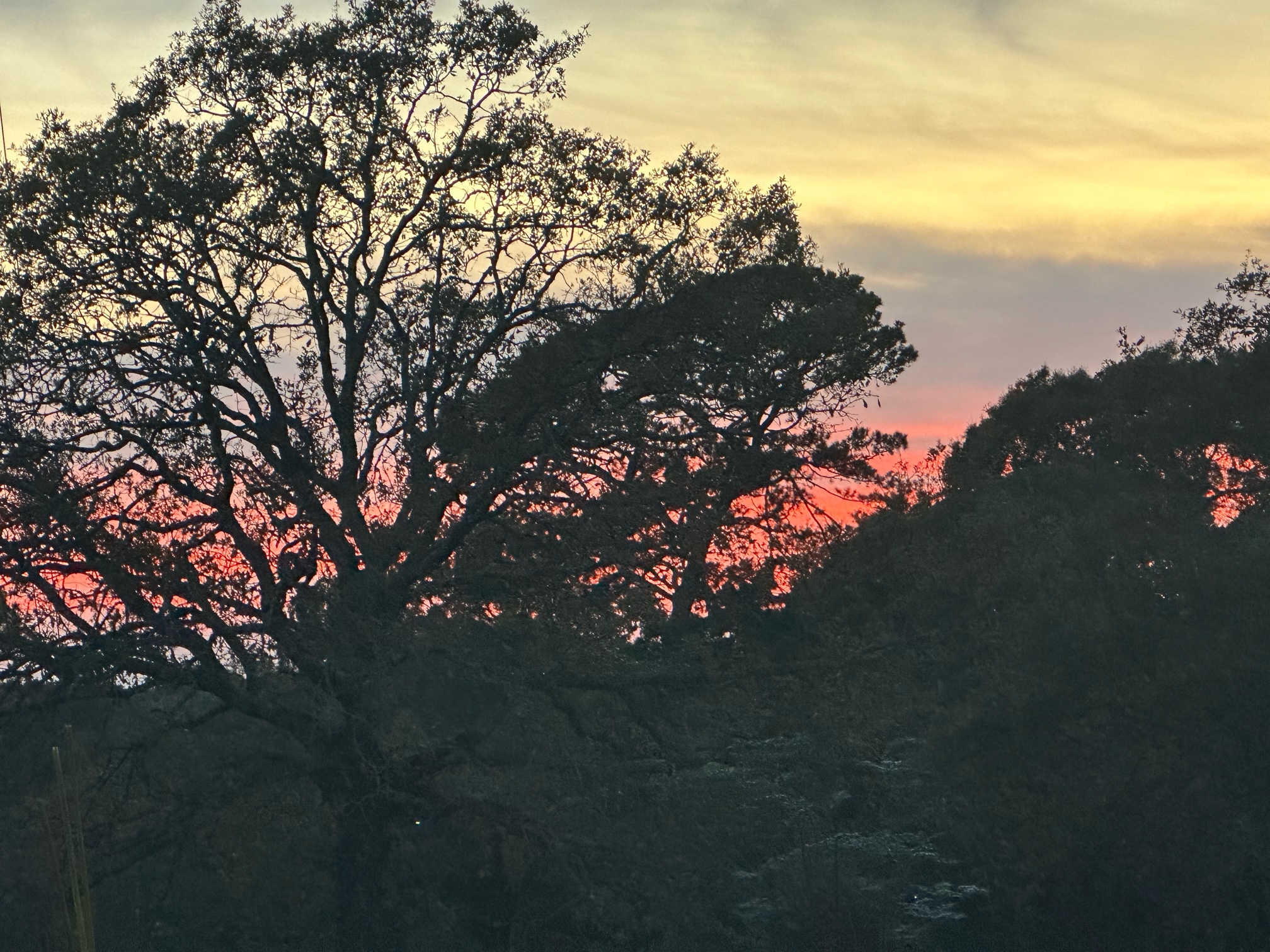
On the Track: Today I got in a few miles in on the track. One of the many beautiful trees left standing was this one. The second one is one (or perhaps more than one) you have seen before, as it is/they are what I see in the evenings as I return from work.
Question: Is it possible God speaks through timber, through the rooted message that springs from his earth’s timber, hangs upon his timber, and fashions that timber to honor his victory? As for me, you can likely induce my view. God speaks, dear ones. One need only ears to hear and eyes to see. And then: praise.
As I was in Ezekiel’s book later in the day, I was again prodded to think on these things. God spoke to his prophet Ezekiel thus:
22 Thus says the Lord God: “I myself will take a sprig from the lofty top of the cedar and will set it out. I will break off from the topmost of its young twigs a tender one, and I myself will plant it on a high and lofty mountain. 23 On the mountain height of Israel will I plant it, that it may bear branches and produce fruit and become a noble cedar. And under it will dwell every kind of bird; in the shade of its branches birds of every sort will nest. 24 And all the trees of the field shall know that I am the Lord; I bring low the high tree, and make high the low tree, dry up the green tree, and make the dry tree flourish. I am the Lord; I have spoken, and I will do it.” (Ezekiel 17:22-24 ESV).
Introduction: There is a lot of moralistic therapeutic deism (to use Christian Smith’s phrase in his book Soul Searching) about. I lament how many people have chucked the Christian faith because they were insulted at the shallowness and baby talk that passes for ostensibly Christian teaching. If my mind is not engaged, I check out. I think there may be others who understand.
I was having to do what I would normally caution against unless it’s necessary: I was having to view the Christian body today via sermons from solid expositors on YouTube. I was blessed to easily find Sinclair Ferguson’s ministry again. He is a resource for me, one to whom I can rely for depth and wisdom. I have read many of his books and have benefited from him immensely.
With Ferguson my mind is engaged. He refers oftentimes in his teaching to church history, so that believers today understand our kinship and lineage with saints who have gone before us. I wish that Christians today would study church history. I’m sitting in my reading chair at the moment and on my shelves are the sermons of the Puritans, the works of Jonathan Edwards, volumes of Lloyd-Jones and seminal volumes from the Reformation. Why? Because one sees there the connections to the gospel and to the saints of the past and to the development of theology as we refine our understanding in light of the authority of Scripture.
Ephsians 5: One of my favorite sections of Scripture comes in Ephesians 5. I think I appreciate it so much because it is filled with contrasts: not this way but that way; rather than that, do this, etc. We learn best by seeing contrasts. Here’s the way Paul puts it in Ephesians 5:15-21:
Look carefully then how you walk, not as unwise but as wise, making the best use of the time, because the days are evil. Therefore do not be foolish, but understand what the will of the Lord is. And do not get drunk with wine, for that is debauchery, but be filled with the Spirit, addressing one another in psalms and hymns and spiritual songs, singing and making melody to the Lord with your heart, giving thanks always and for everything to God the Father in the name of our Lord Jesus Christ, submitting to one another out of reverence for Christ.
Paul Calls Believers’ Attention to the Contrasts:
V. 15–Unwise vs. wise
V. 16–Wasting of time vs. stewardship of one’s allotted time
Vv. 17-21–Secular squandering vs. sacred vocation
Ephesians 5:16 remains one of my favorite gems of Scripture: “making the best use of the time, because the days are evil.” The older I get, the fewer days I have remaining. That’s a tautology and self-evident. And so this gem from the NT becomes more and more potent when I think on it and in light of the biblical narrative.
We have a portion of days marked out for us. Therefore, the wise person will steward those days rather than squander them. I don’t know about you, but when I reflect on how much time I have wasted on things and activities that were just wood, hay, and straw, I am convicted. I don’t want to repeat that pattern. I think that’s why this passage from Paul is so powerful. It shows the sundry contrasts between the foolish way vs. the wise way.
Encouragement: Maybe it’s just to me, but maybe to you, too: If you have ever known in your gut–at the visceral level–that you have one life, and that you long for it to count for the right reasons, and you long to be a faithful doulos, may we heed what has been revealed: “Whatever your hand finds to do, do it with your might, for there is no work or thought or knowledge or wisdom in Sheol, to which you are going” (Ecclesiastes 9:10).
Bottom Line, Up Front: Andy Stanley, the face of the Atlanta-area North Point Community Church, continues to reveal his true colors and consistent theological trajectory away from biblical orthodoxy and the Christian worldview.
Remember Paul’s Address to the Ephesian Elders: When I was ordained into Christian ministry, the presiding elder was the professor from my seminary from whom I saw the most consistent biblical walk. And the text he preached from that day was this passage from Acts 20 where Paul warns of false brethren and of how believers need to know up front that the visible church is filled with false converts and false leaders.
Dr. C. taught me a course in spiritual disciplines of the Christian life and another course in Christian marriage. He was a wise man, a humble man, but above all, he was a discerning man. I can still hear his voice in my head, even though he has since gone to be with the Lord. But he used to say, “Jon, I think when we get to heaven, there will be many surprises. I think we will find that many we thought would be there, aren’t. And many we thought would not be there, are. I think there will be many surprises.”
We Were Warned: These are Paul’s words to the Ephesian elders:
Pay careful attention to yourselves and to all the flock, in which the Holy Spirit has made you overseers, to care for the church of God, which he obtained with his own blood. I know that after my departure fierce wolves will come in among you, not sparing the flock; and from among your own selves will arise men speaking twisted things, to draw away the disciples after them. Therefore be alert, remembering that for three years I did not cease night or day to admonish every one with tears. (Acts 20:28-31 ESV)
Of course there are innumberable other warnings of fierce wolves and false teachers, but this is the passage that Dr. C. preached on. I remember it well. Each time I read the passage I can still hear Dr. C’s voice in my head and feel his hands on my shoulders in the church that day as he and other elders and my loved ones were present. It was sage counsel from a sagacious man and based upon the sagacity of God as reavealed in Acts. Wisdom upon wisdom upon wisdom.
The Question: Why is anyone surprised that Andy Stanley is hosting such a conference? If you are surpised by this, you are likely part of the problem. And what is that problem? Lack ofdiscernment. Spiritual blindness. Obtuseness. Lack of wisdom.
Wolves, Sheep, & the Sheepdogs:
Wolves run in packs; they prey upon the vulnerable, the weak. They devour. They creep in, often on soft paws, but they devour nonetheless. If you’ve ever seen the remains of a wolf attack, it’s bloody, but the wolves eat just fine.
Sheep are not discerning creatures. They need to be shepherded and protected from the wolves. Because sheep desire comfort above courage, and discernment is not a characteristic associated with sheep.
Sheepdogs are the ones who have counted the costs of actually engaging in battle against the wolves for the sake of the true sheep. We have very few sheepdogs today or in any day.
Takeaway: For the discerning, this latest revelation from Andy is about as surprising as the fact that the sun will rise tomorrow. But for the sheep who refuse to see, let us pray that God will send you some sheepdogs who actually are discerning, who actually do care, who actually do act with courage and conviction, and will sacrifice themselves for the sake of the true sheep.
Folks, you will be forced to care. None of us escapes. Theology matters. You can pretend you’re exempt from the lies that your culture is feeding you, but you will be made to care. That is the nature of wolves. They attack. Andy just happens to do it with a soft voice and smooth hands and bromides about a “quieter middle space.”
Wolves, sheep, and sheepdogs. And the discernment seems to be in the first and third groups, by and large, and you are witnessing the results.
Below are linked three articles on this latest evidence of a continued falling away.











 MIND & MATTERS