Friday Evening Reflections

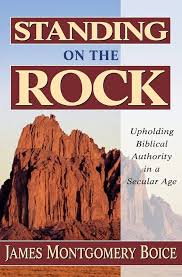
For me, this evening is a quiet one indoors. Outside our home the rain is falling softly and steadily. Small shallow pools of water are on either side of the front steps. Our Cavalier King Charles does not want to go pee outside for fear of getting her paws wet. [She is truly a ‘Lady’ (that’s her name)]. And I just completed the reading of a slim volume of theology by Jim Boice entitled Standing On the Rock.

Like Boice’s other volumes, this one was winsome and wise. In this volume, Boice tackled common objections secularists and liberals have historically raised about the sufficiency, authority, and inspiration of the Scriptures. And just as in his other volumes, he more than withstood all inquiries via vetted scholarship. He answered honest (and often dishonest) questions and assertions raised against the authority of Scripture, and gently called naysayers and skeptics to the truth via evidence.

As one steeped in this sort of polemics, his answers were not new to me. The same questions have been around since the Patristic Era and before. And honest answers are not hard to come by if one will do a bit of study.
But what I was so moved by this quiet evening were all the stories he shared in this slim volume–of skeptics who came to faith in Christ in the most interesting ways. One was of a man shouting ad hominem attacks, who challenged Boice to a debate. Boice willingly accepted the challenge, but the man refused.

Another was of how W.A. Criswell told First Baptist Dallas that he was going to preach through the entire Bible as their pastor–from Genesis to Revelation–knowing that many folks could not even locate books like Habakkuk and Zephaniah in their Bibles. Critics laughed and scoffed at Criswell. But the result? The hearers could not fit inside the church, there were so many. His exposition was so accurate and the Word of God was so powerful, people were regenerated by God.

The stories go on and on. And all of them testify to the power of the Scriptures–the very breath of God.

When I see my own writing on my laptop, I sometimes chuckle now. Why? Because when I was a young man, full of intellectual pride and a sharp tongue, and I studied philosophy and literature, and went on to earn several graduate degrees, I get what the Apostle Paul meant when he said he had learned to count all those things as so much rubbish. He didn’t mean that he devalued the life of the mind. Just the opposite, in fact.

What he meant is that zeal without true knowledge/wisdom is vanity and pride. True knowledge comes when we fall under the recognition that this is God’s world and therefore God’s Word is the authority. It’s not man’s world or the words of men that carry ultimate authority. We are always the creatures; God alone is the Creator. We are borrowers of the creation only.

God is bigger than our trials, dear ones. His Word proves true. You can kick against it, besmirch it, shun it, and pervert it, but it survives and remains authoritative. As a friend of mine wrote earlier this week when she quoted Isaiah, I will do the same:

Behold, I am doing a new thing;
    now it springs forth, do you not perceive it?
I will make a way in the wilderness
    and rivers in the desert.
(Isaiah 43:19)

Chaplain Daily Touchpoint #373: Studies in the Life of Joseph (Part 3)

The Issue: Trust Man or Trust God?

Text from Genesis 39:11b-23:

But one day, when he went into the house to do his work and none of the men of the house was there in the house, she caught him by his garment, saying, “Lie with me.” But he left his garment in her hand and fled and got out of the house. And as soon as she saw that he had left his garment in her hand and had fled out of the house, she called to the men of her household and said to them, “See, he has brought among us a Hebrew to laugh at us. He came in to me to lie with me, and I cried out with a loud voice. And as soon as he heard that I lifted up my voice and cried out, he left his garment beside me and fled and got out of the house.” Then she laid up his garment by her until his master came home, and she told him the same story, saying, “The Hebrew servant, whom you have brought among us, came in to me to laugh at me. But as soon as I lifted up my voice and cried, he left his garment beside me and fled out of the house.

As soon as his master heard the words that his wife spoke to him, “This is the way your servant treated me,” his anger was kindled. And Joseph’s master took him and put him into the prison, the place where the king’s prisoners were confined, and he was there in prison. But the Lord was with Joseph and showed him steadfast love and gave him favor in the sight of the keeper of the prison. And the keeper of the prison put Joseph in charge of all the prisoners who were in the prison. Whatever was done there, he was the one who did it. The keeper of the prison paid no attention to anything that was in Joseph’s charge, because the Lord was with him. And whatever he did, the Lord made it succeed.

Teaching: One of the many things I admire about Joseph is his consistency. You could predict his behavior because he was a “Steady Eddie” personality, an even keel, a “box” in the Shapes curriculum. He was a rule-follower. The leaders in Egypt elevated Joseph to positions of authority because he was trustworthy. Folks could count on him. He was not an excuse-maker, or someone who claimed, “But you don’t understand!” or “You’re misrepresenting me.” No; folks knew Joseph’s track record and they trusted him because he’d earned that trust.

Encouragement: Again and again in Scripture, we read this refrain about Joseph: “the LORD was with him” and/or “The LORD was with Joseph” (Gen 39:2, 3, 23). Folks, this is essential doctrine. We’re to keep short accounts with God, because God sees all.

Joseph endured immense sufferings due to the jealousy and sins of others, whether that be his kith and kin, the rulers in Egypt, a harlotrous wife, prisoners, et al. But “the LORD was with Joseph.” If you’re in Christ, dear ones, the Lord is with you. Be encouraged. God sees and God’s truth prevails.

Chaplain Daily Touchpoint #372: Studies in the Life of Joseph (Part 2)

Text: Now Joseph was handsome in form and appearance. And after a time his master’s wife cast her eyes on Joseph and said, “Lie with me.” But he refused and said to his master’s wife, “Behold, because of me my master has no concern about anything in the house, and he has put everything that he has in my charge. He is not greater in this house than I am, nor has he kept back anything from me except you, because you are his wife. How then can I do this great wickedness and sin against God?” And as she spoke to Joseph day after day, he would not listen to her, to lie beside her or to be with her. (Gen 39:6b-10)

Context, Context, Context: Already at this point, Joseph had been betrayed by his brothers, sold into slavery, sold to Potiphar, and more. But here’s the thing: God was with him. The Lord saw it all. And the Lord was using Joseph for purposes of providence.

Teaching: Joseph kept short accounts with God. He knew the Lord savingly. Joseph was not impressed by Joseph. Joseph’s boast was in the Lord.

Encouragement/takeaway: When Potiphar’s wife framed Joseph, when she enticed him, when she lied about him, etc. Joseph trusted the Lord for vindication and for the truth to be revealed. Should not we do the same?

Chaplain Daily Touchpoint #371: Studies in the Life of Joseph (Part 1)

Bottom line up front: The Hatred of Joseph

Introduction: It is one of the most important stories in history and certainly one of the most important in Scripture. It is the story of Joseph, the son of Jacob/Israel and Rachel. Why is this such an important story? Because it is a foreshadowing of Christ.

Joseph was initially hated by those God sent him to save. Jesus was hated, too, viscerally. He was in fact murdered. But Jesus came for sinners. That’s us, folks. And it’s the good news that Christ came to save His people from their sins.

Following the Story: Jacob the patriarch had been renamed Israel by God:

And God said to him, “Your name is Jacob; no longer shall your name be called Jacob but Israel shall be your name.” So he called his name Israel (Gen 35:10)

Joseph as Typology:

 Now Joseph had a dream, and when he told it to his brothers they hated him even more. He said to them, “Hear this dream that I have dreamed: Behold, we were binding sheaves in the field, and behold, my sheaf arose and stood upright. And behold, your sheaves gathered around it and bowed down to my sheaf.” His brothers said to him, “Are you indeed to reign over us? Or are you indeed to rule over us?” So they hated him even more for his dreams and for his words. (Gen 37:5-8)

Questions:

  1. Do you see how, when Joseph announced his news from God, the people resented him, even hated him?
  2. Do you see how God used symbolism to show how God was going to raise up this man Joseph for His (God’s) own purposes?
  3. Do you see how Joseph was predicted to become as one who has authority to reign?
  4. Do you see how this connects inextricably to the New Testament and to Christ?

Takeaway: Scripture is revealing one coherent story, guys. It’s all connected. It all redounds to God’s glory in Christ Jesus, but you have to be able to connect the dots and see how all of the historical events point to Christ.

*This is Part 1 of several I’ll do as we look into the life of Joseph, and how God used him as a type of the One who was to come later, God the Son incarnte, Jesus of Nazareth. For now, just notice how Joseph was hated, and how that hatred is echoed in the hatred Jesus experienced.

Chaplain Daily Touchpoint #370: What God Hates

What, God hates? Yes. God hates. Why? Because God is good and holy and righteous and true.

Scripture:

There are six things that the Lord hates,
    seven that are an abomination to him:
haughty eyes, a lying tongue,
    and hands that shed innocent blood,
 a heart that devises wicked plans,
    feet that make haste to run to evil,
 a false witness who breathes out lies,
    and one who sows discord among brothers.
(Pr 6:16-19)

Teaching: It is essential to read and understand all of Scripture, not just the verses for which we might have affection and sentimental attachments. That God hates bad things indicates God’s holiness. God is good, totally good. That is why evil is such a perversion in God’s judgment.

Encouragement: If we are people who have been truly born again–regenerated by the Holy Spirit–then we, too, are to esteem and pursue the good and shun and hate evil. We’re to be light in the darkness, sweetness amidst the bitterness, preserving salt amidst the rot and decay. May we be found faithful in the execution of said mission.

Chaplain Daily Touchpoint #369: Integrity vs. the Secret Life

The Issue: Integrity vs. the Secret Life

The Story: The narrative is found in Genesis 27. It is the story of secret plots, scheming, lies, deception, and theft. It’s the story of Rebekah plotting to have Jacob, rather than Esau, receive the blessing of Isaac, the father of both boys.

Rebekah said to her son Jacob, “I heard your father speak to your brother Esau. ‘Bring me game and prepare for me delicious food, that I may eat it and bless you before the LORD before I die.’ Now therefore, my son, obey my voice as I command you. Go to the flock and bring me two good young goats, so that I may prepare from them delicious food for your father, such as he loves. And you shall bring it to your father to eat, so that he may bless you before he dies.” But Jacob said to Rebekah his mother, “Behold, my brother Esau is a hairy man, and I am a smooth man. Perhaps my father will feel me, and I shall seem to be mocking him and bring a curse upon myself and not a blessing.” His mother said to him, “Let your curse be on me, my son; only obey my voice, and go, bring them to me.” (Gen 27:5-13)

Teaching: Jacob went along with his mother’s scheme. He lied to his father, received his blessing, and Esau was driven out. In Isaac’s words,

Behold, away from the fatness of the earth shall your dwelling be,

and away from the dew of heaven on high.

By your sword you shall live,

and you shall serve your brother;

but when you grow restless

you shall break his yoke from your neck.” (Gen 27:39b-40)

Jacob lived up to–or we might say–down to, his name. (“Jacob” means He takes by the heel, or He cheats.)

Takeaway: The fallout from secrecy, deception, lies, scheming, and theft would lead to devastation, family strife, more lies, and bitterness for years because of this act of treachery. But God was going to show Himself sovereign and good through it all, however. Why? Because God is God and we are not. He sees. He is just. He does what is right. And the duty of all those who are God’s regenerate people must be to learn to lean into truth, to pursue truth, to live lives of transparency rather than darkness. Why? To quote Jesus, “the people loved the darkness rather than the light because their works were evil” (Jn 3:19). Believers are to be better than that. We’re to be men and women of the light. Transparency is essential.

Chaplain Daily Touchpoint #368: “Shields Up and Soldier On!”

Bottom Line Up Front: “Shields Up and Soldier On!”

Context: I received an early morning text from a dear friend. It was, true to this person’s form, full of encouragement. Before I share some of what it said, here’s the context. Maybe you can relate. Have you ever had a period in your life when you felt like the harder you worked, the progress just wouldn’t come? Maybe you were laboring for a promotion. Maybe you were hitting the gym harder. Maybe you were putting more miles on the track or treadmill. To be cliché, have you experienced, “One step forward, two steps back”? If we are honest, I think most folks would say, “Yes, of course.”

Segue: I’m currently in studies surrounding the biblical patriarch, Abraham. God used Abraham mightily. Abraham truly was God’s man, a man of faith in the truth-telling God, the God who is truth Himself. Multiple times, God came to Abraham and essentially said, “Trust me. Just trust me. And I’ll bless you.” In Genesis 12, for example, Scripture reads this way:

Now the LORD said to Abram, “Go from your country and your kindred and your father’s house to the land that I will show you. And I will make of you a great nation, and I will bless you and make your name great, so that you will be a blessing. I will bless those who bless you, and him who dishonors you I will curse, and in you all the nations of the earth shall be blessed” (Gen 12:1-3)

What’s Required: But do we understand in our bones what was required from Abraham? It wasn’t his work ethic; it wasn’t his talent; it wasn’t his charisma; it wasn’t his wealth. It was not anything for which Abraham could look within himself and boast about. It was believing God. It was trusting God at His word. Why? Because there are things that we sinners can do that God cannot: we can lie. God cannot lie. That would betray God’s nature, and God’s nature is holy and unchanging. Abraham believed God. He took God at His word. And God blessed Abraham, and the Seed of Abraham who is Christ.

Encouragement: And now, back to the opening illustration. I received a text. It said, among other things, “Please don’t let the slings and arrows of the enemy overwhelm you. As long as we labor for the gospel and the Bride, you know the artillery of the enemy is coming against us. Shields up and soldier on!” I cannot say it any better. “Shields up and soldier on!”

Soul Food (4 January 2026)

From Thoreau’s Walden:

I went to the woods because I wished to live deliberately, to front only the essential facts of life, and see if I could not learn what it had to teach, and not, when I came to die, discover that I had not lived. I did not wish to live what was not life, living is so dear; nor did I wish to practice resignation, unless it was quite necessary. I wanted to live deep and suck out all the marrow of life, to live so sturdily and Spartan-like as to put to rout all that was not life, to cut a broad swath and shave close, to drive life into a corner, and reduce it to its lowest terms, and, if it proved to be mean, why then to get the whole and genuine meanness of it, and publish its meanness to the world; or if it were sublime, to know it by experience, and be able to give a true account of it in my next excursion. 

Today, after fellowship with some of the saints, I grabbed one of my hiking poles and, in boots and with a heavy heart, took to the woods. Like Thoreau, I longed to just listen, to learn, to be sensitive. The Lord spoke through His creation. Below are some images and sounds with which I was blessed:

Encouragement: I do not know who reads these, but perhaps you, too, find yourself at times in need of a reminder that God is bigger than our trials, that God is near to the brokenhearted, that God is near to all who call on Him in truth. If that’s you, be encouraged, dear ones. God sees all, dear ones. And He is good.