The Longing for Encouragement

One of the blessings of being in Christian ministry is personal discipleship. Because I’m regularly teaching biblical doctrines in Protestant services in the military, as an adjunct instructor at a university, or in the local church setting, many ofEncourageWordle my hours are taken up in study and preparation. Contrary to some people’s experiences, sustained research and study are not burdens to me; I emerge from those disciplines reinvigorated. Recently I was requested to speak at a Bible study to military personnel and Department of Defense civilians. I’d been studying in Psalm 67, so I thought that would be a sound passage from which to teach. It was not just because that is where I’d been in some of my recent studies. It was more than that. I consistently see the longing for encouragement that we all have.

Because we are fallen creatures, and because we live in a fallen world, the pathos of this world is more properly identified as tragic rather than comic. Suffering is real. Unlike the cult of Christian Science, the Bible does not deny the reality of suffering. Unlike pantheistic worldviews like Buddhism, the Bible does not teach that suffering can be avoided through an eightfold noble path. Among other profound truths, the Bible teaches that, because this world is fallen, Christians are pilgrims moving through this valley of the shadow of death.

The Bible repeatedly uses the metaphor of the good shepherd (Jesus) who guards his sheep, abiding with them amidst evil, and preserves them from ultimate death. This is why Jesus, after his incarnation, repeatedly referred to himself as the good shepherd: “I am the good shepherd. The good shepherd lays down his life for the sheep” (Jn 10:11 ESV). He reminds his followers that most of the world consists of thieves and wolves in sheep’s clothing, and that he (God alone) is wholly trustworthy. Jesus is the shepherd who encourages his sheep amidst suffering. This life’s slings and arrows are endurable because of Jesus, the conquering shepherd: “I am the good shepherd. I know my own and my own know me, just as the Father knows me and I know the Father; and I lay down my life for the sheep” (Jn 10:14-15 ESV).

There is a relationship between Jesus as the good shepherd and his sheep that endures because of the shepherd’s triumph. Yes, the good shepherd laid down his life for his sheep (the crucifixion), but three days later, he took it up again (Jesus’ resurrection). Therefore, his sheep are to have hope. We can be encouraged. This is the good news. The gospel does not mean that the sheep (Christ-followers) are exempt from suffering, but it does mean that we are equipped to endure, because we are buried with Christ and raised because of his triumphal resurrection.

Psalm 67 begins with a reference to the well-known Aaronic blessing of Numbers 6:25. This is where God told Moses what to teach Aaron about blessing Israel. Like many of you, I love that blessing: “The LORD bless you and keep you; the LORD make his face to shine upon you and be gracious to you; the LORD lift up his countenance upon you and give you peace” (Nub 6:24-26 ESV). I think we gravitate towards it because we sense its intent: God promises to bless his people. It is sheer encouragement, and the whole creation groans for encouragement.

But when you read Psalm 67 closely, you see that God blesses his people in order that they might bless others by introducing them to this fount of blessing–God himself. He blesses them so that God’s way “may be known on earth, [God’s] saving power among all nations” (Ps 67:2 ESV). In other words, the greatest blessing is God himself. Upon receiving the blessing of God, the proper response should be outward—namely, to declare who God is and what God has done.

Growing up as I did in a local church, I remember old ladies saying this many times, “May God bless you, and make you a blessing.” Now, my personality tends to recoil at clichés and platitudes, but there is great truth in that phrase. We are blessed in order to be a blessing.

So what does this have to do with the longing for encouragement? Let me share one anecdote to illustrate it. Several months ago, a senior noncommissioned officer was retiring from the Army after 30 years. He’d been a chaplain assistant his entire career. He was (and is) one of the most gentle and humble men I’ve ever known. Never one to put his name out front for recognition, he eschewed the limelight. He was more like Mary (see Jn 3:3) who poured oil upon Jesus’ feet and dried them with the locks of her hair. Neither this soldier nor Mary was self-absorbed; their focus was outward—upon others because of Christ. Speaker after speaker lined up to share stories of how SFC Franklin had touched their lives by pouring his own life and ministry into them. Sometimes he had done it just by his gentle manner. At other times, he served them by providing a small service at just the right time. But the pattern that emerged over and over was of the encouragement he brought. When it came time for us to listen to his remarks, he kept them short. He said this, “I’ve always wanted God’s favor upon my life. In order to ask for that, I have aimed to please God first. Thank you all for allowing me to be part of God’s plan.” Then he stepped away from the podium, away from the microphone.

Scores of us lined up afterwards to shake his hand, to embrace him, to wish him blessings in his future endeavors. And we all had similar stories: he had encouraged us via his life and ministry. We all long for encouragement. I get that. What is much harder to inculcate and live out, however, is to encourage others. I guess those old ladies in the small Baptist churches were (once again) right all along: May God bless us, and make us a blessing.

 

And You’re Surprised?

The end depends upon the beginning. That seems reasonable enough, right? If it’s reasonable, then why are many people surprised at the results of wrong beginnings? Yesterday, I went forurl a long run. At the end of my run, I entered a gym where I work out when I’m away from home. Upon entering, I was flooded with images of the massacre by 26-year old Chris Harper-Mercer. Multiple people at Umpqua Community College in Roseburg, Oregon had just been murdered. Based upon some eyewitnesses to the murders who’d barely escaped death, Mercer had a track record of hatred, especially for Christians. Sound familiar? Are you still surprised at the violence? Now, I have no idea what worldview Mercer lived by. That is not my main concern here. What is my main concern, however, is how many people express surprise at violence perpetrated against others. Before someone objects that I’m inciting violence, read on. I am not inciting violence; I’m asking readers to go deeper. I’m asking you to examine your view of man, your anthropology. Why? Because the end depends upon the beginning. If you have an incorrect view of man’s nature as fallen, you will continually be surprised when violence invades our lives. However, if you have a correct view of man’s fallen nature, a correct anthropology, you will still grieve, yes, but you will understand why violence occurs with such frequency.

 It makes all the difference in how you view human nature. What is man like? Are we born good? Is man’s nature by disposition one of love, unselfishness, magnanimity, self-sacrifice, and humility? Do those terms describe what you see and read each day on your TVs, computers, and newspapers? Do you have to teach your children how to misbehave, since they are so innocent, so good? Don’t you remember someone having to teach you how to lie, how to be selfish, how to make the world about you? Nor do I. But why? It’s because man is fallen. Therefore, we ought not to be surprised when fallen and unredeemed people act in accordance with their nature. We should be surprised if people were good by nature, but we’re not. We’re fallen. We are sinners. We need to be redeemed from our fallen state. The end depends upon the beginning. If we begin with the presupposition that man is good by nature, then it would make sense to be surprised at violence. But if we begin with the admission that man is evil by nature, then we may understand occurrences like yesterday in Roseburg, OR, and Sandy Hook, NJ, and Virginia Tech, and Fort Hood, TX, and Aurora, Colorado, etc. The end depends upon the beginning. View man’s fallen nature correctly, then we can begin to address the answer.

The Bible uniquely addresses the issue of man’s nature. Unredeemed man is, according to Scripture, wicked and a deceiver: “The heart is deceitful above all things, and desperately sick; who can understand it?” (Jer 17:9 ESV). Jeremiah wrote in the 600s B.C. But Moses penned the same description of man’s nature thousands of years prior: “The LORD saw that the wickedness of man was great in the earth, and that every intention of the thoughts of his heart was only evil continually” (Gen 6:5 ESV). But perhaps this description of man’s nature changed with New Testament writers, right? Surely, we have progressed. Listen to Paul in his epistle to the Romans, written in the 50s A.D: “For we have already charged that all, both Jews and Greeks, are under sin, as it is written: “None is righteous, no, not one; no one understands; no one seeks for God. All have turned aside; together they have become worthless; no one does good, not even one.” “Their throat is an open grave; they use their tongues to deceive.” “The venom of asps is under their lips.” “Their feet are swift to shed blood; in their paths are ruin and misery, and the way of peace they have not known.” “There is no fear of God before their eyes” (Rom 3:9b-18 ESV). Now ask yourself this question: Which view of man’s nature is more accurate? Which view corresponds to what you see with such frequency?  The end depends upon the beginning. Understand man’s nature, and only then will we understand his behavior.

But here is the good news. God offers us fallen sinners a way out. It’s not a program; it’s not therapy; it’s not turning over a new leaf; it’s not trying to be a better you tomorrow. It’s repentance of our sins and looking to Jesus as the Savior. Here is the good news in microcosm: “For our sake he [God the Father] made him [Jesus, God the Son] to be sin who knew no sin, so that in him [Jesus] we might become the righteousness of God” (2 Cor 5:21 ESV). The end depends upon the beginning, at least in most things. But because of Christ, all who flee to him in repentance and faith, have transformed natures. It’s not because we’d ever reform our own natures; we wouldn’t. It’s not because we are smarter than our neighbors; we’re not. It’s because God circumcises our hearts of stone and gives us hearts of flesh. Scales fall from our eyes. We see that this gospel redeems our fallen nature and fits us for heaven, all because of God who came to seek and save the lost. The end depends upon the beginning, and the beginning and the end of all things is found in Jesus.


The Forbidden Topics: Religion and Politics (Part one)


imgresimgres-1No, I would not presume to tell anyone for whom to vote, but I would presume to speak to Christians about biblical guidelines for voting. Christians have an objective guide. Scripture is to inform our beliefs and behavior. In other words, the Christian worldview is to be shaped by the Bible. That means Christians are to be a discerning people. In a culture given over to superficiality, glitter, and celebrity, Christians ought to discern the differences between what God reveals as praiseworthy and what God reveals as wicked.

The media traffic in whipping up people’s emotions. The days of articulate, well-reasoned, thoughtful debates are long gone. I saw about three minutes of a recent debate, and that was about two minutes too long. Why? Instead of debate about substantial ideas, I heard almost nothing but ad hominem attacks. Interrupting one another, finger-pointing, crass language, and juvenile insults degraded the once noble office of U.S. president. So, what should the Christian do? Give up? No, I don’t think that is biblical. We are called to be good citizens, to pray for those in authority over us, and to live godly lives in an ungodly world (Mk 12:17; Rom 13; 1 Pt 2:13-17).

So what are some basic biblical guidelines for Christians when it comes to voting in this country, especially when our options are, to some degree, out of our control? I’m suggesting at least three here (more are to follow): character, a demonstrated commitment to life, and demonstrated commitment to upholding the Constitution. Other guidelines may follow in subsequent articles, but today my focus is theological/philosophical and specifically upon Christian U.S. voters.

First, character. Perhaps I can best illustrate what I mean via a real event that happened a few years ago when I was teaching a debate class to high school students. I asked the students (17 and 18-year olds) who they thought was one of America’s greatest presidents. Immediately, most of them said Bill Clinton. I said, “Okay, can you tell me why you think that?” Well, the class went quiet. I said, “Okay then, well what was Mr. Clinton known for?” Immediately, the class erupted in unison: “I did not have sexual relations with that woman!” They quoted Mr. Clinton’s own words. Thereafter, intelligent discussion ended. They began giggling and joking coarsely about body fluids, interns, and how Bill was a real hero to them. Now, think about this. When teenagers cannot tell you anything substantive about the U.S. presidency except that one of their heroes was an adulterer who lied under oath, what does that reveal about the character deficit in the nation? Not only does the office become cheapened, but the electorate becomes coarsened. Discernment is lost, celebrity is king, and we all lose. It’s important not to confuse categories. The students were, after all, teenagers. Most were not Christians, so I don’t want to stretch the illustration too far. I merely want to suggest to you that lack of character cheapens us all.

For voting Christians, therefore, we ought to look for a man/woman of character. Even though our options for president may not be Christians, we ought to discern the difference between those given over to wickedness and lying versus those who are men/women of character and who are faithful to their words. Is the person running for office noteworthy for his integrity, his fidelity to his promises, his character? Scripture calls us to discern. “Many a man proclaims his own steadfast love, but a faithful man who can find?” (Pr 20:6 ESV).

Second, commitment to life. I’m sure I will take some hits for this, but that is fine. If a man/woman asking for my vote does not protect the sanctity of life, I cannot support him. Not only is the sanctity of human life in our Declaration of Independence (“We hold these truths to be self-evident, that all men are created equal, that they are endowed by their Creator with certain unalienable Rights, that among these are Life, Liberty and the pursuit of Happiness”), it is fundamentally biblical. Scripture teaches that all human life is created in the image of God: “So God created man in his own image, in the image of God he created him; male and female he created them” (Gen 1:27). This foundational truth is non-negotiable for the biblical Christian because in it, we see that all human life has value. Because humans are created by the design of the holy, loving, and perfect God, human life is not to be sold for a profit by Planned Parenthood, to be prostituted, to be desecrated or discarded in rubbish tins.

The fact that we are living in a nation where 177 Democrats (no Republicans) recently voted that infanticide is the right of the mother, is disgraceful. Let that sink in, folks. On September 18, 2015, when H.R. 3504 went before the House for a vote to protect babies born alive after their mothers’ attempts to abort failed, and the child was born alive, 177 Democrats voted that the mother should be allowed to legally have her child aborted…even after birth. In other words, the child is alive, outside of the womb, and 177 Democrats voted it’s alright to murder it. You can link to HR 3504 via a simple Google search.

A political party in our nation says that a mother can deliver her child, then have it murdered, and it’s the woman’s right. If that is not barbarism, nothing is. For the Christian voter, the man/woman who would defend such a practice ought to be excluded from consideration as president. We remember that 6,000,000 Jews were murdered in WWII, right? Yet since 1973, just in America, 59,000,000 million babies have been murdered. Today alone in America, 2,900 babies have been murdered. That is a holocaust. If that barbarism does not convict you, I don’t know what will. Ten times as many babies are murdered as the number of Jews murdered in WWII, and yet there is an entire U.S. political party who defends this? The nation that murders its mothers’ wombs cannot, in good conscience, ask for God’s blessing. What would be just is God’s judgment. The biblical worldview teaches that God is the Author of life (Acts 3:15), and that life is sacred: “For you formed my inward parts; you knitted me together in my mother’s womb. I praise you, for I am fearfully and wonderfully made” (Ps 139:13-14a).

Third, the U.S. Constitution. If the person running for U.S. president views the Constitution as an antiquated document with no bearing upon governance of the nation, then Christian voters need to know that. I have paperback copies of the Declaration of Independence, the Bill of Rights, and the Constitution that I carry. When I’m sitting in traffic, or waiting in the optometrist’s office, or other places where I’m waiting, I reread them. If Americans do not know these documents, we are complicit in the continual downgrade of intelligent discussion. If candidates for political office oppose the Constitution, we need to be educated enough to recognize that, and vote accordingly.

There is much more to say about Christians in the voting booth. Christians need to discern; we need to recognize trees by their fruit; we need to evaluate demonstrated behavior rather than stated belief. We need to recognize, before it’s too late, that “He [God] makes nations great, and he destroys them; he enlarges nations, and leads them away. He takes away understanding for the chiefs of the people of the earth and makes them wander in a pathless waste” (Job 12:23-24 ESV). God is sovereign over historical events, but Christians are to be articulate and thoughtful citizens and voters. We need to learn that a person’s character, his/her demonstrated behavior when it comes to the sanctity of life, and his/view of the U.S. Constitution (at a minimum for Americans) reveal much. To all who will do the work of thinking deeply and praying for the next leaders of this nation, may we be faithful, to bear witness, and to live “godly lives in the present age” (Titus 2:12).

The Paradox of Connectivity

Wired. The digital age. Age of voyeurism. The “I post, therefore, I am” lifestyle (see Os Guinness’ wonderful book Fool’s Talk). I call it selfiedom. It’s where a culture is given over to worship of the self, and the sacred has been ejected in favor of the profane self. Selfiedom is the Digital Tower of Babel. Maybe the term selfiedom won’t catch on, but dealership-social-mediawere folks to tweet/post/blog about it, it just might. See the temptation? Here’s the issue for consideration: Are we not more connected digitally than ever in history, yet perhaps more lonely than ever in history? There’s a paradox in the fact that people have hundreds, or even thousands, of virtual friends but few, if any, actual friends. It’s now in the vernacular to call people “Facebook friends.” That is revealing. When is the last time we went to dinner with our Facebook friends? We may view posts and tweets, but I wonder if we are meaningfully connected to other people.

Over the last few days, I served as an instructor at a marriage retreat. We were ministering to current and former military personnel and their spouses. We held the retreat at a lake in the hills of north GA. The weather was spectacular—70s and 80s in the daytime, 50s and 60s at night. Clear skies, a slight fall breeze off the lake, waterfowl sliding across the skyline at dawn and dusk. Truly beautiful. Some of the helpers who worked at the location were high school and college students. As I was walking the shores of the lake one evening, I saw a group of 6 girls assembled on a long bench overlooking the lake. The girls were all dressed in shorts, t-shirts, and sandals. And do you think they were all talking to each other? Do you think they were even looking at each other? Do you think they were even facing each other? No…to all three questions. They all were connected to Facebook, Instagram, Twitter, or other social media. They were scrolling but they were not meaningfully connecting.

Now, I know there’ll be those who object. “They’re actually reaching more people,” one might say. I disagree. Because I work with young people (it’s growing just as serious with older people, too, however), I know what I’m told over and over by couples I counsel: they are lonely. One or both spouses spend hours online with virtual friends but don’t spend time with actual friends. We’re connected by way of the Web instead of connecting with the heart. Be honest. Would you rather have a text message from a virtual friend or a hug from an actual friend? Now, if distance precludes that, certainly we all welcome the conveniences ushered in via technology, but you see my point.

As I watched the girls assembled by the bench, they weren’t truly with one another. They wanted to see if others approved of them in the digital world. They took selfies. They posted. Rather than making lasting memories with each other, they tweeted. But something was lost. They wanted others to like their individual statuses by portraying themselves as satisfied, as the heroines of their individual stories.

We’re awash in a culture where the favorite pronoun is “I.” The culture celebrates the swagger of style instead of still waters of character. Someone sent me a book recently entitled The Road to Character that explores this whole theme. The author’s point is that the Adam I life (your resume of accomplishments, your degrees, your titles, your status, etc.) has largely eclipsed the Adam II life (the things people will say about you at your funeral about you being a man/woman of character, of sacrifice, of trustworthiness, etc.). He’s spot on.

imagesWe’re often connected to the Web but not to each other. So, what to do? The Web is not going away, I’d venture to say. Technology will increase rather than decrease, in its availability and speed. But might we pay a price? Might we be paying it already? It bears repeating: I hear from husbands, wives, and children repeatedly: “My wife/husband/son/daughter/friend won’t talk to me. Instead they play on their iPad or phone all the time.” Again, I’m not blind to how the logic cuts both ways. Here I am writing on a computer, posting it on the Web, and hoping others will be on the Web to read it and think about it. I see the paradox. However, just like the girls gathered near that bench this weekend up at the lake, I want genuine contact, not just virtual contact. The Digital Tower of Babel is just as idolatrous as the ziggurat in Genesis 11. In the Confessions, Augustine wrote, “Our hearts are restless until they can find rest in you [God].” That’s often quoted. But what’s less explained is the context out of which Augustine wrote. Despite being raised by a Christian mother, Augustine pursued a life of sexual lust and idolatry until Christ convicted him of his sin. It was only after being convicted of his sin that he understood his own Tower of Babel, wherein he was the god at the top. Because he excelled in academia, in rhetoric, law, languages, etc. his pride led to his downfall—a constant theme in literature and in life. Yet Augustine longed for true friendship, true rest, true connection—and this was millennia before the Web.
Human nature does not change until it’s transformed by God’s grace.

imgres  Scripture records one of history’s most moving tributes to friendship: “As soon as he [David] had finished speaking to Saul, the soul of Jonathan was knit to the soul of David, and Jonathan loved him as his own soul” (1 Sam 18:1 ESV). What you see in the subsequent pages is a story of true, rather than apparent (we’d say virtual in our day), friendship. Should we use technology to improve relationships? Yes. However, I am not confident that will occur until we scroll our feeds less, and love our neighbors more.


 

Refugees, Migration, and Escape vis-a-vis the Gospel of Jesus Christ

“You will be made to care,” quipped a commentator on a nearby radio. He is right. Thousands of Muslim refugees have fled, are fleeing, and will continue to flee Muslim terror. Families in Syria, Libya, Iraq, Iran, and northern Africa are streaming into Europe as refugees. Images of people scaling fences, fighting to get onto Hungarian railroad cars, egressing from boats, etc. bombard our papers, magazines, TVs, and websites. Europe is being overrun. And Canada and the U.S. will be, too. They are coming, and we will be made to care.

But we should care already. First of all, had Muslim terrorism been squashed rather than placated, this would’ve been prevented. But current leadership in America and Europe is lacking. Over recent years, we’ve seen a capitulation to Muslim terror. As a reminder to those who pretend we can “coexist” peacefully, we don’t see Christians putting YouTube videos up wherein non-Christians are dressed in orange jumpsuits and decapitated. We don’t see Christians burning mosques to the ground. We don’t see Christian training camps arming children with assault weapons and indoctrinating them to destroy Israel and inculcate a violent caliphate. Boko Haram slaughters people in the streets in Nigeria, and the murders are caught on video and broadcast over the world, yet we wonder why we cannot coexist peacefully? Is it any wonder that families are fleeing these nations?

I don’t begrudge these fleeing families. I grieve for them. But what can the nations being flooded with Muslim refugees do? Those nations will be made to care. This nation will be made to care.

We are living in a time of platitudes. Sentimental statements like, “We need to have a discussion about this” fall flat. Bumper stickers touting coexistence among worldviews are laughable. We don’t need platitudes and sentimentality. We need courageous leadership. Rather than lauding the Chamberlains of the world, we need another Churchill.

More than political figures, however, the world needs redeeming. This is, therefore, theological. Why are these people refugees?

080703-130824-syria

Because they are fleeing Islamic terror? Yes. Are they fleeing to places where they are free to worship as their consciences dictate? They certainly hope so.

Look at the pattern: Terror and persecution are currently driving people away from their homelands. Consider these examples from history. In Scripture, in the 1st century A.D. it’s recorded how Herod had boys two years old and under murdered. Why? Because the terrorizing Herod wanted to eliminate the promised Messiah (Jesus). But Joseph had been warned by an angel of the Lord to “Rise, take the child and his mother, and flee to Egypt, and remain there until I tell you, for Herod is about to search for the child, to destroy him” (Mt 2:13b ESV).

Persecution served to both harden those who refused God’s offer and to scatter others in order that God’s promises might be fulfilled. Moses, centuries earlier, had returned to Egypt from Midian (present day Saudi Arabia) in order that God’s plan for the nations continue. Moses and the Israelites were both persecuted and scattered—but all in order that God’s promises might be fulfilled. God was calling a people to Himself and allowing others to be hardened in their rejection of Him and the One He sent.

Does the “refugee crisis” take God by surprise? No. God, after all, is sovereign: “And he made from one man every nation of mankind to live on all the face of the earth, having determined allotted periods and the boundaries of their dwelling place, that they should seek God, in the hope that they might feel their way toward him and find him” (Acts 17:26-27a, ESV).

The gospel did not fail due to terrorism by Egyptian pharaohs over Moses in the 1400s B.C. with ancient Israel. The gospel did not fail due to Herod’s terrorism in the 1st c. with the incarnation of the messiah Jesus. The gospel will not fail if these refugees put their hope and faith in the One who redeems exiles. The gospel grafts strangers in. The gospel will not fail because God does not lie. May God use the cowardice of men to exalt the Redeemer who brings in refugees and exiles. We have more in common with those refugees and exiles seeking rest than we may understand. God has brought good out of evil many times in order that exiles from Eden might be redeemed.


Focus or Distraction: That is the Question


6602332085_60b6526b99_z

“If the devil can’t make you bad, he’ll make you busy.” I’m not sure where I heard that phrase the first time but its truth remains with me. Am I the only one who is too busy? More often than not, I’m pulled in several different directions, and those pulls happen at the same time. Like you, I can only be one place at a time. Thus, prioritizing has become critical in my life. Knowing in what order to work one’s to-do list is a critical skill. It’s triage in time management. Below are two recent illustrations where I was confronted with the importance of focus. Expressed another way, there are seas of distractions. Since the easiest thing to do is fritter one’s time, learning to navigate well is focusing on the lighthouse. That focus lessens the likelihood of being tossed about.

The first illustration involves when our daughter returned home from college for a holiday weekend recently. My wife and I have been experiencing that ache that parents know. It comes after their children leave the nest. Suddenly you find yourself searching for familiar footfalls, the smells and sounds of one’s children, etc. that parents intuitively know. When our now-college-student-daughter came home, the passage of time became palpable. She told us of her classes, her teachers, her new sets of friends, etc. I found myself envious. Because I love learning, and because I enjoyed college perhaps too much in my generation, some of which involved learning, I told her, “I wish I could go back to college and do it all over again.” She just laughed at me. Why? It’s because there were so many opportunities I wasted. The things that seemed important at the time were often distractions from what would last.

The second illustration revolves around a conversation my son and I had as he and I were walking one of our dogs. Titan, our less-than-gargantuan Pomeranian/terrier mix of a dog (I couldn’t resist the irony when we named him) was pulling at his leash I was walking him on. He let me know he wanted to increase our pace. So, we gave in. Jeremiah took off running. Titan gave chase and took off after Jeremiah. Holding the leash, I found myself in the race. Jeremiah sprinted ahead of our little group, followed by Titan. I came in last, holding the leash, panting. When we reached the end of the road where we typically turn around, I was trying to regain my breath. Neither my son nor my dog was breathing as heavily. Without missing the opportunity to laugh at his old man, my son said, “Come on, Dad! It’s not like you’re old or something. You’re only 46.”

Just like when my daughter laughed at my comment about wanting to return to college and do things better the second go-round, my son’s comment reminded me of a basic truth: we don’t get do-overs. We better do what’s important the first time.

In Paul’s letter to the Ephesians, he wrote “Look carefully then how you walk, not as unwise but as wise, making the best use of the time, because the days are evil” (Eph 5:15-16 ESV). The idea Paul explores here involves redemption, redeeming one’s time, purchasing what is valuable indeed. In a world of distractions, wisdom lives near simplicity, and simplicity (at least for this old guy) hinges on focus. Focus or distraction, that is the question. May my children learn early to make the best use of their time. Before they know it, they’ll be panting, too, as my grandchildren outrun them.

What do Oedipus, Chick-fil-A, and a Kentucky Christian Woman Share?


Oedipus-RexAt the end of Sophocles’ play Oedipus the King, after Oedipus has gouged out his eyes with his mother’s “long gold pins” that held her robes, and after he’s “seen” the folly of his anger, his hubris, his failure to listen to counsel, the Chorus in the play concludes the tragedy with this lament: “Count no man happy till he dies . . .” Then it’s curtains. Tragedy befalls even kings.


In recent news, Chick-fil-A, a restaurant chain owned by Christians, is once again persecuted for one reason: they’re Christian and won’t capitulate to secularism which mandates that marriage be redefined to mean what it never has meant.Chick-Fil-A-Logo So, Denver International Airport’s board, heavily influenced by leftist/secularist ideologies, may bar Chick-fil-A from setting up a business inside the airport, despite the demand for their products. “Count no man happy till he dies.”
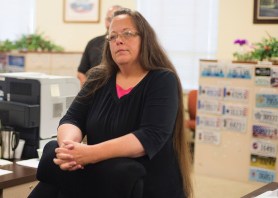
In Rowan County, KY this week, County Clerk Kim Davis has been taken to jail for refusing to issue marriage licenses to people of the same gender, claiming her Christian 150902_POL_KimDavis.jpg.CROP.promo-xlarge2convictions, based upon the Bible, forbid her condoning so-called same sex marriage, because that would violate her sincerely held religious belief that marriage always has been, and always will be, the sacred union of one man and one woman, under God. Today, she’s in jail for refusing to abide by the arm of secular law. “Count no man happy till he dies.”

As always, God taught his people about what it meant to follow him: “If the world hates you, know that it has hated me before it hated you. If you were of the world, the world would love you as its own; but because you are not of the world, but I chose you out of the world, therefore the world hates you” (Jn 15:18-19 ESV).

What do Oedipus, Chick-fil-A, and a Kentucky Christian woman share? First, be clear: Sophocles was a Greek politician, military general, and playwright, steeped in paganism and polytheism. However, for the Christian-owned Chick-fil-A and Kim Davis, they are daring to follow a crucified and risen Lord who told his followers they’d be hated because they’re not of this world. What that means is that they’re not of this world system of godlessness, of paganism, and Gnosticism—all of which attempt to deny the obvious differences between men and women, as well as their complementary roles as designed by God.

There is, to risk overstating the obvious, a reason God commanded our first parents, Adam and Eve, to be fruitful and multiply (Gen 1:28). They were designed for one another. When homosexuality, pederasty, and other abominations pervade history, God’s judgment falls (Gen 18:23-29). Since God is incapable of change (perfection cannot be improved upon) then God has not “evolved on the issue.” He has not evolved on any issue. In other words, God has not evolved.

What we are witnessing, and what more and more Christians are experiencing, is exactly what we were told we’d experience. Sophocles skirted with the truth when he penned that we should count no man happy till he dies. But another writer, the apostle Peter, martyred for his Christian faith under government persecution, was crystal clear: “Beloved, do not be surprised at the fiery trial when it comes upon you to test you, as though something strange were happening to you. But rejoice insofar as you share Christ’s sufferings, that you may also rejoice and be glad when his glory is revealed. If you are insulted for the name of Christ, you are blessed, because the Spirit of glory and of God rests upon you” (1 Pt 12-14).

“Count no man happy till he dies,” penned Sophocles. Wise counsel. However, because of Christ, and because of his conquering through pagan persecution, there is hope beyond the grave…not just for Chick-fil-A’s witness, not just for Kim Davis’ witness, but for all who will call upon the Lord as Christ. May God grant ears to hear that good news, for that news changes everything.

Too Much World

034BED83-D911-4074-801968990B8EBFDC


“The world is too much with us” is the opening salvo in one of William Wordsworth’s sonnets. Wordsworth’s setting was 1800s England. If understanding the risk of choking on this world was a real danger to one’s soul in the 1800s, how much more nowadays? Below I share an anecdote with a message I bet you already know intuitively: it’s important to simplify.

When I’m in my hometown, I have several things I do to blow off steam. First, I like to work outside in the yard. Second, I enjoy exercising/doing PT (physical training, for non-military folks). On a recent trip to the local gym where my family and I work out, I was struck by something: there was no silence. When I entered, I was overcome with the sounds of music from the overhead speakers. Moreover, on the treadmills, there perched TV screens with ports for users to plug in to watch 24/7 “breaking news,” alerts, the latest murders, protests, etc. Of course, that equipment was not new to the gym. Apparently, customers should have TV and music piped in while working out nowadays.

I went to exercise, to sweat, to push myself physically, and I could not escape media bombardment. What does it say about our culture that many people know more about Hollywood gossip (aren’t there entire shows, magazines, and even networks dedicated to this stuff?) than they do about what endures, about what matters, about what is enduringly important? Does anyone really think that the latest breaking news/alert is going to matter in the end? I fear that many people are choking on this world and missing the true, good, and beautiful. There’s too much world in our everydayness. Might we not be better to simplify, unplug some, and thereby increase our likelihood of making the best use of our time (Eph 5:16)?

I’m amazed often when someone tells me about the latest Hollywood shenanigans, and I’m lost. I could not care less who’s marrying whom, divorcing, having adulterous affairs, or what Rosie O’Donnell or Ben Affleck think about politics. Asking Rosie or Ben what they (or others of their ilk) think of political science would be akin to asking me how to repair a Porsche: no thinking person would do it.

Before I’m accused of being a Luddite, I’m not opposed to technology. I, too, spend many hours on a computer, cell phone, etc. with my various jobs and ministries. So, I’m not aiming at the very medium I’m using. Rather, I’m aiming at this question: Are we using technology with discernment or are we enslaved to the banal? In other words, what are the criteria of what’s news? What is newsworthy? May I humbly suggest that the so-called news is infinitely more about profits than discernment? How people can sit in front of TVs or the internet for hours and not feel convicted that their lives are sliding down the drain, mystifies me. Don’t they want to contribute to life? Don’t they have someone they can help? Don’t they want to volunteer at a charity? Don’t they have family or friends they can spend time with or to whom they might write a letter (remember those?)?

Now, to change the setting from our local gym to home. Recently my wife, our 8-year old son, and I were reading a book aloud together as a family. The book was a children’s classic, Hatchet, by Gary Paulsen, about an adolescent boy who is stranded in the woods of northern Canada. He struggles to survive after a dramatic plane crash. It’s a wonderful, drama-filled, imaginative story of a boy, fear, loneliness, adventures in the Canadian woods, close escapes, and discovering resilience amidst his new knowledge of the real world, etc. As the three of us took turns reading and talking about what we read, education occurred. And it involved nothing but a book, a family, and time. No TVs, no digital devices, no breaking news or updates, etc. It was simple. It was the ordinary simple ways of learning. However, I bet it’s another time that’ll endure as valuable.

The world is too much with us, I fear, perhaps more than ever. As Christ himself taught, the easiest thing to do is gain the whole world and forfeit one’s soul (Mk 8:36).