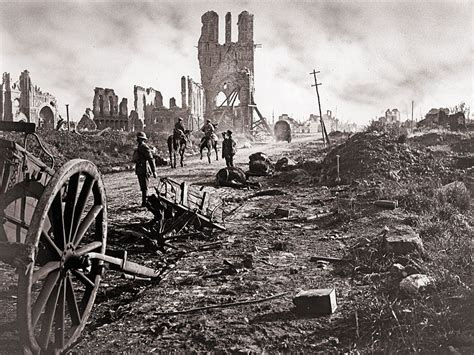
Bent double, like old beggars under sacks, Knock-kneed, coughing like hags, we cursed through sludge, Till on the haunting flares we turned our backs, And towards our distant rest began to trudge. Men marched asleep. Many had lost their boots, But limped on, blood-shod. All went lame; all blind; Drunk with fatigue; deaf even to the hoots Of gas-shells dropping softly behind.
Gas! GAS! Quick, boys!—An ecstasy of fumbling Fitting the clumsy helmets just in time, But someone still was yelling out and stumbling And flound’ring like a man in fire or lime.— Dim through the misty panes and thick green light, As under a green sea, I saw him drowning.
In all my dreams before my helpless sight, He plunges at me, guttering, choking, drowning.
If in some smothering dreams, you too could pace Behind the wagon that we flung him in, And watch the white eyes writhing in his face, His hanging face, like a devil’s sick of sin; If you could hear, at every jolt, the blood Come gargling from the froth-corrupted lungs, Obscene as cancer, bitter as the cud Of vile, incurable sores on innocent tongues,— My friend, you would not tell with such high zest To children ardent for some desperate glory, The old Lie: Dulce et decorum est Pro patria mori.
Let us not forget: this has happened before. Think it through. Adrenaline atrophies but human nature abides: Learn.
I pray for my nation but long for my ultimate, desired home. (Distinction.)
Poet, prophetic voice, soldier–speak to my generation.
The title is not meant to pilfer from the great Genesis song by the same name. It is rather to elaborate more on a theme I find myself exploring more often lately–namely, understanding the times and perhaps speaking in the future about what to do.
I was coming back from a short lunch where I’d drunk a bottle of strawberry watermelon Prime. Love that stuff. And I’d used my lunch to read some history from a slim volume I’m currently working through.
On the way back to the office, I drove down the familiar asphalt road. Pine trees lined both sides of the road, some old and some young. And the humidity was so bad, my hands were swollen and sweaty, even with the car’s air conditioner blasting. A few black clouds crept above. Feelings of foreboding.
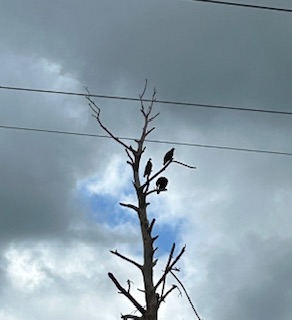
As I drove down the asphalt road, the heat waves were visible in eery throbbing images. A dead pine was on my left side. Black vultures perched on the rotten limbs.
1 Chronicles 12 records this wonderfully instructive line: “Of Issachar, men who had understanding of the times, to know what Israel ought to do …” (1 Chronicles 12:32, ESV). That line about understanding the times and knowing what to do is pregnant with implications. I think it is safe to say that the line was a commendation–to have wise leadership who understood the lay of the land.
Those ominous vultures, though I’d passed them earlier, still circled above in my thoughts.
Text: “Commit your work to the LORD, and your plans will be established” (Proverbs 16:3, ESV).
Context: The book of Proverbs is just what it implies; it’s a book of wisdom with a father addressing his son. Its purpose is to communicate how to navigate with wisdom in life, and of how and why that hinges upon doing things God’s way. The other way, the fool’s way, is to trust oneself and trust in the ways of sinners.
Teaching: The beauty of verses like Proverbs 16:3 is that it focuses the wise person’s attention on how the intent behind plans is fundamental. To whom should one commit one’s labors? To the Lord. Even before there’s a decision-making process, whether military or civilian, the intent behind the mission should be to honor God. The plans of the heart (intent) should drive direction (content).
Encouragement: No amount of externals will ever conquer the internals. Smart phones, smart bombs, and smart alecks will never conquer a rotten or cancerous heart/soul. First things first.
“For the Lord GOD does nothing without revealing his secret to his servants the prophets. The lion has roared; who will not fear? The LORD GOD has spoken; who can but prophesy?” (Amos 3:7-8, ESV)
***When you study the lives of the prophets of God, they shouldered staggering amounts of theological weightiness and truth for the people of God. And the world hated both these messengers of truth and their messages.
When Amos was writing about judgments that would befall the northern kingdom of Israel, the people largely retorted that judgments were for other nations, but surely not their own. And in 722 B.C. Assyria would topple Israel, just as the prophet Amos had written.
Again, I would argue, when you study the lives of the prophets of God, you see that they shouldered staggering amounts of theological weightiness and truth for the people of God. And the world hated both these messengers of truth and their messages.
So much depends on the receptivity (or lack thereof) of the prophets’ messages of truth.
It’s the same principle Christ taught when He spoke of the different soils. He even had to stoop to such a level as to break it down into bite-sized nuggets of truth for some people to understand:
Hear then the parable of the sower: When anyone hears the word of the kingdom and does not understand it, the evil one comes and snatches away what has been sown in his heart. This is what was sown along the path. As for what was sown on rocky ground, this is the one who hears the word and immediately receives it with joy, yet he has no root in himself, but endures for a while, and when tribulation or persecution arises on account of the word, immediately he falls away. As for what was sown among thorns, this is the one who hears the word, but the cares of the world and the deceitfulness of riches choke the word, and it proves unfruitful. As for what was sown on good soil, this is the one who hears the word and understands it. He indeed bears fruit and yields, in one case a hundredfold, in another sixty, and in another thirty. (Matthew 13:18-23, ESV)
Reminders for us: The prophets God raised up in the Old Testament are no more in the sense that Christ has come. Judgment was executed upon God the Son at Calvary for all who will be redeemed. But I would argue that God still sends prophetic voices to His creation in at least one sense–namely, in the form of discerning teachers-shepherds. One of the battles involves helping people to see the reality, to see a message, if you will, that God continually teaches in Scripture: wisdom/discernment.
Here are just a few examples:
“Be wise, my son, and make my heart glad” (Pr 27:11a, ESV)
“Look carefully then how you walk, not as unwise but as wise, making the best use of the time, because the days are evil” (Eph 5:15-16, ESV)
“How much better to get wisdom than gold!/To get understanding is to be chosen rather than silver” (Pr 16:16, ESV)
“Whoever walks with the wise becomes wise, but the companion of fools will suffer harm” (Pr 13:20, ESV)
“. . . but I want you to be wise as to what is good and innocent as to what is evil” (Rom 16:19, ESV)
Encouragement: No matter how many times one reads through the Scriptures, he finds that the Scriptures actually read him. They are where wisdom resides, in God’s revelation to us of what we are really like, why we are in the conditions we’re in, and why the macro-level issues are what they are. This is a post-lapsarian world, that should be obvious to all. But God sends us prophetic voices still in the form of wise teachers-shepherds. May we be a people who discern the genuine ones, so that we may get a heart of wisdom.
Bottom line up front: The Unfolding Plan: God keeps His Word
Historical context: “The silent years,” that’s what they’re called when we refer to the historical period between the closing of the Old Testament and the opening of the New Testament. They’re called the silent years because God did not inspire any biblical texts during that period. Malachi is the last book of the Old Testament, and he wrote at the same time as the books Ezra and Nehemiah encompass(400s B.C.). That period from the 400s B.C. to the incarnation of Christ is called “the silent years” and our calendars reflect B.C. (before Christ) and A.D. (Anno Domini, “in the year of our Lord”) to this day. But those so-called silent years were pregnant with meaning. Why? God has determined to save His people from their sins (Matthew 1:21), and He is faithful to His covenant promises to adopt a people in the Beloved (Ephesians 1:6). During those years where no Scripture was inspired, God was still at work.
More context: When Matthew’s gospel opens, the main theme he emphasizes for 28 Christ-saturated chapters, is that God’s promises are fulfilled in Christ. Christ is the promised Redeemer. He’s the One to whom all the Old Testament types and shadows pointed. He is the true and final prophet, priest, and king. He is the sacrifice that is acceptable and pleasing to God. That’s why Matthew opens his gospel the way he does–namely, with the genealogy to show that Christ is the promised Immanuel, “God with us.” To borrow Francis Schaeffer’s language, God is there, and He is not silent.
Gabriel’s announcement of Christ’s mission: “She [Mary] will bear a son, and you shall call his name Jesus, for he will save his people from their sins” (Mt 1:21, ESV). The 39 Old Testament books (Genesis-Malachi) promised the Redeemer. And the 27 New Testament books reveal that Redeemer as Christ the Lord. Promise and fulfillment. Shadows and then the substance. Promises made, promises kept.
Encouragement/takeaway: This is one of the most encouraging aspects of the Christian worldview. It’s the coherence of Scripture. The fact that Scripture has one overarching storyline, written by multiple authors, but inspired by the one God, composed over centuries and myriad cultures, but with one consistent storyline of the redeeming God.
I’m entering Matthew 21 next Sunday with the saints from class, and Matthew 21 is the beginning of Holy Week/Passion Week in church history. It’s where Christ enters Jerusalem and the crowds sing out, Hosanna! (Mt 21:9), but then they will soon be demanding his crucifixion.
Again, it was all laid out in the Old Testament—that this promised Redeemer would be born in Bethlehem, of the house of David and tribe of Judah, be rejected by sinners, pierced for their transgressions, and crushed for their iniquities, be crucified, buried, and raised again on the third day.
And just like “the silent years” were not to lead people to think that God was absent but rather to give us yet another day to see that God is executing His mission in precise detailed fulfillment. Our duty is to trust Him and to be found faithful.
Connection: Parts of the Middle East are aflame this morning. Some American cities that heralded themselves as sanctuaries are aflame, too. ‘Protests’ are predicted across certain demographics. Somehow certain people have plenty of time to organize, throw incendiary devices, demolish private property, assault law enforcement officers, and deface buildings and properties. Spray painted lewdness is included, too.
While some of us work a job, or two, or three, and provide for our families, and support our local church, etc. others somehow have time to destroy. ‘Sanctuaries’ smell of incense in some religious communities, but now these so-called sanctuaries are thick with the scents of tear gas instead. Who knows the end? I don’t. What I do sense, however, is that some people’s fuses are getting shorter. To borrow from Austen, sense and sensibility are being jettisoned and replaced with ad hominem attacks, temper tantrums, and violence.
Encouragement: God speaks to this. Will we listen to His word: “Scoffers set a city aflame, but the wise turn away wrath. If a wise man has an argument with a fool, the fool only rages and laughs, and there is not quiet. Bloodthirsty men hate one who is blameless and seek the life of the upright” (Pr 29:8-10, ESV).
It’s become cliché nowadays; you see memes and t-shirt slogans and decals with the same message, and it’s this: Stay calm and drive on. As Ecclesiastes 3 reminds us, there is a time “for every matter under heaven.” Let us pray that cooler heads prevail and that the violence will abate. May we be a people who are calm amidst the storm.
The first time I saw the Beach Boys, it was at Chastain Park in Atlanta. My Aunt Dee had turned me onto them after she’d been a student at UGA. She was listening to Squeeze, R.E.M., and others. I loved one Squeeze album in particular, several songs from R.E.M., but the band who gripped me was the Beach Boys.
The harmonies, of course; we all get that. The beach sounds; we all get that, too. But there was a tragic innocence of Brian Wilson that was endearing. It’s similar to the ways in which one might appreciate Walker Percy or Pat Conroy or Dickens in the literary medium.
Each had a slice of life he was uniquely equipped to exploit beautifully. For Wilson, it was the world of sounds.
There’s no telling how many millions of fans around the planet tonight are listening to the same album, Pet Sounds.
You were a troubled, beautiful, musical soul, Mr. Wilson. Thank you for using your gifts with us.
Have been on a Bret Lott kick lately, reading through his oeuvre. Not disappointed. Reading his body of work backwards, it’s been rewarding. I see the images, the sounds, the moods, etc. that recur.
The novel I completed this evening was the first one he published. It’s about marriage, trying to make it work, about losing a child, about how hateful spouses can sometimes be to one another, about grief and anger, and about the ache of it all.
But amidst, in, and among all of that, there is love. And friendship. And a kind word. And an invitation to go deer hunting with one’s plumber, and a revelation of hubris and human folly.
All that to say, it’s all here–in this first novel. It has its flaws, as does everything this side of Genesis 3, but it’s a fine story about tender matters. And I commend it to you.
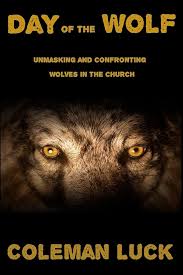
“When you want to help people, you tell them the truth. When you want to help yourself, you tell them what they want to hear” (Coleman Luck, Day of the Wolf).
Paul wrote as much centuries ago:
“For the time is coming when people will not endure sound teaching, but having itching ears they will accumulate for themselves teachers to suit their own passions, and will turn away from listening to the truth and wander off into myths” (2 Timothy 4:3-4, ESV).
Introduction: When I was in graduate school in English, one term I took an entire semester in the poetry of William Butler Yeats. It was one of the most revealing courses I ever took. Revealing in the sense that we students had to learn the intellectual and spiritual wells from which Yeats drank, in addition to learning Yeats’ body of work. We studied not only Yeats’ poetry and other writings, but also the writers that Yeats read and the ideas he imbibed. Even those who may be largely unfamiliar with Yeats may have at least some relationship with Yeats’ oft-anthologized poem, “The Second Coming.”
Text:
Turning and turning in the widening gyre
The falcon cannot hear the falconer;
Things fall apart; the centre cannot hold;
Mere anarchy is loosed upon the world,
The blood-dimmed tide is loosed, and everywhere
The ceremony of innocence is drowned;
The best lack all conviction, while the worst
Are full of passionate intensity.
Surely some revelation is at hand;
Surely the Second Coming is at hand.
The Second Coming! Hardly are those words out
When a vast image out of Spiritus Mundi
Troubles my sight: somewhere in sands of the desert
A shape with lion body and the head of a man,
A gaze blank and pitiless as the sun,
Is moving its slow thighs, while all about it
Reel shadows of the indignant desert birds.
The darkness drops again; but now I know
That twenty centuries of stony sleep
Were vexed to nightmare by a rocking cradle,
And what rough beast, its hour come round at last,
Slouches towards Bethlehem to be born?
Context:
Why do I share all this? Because even as unorthodox and convoluted as Yeats’ intellectual moorings were, his best poems (“The Second Coming” is surely one of those) do portend important themes. When I look around at all the violence being perpetrated in America’s cities by unhinged mobs, it grieves me. How does one reason with a mob? Obviously, one cannot reason with a mob, as they’ve foregone reason and descended into terror. This is what got me again thinking about Yeats’ poem.
Imagery:
The images are striking, are they not?
There’s a schism between the falcon and falconer.
A “rough beast” is slouching in pregnant terror, like a foretaste of what’s coming in formidable violence.
A “blood-dimmed tide” is washing over the shores.
On and on the images of madness and violence are put forth. Why? I would argue, to get us to see. Sometimes folks will refuse to see reality until it literally hits them in the face. It takes that for some people. When you have an undiscerning people, evil rides roughshod over the sheeple. Or as Yeats so beautifully phrased it, “the centre cannot hold” and “The ceremony of innocence is drowned.”
Takeaway:
When you study Yeats’ theological and philosophical moorings, he was awash in mysticism, the occult, some teachings of Roman Catholicism, and loads of Oneist paganism. His fractured worldview is instructive for us, though, in this regard. He understood that men can easily become beasts if and when they abandon truth and embrace the lie. This is the way Scripture teaches it:
18 I said in my heart with regard to the children of man that God is testing them that they may see that they themselves are but beasts. 19 For what happens to the children of man and what happens to the beasts is the same; as one dies, so dies the other. They all have the same breath, and man has no advantage over the beasts, for all is vanity. 20 All go to one place. All are from the dust, and to dust all return. 21 Who knows whether the spirit of man goes upward and the spirit of the beast goes down into the earth?” (Eccl 3:18-21, ESV).
Solomon’s point in Ecclesiastes is to teach that when we embrace paganism, we actually end up empty. It is when we listen to and obey God that benediction comes. That’s sounds saccharine and anemic to a world that doesn’t want to hear.
But the question remains: How’s the lie working out in the world system? How’s secularism playing out? How’s cognitive dissonance working out in L.A. right now? Why are politicians protected by men with guns, by walls around their estates, and personal bodyguards, but the mobs simultaneously decry walls and borders and law and order? As Yeats would remind us, “The best lack all conviction, while the worst/Are full of passionate intensity.” Would that we learn from Yeats and Solomon. I am weary of the blood-dimmed tide.






 MIND & MATTERS