The Import of Abraham’s Questions to God & Paul’s Words to Timothy

Introduction: You remember the discussion, right? It is one of those passages that lingers in the soul. It’s Genesis 18. It’s where Abraham pleads with God. He intercedes on behalf of sinners and a sinful civilization. And God teaches a mighty powerful lesson.

Bottom line up front: There is none righteous. That is why we must look to God, not to man, for rescue.

Here’s the second half of the chapter:

22 So the men turned from there and went toward Sodom, but Abraham still stood before the Lord. 23 Then Abraham drew near and said, “Will you indeed sweep away the righteous with the wicked? 24 Suppose there are fifty righteous within the city. Will you then sweep away the place and not spare it for the fifty righteous who are in it? 25 Far be it from you to do such a thing, to put the righteous to death with the wicked, so that the righteous fare as the wicked! Far be that from you! Shall not the Judge of all the earth do what is just?” 26 And the Lord said, “If I find at Sodom fifty righteous in the city, I will spare the whole place for their sake.”

27 Abraham answered and said, “Behold, I have undertaken to speak to the Lord, I who am but dust and ashes. 28 Suppose five of the fifty righteous are lacking. Will you destroy the whole city for lack of five?” And he said, “I will not destroy it if I find forty-five there.” 29 Again he spoke to him and said, “Suppose forty are found there.” He answered, “For the sake of forty I will not do it.” 30 Then he said, “Oh let not the Lord be angry, and I will speak. Suppose thirty are found there.” He answered, “I will not do it, if I find thirty there.” 31 He said, “Behold, I have undertaken to speak to the Lord. Suppose twenty are found there.” He answered, “For the sake of twenty I will not destroy it.” 32 Then he said, “Oh let not the Lord be angry, and I will speak again but this once. Suppose ten are found there.” He answered, “For the sake of ten I will not destroy it.” 33 And the Lord went his way, when he had finished speaking to Abraham, and Abraham returned to his place. (Genesis 18:22-33, ESV)

The type: Typologies are overt here. Abraham typifies the one who interceded on behalf of sinners to God. He was the intercessor/mediator/go-between. He loved his people, but he knew that they were just like he was, sinful.

There’s the revelation of latent works-righteousness that’s typified here, too, and their utter sinfulness to God. In his pleading on behalf of Sodom, Abraham starts at 50 supposedly righteous men. Then it’s 45. Then it’s lower still. Then again. On and on Abraham lowers the standard. Why? Because he knows no one is sufficient. The lesson is clear: none is righteous. We need to look away from ourselves, away from man-centeredness, to be saved. We must flee to God in the gospel.

Connections: If you are a Christian, you are likely involved in a church. But if we are honest, how often do we see man-centeredness in the church? Rather than a God-gifted and qualified plurality of elders to shepherd the flock of God, what can often happen is that undiscerning sheep are misled by deceptive hirelings whose god is themselves. What we are required to do biblically is to look away from ourselves, away from man-centeredness, to be saved. We must flee to God in the gospel.

New Testament Connection: I was in 2 Timothy this morning and Paul is so clear about what’s on the line. In verse 10 and following of 2 Timothy 3, Paul writes this:

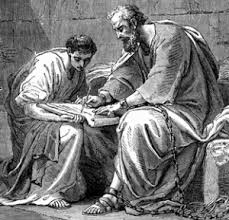
 10 You, however, have followed my teaching, my conduct, my aim in life, my faith, my patience, my love, my steadfastness, 11 my persecutions and sufferings that happened to me at Antioch, at Iconium, and at Lystra—which persecutions I endured; yet from them all the Lord rescued me. 12 Indeed, all who desire to live a godly life in Christ Jesus will be persecuted, 13 while evil people and impostors will go on from bad to worse, deceiving and being deceived. 14 But as for you, continue in what you have learned and have firmly believed, knowing from whom you learned it 15 and how from childhood you have been acquainted with the sacred writings, which are able to make you wise for salvation through faith in Christ Jesus. 16 All Scripture is breathed out by God and profitable for teaching, for reproof, for correction, and for training in righteousness, 17 that the man of God may be complete, equipped for every good work. (2 Timothy 3:10-17, ESV)

Paul tells Timothy lessons Abraham, too, learned in Genesis 18–that none is righteous, that we need to look away from ourselves, away from man-centeredness, to be saved. We must flee to God in the gospel.

Paul tells Timothy the following fundamentals:

  • Persecution of faithful Christians is unavoidable (vv. 11-12)
  • Impostors are pervasive, and will only grow more brazen (v. 13)
  • Impostors not only deceive others, but they deceive themselves. They are blind guides. (v. 13)
  • Look away from man-centered worship, and turn to God in Christ (v. 15).

Teaching: Abraham learned that God would not destroy the righteous. You know why? There weren’t any righteous. God did spare Lot and two of his children out of sheer grace. In fact, Peter would call Lot righteous in his (Peter’s) writings (2 Peter 2:7). Lot, though gravely sinful, did intercede on behalf of the angels, trying to prevent their rape by the homosexual rapists in Sodom. The principle, I would argue, is not that Lot was righteous (sinless) but that he fought the good fight in his day, though imperfectly. Like Abraham, he, too, knew he was not righteous. He, too, had to look away from himself, away from man-centeredness, to be saved. He fled to God in the gospel.

Encouragement: Abraham pleaded on behalf of those he loved. He was used by God in God’s mission of redeeming a people for himself. Paul, too, pleaded on behalf of those he loved. The letters to Timothy are among the most beautiful letters in all of Scripture and world literature. Paul loves his child in the faith. So he does what? He tells him the truth–to be discerning, to be wise, to not be sheeple who follow impostors. Why? Because, Paul writes, those are “evil people and impostors [who] go on from bad to worse, deceiving and being deceived” (v. 13). Abraham interceded; Lot interceded; Paul interceded; and Timothy went on to intercede, too. But they’re all types of the only Interceder, the Lord Jesus, who bore the wrath so that all of us who flee to Him might be spared. And to do that, we must look away from man-centered thinking, man-centered worship, man-centered impostors, and look to the founder and perfecter of our faith (Hebrews 12:1-3).

Chaplain Daily Touchpoint #264

Bottom Line Up Front: Fidelity as a Fundamental

Context: Last evening when I returned to post after a week of leave, I read 1st and 2nd Timothy again. And again, I was struck by Paul’s emphasis to his student Timothy about what is a non-negotiable for God-honoring ministry: faithfulness.

Questions: To use a cliché from the resilience world, how does one “hunt the good stuff” when corruption is pervasive? How does one not grow discouraged when it appears evil is winning, that light is being eclipsed by forces of darkness? The short answer is this: God is undefeated. Therefore, all who are in Christ are more than conquerors (Romans 8:37). Even in the dark times. Especially during those dark times, that’s when we must steep ourselves in that truth.

Here’s just one example of how Paul teaches Timothy about the link between God’s faithfulness and Timothy’s endurance. There’s a profound connection between the two things. Timothy’s endurance is to rest upon God’s faithfulness. Timothy’s identity is founded upon the fidelity of God himself:

Remember Jesus Christ, risen from the dead, the offspring of David, as preached in my gospel, for which I am suffering, bound with chains as a criminal. But the word of God is not bound! Therefore I endure everything for the sake of the elect, that they also may obtain the salvation that is in Christ Jesus with eternal glory. The saying is trustworthy, for:

If we have died with him, we will also live with him;
if we endure, we will also reign with him;
if we deny him, he also will deny us;
if we are faithless, he remains faithful—

for he cannot deny himself. (2 Timothy 8-13, ESV)

Encouragement: Paul did not sugarcoat his suffering; he did not gloss over it. He spoke plainly of it. Why? For the sake of the elect (v. 10). In other words, for all who are in God’s family. For men like Timothy, who would discover lots of heartache, just as Paul endured. Why? Because the crucible of suffering teaches us about the glories of Christ himself, who endured what we never could or would. Christ was the one who was betrayed, lied about, set up, spat upon, mocked, crowned with thorns, flayed, stripped publicly, nailed to the tree, speared in the side, whipped, and murdered. And yet the Bible says that it was all part of God’s plan. To quote Peter in Acts, “this Jesus, delivered up according to the definite plan and foreknowledge of God” (Acts 2:23, ESV). That’s very clear. The definite plan and foreknowledge of God.

In other words, no coincidences, no hope-so salvation, no open theism junk, no halfway-ness with God. In other words, God is 100% faithful, not just faithful on our good days. That’s what Paul labored so hard to teach Timothy. Why? Because it is God’s faithfulness that brings good out of evil, light out of darkness, and life over death.

Back from the Beach

Back from the beach in May of 2025. First time to that part of the Atlantic in a few years. Our first day there the skies were cloudy and it was windy. Typical of beach weather, however, the rains were hard but brief. The clouds slid across the firmament soon after emptying some of their liquid sunshine, and soon the sun reappeared. We got loads of sun. (CJ turned her usual dark brown. And I turned my usual pink and red. Mind you, we have traditions to uphold.)

In the mornings, we walked several miles down the beach and back. We spoke with fellow morning strollers. The shoreline was littered with shells in various shapes of sea-wornness. We spotted a few beached jellyfish along the way, too. A few parents were flying kites with their tykes.

When we returned, I made breakfast. Well, one morning, we went to the Waffle House just down the strand. No beach time is quite complete without a Waffle House excursion or two.

In the midday hours, we put our chairs out and unfolded the umbrella, and enjoyed the sun, sand, water, and waves. And there was no end to people-watching. I read a couple of short Bret Lott books, too, a writer I enjoy. And CJ read the Coleman Luck book I recommended to her–Day of the Wolf, an important book about the call to discernment.

Our last night we went out for our indulgences–crab legs for CJ and raw oysters and shrimp for me. We went to an all-you-can-eat seafood place on the main drag. (It is quite possible you may see a spike in seafood prices soon. CJ may’ve depopulated the crab population to dangerously low levels. And I consumed about 60 oysters before I stopped counting. So, you’ve been warned.)

There was a massive live oak just outside our place. Strings of white lights were strung along most of the limbs. Underneath the giant people had put out Adirondack chairs and benches, too, and built wooden benches and a handrail, too.

Our son is returning from one of his summer trips today, too; so, it’ll be good to be home together soon.

We fed the pigeons and gulls some, too, between breaks in the water.

Sunday we’ll celebrate CJ’s birthday with friends, after Breakast Sunday with the saints from Sunday school class.

I piddled in the woods around the house some after we returned, and woke to find deer enjoying my bird seed I had put out.

Now it’s time to nurse my pink and red skin, finish a book, play with the family pets, and be thankful for the times of refreshment. Grateful.

Chaplain Daily Touchpoint #263: Godly Distinction: Christian Beauty in a World Cursed by the Ugly

Issue: Godly Distinction: Christian Beauty in a World Cursed by the Ugly

Slice of Life: Yesterday at PT, I was jogging my favorite trail on post. The reason it’s my favorite is because much of it parallels a creek that runs almost all year. In the driest days of summer, it will sometimes stall; but when the next thunderstorm comes, it’s running again. To the sides of the creek are some of my favorite trees and shrubs and vines: myriad oaks, dogwoods, magnolias, and massive sycamore trees. And along the edge of the trail, currently the honeysuckle, jessamine, and blackberries are growing. The May air is thick with the scents of honeysuckle and yellow jessamine. I imbibed both each time I passed that side of the creek. And when I ran under the massive sycamores, my memory took me back to Grandma and Granddaddy’s place, where Granddaddy had a massive sycamore on the east side of his house, and it’s still there today, towering over that property, even though Grandma and Granddaddy have since passed. But I’ve many fond memories of hunting Easter eggs under that tree and around all the azaleas and monkey grass they throughout the yard. Such simple pleasures and simple memories.

Two Ways of Being: There is much beauty about still, but you must be able to see it. When I checked the news this morning online, the first headline was of two murders in our nation’s capital city. Two Jewish employees were murdered by another Islamic terrorist. This scenario gets played out so often, I suspect many have grown cold to it. The tragedy gets politicized, lots of shouting and cursing one another’s sides occurs, and the headline fades as quickly as it appeared. Meanwhile, two more young people have been murdered. The temptation is to give in to the forces of darkness, to throw up our hands and gasp, “It’ll never change. This is just our world now.” Well, it will be if good people remain silent. My prayer is that we won’t, however. You don’t conquer darkness by hiding the light. Christ teaches clearly on this theme.

Text: “You are the light of the world. A city set on a hill cannot be hidden. Nor do people light a lamp and put it under a basket, but on a stand, and it gives light to all in the house. In the same way, let your light shine before others, so that they may see your good works and give glory to your Father who is in heaven” (Matthew 5:14-16, ESV).

Encouragement: We were told in that in this world we would battle trouble (John 16:33) due to the Fall. The cosmos groans under a curse; again, we were told this up front (Romans 8:22-23). Nevertheless, the Christian is called to be a light in the darkness, (Matthew 5:14-16), a fragrant aroma (2 Corinthians 2:15-16). Rather than succumbing to the forces of evil, rise above them, much like those giant sycamores and majestic oaks I love so much, rise far above the floors of the forest, making the jogs that much sweeter.

The ‘D’ Word: Some Biblical Analysis

Context, Context, Context: Will We Notice the Motives of the Enemies of Christ?


The Pharisees’ Stated Issue: Divorce


The Real Issue: Sin


Text: Matthew 19:1-12


Historical context: Jesus was closer and closer to his crucifixion. He had completed his public ministry in the northern parts of Israel (Galilee) and had set his face towards Jerusalem, where he would give his life as a ransom for many (Mark 10:45). The confrontations with Pharisees and scribes and others hostile to the truth were approaching a boiling point.


V. 3 of Matthew 19 is so important to read carefully: “And Pharisees came up to him and tested him by asking, “Is it lawful to divorce one’s wife for any cause?” (Mt 19:3, ESV). Did you catch it? To test Jesus.

Their motives were not about theological accuracy. You don’t have to do a whole lot of research of 1st century Judaism to see that divorce was rampant, that women were of little value in Judaism, that divorces under Rabbi Hillel’s teachings were permissible for a wife even burning her husband’s breakfast or for anything the husband deemed an indiscretion. In the stricter Rabbinical teachings of Shammai, the conditions for divorce were more limited to what the husband considered sexual immorality. The sects within Judaism were in conflict with one another. So, what was the motive of the Pharisees? To test God.

The same Moses to whom the Pharisees refer in Matthew 19 also wrote this: “You shall not put the Lord your God to the test, as you tested him at Massah” (Dt 6:16, ESV). Interesting how those whose motives are to trap Jesus fail to cite that verse. Why might that be?


So, what did Jesus do? He took them right back to God in the creation, back to the Scriptures, not to extrabiblical Rabbinical traditions of sinful men. Here was Jesus’ response: “Have you not read that he who created them from the beginning made them male and female . . .” (Mt 19:4, ESV). In other words, Moses came much later in the history of redemption. The Fall happened in the garden, and it changed everything that came afterwards. Man’s sin is the underlying reason that God allows divorce. Moses provided reasons for it; Jesus provided reasons for it; Paul provided reasons for it, etc.


Jesus drives the point home further in v. 8: “Because of your hardness of heart Moses allowed you to divorce your wives, but from the beginning it was not so” (Mt 19:8, ESV).

God ordained marriage between one man and one woman (Gen 1:27-28; 2:24; Mal 2:14; Mt 19:6). And God hates divorce (Malachi 2:16). And yet God allows it under certain circumstances. The point Jesus makes again and again to the Pharisees is that divorce, like other sins, is a consequence of man’s moral rebellion against God; we are hard-hearted (sklērokardia). That’s the word Jesus uses in v. 8.

Some people would like to make divorce the unforgivable sin. Or they labor to put a scarlet letter upon divorce, such that it’s “the really bad sin” but their own sins of legalism and pride are mere trifles, of course. They’re experts at seeing the speck in others’ eyes, but blind to the beams in their own eyes (Mt 7:3).

Again and again, Jesus drives home the point: Our fallenness, our hard-heartedness, is the crucial sin for which we need new hearts. And that heart transplant comes by way of the gospel of Jesus Christ (2 Cor 5:21).

Encouragement: I know many, many people who have been divorced. And you know what? They’re sinners–just like you and I are. But they’re not less valuable people. Let us not forget that. Christ came into the world to save whom? Sinners (1 Timothy 1:15). Let us not erect barriers to forgiveness that Christ has demolished. Otherwise, we’re just like the ghastly Pharisees Jesus rebuked in the gospels.

Chaplain Daily Touchpoint #262: Praying Against Evil & Evildoers

Issue: Praying Against Evil & Evildoers

Questions: Do we have warrant for praying against evil and evildoers? Do we have historical examples of praying against evil and evildoers? Are we not in fact instructed to pray against evil and those who perpetrate it? Yes, we have warrant. Yes, we have historical examples. And yes, we are instructed to pray against evil and those who perpetrate evil. Below are two examples from David and two examples from Christ:

  • “Deliver me, O LORD, from evil men; preserve me from violent men, who plan evil things in their heart and stir up wars continually. They make their tongue sharp as a serpent’s, and under their lips is the venom of asps” (Psalm 140:1-3, ESV).
  • “Grant not, O LORD, the desires of the wicked; do not further their evil plot, or they will be exalted!” (Psalm 140:8, ESV).
  • “I do not ask that you take them out of the world, but that you keep them from the evil one” (John 17:15, ESV).
  • “Be gone, Satan! For it is written, ‘You shall worship the Lord your God and him only shall you serve.’ Then the devil left him, and behold, angels came and were ministering to him” (Matthew 4:10-11, ESV).

The first two examples are from David. David, though a fallen man, a man who had one of his own military men (Uriah) set up to be murdered, a man who was an adulterer, a man who failed as a dad, especially with his son Absalom, was nonetheless a contrite man, a broken man, a man redeemed by God. One cannot read the 51st psalm, e.g., without feeling the depth of David’s humility and brokenness before the Lord. And in Scripture, David is called a man after God’s own heart (1 Samuel 13:14; Acts 13:22). David, though fallen, was redeemed. And as a redeemed sinner, he prayed against evil and evildoers (Psalm 140).

The second two examples are from Christ himself. Jesus, the second person of the triune God, had taken on flesh in the incarnation. The holy One of God had condescended to us sinners. In his prayer from John 17, in what’s often called the High Priestly Prayer, because one of Jesus’ mediatorial roles is that of the High Priest who intercedes on behalf of those he represents to God, he prays protection from the demonic.

Christ is our mediator, Scripture teaches (1 Timothy 2:5-6). Jesus prayed that his followers/disciples/Christians would be kept from the evil one, i.e., Satan. And when the disciples asked Jesus to teach them to pray, part of his model prayer for them included to pray to not be led into temptation but to be delivered from evil (Luke 11:1-4).

Encouragement: So, should we pray against evil and evildoers? Yes. Do we have multiple examples in Scripture of Christ, the disciples, Old Testament saints, apostles, and believers praying against evil and workers of iniquity? Yes. Has God promised that all who are in Christ will be kept by God’s power against the forces of hell? Yes (John 6:37-40).

In my own life, I have found that God draws me to himself often through the crucible of suffering wherein I will see the evil that is pervasive. If people don’t see the spiritual warfare we are all in, they are blind (2 Corinthians 4:4). Therefore, we should align with the spirit the disciples had that day when they said to the Lord Jesus, “Lord, teach us to pray.”

Chaplain Daily Touchpoint #261: Responses to Truth-tellers

Bottom line up front: Responses to the truth-tellers

Illustration: On my way to post the other day, I had a 3-hour drive. It had recently rained. The roads were wet across much of the state. But that did not seem to slow enough drivers down. I witnessed the wreckage of multiple crashes on the drive down. Maybe it’s because I’ve driven these roads for so many years, but I can almost guarantee that you’ll see crashes and skid marks and ambulances and firetrucks on just about any day you drive in or around metro Atlanta, especially if it’s raining or has recently rained. Many folks just refuse to slow down.

Anyway, when I had gotten through the city and was on I-85 south, I thought I had seen all the crashes I was going to see for this Sunday. But I was wrong. When I neared the 85 and 185 split, a driver headed north had apparently hydroplaned with his car on the interstate. His car had turned 180 degrees and crashed into the median, but not before a line of drivers behind him crashed into one another like dominoes. Flames issued from the first car, even in the still-humid thick air. The traffic headed north was at a complete standstill, except for the GHP, firetrucks, EMS, wreckers, and ambulances. They were all racing up the side of the highway, trying to get to survivors and to whatever/whomever else remained.

And it all got me thinking: If people died in that horrible incident, had they given any thought to ultimate matters that day? Had they even crossed their minds–questions about God, about their souls, about the brevity of life? I don’t know, but is it not worth asking?

Teaching: In Isaiah 62:6, God says there, “On your walls, O Jerusalem, I have set watchmen; all the day and all the night they never be silent” (Isaiah 62:6a, ESV). Much of Isaiah is written in poetic, figurative language, but all he is saying there is this: God sends truth-tellers into his world, into our lives. But we’re not promised them indefinitely. In other words, we’ve all got a due date. And I think it is only wise for us to face that reality while we can and get things right.

Encouragement: I have no idea if or how many people died Sunday on the interstate that I (and thousands of others) drive every week. But I cannot shake the image of those burning cars from my mind’s eye. The cars were just metal and plastic and rubber, but they contained men and women, boys and girls, who were created in God’s image, and I wonder if they knew the truth and heard the truth savingly, before it was too late.

God has sent his prophetic truth-tellers to us, again and again. How did we treat them? God says it this way through his prophet Jeremiah: “I have sent to you all my servants the prophets, sending them persistently, saying, ‘Turn now every one of you from his evil way, and amend your deeds, and do not go after other gods to serve them, and then you shall dwell in the land that I gave to you and your fathers.’ But you did not incline your ear or listen to me” (Jer 35:15, ESV). Cemeteries are filled with folks who thought those are just for other people. We should listen and heed God’s truth-tellers, for we know not when the rains may fall.

Chaplain Daily Touchpoint #260: Thoughts Upon Our Foundation

Questions: How important is our spiritual foundation? How important should it be?

Context: In Christian theology, one of the core attributes we see revealed repeatedly in Scripture is that God knows everything (omniscience). Is it not both prudent and wise, therefore, for us to look to the One who is omniscient? Asked another way, should not the wise person build upon the foundation of the One who knows all, the Creator of all things?

Text: I love the way David phrases it in Psalm 139:1-18:

O Lord, you have searched me and known me!
You know when I sit down and when I rise up;
you discern my thoughts from afar.
You search out my path and my lying down
and are acquainted with all my ways.
Even before a word is on my tongue,
behold, O Lord, you know it altogether.
You hem me in, behind and before,
and lay your hand upon me.
Such knowledge is too wonderful for me;
it is high; I cannot attain it.

Where shall I go from your Spirit?
Or where shall I flee from your presence?
If I ascend to heaven, you are there!
If I make my bed in Sheol, you are there
!
If I take the wings of the morning
and dwell in the uttermost parts of the sea,
even there your hand shall lead me,
and your right hand shall hold me.
If I say, “Surely the darkness shall cover me,
and the light about me be night,”
even the darkness is not dark to you;
the night is bright as the day,
for darkness is as light with you.

For you formed my inward parts;
you knitted me together in my mother’s womb.
I praise you, for I am fearfully and wonderfully made.
Wonderful are your works;
my soul knows it very well.
My frame was not hidden from you,

when I was being made in secret,
intricately woven in the depths of the earth.
Your eyes saw my unformed substance;
in your book were written, every one of them,
the days that were formed for me,
when as yet there was none of them.

How precious to me are your thoughts, O God!
How vast is the sum of them!
f I would count them, they are more than the sand.
I awake, and I am still with you.

Teaching: What we see in Psalm 139 are the heart and mind of a man who has been gripped by God. God is not just a name David throws out there like Hollywood actors might throw out a pittance of appreciation when accepting a prize. God is not a t-shirt slogan or lettering on a rubber bracelet. In Psalm 139, we see a man with a heart and mind renewed by God such that the tone and timbre of David’s theology here are those of benediction. David knows that God sees him through and through. And so, David is a humble man. Why? Because he knows God is holy and that none of us escapes God. We cannot outrun God.

David, in talking to the Lord, says that the Lord “formed [his] inward parts” and “knitted [him] together in [his] mother’s womb” (v. 13, ESV). That’s an intimacy that staggers the mind. I remember when I was in graduate school many moons ago, and where I went to university, we were just a few miles from the Blue Ridge Parkway. We would hike the trails often that wind through the Smokies and much of the Appalachian Trail. But if night came sooner than we planned for, when darkness fell upon us, and those stars became visible on clear nights, and the moon glowed in its ghostly light over those magisterial hills and forests, it all humbled us. Why? Because we realized—time and time again—that God is so much bigger and more majestic than we often understand. The stars and planets and galaxies stretched on and on. Their Author is greater still. Who laid the foundation of all that we beheld on those starlit nights in western NC? It wasn’t us. It wasn’t David in Psalm 139.

Encouragement: When it comes to our spiritual foundation, we often don’t know how desperately we need it until we’re amidst times of duress or suffering. And those times invariably come. How vital, therefore, for us to build upon the Rock rather than shifting sands. As David penned in v. 14 of Psalm 139: “I praise you, for I am fearfully and wonderfully made” (Psalm 139:14, ESV). David knew the Foundation was not wish fulfillment, or psychological mumbo-jumbo, or pep talks, but rather the One who says, “ Come to me, all who labor and are heavy laden, and I will give you rest” (Matthew 11:28, ESV). The Foundation is not only there, but He welcomes us pilgrims all the way home.

Chaplain Daily Touchpoint #259: Lessons from Balaam

Bottom line up front: Faithfulness when no one’s watching

Text: Numbers 22

Context: It is too long of a chapter for such a forum as a blog/email, so here’s the summary: God is faithful to his covenant promises. Israel was camping in the plains of Moab, just north of the Dead Sea. The people of Moab had heard of God’s mighty works for Israel. So, the enemies of God (personified in the Moabite king Balak) tried to bribe one of Israel’s leaders (Balaam) so that Balaam would curse his own people (Israel). Initially, Balaam resisted the temptation. But after Israel’s enemies upped their offer of remuneration, Balaam opened the door to the enemies of Israel. But he was very sneaky in the way he did it. He cloaked it in spiritual-sounding language: “So you, too, please stay here tonight, that I may know what more the LORD will say to me” (Numbers 22:19, ESV). But here’s the rub: God had already told him clearly not to go with Israel’s enemies, not to give the enemies a foothold, and not ever to curse what God has covenanted to bless: “You shall not go with them. You shall not curse the people, for they are blessed” (Numbers 22:12, ESV).

Encouragement: Balaam was ultimately humiliated. Why? Because he gave in to temptation. He gave in to the lure of wealth. He gave in to his lust for his own comfort. He put himself (i.e., his own self-interest) before those he was to represent. Rather than being faithful when he thought no one was watching, he tried to minimize the fact that the Lord is always watching. The Lord does not sleep or slumber. He sees all. And so, we should labor to be faithful when we might be tempted to think that no one is watching. Why? Because we’re called to the highest standard of fidelity—God’s. In short, there was more than one ‘donkey’ in Numbers 22. There was the four-legged beast who was saddled with leather, but also the one who sat upon the leather saddle. Faithfulness is all.

Forebodings

My aspens dear, whose airy cages quelled,
Quelled or quenched in leaves the leaping sun,
All felled, felled, are all felled;
Of a fresh and following folded rank
Not spared, not one
That dandled a sandalled
Shadow that swam or sank
On meadow & river & wind-wandering weed-winding bank.

O if we but knew what we do
When we delve or hew —
Hack and rack the growing green!
Since country is so tender
To touch, her being só slender,
That, like this sleek and seeing ball
But a prick will make no eye at all,
Where we, even where we mean
To mend her we end her,
When we hew or delve:
After-comers cannot guess the beauty been.
Ten or twelve, only ten or twelve
Strokes of havoc unselve
The sweet especial scene,
Rural scene, a rural scene,
Sweet especial rural scene.

(G.M. Hopkins, “Binsey Poplars,” 1879)