
















In a word, yes.
Sometimes when you watch your children, you see they’ve surpassed you–in height, speed, talents, etc. This week I’ve been able to step away from work and watch my boy. He discusses his passion for music and his calling into the world of ministry via music. It is a beautiful thing to see and hear. May the Lord call him irrevocably to Himself and make him faithful to his appointed end.



Some scenes from recent days in the Smokies follow. I will upload a few shots over coming days. There are too many for one post on my blog.
It is hard for me to overestimate how much this place means to me. Something about it touches what Scripture calls the inner man and what pagan poets even term the soul.
Thankful to the Lord for this place and for precious people with whom to appreciate it.
I know that I’m just one man, but my prayer is that each generation would protect and preserve such beauty and know such joy.
A special thank you to Peter, too, my old buddy from my seminary days, for his continued kindness and wisdom, and for his allowing us to enjoy his cabin.










Introduction: I was reading Jeremiah 20 again and again. Why? Jeremiah was ministering at a time (500s B.C.) when Judah continued its spiritual and moral decline. They’d grown spiritually fat and happy, so to speak, thinking judgment would not really fall. Enter Jeremiah, God’s man.
Historical context: Jeremiah had the divine but difficult commission to tell the truth about his times. He was like the men of Issachar in that he understood the times and knew what the nation should do. But knowing that, and being faithful to herald that message, entailed many risks and great suffering. (Sound like the gospel, perhaps?) Scripture is one coherent story; it all hangs together.
The religious leadership in Jeremiah’s day was especially corrupt. Those who are supposed to be set apart for leading people in the things of God were the most morally compromised and corrupt. Therefore, they hated the truth-teller, Jeremiah. That’s what Jeremiah 20 is all about. But Jeremiah was faithful to his call from God. He had counted the costs of being a disciple of God.
Text: “But the LORD is with me as a dread warrior; therefore my persecutors will stumble; they will not overcome me. They will be greatly shamed, for they will not succeed. Their eternal dishonor will never be forgotten” (Jer 20:11, ESV).
Teaching: The true prophet of God (Jeremiah) calls the Lord a dread warrior. In other words, God’s a warrior. He is fierce. He is a fighter for light and truth. He is sovereign and the king. Though sin darkens the souls of men, though spiritual wickedness infected the religious leadership, God was still God and still had his prophetic truth-teller Jeremiah to herald the truth of God in an environment where most did not want to hear it. But here’s the good news: some did long for the truth and did have the intestinal fortitude to receive it and live by it. There’s always a remnant, in short, due to God’s sovereign grace.
Most will take the broad way of destruction; that is the clear teaching of Scripture (Matthew 7:13-14, e.g.). But some will recognize the darkness and turn to the light. Why? Because they, like Jeremiah, understand that God is their Dread Warrior.
Encouragement: Scripture teaches “It is a fearful thing to fall into the hands of the living God” (Hebrews 10:31). Why? Because God is the Dread Warrior. That reality should drive us to God, not away from God, when we realize that God’s grace is extended to us in the Gospel. Jeremiah would go on and on in his ministry to teach faithfullly. He labored profoundly to reach the people. He loved them enough to warn them of the biblical commands to discern the true from among the false. And Jeremiah’s one of the greatest of the prophets in history. Why? Faithfulness. It comes down to that. He knew God was his Dread Warrior, and that there’s no ultimate success in hiding from Him.

My favorite time of day is the 30-45 minutes before the sun rises and the first moments afterwards. Especially on clear mornings. That was the case again recently on a flight. I’d gone out to Texas and then Arkansas to minister to some fellow soldiers. On the flight back into Dallas, Texas we were still over Arkansas below. The sky was clear, the sun was emerging, and all seemed irenic. Though the flight was full, folks were getting along and mostly patient with one another. (If you fly often, you will discover such characteristics are not always prevalent.)
Anyway, we landed in Texas safely and I had about an hour before my connecting flight to Atlanta. I patronized a bagel shop for a bottle of water and a breakfast bagel, walked to my gate, and sought a chair to sit down in and eat while waiting for my flight. From the looks of it, this flight to Atlanta was going to be full, too. It is July, after all, and I suppose many folks are vacationing.
When I wathced the people, it was clear who’d been to the beaches or other sunny destinations. The girls and women had on their loose-fitting clothes and their skin was brown with summer. And the boys and men often wore t-shirts and shorts, often with a cap of some sort, with place names like Cancun, Miami, or Cabo Wabo embroidered thereupon.
My eyes perused the terminal for a seat, and I finally spotted two empty ones. I pulled off my backpack and put my backpack down in one seat and I sat in the one next to it. I unwrapped the foil and began to munch on the breakfast bagel and drink the bottle of water. As I finished the breakfast sandwich, I rose from my seat and walked over to the trash bin to discard the foil wrapper and put the now-empty water bottle in the recycle bin for plastics. But as I returned to my seat, something caught my eye. Sticking out from under my backpack was a wad of cash. I simply had not seen it when I took my pack off and placed it in the seat. When I spotted the wad of cash now, I picked it up and asked the people around me, “Excuse me, do you know who this belongs to?” but each person denied knowing who it belonged to.
I put the wad of cash back on the seat, but kept looking around the terminal. Surely, someone will come back looking for this, I thought. Plus, there are cameras everywhere in airports. Surely, it should be discoverable how someone dropped this, forgot it, or exactly what had happened.
But I kept looking around. As people came and went, several times I saw their eyes fall upon the wad of cash, but I just left it there, hoping the rightful owner would return.
Another 40 minutes passed, and still no one appeared for the wad of cash. Finally, the girl’s voice came on the intercom, announcing it was time for my group to board the flight to Atlanta. I picked up my backpack and slung it over my shoulders and boarded.
As I flew back, and the sun rose, I read my book. But my thoughts kept returning to that wad of cash. I wish I knew that righteousness would prevail, that the rightful owner returned, that the good would come out on top. But I just don’t know.

Introduction: I had flown to Texas and then to Arkansas to minister to fellow soldiers. I was in my element–mobile, teaching military personnel, and teaching on topics near and dear to my heart: spiritual readiness and spiritual fitness. I was thrilled to come to see this set of guys again. It had been several months since I had been able to pour into them and to just be with them. They’re among my favorite soldiers–good ‘ole boys from Arkansas, Texas, and Oklahoma, mostly. Salt of the earth patriots. My kind of people.
A few hours later, the American flight landed in Dallas. I had an hour or so to kill until my next flight. I found an open chair and resumed the book I’d read on the flight. I only had a few pages left, and I finished the book.
I’d had to wake at 0130 back in Georgia in order to be at the Atlanta airport at 0330 for American’s first a.m. flight to Dallas. All had gone well so far, though. There was scant traffic at that hour, and I had no significant hassles to speak of, even at Atlanta’s airport.
Anyway, the flight had landed in Dallas, just as the sun was coming up. As far as you could see, it was flat and already hot, even at dawn. I’m not wired for July heat in Texas or much of July heat anywhere else, but that’s another story.
Closer than I Thought: When I took another flight to my final destination, I picked up my ride. My lodging was not ready yet, so I drove to a local bookstore to peruse the shelves. I found a book of Faulkner stories. I’ve read Faulkner for decades now, and respect him now as always. A giant of literature.
Anyway, I gripped the book of Faulkner stories in my right hand, retrieved my wallet with my left hand, and walked to the front counter to pay. A petite brunette with a ponytail and black Books-A-Million t-shirt rang me up.
“Could I interest you in a membership card?”
“No thanks.”
“How’s your day going so far?”
“Fine,” I said.
“Just relaxing, eh?”
I just smiled. I sometimes struggle to engage when the conversation is about drivel. Say something significant, or I’m likely to check out.
“Could I interest you in a gift card?” she continued.
“No thanks.” Honestly, I was starting to get annonyed. Just let me pay for the Faulkner book and be on my way, I thought.
“I had to park close to the store this morning,” she said.
“Sorry?”
She kept cutting her eyes to the left, signaling me somehow.
“My husband … he told me to park right in front of the store,” she said.
I was completely lost as to what she was driving at.
She whispered, “We found out. There’s a man with a warrant between us and the store next door. The cops are on their way. My husband told me to park close to the front of the store, so I did.”
“Oh,” is all I could think to say.
I looked down at the little black pad for me to pay. The total appeared; I tapped my debit card.
“Receipt?” she asked.
“No thanks.”
I walked out, the hot sun blaring down already, my Faulkner book in my right hand. I noticed a silver Nissan by the Books-A-Million, near the bookstore’s entrance. I assumed it belonged to the girl at the register. I sat in the car for a few moments. Waiting. For something. Cops to show? A criminal to become visible to me? I waited. Nothing. No cops that I saw. Perhaps they would come circumspectly, in unmarked clothes and plain clothes. I waited some more. Still nothing.
I sat in the driver’s seat, the A/C on blast.
Here I was, out here to teach fellow soldiers about spiritual readiness and spiritual fitness, and I’d just listened to a girl tell me that a criminal was steps away, a man with a warrant out for his arrest.
I got notice: my lodging was ready. I scanned the parking lot again. I think I was looking for a man to walk in the Books-A-Million, a shady-looking guy, perhaps, but no one entered the store since after I exited.
Reluctantly, I pulled out of the bookstore parking lot and onto the road that led to my lodging. But I am still wondering what happened/didn’t happen.

Amuse-(vb.) “To divert the attention, beguile, delude,” from Old French amuser “fool, tease, hoax, entrap; make fun of,” literally “cause to muse” (as a distraction), from
Discern-(vb.) “To perceive or recognize the difference or distinction between (two or more things);” also “distinguish (an object) with the eyes, see distinctly, behold;” also “perceive rationally, understand;” late 14c., from Old French discerner (13c.) “distinguish (between), separate” (by sifting), and directly from Latin discernere “to separate, set apart, divide, distribute; distinguish, perceive.”
Introduction: When I was a college kid, there was a popular grunge band named Nirvana. I never cared anything for their music, but I do remember a lyric from one of their songs some of my peers played often: “Here we are now; entertain us. I feel stupid and contagious. Here we are, now; entertain us.” Well, there you have it.
Connections to Depth: Over the last many months in teaching through Matthew’s Gospel to the saints, again and again I discover that Scripture is replete with the command for Christians to be a people of discernment. We are commanded to be a people of wisdom and depth. We are not to be children in our thinking. Here’s how Paul penned it: “Brothers, do not be children in your thinking. Be infants in evil, but in your thinking be mature” (1 Corinthians 14:20, ESV).
Samuel Johnson wrote that discernment is “the power to tell the good from the bad, the genuine from the counterfeit, and to prefer the good and the genuine to the bad and the counterfeit” (see Bowell’s Life of Johnson).
Remember when Paul wrote to the Christians at Philippi? Do you remember what he wrote? Here’s just a sample. Again, it’s about discernment:
And it is my prayer that your love may abound more and more, with knowledge and all discernment, so that you may approve what is excellent, and so be pure and blameless for the day of Christ, filled with the fruit of righteousness that comes through Jesus Christ, to the glory and praise of God (Philippians 1:9-11, ESV).
There’s a world of difference between amusement and discernment. The word amuse literally means “to not think.” A is the negative in Greek. And muse means “to think.”
As a publication of a few years back was titled, Let My People Think. To that, all I can say is, yes and amen.

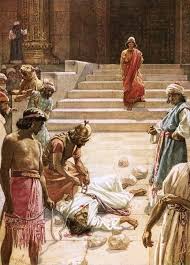
Bottom line up front: Killing the Truth-teller
Context: 48 hours before the execution of the Christ. Antagonism towards God the Son incarnate had reached a fever pitch. Pharisees, scribes, and Sadducees, and other religious hypocrites, especially, demonstrated a hatred of Jesus unparalleled in its fierceness except perhaps by Satan himself.
Question: Will we learn from Jesus’ rebuke? Below are Jesus’s words. Remember: This is just hours before He’ll be flogged, spat upon, stripped, mocked, and crucified publicly.
Text: “O Jerusalem, Jerusalem, the city that kills the prophets and stones those who are sent to it! How often would I have gathered your children together as a hen gathers her brood under her wings, and you were not willing!” (Matthew 23:37, ESV)
Teaching: Did you catch the rebuke that Jesus pronounced? The center of religiosity, Jerusalem, with all of its robed religious leaders, with all of its learned lawyers, theologians, teachers of the Law, scribes, etc. this center of religiosity was known for what? Killing the prophets. Stoning the truth-tellers. For shutting up the truth in order to preserve its traditions that damned souls.
Takeaway: How do we respond when God graciously sends a truth-teller into our midst? Do we embrace him? Learn from him? Do we return to God? Do we demonstrate a spirit of humility? Do we train ourselves in the powers of discernment? Or do most folks do what Jerusalem did when Jesus rebuked those who should have seen the judgment they were invoking on themselves for their rejection of the ultimate truth-teller, the Lord Jesus? If you want to see where people stand theologically with God, look how they treat the truth-tellers.

Bottom line up front: A Conversion Story
Context: Just for the sake of candor, Ecclesiastes is probably my favorite book of Scripture. It is part of the Wisdom Literature of the Old Testament, so that is appealing to me. And it’s highly literary; that also appeals to me. Plus, it is penned by one who lived life to the max, and eventually found out the hard way that wisdom is found not in indulgence but in God. That, too, appeals to me.
Solomon, for all his faults, was a man who laid it out bare. As I’m wont to say, he went from hero to zero (and back again) many times. But the context of the one verse I want to look at today concerns the conversion of R.C. Sproul, indubitably one of the 20th and 21st centuries’ greatest theological minds. R.C. said he was converted by God, and Ecclesiastes 11:3 was instrumental in that conversion.
Text: “If the clouds are full of fain, they empty themselves on the earth, and if a tree falls to the south or to the north, in the place where the tree falls, there it will lie” (Eccl 11:3, ESV).
Takeaway: One might scoff and mutter, “Really? That verse? Are you kidding me?” But slow down and think. What’s the book of Ecclesiastes about? Vanity of foolish pursuits vs. fulfillment in God. Wisdom vs. folly. Under the sun vs. under the Son. And so when Sproul’s friend confronted Sproul with Ecclesiastes 11:3, God used the word picture in that verse to quicken Sproul’s soul. He (Sproul) saw that if he continued to live a life of self-indulgence, it was just so much vanity and futility. He would be like that tree that fell in the forest of the cosmos–utterly insignificant. But if he understood that he was not just a random collocation of atoms, if he understood that he was created in the image of the sovereign God, suddenly everything made sense. And Sproul was converted, and he became a massive influence on his and subsequent generations.
Here’s the way one writer describes this event: “A fellow student of R.C. Sproul read this verse to Sproul while the latter was a freshman in college in September 1957. Sproul was immediately convicted, seeing himself as a dead tree, fallen and rotting on the ground. After a few hours of wrestling in prayer, seeking the mercy of God, R.C. Sproul was converted. He later confessed that he is likely the only person in church history to have been converted by this verse.”
Let us not underestimate God.
 MIND & MATTERS