What a week. As a family, we had to put down our old but beloved German shepherd Brewster. He was as fine a dog–better even–than we could have ever asked for. We miss you, old buddy.
Second, I was blessed by reading a few (mostly) short books this week, among others. The first is one of my favorites, a Reformed classic and summary of what it means to be a Christian. It is unadulterated biblical doctrine about sovereignty, providence, the order of salvation, preservation, etc. A classic.
The second was a brief, clear, basic introduction to Christianity, and the biblical worldview’s responses to commonly asked questions. This is a very easy read and written in a manner to appeal to honest skeptics of the Christian faith and/or to new Christians. I know the author personally; he is a good man, a fine chaplain, and the real deal. This could be a good starting resource for those with little or no theological training, but who are open to the truth.
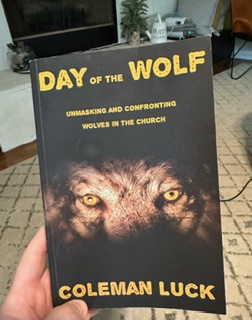
Third is a book by Coleman Luck that I heard about through the revelations that continue to be disclosed regarding McLean Bible Chuch’s David Platt and other “Big Eva” ‘leaders’.
Here again is another fine work written in a clear and practical style. Thankful for Luck’s honesty and courage to pen this needed resource for those who love the truth and the true church.
Fourth, looking forward to enjoying a concert tonight by one of my favorite groups. What’s more, they are playing in my favorite musical venue, too. Plus, I get to take my favorite girl. Should be great fun.
Lastly, looking forward with gratitude to baptizing two saints from my Sunday school class this Sunday as the church gathers. They are taking steps of obedience, and I am humbled to be part of celebrating God’s work in their lives.
“Twas a rough week emotionally. Had to put down our aged German shepherd, Brewster, after about 15 years together. He was my buddy. He put a lot of miles in hiking with me, walking with CJ, playing with the kids as they grew up, and shedding more than a little hair in the houses during that time. I have had a lot of dogs, and have loved them all, but you were special. I’ll miss you, old buddy. You were everything a man could wish for in his dog.
As I took off this morning, the predawn over the Upper Midwest cheered me, though, as if a reminder of provision.
Introduction: It follows one of the most dramatic events in the Old Testament. Elijah has just been used by God to humiliate the false prophets of Baal (1 Kings 18). It is impossible not to respect Elijah’s courage and his clarity of thought, as he confronted idolatry in his day. Listen to the way history records Elijah’s mighty words:
And Elijah came near to all the people and said, “How long will you go limping between two different opinions? If the LORD is God, follow him; but if Baal, then follow him.” And the people did not answer him a word. (1 Kings 18:21 ESV)
The tension increased. The drama built. What would happen? Was God up to the challenge to vindicate his sovereignty and vanquish false religion? Was Elijah going to follow through on his courage and clarity? Who would be shown to be true and standing at the end? Here’s what happened:
36 And at the time of the offering of the oblation, Elijah the prophet came near and said, “O Lord, God of Abraham, Isaac, and Israel, let it be known this day that you are God in Israel, and that I am your servant, and that I have done all these things at your word.37 Answer me, O Lord, answer me, that this people may know that you, O Lord, are God, and that you have turned their hearts back.” 38 Then the fire of the Lord fell and consumed the burnt offering and the wood and the stones and the dust, and licked up the water that was in the trench. 39 And when all the people saw it, they fell on their faces and said, “The Lord, he is God; the Lord, he is God.” 40 And Elijah said to them, “Seize the prophets of Baal; let not one of them escape.” And they seized them. And Elijah brought them down to the brook Kishon and slaughtered them there. (1 Kings 18:36-40 ESV)
Connection to Our Day: Yesterday I was able to do one of my favorite things as a chaplain: I was asked to address a myriad audience on topics that matter to people, and to present the hope of redemption via the truth. The audience was comprised of veterans, the families, of older folks down to high school JROTC cadets, men and women of multiple races, Christians, and non-Christians. I was asked to address (4) main themes: 1) ministry amidst rapid cultural change; 2) some rigors of military life; 3) peace; and 4) hope. I addressed each theme and connected them all back to the heart of problem, and to the only means of reconciliation, redemption, and restoration.
And here’s how this connects to the story of Elijah. Elijah understood the lay of the land in his day at Mount Carmel in northwestern Israel. He understood the theological battle he was in, and he understood—more even than the idolaters did—the worldviews of secularism and paganism.
So much of Elijah’s ministry hinged upon his clarity of thought and his courage. Those were essential. But ultimately, even evil people can have clarity of thought and courage. What was and is required is the God of truth who rules history. When that God acts via demonstrable and often dramatic events (like at Mt. Carmel), even the pagans cry out, “The LORD, he is God; the LORD, he is God” (1 Kings 18:39 ESV). The same thing happened but in the final and ultimate way at another mountain in Israel, you see, but it was Mt. Calvary. There again, God acted. He raised the God-man from the dead, in precise fulfillment of hundred of prophecies.
Clarity of thought? Yes. Courage? Yes. But truth, folks—stark, unadulterated truth. The God who rules the nations, raises the dead, upholds the cosmos by the word of his power, and calls us sinners to be reconciled through the work accomplished by Jesus—this is message that started with God, is executed by God, and redounds to God’s glory, and yet He invites us to come. May we have the intellectual integrity, courage, and humility to say the same as people in 1 Kings 18: “The LORD, he is God; the LORD, he is God.”
Few are the days that pass without my reading at least some Charles Dickens.
In reading a biography of church history recently I came across this quote from Dickens. Found it worth sharing:
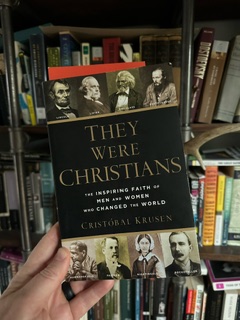
All my strong illustrations are derived from the New Testament; all my social abuses are shown as departures from its spirit; all my good people are humble, charitble, faithful and forgiving. Over and over again, I claim them in express words as disciples of the Founder of our religion; but I must admit that to a man (or woman) they all arise and wash their faces, and do not appear unto men to fast (Cristobal Krusen. They Were Christians: The Inspiring Faith of Men and Women Who Changed the World. Grand Rapids, MI, Baker Books, 2016, p. 186).
A Prayer for My/Our Nation: Lord, You have no need for me to tell You what is on my heart, because You know all things. You tell us in Hebrews 4:13 that no creature is hidden from Your sight, “but all are naked and exposed to [You] to whom we must give account.” So, I do not purport to pray unwisely. I know that all things, especially my fallen heart, are exposed to You. I know You know all things. Your psalmist records, “Great is our Lord, and abundant in power; [His] understanding is beyond measure” (Psalm 147:5). You have revealed to us who You are.
And because of who You are, my prayer is offered to You and not to man. Your people have always been part of a culture—whether in Israel, in Egypt, as exiles in Iraq, as strangers and aliens dispersed across the former Roman Empire, or whether as Reformers in England, Switzerland, Scotland, Germany, or as missionaries to cannibals in the jungles of South America, or as missionaries in China and India, or as Christians trying to bear witness in our own zip codes in our generation.
Your people are scattered by design, in order to be salt and light to a corrupt and dark cultus of self-absorption and death. Lord, forgive our iniquities, which are many; encourage Your people with Your Spirit by Your Word; and raise warriors for truth and light for such a time as this. This is not a time for self-reliance or secular machinations; it is a watershed in our day wherein our souls are being tested. May You quicken the hearts and hands of Your people to be of good courage, because You are omnipresent and wholly wise. Hear my/our prayer, Lord, for the glory of Christ. Amen.
Wasn’t it Mark Twain who quipped, “The art of prophecy is very difficult, especially with respect to the future”? It certainly can be difficult from a human perspective. For the Christian, however, he/she is commanded to take heart. Why? Here are a few reasons:
God is sovereign over human affairs (Ephesians 1:19-22).
Tumult can be used to return a people to God (Genesis 50:19-21).
God humbles the proud and gives grace to the humble (James 4:6).
To reveal the failures of secularism (Psalm 2).
I do not know what the result of this election will be, if it is any way free or fair, or if there is any integrity left in the system at all. I admit to significant skepticism. My family and I have voted, and we have prayed, and we know where we stand. We trust the Lord. Come what will, our ultimate allegiance is to God, and we pray we would be good citizens who reflect righteousness rather than chaos.
“You just keep thinking, Butch; that’s what you’re good at.”
It remains as one of my favorite lines from great films.
The graphics impressed, for their day. But it was the story. That’s what mattered.
One buddy fancies himself the daredevil. He’s all bravado and swagger.
The other buddy is cerebral (or so he fancies himself).
It was long ago now. I have lost count of how many times I have watched it. Usually it was on long hot soft hot still summer Sunday afternoons, with the pond behind us, and my stepfather, a man from whom I learned many lessons as a boy, taught me when I did not grasp fully that I was being taught. We’d watch that or Cool Hand Luke or Eastwood’s spaghetti Westerns, especially The Good, the Bad, & the Ugly. We’d watch the films year after year. I learned Redford’s mannerisms and Newman’s smirks, and took them into me as cultural iconography.
My stepfather could build just about anything. He taught me to hunt and fish; he and his family built our homes; he laid block; he plumbed; he ran wife; he taught me how to lay shingles; he shot a recurve bow so well, he could halve pears with a broadhead at 35 yards. He cast a fly rod like as smoothly as the language of lovers. He coached basketball and taught school, too, where he was gentle with students who needed a father figure.
The pond behind us was my place, however. Not deep, but mysterious, and my seminary in youth. Sweet gums, dogwoods, maples, Eastern redbuds, and more, limned the pond’s edges. But it was the fallen timber that my stepfather had dragged into the pond when he and his dad carved it out, perhaps more than even standing timber, that drew me. Old scrub oaks and pines, their limbs protruding like twisted symbols from Poe and Hawthorne stories, summoned me to black waters.
The pond behind the house, where I was just a boy– a boy who fell headlong into swampy still mosquitoed waters, where the pines bent under May’s heavy rains and the bream smelled rich and fertile by the banks, and bass fanned sandy bottoms on the pond’s sandy unders, and the sweet gums would drop their thorny brown bombs atop the centipede grass, and the crosstie wormbed grew crawlers for Granddaddy’s channel and blue cats, and I inhaled the smells of bedding fish, piney southernness, and and richness amidst everydayness that perhaps only Thomas Wolfe, William Faulkner, Larry Brown, and William Gay grasp fully in language.
It had to do with the pond behind–the way the sun set over the trees, the smell of water in hot GA days, the feel of the ground, the accent of Mrs. Will as she’d say, “Christopha, come home at dark, now!” in her tremulous voice, to her son, and we’d all go out–yet again–and ride go-carts, and burn pine cones, and I’d go off and fish in a spot I’d not shared with them, and I’d come in at dark–sweaty and happy that I’d understood Huck Finn in my bones. I’d give it all up to go back–to smell it all again, to see that there’s nothing better than to know one’s soil, to love it, to understand it as a gift to be shepherded–and to long for restoration.
If I could do it all over again, if I could ask God for any place to grow up, I would say, without hesitation, “Put me where the sun sets over the pond, where the West blinds me with golden brilliance, where I have to go under the treetops, along the edges of the pond, the pond behind, and smell those smells, and feel those birds’ wings as they lifted from the redbuds, their limbs bobbing in time to nature’s music, and the fecundity of bream and bass by the banks, and the swirl of their departure upon my footfall–yes, bring it, bring it all.






 MIND & MATTERS