Upon Looking Out Upon the Fields

What is it about an image that plows one’s imagination and returns one’s soul to affections pastoral and powerful? Let me explain.

I had just returned to my lodging after teaching fellow soldiers. I changed out of my uniform and into shorts and tennis shoes and a t-shirt. The sun was still out and the afternoon sky was clear. I looked out across the fields. A John Deere tractor was moving broadside across my field of vision several hundred meters away, but the day was so clear, the sky a seemingly limitless blue, and the hardwood trees limning the fields showcased autumnal colors of amber, cider, orange, and rust. A cloud of dust followed just behind the tractor from where the farmer plowed.

It was several moments before I realized I had lost track of time. I may’ve even been looking through the window with my mouth open, I was so taken. Suddenly I was a boy again, and inhaling the sweet rich smells of the soil, and I could smell the trees, and feel the airs of autumn, and the odors of harvested corn, and see the imprints of the hooves of whitetails as they fed upon the corn, and feel the footfalls of my boots as their soles pressed almost silently in fields freshly plowed, and behold doves as they criss-crossed the fields of autumn and gleaned like Ruth, and feel autumnal breezes come with October and November, and leaves from oaks and hickories fluttered down, twirling from the boughs like God’s colors of confetti.

It was impossible to say what was reality and what was memory and imagination. The tractor made long furrows, the cloud of dust close behind. There was a richness here that cut lines in my heart as visceral as the furrows that stretched before my eyes, and I longed to never outgrow bucolic beauty that plucks the strings of my soul.


Good Back in Indy: A Visual Reminder

I have seen a lot of airports. Some are like Indy’s–clean, friendly, and with a USO that is super-clean and staffed with friendly volunteers. Other airports are, well, fertile grounds for significant improvement.

When I landed recently, I went to the USO to grab some water and a bag of pretzels while I waited for my ruck to appear at baggage claim. Two ladies at the counter had me sign in, show my military ID, and I was good to go.

I sipped on the water, munched some pretzels, and perused the walls. It was again encouraging to see patches I’ve worn myself or still wear. The years have gone quickly, at least upon reflection. For non-military folks, these patches may not resonate with you. But for military folks, they often come to mean a great deal. They serve as visual reminders of guys with whom you served or still serve, of countries you’ve been in, of combat theaters of operation, of permanent duty stations, of temporary duty stations, of guys who did not return the way they left, or of a nation that is different than the one we left, and on and on.

When I looked at the rifle, I reflected upon my days in KY, with some great guys there, and remembered a chaplain that came to mean a great deal to me, and of my seminary years when I worked more than was healthy and slept aImost none at all, and of a few professors who were the real deal.

When I look at the boar’s head, and at 48th’s lightning bolt, and at 3ID, I think of my home state and how I’ve been blessed to serve alongside so many great guys, and of the opportunities I’ve had, and of many, many sweaty days and nights around the globe.

3 Corps will always have a special place in my affections because of Afghanistan and my time there, and some great memories of God gripping people.

The “Big Red One” was my first patch, and brings back countless memories of times with buddies in Germany, Switzerland, England, Hungary, Italy, Czechoslovakia, Austria, deploying to Bosnia as a young soldier, and being shaped by amazing NCOs like SSG F. Reynolds and skiing the Alps with my buds from Vilseck, Germany.

If I had stayed longer in the USO, I would have found other patches I have worn, patches from Iraq or from the 201st, but I had to grab my ruck from baggage claim and continue my next leg of the trip.

I remain grateful for this ministry and this calling. Salute.

The Invisible Isn’t Really Invisible (you just have to pay attention)

Slice of Life: This past weekend, I was blessed to be part of a team from my unit to work Oktoberfest at our location. We grilled bratwurst and frankfurters, and watched our fellow Soldiers and Families enjoy the festivities. I was struck with one impression more than any other: When you really pay attention to people, you see what’s important to them. I saw men I know from daily operations, but when you see them pushing their sons and daughters in strollers, and when you watch dads carry their toddler daughters on their shoulders to the bounce houses, or when you watch Soldiers dab sticky strawberry ice cream off the chubby cheeks of their children, you see where their heart is. This is why Soldiers train, and work, and endure family separation, and grind it out. It’s the moments like these that don’t make the headlines, that don’t get ceremonies, that don’t make the broadcasts—these are the main reasons we do what we do. Our MTOE does not issue us spiritual resilience; it’s therefore incumbent upon us to foster a spiritual foundation that is the bedrock of truth, not just silly bromides about resilience.

I loved the whole weekend, even though my wife and kids were hundreds of miles away. And it was our anniversary, too. Almost two and half decades of being a Family now, and I called my wife afterwards, and we wished one another a Happy Anniversary, and both understood that we endure separations like this for my military career because it’s an investment in Soldiers and their Families. (These times will be remembered, I assure you, by those boys and girls that stuffed themselves on wurst and pretzels and bounced till their little bodies were exhausted.) And when we learn to value the spiritual realities undergirding any enduring institution, we will be better for it. God created the family (Genesis 1:27-28) and blessed it. We are a wise people when we heed the Designer’s manual.

Happy Anniversary (from a distance)

Another year has come and gone, another anniversary, as I miss my Carrie Jane. I had to be away yet again due to military life, but we spoke over the phone, and you are singing at church and are in your element, and I am in mine.

Shakespeare’s Sonnet 116:

Let me not to the marriage of true minds

Admit impediments; love is not love

Which alters when it alteration finds,

Or bends with the remover to remove.

O no, it is an ever-fixèd mark

That looks on tempests and is never shaken;

It is the star to every wand’ring bark

Whose worth’s unknown, although his height be taken.

Love’s not time’s fool, though rosy lips and cheeks

Within his bending sickle’s compass come.

Love alters not with his brief hours and weeks,

But bears it out even to the edge of doom:

If this be error and upon me proved,

I never writ, nor no man ever loved.

When I look back over decades of life together now, and understand providence not just as a theological doctrine but as light unto my path, I am grateful–for your patience with me, for your forgiveness, for your putting up with my weird ways, for your dedication, loyalty, and commitment to home and our children, and for the ways we laugh at things only we understand.

I knew when I saw you all those years ago–with your jeans on and your black sandals, and your pretty toes, and your long piano fingers, I knew then you’d be my Carrie Jane. And all these years later, you still are. Happy anniversary.

A Book about Spurgeon’s Struggle … Wow!

I have been on a Spurgeon kick again. I read one of Tom Nettles’ books on Spurgeon this week. It was, like Nettles’ other books, meticulously researched and biblical. Its title: The Child Is Father of the Man: C.H. Spurgeon. Highly recommended.

But I was blessed to stumble upon Eswine’s book on Spurgeon’s struggles with depression, too. It was so beautifully written and so pastoral in its compassion for the inimitable preacher, Charles Haddon Spurgeon, I cannot sing its praises sufficiently.

As I read it, I thought so often of men I have looked up to, men in Christian ministry, but who wrestled with demons of darkness, or with spiritual heaviness, that they dared not share publicly. Or maybe this struggle is personal with you, too, as with some dear ones I have in mind.

Perhaps you, or someone you know, could benefit from this short book. Short, I say; you can read it in an hour or so, if you will not distract yourself. And Eswine’s writing, his deftness with language, summons you to read and savor his well-chosen words. Wow, what a precise, pastoral, powerful book.

Spiritual Ambushes

Text: It is among the most dramatic episodes in the history of redemption–Christ’s temptation by the devil. It is recorded at length in Luke 4:1-13 and Matthew 4:1-11. For today, I will focus on Luke’s recording of it. Here’s the context: Jesus (God the Son) was led by God the Holy Spirit “in the wilderness for forty, days, being tempted by the devil” (Luke 4:1-2 ESV). There you have the bottom line up front. We know who led Jesus (God the Holy Spirit); we know where the mission took him (the wilderness), and we know the why (to be tempted by the devil).

And Jesus was tempted by the devil with three things: hunger, power, and pride. “If you are the Son of God, command this stone to become bread,” the devil said to Jesus. That’s the temptation to give in to hunger. “To you I will give all this authority and their glory, for it has been delivered to me, and I give it to whom I will. If you, then, will worship me, it will all be yours,” the devil said to Jesus. That’s the temptation unto power. And lastly, “If you are the Son of God, throw yourself down from here, for it is written, ‘He will command his angels concerning you, to guard you . . .’” the devil said. That’s the temptation unto pride.

I think we would all agree those are no small temptations—hunger, power, and pride. And Jesus had not eaten for forty days. Yet He endured and overcame. How did Jesus respond to each temptation? How should that shape how we respond? How ought we to respond when the devil or evils come to us via temptations?

Encouragement: In 2 Corinthians 12, Paul records how “a thorn was given him in the flesh, a messenger of Satan to harass [him], to keep [him] from becoming conceited” (2 Corinthians 12:7 ESV). Paul pleaded with God over and over to remove it, but God left it. To teach him (and to teach all who would follow Christ) what it means to endure and prevail. Be encouraged; you have a Redeemer who endured and overcame so that you and I might look to Him in repentance and faith, knowing that He is more than able, so that His people are more than conquerors.

Back to Basics

Recently a peer of mine came to me with something in his hand.

“I got you this,” he said, extending his hand.

It was a small booklet from the American Bible Society. It’s a series of short devotions rooted in Scripture.

I have gone through it several times now. What I appreciate most about the booklet is the prayer that precedes the teaching for each day. It is simple and straightforward: “Lord God, quiet my soul and open my mind and heart to receive your Word. Amen.”

More and more often, I have to step away from current events, for my own sanity. How much word salad can one be expected to endure? How much more proof of chaos in the streets will it take before people say, “Enough!” How much more money will it take to buy a dozen eggs at your local market before folks say, “This is crazy”? All that to say, this is why I appreciated so much the prayer before the teaching: “Lord God, quiet my mind and heart to receive your Word. Amen.”

Because there are times when my soul is anything but quiet. There are times when my heart is so troubled, so filled with grief, so aghast at what is happening, that I can know the truth of Scripture but not exemplify it because I feel overwhelmed by trending events.

Of course, I could try and appear like I’m above it all by referencing familiar passages:

do not be anxious about anything, but in everything by prayer and supplication with thanksgiving let your requests be made known to God. And the peace of God, which surpasses all understanding, will guard your hearts and your minds in Christ Jesus (Philippians 4:6-7 ESV)

or

The thief comes only to steal and kill and destroy. I came that they may have life and have it abundantly. (John 10:10 ESV)

Yes, I know those passages, too. I have taught them many, many times. But the reality is that I do find times when I am nervous, when I am unsure of how unstable things are being made by the puppeteers, by those who are enemies of all righteousness.

Then the refrain hits me again: “Lord God, quiet my mind and heart to receive your Word. Amen.”

Encouragement: I was reading earlier this morning from David’s poems in the Psalter:

Restore to me the joy of your salvation,
    and uphold me with a willing spirit.
(Psalm 51:12 ESV)

What a simple, straightforward, and powerful prayer. Yes, Lord, and quiet my mind and heart to receive your Word.

Christ or Chaos

Introduction: I was reading another Larry Woiwode book and the power of his argument again struck me due to its logic: “If values evolve from traditions and common sense, then when values start clashing, we need a judge or referee, as we do when we turn to a dictionary to define words. Otherwise any individual value is as valid as another. Without an outside guide we’re in Babel, where everybody is talking nonsense, because everybody is using words that have meaning only to themselves, and, as Einstein has pointed out, “It is easier to denature plutonium than to denature the basic evil nature of man” (Woiwode, Essays on Literature and Culture, p. 34).  

Illustration: In our discipleship group with our church, I’m currently teaching through Matthew 12:22-32. This is one of the New Testament passages with some of most oft-referenced verses from the lips of Christ, especially about kingdoms divided against themselves, and what happens to them; and about either being with God or against Him (no middle ground); and about calling Christ demonic when He was/is the only fully good/holy person to ever live, etc. And it all got me thinking. The teaching Christ gives in these verses all centers on His upending and overturning the kingdoms of darkness that we sinners establish. And the way people respond to the truth of Christ reveals their nature and allegiance. They’re either for Christ or against Him; they’re either for good or for evil; they’re either humble before the truth or they gnash their teeth against truth. 

Text: In vv. 9-14 of Matthew 12, Christ healed a man with a withered hand. You’d think that would be a time for the Pharisees to rejoice, right? But what did they do? They kvetched about Sabbath extra-biblical oral traditions and work on the Jewish Sabbath. And v. 14 says, “But the Pharisees went out and conspired against him, how to destroy him.” See it? No middle ground. They hated the truth. They hated Christ. They hated the Holy One of Israel. Then in v. 24, after Christ had delivered a man from demon oppression, the Pharisees accused Jesus of being satanic, and of course Jesus once again rebuked them and their shoddy theology. 

Encouragement: What Woiwode was writing upon is the same fundamental issue Christ is teaching, namely, that it is the stony human heart that must be transformed by the Spirit of God in order to be in the kingdom of God, the kingdom of light, the kingdom of the holy. Otherwise, we remain sinners displaced from Eden, rebels erecting countless towers of Babel (Gen 11), and you see how that worked out.

You don’t have to check your mind to submit to the power and authority of God and His Word; you only have to check your pride, and that is a lesson it takes God’s Spirit to accomplish. 

(3) Current Ones:

First, Tom Nettles remains a consistent scholarly church historian and biographer. Currently I am profiting from his The Child Is Father of the Man: C.H. Spurgeon.

Second, and especially since another anniversary of Martin Luther’s 95 Theses arrives October 31st, 2024, I am reading Luther’s Commentary on Galatians. It is, like reading Spurgeon’s writing and preaching, invigorating. How? Because it reveals how vapid preaching is at most churches in our time. We are largely biblically illiterate. And many of our self-styled preachers fare no better.

When I read Luther, I see a mind and heart aflame with the greatness of God and His grace towards particular sinners who are to be redeemed. I see a man consumed by the power of Scripture. No spiritual TED Talks here; instead, it’s 100-proof law and gospel.

Third, A River Runs Through It by Norman Maclean. This is my first reading of this book. It reminds me so far of an effort towards Hemingway’s short stories about trout fishing in Michigan, but it falls far short. So far, it is okay.

Soul Food (October-style)

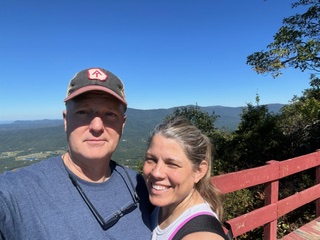
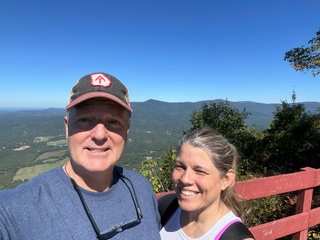
CJ and I took to the woods, trails, overlooks, and more today. Perfect weather. Cerulean sky; small breeze; leaves beginning to change colors; uncrowded trails; friendly fellow hikers, etc. Purchased a couple of hoodies at a trailhead. Saw spectacular sights. Even had my heartrate quicken today as I almost stepped on one of the good snakes. Returned this evening; burned some fallen limbs out back. Three of us went out for subs this evening and saw a brother from church, and we all chatted for a bit. All in all, a very good day. Thankful. Below are some of the pictures from the day:

Below is just a simple picture from a tree that’s in our little town, but I love it. My old iPhone does not do it justice, but as we drove down the hills today into the city to grab sub sandwiches for supper, the way the evening sun hit the limbs, and the way the shadows fell upon the ground, I was once again in one of my little silent worship services I have wherein my soul cries out to the Lord who is beauty Himself and the Author of beauty, “Thank you for this. I see. And I am grateful.”