Providence: Studies in Esther, Part 4

Principle: Darkness always resists the light; expect resistance, but persevere.

In Esther 5, we see what perhaps all people have encountered–spiritual resistance. Here was the context. Haman, the main antagonist in the book of Esther, has plotted a Jewish holocaust. Mordecai, a faithful believer in the one true God, exiled to Persia, is both courageous and faithful. He resolves to trust the Lord, and he bolsters his cousin Esther’s faith in God, too. She, too, is a Jewish exile under Ahasuerus’s pagan rule. Mordecai’s famous words to Esther are, “And who knows whether you have not come to the kingdom for such a time as this?” (Esther 4:14).

When Haman thinks he is to be honored by the king and the queen for being the man of the hour, Haman, a hater of Jews and of God, despises Mordecai. Why? Because Mordecai understands who Haman is, how wicked he is, and Mordecai does not fear Haman. Mordecai trusts the Lord.

If that is not clear enough, here is the way the text reads: “But when Haman saw Mordecai in the king’s gate, that he [Mordecai] neither rose nor trembled before him, he was filled with wrath against Mordecai” (Esther 5:9b).

Here’s the principle again: Expect resistance when you’re doing the right thing. Darkness hates the light. But persevere in righteousness and witness God work.

Another Assassination Attempt in 2024: When Will It All End?

“O Lord, hear; O Lord, forgive. O Lord, pay attention and act. Delay not, for your own sake, O my God, because your city and your people are called by your name” (Daniel 9:19, ESV).

We do not deserve mercy, Lord. We do not.

I pray that you spare for your name’s sake, because of your goodness, because of your nature. Not ours. Because ours is rotten to the core.

Give us new hearts, new minds, and transform our affections to those that love what is good, true, and beautiful. For we have rebelled in thought, word, and deed, and you alone are sufficient to redeem us sinners. Have mercy, Lord, for your great name’s sake.

Sunrise in the Skies Above Indiana

I had just taken off a few minutes earlier from Indianapolis and was headed to Atlanta. I opened my blind on the left side of the plane. Because we were headed south, the sunrise was in full view.

A storm was below us now, in the heavy clouds. The pilot had raised us above that.

And aurora spoke in pictures Psalm 8 and Psalm 19, and I received a sermon via God’s handiwork.

Providence (Famous Phrases, Part 3)

One of the most dramatic passages in the entire 66 books of the Bible, the fourth chapter of Esther, pushes the drama of the book bearing her name to one’s viscera.

The Characters:

Haman (the villain; pagan; a hater of Jewish exiles and of God; he made a vow to launch a Jewish holocaust)

Mordecai (a faithful believer in God; cousin/avuncular authority figure to Esther, his Jewish cousin)

Esther (the new [Jewish] queen to Ahasuerus, a pagan king; Esther and fellow Jews are in exile in Persia [Iran]; she is tasked with the impossible–namely, go to her captor/king Ahasuerus, and tell the truth about wicked Haman’s plan to launch a holocaust of the Jewish people

What Esther Did:

She and her friends fasted (4:16a).

She counted the costs (4:16b).

What Mordecai Did:

Mordecai understood the times; he saw through the facades to how evil things really were, and he resolved to be God’s man (Esther 4:13-14).

Mordecai understood that failure to act was to act; it would be complicity. “For if you keep silent at this time, relief and deliverance will rise for the Jews from another place, but you and your father’s house will perish. And who knows whether you have not come to the kingdom for such a time as this?” (Esther 4:14)

Two Profound Theological Verses:

  1. Mordecai’s words to Esther: “And who know whether you have not come to the kingdom for such a time as this? (4:14)
  2. Esther’s words: ” . . . . and if I perish, I perish” (4:16b)

Encouragement: The doctrine of providence hinges upon faithfulness and courage. Mordecai is an example of both. Esther is an example of both. And Christian pilgrims today, too, will do well to think upon these things. Faithfulness and courage. What do they have to do with Christ? Everything. He was/is the only One who is wholly faithful and true. He was the One who was faithful even unto death, the ignominy of the cross. Mocked, stripped, beaten, forsaken–and yet he endured from sinners such shame for the sake of redeeming a people for God. Faithfulness and courage, dear reader, and the providence of God.

Providence: Studies in Esther (Part 2)

Providence: Lessons from Esther (Part 2):

One of my favorite and crucial episodes in Esther’s story centers on the faithfulness of Mordecai. Mordecai was the much older cousin to his Jewess cousin, Esther. He functioned more like an avuncular influence upon Esther. We might think of him as an “Uncle Mordecai” to Esther. Anyway, after Vashti refused to parade herself for Ahasuerus’ ogling (Est 1:12), and Memucan had stepped up and proposed ways for the king to put his foot down (Est 1:16), and the king had heeded the aforementioned counsel (Est 1:21), we see Esther chosen to be queen in Vashti’s place. Esther was clearly a physically beautiful woman (Est 2:7, 17). She was markedly stunning. But the episode upon which I want to focus here concerns not Esther’s physical beauty but Mordecai’s and Esther’s faithfulness

Here’s what is so important to remember: Both Esther and Mordecai were Jewish exiles. They were captives. And the natural reaction most of us would have would not be to try and please our pagan leaders, and certainly not seek their welfare. But that is exactly what you see happen in Esther 2:19-23. Mordecai discovers a plot against Ahasuerus’ life, and Esther (at the request of Mordecai) alerts the king. Think of that–doing good unto those who don’t deserve it. 

Connection to the Gospel & the Doctrine of Providence: All of Scripture coheres, dear reader. It is telling one unified story. The faithfulness of Mordecai and Esther is a microcosm of what God has done in Christ. Just as the Jews were in exile from the true King of kings, we sinners are exiles from Eden and God due to our sin. Yet God provided through the faithfulness of One whose work is accepted by the King of kings. Providence, you see. Mordecai and Esther were types and shadows of the Substitute who was to come, whose name is Jesus, the Christ. 

Providence: Studies in Esther (Part 1)

When I wrote my dissertation on the biblical anthropology of Cormac McCarthy, I based it upon how McCarthy’s fiction models the paradigm found in the Old Testament book of Esther. Esther remains near tops for me in terms of books I have read, and read, and read, and read again. I love the aphoristic style of Ecclesiastes, but in terms of narrative and just wonderful storytelling, one cannot improve upon the book of Esther. 

Esther is a master study in the doctrine of providence. The name of God does not even appear in Esther, but the book is overtly about God’s rule. As one person has written, “The Almighty has no need to write his name in order to let us know that his wisdom and power have been controlling the march of human events. The name of God may be absent, but his power is everywhere visible.” In other words, you cannot see the wind, but you cannot deny its effects. You feel it; you see the boughs bend; you feel the perspiration dry upon your brow; you see the waves, and you see the sail fill due to the forces of the wind. God is a lot like that in the book of Esther; he does not go, “Hey, I am right here.” Rather, he works all things together for good, for those who love him and are the called according to his purpose (Romans 8:28). 

In chapters 1-2 of Esther, we see a couple of main themes: 1) political leadership is dissolute and 2) the emergence of courage amidst cowardice and corruption. When Ahasuerus was “merry with wine” (Esther 1:10) he gave self-serving orders. But there was a refusal of the unwise orders by Queen Vashti (1:12). This sets the stage for the whole book of Esther. Will there be a faithful one (or perhaps several) who will refuse wicked orders? Will there be courage amidst the cowardice and corruption? Who will count the costs and be faithful? 

Encouragement: I do not want to rush time in Esther this time either. If I coul just have folks do it, just read the book of Esther. Then read it again. Then read it again. It is marvelous. Over the next few installments, I want to explore this masterful narrative. For now, be encouraged by this: All it takes is for one to be faithful. Others will follow. But being faithful demands courage. To stand. And when having done all, to stand firm (Gal 6:13).

How I, Too, Came to Love the True Church

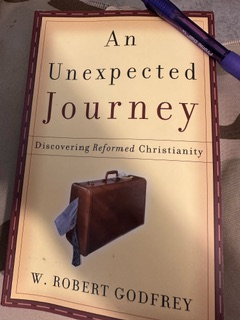
It is not altogether common I read contemporaries. But when it comes to vetted historians, Bob Godfrey is rock-solid. His books consistently, especially about Reformation history, are gems.

Godfrey has a scholar’s mind, no doubt about that, but he has not lost his love for the church. He understands that most Christians will never pick up a book of serious theology or church history (to our shame) but he loves the true church nevertheless, and he writes books that, if folks would only read and heed them, edify the body.

Today after work I read his An Unexpected Journey, about how a Reformed congregation loved him, taught him, was patient with him, and taught him the great biblical doctrines of grace wherein he discovered God had gripped him. That was–now–many, many moons ago.

And now, decades later, Godfrey has become of the last seventy-five years’ best church historians.

Tolle, lege.

It was similar for me. I grew up in the visible church. But I learned the true church only after I met the woman who would become my wife. I knew how to “do church” from an early age. But when I was loved, taught, discipled, and saw genuine commitment to Scripture and to the gathering of the called-out body of believers, church became not a theological concept, but a people of which I became a part. Hence, my affinity for Godfrey’s book.

Monday’s Literary Gem

In her hometown tonight, I thought it shrewd to read her again. And it did not disappoint.

From one of her best pieces:

The music will swell until at last it seems that the sound does not come from the twelve men on the gang, but from the earth itself, or the wide sky. It is music that causes the heart to broaden and the listener to grow cold with ecstasy and fright. Then slowly the music will sink down until at last there remains one lonely voice, then a great hoarse breath, the sun, the sound of the picks in the silence.

And what kind of gang is this that can make such music? Just twelve mortal men, seven of them black and five of them white boys from this county. Just twelve mortal men who are together.

When Reading Tonight: A Salute to a Noble Young Officer

It had been a good day. Nothing too eventful, really, but a good day. I had a young officer, a man I have respected since I have known him, come to me to say goodbye. He was transferring to another location in his military career. Part of his reasons were to care for his family and to get back closer to home so that his wife could be closer to her family, too. He was being a good husband and shepherd of his family, and was putting his own military ambitions on the back burner for the sake of his wife and their extended family.

My respect for him continued to rise. I have known men in my decades in the Army that have General written all over them–in their character, their intelligence, their abilities. He was and is one of those men.

I am old enough to be his father, and I hate to see him go.

But it got me thinking. After work, I drove to my residence, and I was reading some Reformation history, as is my custom, and continued to work my way through the classics of literature, too, via one of Tolstoy’s 1,000-page tomes, in which I can never keep track of all the characters.

But I was writing some things down in one of my journals and came across something I had written down before from some of my lifetime of reading: “Our lives begin to end the day we become silent about things that matter.” I stand by those words.

I know it is cool to be tough, to seem unfazed by those who enter and exit our lives, to seem like we are too cool to care. But I think it is folly to don that facade–at least for me.

We will all die one day, and all will come to light. And we will answer. And the scales will be open (as they are now) before God, and there will be no place for pretense or bravado or duplicity.

I guess I just want to say this: There are good men (and women), still. And we should say so. So, Nate, God bless you and your family. I am old enough to be your dad, but you’ve impressed me like few others I have known. May the Lord prosper your way.

Expect It

Principle: Expect Resistance

Introduction: Train like you fight is proverbial wisdom for a reason. If you want to win, you have to put in the hours, days, weeks, and months of training. There is no shortcut to mission success. You will suffer setbacks and disappointments. When it comes to our inner spiritual lives, our mindset, our worldview, etc. I think sometimes we think the same logic does not apply. But it does. 

Just as a matter of transparency, one of my weaknesses is overestimating people’s sense of honor. I am certainly a great sinner (just ask my wife), but I have been guilty oftentimes in my life of assuming, “Ah, he’s a good guy; he would never do something like that …” kind of thinking. But then I get the hard slap of reality. And the sad reality is, it hurts. Because people let each other down. We all do. We have invariably been let down by others, but we have also let others down. No one is without responsibility here. So I do not speak as one who is without blame/responsibility here, too. 

God Speaks to This in Scripture:   In Psalm 41:9, the poet writes, “Even my close friend in whom I trusted, who ate my bread, has lifted his heel against me.” There is something exceptionally human and viscerally painful about betrayal and abandonment by those for whom one cares, especially when you don’t know what you’ve done wrong to merit such treatment, if anything. I had a couple leave my Sunday school class awhile back without so much as a text message, email, handshake, or anything. Just vanished. And it hurt me. Why? Because I had done everything I could for years to love them, make them feel welcome, give the husband books to encourage their new Christian walk, books appropriate for their level, provide fellowship meals, etc. But they left. The painful thing was its lack of closure. No explanation. Just vanished. Now, if I were an uncaring under-shepherd, I would not bat an eye. I would just keep on truckin’. But that’s not my nature. But as the cliche goes, it is what it is. I think this is why verses like Psalm 41:9 are in Scripture for us. Nothing is new under the sun, of course. Human experiences both repeat and rhyme through the annals of history (Ecclesiastes 1:9). 

Encouragement/takeaway: I think this is why we never should tire of studying the life of Christ. Scripture teaches that he was abandoned, forsaken, betrayed, and yet he died for the sins of his people. He prayed for their forgiveness. He gave himself for them. He loved them till the end. Though reviled, he did not revile in return, etc. A non-negotiable of the Christian life is that God ordains our suffering so that we might learn to appreciate and adore the Savior, Christ himself, whom we have betrayed over and over again by way of our sin. And yet he continued to love us to the end.