Introduction: I had just taken the dogs out to do their morning routine. All appeared normal. When I reentered the house, I felt something looking at me. I looked out from my library windows, and this fellow was staring at me. Well … good morning.




Introduction: I had just taken the dogs out to do their morning routine. All appeared normal. When I reentered the house, I felt something looking at me. I looked out from my library windows, and this fellow was staring at me. Well … good morning.
Anyone who knows me well would likely know mornings are my favorite times. I love rising early, enjoying coffee, reading, and (weather permitting) dawn.
Below was a shot from my old iPhone of one of my mornings this week in Pennsylvania.

Anyone who is honest will admit that we are living amidst a cultural civil war. The values could not be more disparate and opposed to one another. No one can say, “I sure wish I knew where _________ stood regarding [insert issue here].” No, we can tell.
Some folks think we should honor our law enforcement and our military service members; another side demands we defund the police and embrace nihilism and anarchy. Some folks think we should acknowledge reality; other folks demand we bow the knee to insanity, live by lies, and embrace chaos.
Stupidity is not a winning strategy, as is often said, so reality will sink in eventually. But how severe it may all get, and how long it will all last, is another matter for another discussion.
In such a time, I take a few minutes of time near dawn, often with coffee in hand, bow my head in petition to the God who made heaven and earth, and try to say as plainly and viscerally as I am able, “Lord, we need you. Have mercy upon me, a sinner. Lord, thank you for another opportunity to flee to your gospel.”

I am grateful for a friend recommending this book to my family recently. I read it in just a couple of sittings. It was that good. My copy is now underlined and filled with marginalia. The book is Michael Kruger’s Bully Pulpit. Kruger is a respected New Testament scholar, professor, and pastor with decades of faithful writing, mentoring, pastoring, and teaching. I had read some of his earlier books on church history and biblical canonicity, which were excellent. But this volume focuses in plain, non-academic, biblical language upon how narcissistic insecure men often enter and infect Christian ministry and how we can guard the true sheep against these wolves dressed as sheep.
Kruger’s book is filled with examples from Scripture (1 Samuel 2, 3, 8, 25; 1 Kings 12; Ezekiel 34; Matthew 23, etc.) and from church history, both ancient and current. For those who only know recent events, Kruger cites these examples, among many others, of what happens when churches and organizations were duped and manipulated by wolves dresses as sheep: Ravi Zacharias, Mark Driscoll, Bill Hybels, James MacDonald, Jerry Falwell, Jr., Acts 29, etc. The list could go on and on–David Platt, David Timmis, etc. of the “trail of dead bodies” that is behind the ministries of many influential people that became successful in the world’s eyes (and in the eyes of many in the so-called church).
They do not care for the people but care only for themselves (p. 44). That is the repeated theme, evidenced over and over again via examples from Scripture, church history, and the recurring daily headlines, that runs throughout Kruger’s book.
If we love the truth, and therefore love the true church, we should read this book, commend it to others, and teach it to the saints.
Well done once again, Dr. Kruger. Grateful for your courageous and pastoral example. You are living out what it means to be a good and faithful servant by addressing an issue the true church needs to hear and heed.
The flight path from GA to my location in PA pleases me visually. On clear days I can follow the ridges of the Allegheny Mountains from WVA to PA, a long green spinal cord (it’s summer now) linking disparate American cultures (from above, anyway).

As the plane descended, PA came into view:


The farms here impress me each time, as if I have stepped back in time.

But it is always soon–too soon–when I am amidst another line of travelers, waiting.
On the first flight up, a young couple was seated in front of me. The young dad was a soldier, too. He had a tattoo identifying his field of aviation on his arm, and his beige hat had a stitched emblem of a CH-47 Chinook. The older of the two daughters lay in a car seat that faced my direction. The child had flushed red cheeks the color of cotton candy and strawberry blonde fine straight hair. Her dad gave her a lollipop which she sucked for the entire flight, her blue eyes looking at me through the space of the two seats dividing her from her dad. It made me miss my daughter when she was that age.
Across the aisle sat the mother of the two girls. She had the younger of two girls on her lap, and a car seat on the window seat, but the toddler would have nothing to do with lying down. She wanted to stand in her mom’s lap; otherwise, she screamed. And screamed. And screamed. But when her mom stood her up on her lap, the screaming ceased like the turning off of a faucet, and her blue eyes (identical eyes to those of her older sister) surveyed us all. Her pudgy arms were so cute, red, and pudgy they reminded me of beef with white strings around it, striations of white running along her toddler limbs like integument.
When we landed, I had a three-hour layover. I went to one of the airport shops and purchased a protein drink, a Pepcid AC, and a fruit snack, all of which were exorbitantly priced. I called my wife, letting her know I had made the first leg of this trip. We chatted for a bit.
The next leg of the trip was a full flight. The two women seated on my left were returning from a trip to Alaska. They took selfies and posted their images on social media, sticking their tongues out and somehow grinning simultaneously. (I do not purport to understand the current rage of photographing ourselves doing what [surely] every former generation would have thought self-absorption, fatuousness, or worse. But they took at least a dozen pictures of themselves, appearing more and more delighted with each new face they donned for their selfies, and uploaded them for the world to enjoy.)
I opened the book I was reading today, a wonderful paperback by James Wood on the history of literature. To the two women to my left, I must have appeared a Luddite who scribbled beasts of yore uoon the walls of caves. The ladies continued snapping selfies and checking social media. We were two separate universes separated by inches.

Arrived in PA and made the drive to lodging. Will see my fellow soldiers in the morning. Time to finish the Wood volume. Truly a wonder-filled read by one who relishes literature’s gems. Then the gym and a burger for supper. To be continued . . .

Why not Dr. Seuss’ wisdom? Here goes: “The more that you read, the more things you will know. The more that you learn, the more places you’ll go.” In a word, yes.
Recently I discovered the fiction of British novelist Jeremy Cooper. In my view, his writing is akin to Patrick DeWitt’s, especially in deWitt’s novel, The Librarianist, and Walker Percy’s excellent novel, The Moviegoer.
Brian (the novel) is about a solitary reader who becomes an avid, one might even say obsessive, moviegoer and cinephile. The story involves how film enables him to break out of his emotional carapace to embrace others, to get out of himself and care about others in actuality, not just emotional posing/virtue signaling.
Like some erstwhile English literary fiction writers, Cooper can be sometimes efficacious via his literary understatement; at other times, he clearly reveals a desire to virtue signal to the Spirit of the Age, especially regarding sexuality and even, dare one even mention it, a former (and likely returning) president of America. It seems even as gifted a writer as Cooper sometimes is in this novel, he cannot resist genuflecting to the Leftists who cannot view anything without going through a lens of TDS (Trump Derangement Syndrome). All in all, however, it (Brian) remains a worthwhile read.

It is hard for me to say whose poetry I more enjoy, David’s or that of his son, Solomon. Both were masters of expressing sinners’ wiles and human craftiness. Listen to David in Psalm 55 where he warns about those who speak smoothly but inwardly are ravenous wolves:
My companion stretched out his hand against his friends; he violated his covenant. His speech was smooth as butter, yet war was in his heart; his words were softer than oil, yet they were drawn swords (Psalm 55:20-21 ESV).
In other words, watch people’s actions; don’t be duped by words that are “smooth as butter.” This is the textbook characteristic of a politician, whether he be in sales, government, or church. The principle applies across the board.
Now listen to David’s son, Solomon:
3 For everything there is a season, and a time for every matter under heaven:
2 a time to be born, and a time to die;
a time to plant, and a time to pluck up what is planted;
3 a time to kill, and a time to heal;
a time to break down, and a time to build up;
4 a time to weep, and a time to laugh;
a time to mourn, and a time to dance;
5 a time to cast away stones, and a time to gather stones together;
a time to embrace, and a time to refrain from embracing;
6 a time to seek, and a time to lose;
a time to keep, and a time to cast away;
7 a time to tear, and a time to sew;
a time to keep silence, and a time to speak;
8 a time to love, and a time to hate;
a time for war, and a time for peace (Ecclesiastes 3:1-8 ESV).
Timing is so important to notice. One might say it is crucial.
Do we have discernment to cut through smooth-as-butter words to see the vulpine war that is being smuggled in?
To be cliche, do we follow the money? Do we follow the evidence or just listen to smooth words? We are told up front that there are many among us whose god is their belly (Philippians 3:19). Are pastors shepherding the true sheep or simply building their own barns of comfort? Watch them. May God equip a discerning people, for there is, to reference Solomonic poetry again, “a time to love, and a time to hate.”

In our continued study of Matthew’s gospel, we are currently in chapter 9 where the Christ heals two blind men (vv. 27-31) and where he heals a man unable to speak/mute (vv. 32-34). The passages break into two distinct principles–1) the embrace of Jesus as the fulfillment of the promised Messiah (vv. 27-31) and 2) the rejection of Jesus despite the evidence and the remaining curse for rejection of the truth (vv. 32-34).
Quote: R.C. Sproul penned and preached a lifetime of profound biblical truths, one of which is this gem: “When there’s something in the Word of God that I don’t like, the problem is not with the Word of God, it’s with me.”
Encouragement/Takeaway: The people we study in Scripture are no different than people today. It is not lack of evidence preventing people from believing the truth; it is simply a moral obstinacy and rejection of the obvious. But here is the beauty, folks: Some will believe; some will come to the truth; some will be redeemed. Therefore, we go to all proclaiming the truth in the blessed assurance that some will come to the way, truth, and life who is Christ the Lord.
Blessings and curses are simply the natural outworkings of people’s responses when confronted with the truth.

When I departed Atlanta’s airport the sun was up but blurred by unrelenting heat and haze. The city’s buildings, nested along her overcrowded highways, were as vittles steaming in a southern kettle.

The flights to the West were good, however. The lady at the Delta counter was friendly, dressed in her blue blouse, with an azure rubber wedding band on her left hand. At the TSA Pre ✔ counter the old man with a beer belly and white mustache waved me through quickly. It was apparently evident to him I was military. He barely scanned my military ID card. My rucksack did not signal inspection either as it went through the coffin-like tunnel that, to me anyway, elicits images of a horizontal PET scan.
Once upon the plane I retrieved Smith’s You Are What You Love. I had just begun it an hour or so before but could tell it was my kind of book–biblical, Reformed, and replete with literary allusions, my favorite of which was from Eliot:
We shall not cease from exploration
And the end of all our exploring
Will be to arrive where we started
And know the place for the first time (T.S. Eliot, “Little Gidding”)

Made it out West and am about to turn in for the evening after a few more pages of Jeremy Cooper’s fine novel Brian. Cooper’s somewhat new to me but I am enjoying his Anglican understatement, especially when it comes to themes explored profoundly by Walker Percy, John Updike, and others.

The thought about calling (at least for some): “This is what we were made for: to love what God loves. Our telos brings us back to our beginning. And we were made to be sent” (You Are What You Love, p. 189).
This week I am studying a passage from Matthew 9:18-26 where Christ does at least two things: 1) he restores a girl to life and 2) he heals a woman who had suffered a blood issue; apparently, she bled profusely.
I am familiar with the passage. I have heard it referenced, preached, and alluded to many times. But this is I think the first time I have focused just upon the two miracles that are recorded here. For purposes of today I want to focus on just one principle, namely, the contrast between the woman who came up behind Jesus and touched the fringe of his garment (v. 20) and the faith in Christ she demonstrated versus the scoffing and disbelief of the crowd surrounding the dead girl whose father was a ruler in the synagogue (vv. 18, 25).
The woman with the issue of blood is an embodiment of the sinner’s complete brokenness and utter reliance upon the grace of God in Christ. And Christ both received her and healed her.
The ruler of the synagogue implored Christ to raise his deceased daughter, and when Christ does just that, the crowds “laughed at him” (v. 24) out of their disbelief.
Here’s the rub: Genuine belief in the person and work of Christ entails casting ourselves upon the mercy and grace of God, that he is who he says he is and proves himself over and over to be. But some folks just want a show; they do not come to Christ as Lord, but Christ as someone less than what he is: Lord.
The woman was healed, made well, and Christ knew her savingly. The crowd who witnessed the results of Christ raising of a corpse (v. 25) wanted a show, mere entertainment. There is a world of difference between those who want a show and those who want the Lord.

I got to the pond before dawn. Above the pines there was the glowing orange of promise. The sun would be visible in moments now. I could smell the water. Two herons were at the deep end of the pond, still as a portrait, watching me. The red-winged blackbirds fluttered into a tree above me, squawking at my presence.

I walked some in the grass along the banks. Finally I retrieved a rod and put a topwater lure on and cast out beyond the tip of a felled tree that has yielded fish consistently. Cast, retrieve, cast. No bites yet. Beyond the tips of my shoes, I glimpsed two turtles connected, one atop another, just inches below the water’s surface. My movement startled them, and the mounted one took them into deeper water.
The promised sun showed itself above the pines now and a soft breeze picked up. Cast, retrieve, cast. Still no bites, and the day promised to bring high temps and a punishing sun.
At lunch I decided to take a break and get a walk in. I snapped some photos of trees I found beautiful, despite the dry days of late.

We need rain badly, but for now it is simply hot and dry.
When I returned to the water, a fellow soldier was jogging around the water. He was muscular, barrel-chested, with red hair and freckles. He looked like what I imagined an adult Opie Taylor would have looked like had he become a bodybuilder.
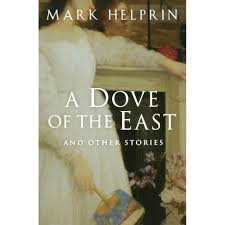
I completed a reading of Helprin’s collection of short stories, A Dove of the East and Other Short Stories. Helprin is remarkable on multiple levels. He’s a prolific author of literary fiction; he’s a seasoned soldier; he’s a political conservative; and he’s one of America’s finest living writers. His stories are unlike anyone else’s I know of. One might be set in NYC and the next one is set in Tel Aviv. Like Helprin himself, his characters are well-traveled, well-read, and unafraid.
 MIND & MATTERS