Nothing speaks so loudly as irony. Those who talk about “safe spaces” and tolerance and love, etc. will stop at nothing to execute their evils upon the most vulnerable.
No borders, no enforcement of law, no moral restraint, no God; just power and savagery and violence. It’s Cormac McCarthy’s Blood Meridian day in and day out and the sheeple stand by and watch it happen.
The reality is horror, of course, but the leftists/secularists/progressives will not stop.
You will be made to care.
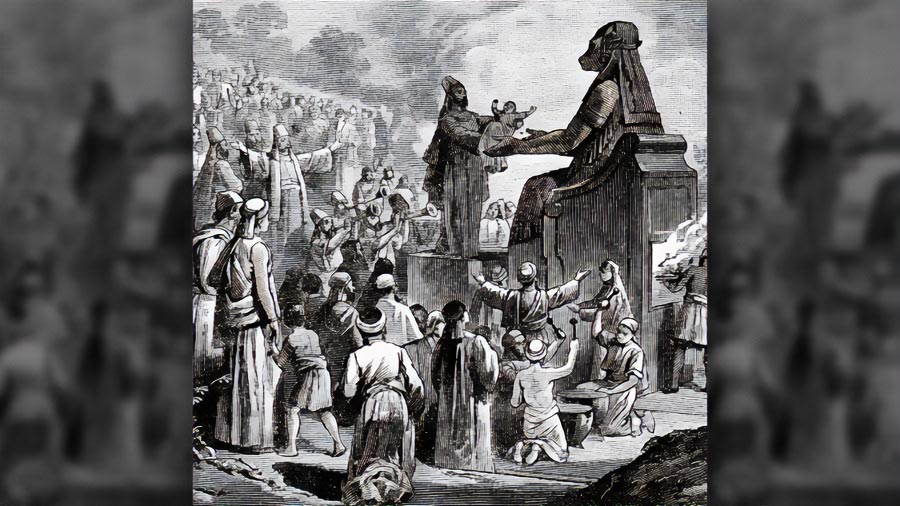
When the mob shouted, “We’re coming for your children!” they were not jesting.
You will be made to care. Behold, the consequences of ideas.
People who don’t know their Bibles might say, “How can this happen? People sleeping with children? People sleeping with animals? People without conscience?” Yes, reader, yes; Scripture is replete with warnings about this, because when people reject God, reject His revealed will, reject His moral law, reject His design, reprobation ensues, judgment falls, and there is no bottom to man’s depravity. What’s more, those who say they’re for righteousness are cowering in the corners, assuming and hoping the evil won’t come for them. But it will, because Satan has nothing to fear from cowards. May God raise up courageous, biblical warriors for righteousness. If people don’t have eyes to see the evil upon them, they’re willfully blind.
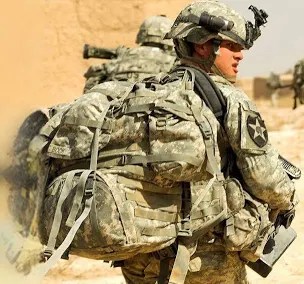
“Truth is heavy, so few men carry it,” is an aphorism I keep in my mental and spiritual rucksack.
Connection to today: Recently we had another suicide of another NCO that is near to many here. As chaplains we invariably are brought into the conversation about the loss of still another warrior, often to try and bring spiritual balm to a sad situation. It does not matter how many books I have read on suicide prevention, how many certifications I have in suicide interdiction and prevention, how many courses I have taught in suicide prevention, etc. The reality is that Soldiers continue to take their own lives, often via violent means. We walk a fine line as chaplains because we are charged with spiritual and religious support for Soldiers and Families, among other responsibilities, but the reality is that few leaders have the courage to address the truth that is being denied in so many areas. We are spiritual beings. But spirituality must have intellectual and visceral content; it cannot be a vague ‘spirituality’ that is impersonal and/or devoid of empirical content.
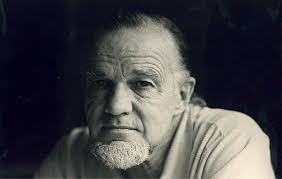
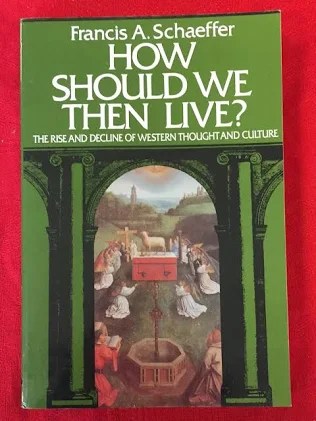
Wisdom from Francis Schaeffer: This week I reread Schaeffer’s classic work, How Shall We Then Live? In it, Schaeffer cut right to the heart of the issue of what I am addressing here: “Nietzsche knew the tension and despair of modern man (no matter what he says he is), cries out for a meaning that can only be found in the existence of the infinite-personal God, who has not been silent but has spoken, and in the existence of personal life continuing into eternity” (HSWTL?, p. 180).
Encouragement & Application: See what Schaeffer recognized? Man is designed by God for meaning, connection, and significance. Those are all found in the gospel. Why? Because man is not, contrary to secular humanism’s lies, a cosmic accident. He is created in the image of the infinite-personal God. But secularism has no answer for modern man’s hopelessness because it cuts the umbilical cord of man from his Maker, who is God. Man is severed. He is thrust adrift with no means of explaining his own existence. What will it take for us a culture to return to our Creator, Redeemer, and Lord? May we have the intellectual and spiritual courage to admit what is overt. I am just one among many fine chaplains and Soldiers who is long weary of having Soldiers go out this way.
Schaeffer’s influence on understanding intellectual history/the history of ideas is remarkable. This week, I reread his masterpiece How Should We Then Live? Below are just (3) of the book’s myriad nuggets of wisdom:
“Nietzsche knew the tension and despair of modern man. With no personal God, all is dead. Yet man, being truly man (no matter what he says he is), cries out for a meaning that can only be found in the existence of the infinite-personal God, who has not been silent but has spoken, and in the existence of a personal life continuing into eternity”(HSWTL, 180).
“If there is no aboslute moral standard, then one cannot say in a final sense that anything is right or wrong. By absolute we mean that which always applies, that which provides a final or ultimate standard. There must be an absolute if there are to be morals, and there must be an absolute if there are to be real values. If there is no absolute beyond man’s ideas, then there is no final appeal to judge between individuals and groups whose moral judgments conflict. We are merely left with conflicting opinions” (ibid, 145).
“To make no decision in regard to the growth of authoritarian government is already a decision for it” (ibid, 257).
Question: Ever heard someone object to the biblical doctrines of man’s depravity and God’s election by posing a question along these lines: “But what about the innocent man on a remote island who has never heard the gospel? That would be ‘unfair’ for God not to save him.”
Sure, we all have heard questions like that. It can be helpful to ask the person asking the question to show you an ‘innocent’ person. Who is innocent among us? Will we listen to what Scripture actually teaches?
They are all corrupt, they do abominable deeds; there is none who does good (Psalm 14:1b, ESV).
How about the next two verses of Psalm 14:
The Lord looks down from heaven on the children of man, to see if there are any who understand, who seek after God.
They have all turned aside; together they have become corrupt; there is none who does good, not even one (Psalm 14:2-3, ESV).
How about Isaiah? Maybe he has a different message than David:
We have all become like one who is unclean, and all our righteous deeds are like a polluted garment (Isaiah 64:6a, ESV).
How about Moses? Maybe he has a different message than David and Isaiah:
The LORD saw that the wickedness of man was great in the earth, and that every intention of the thoughts of his heart was only evil continually (Genesis 6:5, ESV).
How about Paul? Maybe he has a different message than David, Isaiah, and Moses:
And you were dead in the trespasses and sins in which you once walked, following the course of this world, following the prince of the power of the air, the spirit that is now at work in the sons of disobedience—among whom we all once lived in the passions of our flesh, carrying out the desires of the body and the mind, and were by nature children of wrath, like the rest of mankind (Ephesians 2:1-3, ESV).
How about Christ Himself? Surely, He will have a different message than David, Isaiah, Moses, and Paul:
And this is the judgment: the light has come into the world, and people loved the darkness rather than the light because their works were evil (John 3:19, ESV).
Connection to Amos as a Forerunner of the Good News: Amos 3:7 entails a profound truth: God does not hide Himself or His message of redemption through judgment; He sends prophets to speak for His truth:
For the LORD GOD does nothing without revealing his secret to his servants the prophets (Amos 3:7, ESV).
In plain terms, God is a communicating God. To use Schaeffer’s phrase, God is not silent.
There is no innocent person on a deserted island. Why? Because there are no innocent people. We are all sinners by nature. That’s the point of the verses above, and countless others in the 66 books of Scripture.
But all of the Bible coheres. It tells one unified story of what God has done in Christ for all who will hear, repent, and believe:
But God, being rich in mercy, because of the great love with which he loved us, even when we were dead in our trespasses, made us alive together with Christ—by grace you have been saved (Ephesians 2:4-5, ESV).
Encouragement: Christ has done what we neither would do nor could do. And He bids us sinners welcome, or to use poetic biblical language, to taste and see that the LORD is good (Psalm 34:8, ESV).
Introduction: If each prophet of the one and only true and living God has his unique oratorical style, Amos’ is surely among the most memorable: “For three transgressions of . . . and for four, I will not revoke punishment.” You find it, among others, repeated in Amos’ book of the Old Testament: 1:9, 11, 13; 2:1, 4, 6, etc. The point, of course, is emphasis. It’s a poetic way of saying, “Don’t miss this.”
But don’t miss what exactly? Judgment for sin.
Historical Context: Amos was a shepherd-farmer in the 700s B.C., during the time of Uzziah, the time of the prophet Isaiah. Economically, Amos lived in a time when Israel and Judah were materially prosperous. But accompanying all that material wealth was massive spiritual corruption. As the people became fat with material blessings, they were spiritually bankrupt. And so, God calls this man to speak forth truth, to be a prophetic voice in his generation, to tell the people: God judges sin, so don’t think there’s not a cost to your spiritual rebellion. You will be made to care, in other words.
Listen to just three of the warnings from Amos’ opening salvo:
For three transgressions of Damascus, and for four, I will not revoke the punishment, because they have threshed Gilead with threshing sledges of iron (1:3, ESV).
For three transgressions of Edom, and for four, I will not revoke the punishment, because he pursued his brother with the sword and cast off all pity (1:11, ESV).
For three transgressions of the Ammonites, and for four, I will not revoke the punishment, because they have ripped open pregnant women in Gilead, that they might enlarge their border (1:13, ESV).
Connections to Today: Sounds like today’s violence, terrorism, invasion, and illegality, doesn’t it? Because it is. And what happened then is what will happen now: God’s judgment of our sin.
Amos was a shepherd who spoke forth the word of God to stubborn people who were under judgment for their sin.
Why did Amos do this? To be faithful to God’s call. To love people enough to tell them the truth. So that people would be saved from the wrath of God’s holy and just judgment.
Takeaway & Encouragement: The role of the prophet is a tough one, you see, because it entails speaking God’s truth to a morally recalcitrant and hard-hearted people. But that’s the cost of bearing witness to the truth. And it’s a picture of the gospel in microcosm in Amos. Ultimately, God’s wrath was executed upon the one and only fully faithful Shepherd, and that is Christ, who took the blame and bore the wrath, in order that those who flee to Him in the gospel will be saved from the judgment we deserve. All of Scripture, in other words, is pointing you to what God has done in Christ for all who will attend to the word of truth.
Text: 4 And the Lord said to him, “This is the land of which I swore to Abraham, to Isaac, and to Jacob, ‘I will give it to your offspring.’ I have let you see it with your eyes, but you shall not go over there” (Dt 34:4, ESV).
Context: It’s the last chapter of the Pentateuch, Moses’ five books. But what it’s most known for, chapter 34 anyway, is that it’s the death chapter. It records the death of the great man of God, Moses.
Here’s where I wanted to end this part five/five on Moses. I don’t know how one can have been with Moses’ story and be unmoved by the rebuke God levies upon His prophet/shepherd. He (God) won’t let him (Moses) enter.
Just think of that. Moses had shepherded a people for decades, nearly four decades of putting up with and trying to teach hard-hearted, recalcitrant, willfully ignorant, stubborn people who fancied themselves ‘God’s people’.
And yet he, God’s shepherd for this epoch, was banned from entering the land promised. Why?
The answer is clear: Moses was a sinner, and God didn’t forget. In short, we all will answer. We’ll give an account.
**After we got back from a supper of Mexican food and some time to pick up some shorts and sandals for an upcoming trip, Carrie Jane and I came home. She sat with on the couch with her pretty brown toes underneath the pink blanket on the couch, and I sat in her chair to read and write some, and the deer grazed behind the house, and the dogs and cat lay about like royalty, and all appeared well, but in the back of my mind was this reality: I will stand before the Judge of all the earth. To answer. And whether you believe it or not, well, is quite beside the point. It’s true, whether you believe it or not. We’ll have our Deuteronomy 34 moment, dear ones.
Takeaway: Moses was there, on the mountain, looking at a land promised to those who believed God. But he (Moses) was barred from entry. He entered heaven ultimately; we know this from the New Testament. However, even Moses was denied entry into this blessing. Why? Because of his own sin. He could not lay it at the feet of another; it was his own. And he answered for it. If you’re like I am, you have much for which to answer. Per Scripture, dear ones, we will answer.
The beauty of the gospel is that the entry of each and every sinner who comes to Christ does enter the ultimate land of promise, but it’s all due to the work of the One who was made sin for us so that we sinners might be declared righteous (2 Cor 5:21).
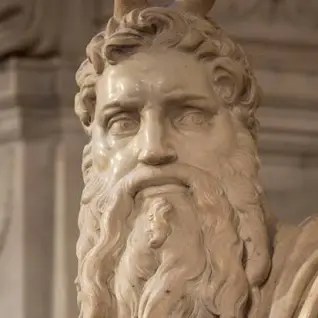
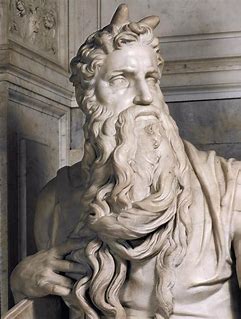
Introduction: The sculpture above is of course Michelangelo’s Moses. When you see it in person, you cannot help but marvel. I remember looking at the sculpture of Michelangelo’s David, and I almost broke down, because it was so beautiful. I hesitate to even write about what moves me in my studies of Moses, because the passage I’m thinking upon is of Moses at the Burning Bush. It is surely familiar to everyone. Okay, to some.
Here’s What Intrigues Me: God uses humble means for mighty purposes.
You’ll remember how Exodus 2 ends. Basically, God says that He is aware of His people’s plight, and He’s determined to address it:
23 During those many days the king of Egypt died, and the people of Israel groaned because of their slavery and cried out for help. Their cry for rescue from slavery came up to God. 24 And God heard their groaning, and God remembered his covenant with Abraham, with Isaac, and with Jacob. 25 God saw the people of Israel—and God knew (Ex 2:23-25, ESV).
In short, God remembered, God saw, and God knew.
A Meek Man: The dramatic stage is set: God is surely going to find some Chris Hemsworth, some Stallone or Schwarzenegger, to set things to rights.
Enter Moses. Remember his calling? Here are a few examples:
“And Moses hid his face, for he was afraid to look at God” (Ex 3:6b, ESV).
“Who am I that I should go to Pharaoh and bring the children of Israel out of Egypt?” (Ex 3:11, ESV).
“But behold, they will not believe me or listen to my voice, for they will say, ‘The LORD did not appear to you'” (Ex 4:1b, ESV).
On and on it goes, of course. Moses, so often thought of as mighty, was quite the contrary at times. He was quite often rather meek, doubtful, reluctant, and fearful.
Encouragement & Application: If you’re at all like I, I don’t like controversy. I would just as soon folks get along. But the reality is that truth divides. And God uses fallen, humble, meek men & women oftentimes to herald the most piercing of messages–whether to Pharaohs, or kings, or false shepherds, or hirelings, or presidents, or unbelieving spouses and children. It’s not we who do the saving. We’re just messengers. But we are to be faithful with the message of redemption.
The hour before dawn breaks, when it breaks, and the few moments after, are my favorite glimpses of the day. Beauty is both intellectual and visceral. You can look up aesthetics in volumes of the philosophy of art and beauty, or you can walk outside and behold the firmament. Which one teaches? Both, of course. But when you’re outside, you smell creation; you feel the wind (or perhaps stillness); you see colors that dare you to define them. You see a star rise in the East that enables your food to grow, turns your skin darker, and declares the glory of Jesus. The picture above was of clouds in the morning sky as I exited the gym on post after my morning PT.
Later I boarded a plane in Atlanta, bound for Texas, then on to Arkansas. I don’t particularly like crowds. I tend to seek out a bookstore or a coffee shop, and open a book, or watch people. I like people; I just cannot hear myself think if I’m amidst the buzz of a crowd. A few close friends is my preference, where we can talk, connect, and just be. If that’s not an option, I never travel without several books.
But over recent years I have been blessed in my job to be able to travel a great deal and minister to fellow soldiers. When I arrived at the parking lot several hours before dawn, I pushed the little green-glowing button, retrieved my ticket to park, found a parking space, parked, retrieved my ruck and bag, and boarded the shuttle. Right away, I adored the driver. She was a heavy black lady, probably in her late fifties, but was simply kind. She greeted me before I could even say “Good morning.”
“Have you ridden with us before?”
“Yes, many times,” I responded.
“Great! Well, good morning! We’re going to wait a few minutes for some others who’ve just pulled up; then it’ll take us three or four extra minutes to get to the terminal because of all the new construction,” she said.
She was so open, so friendly, I liked her immediately. I looked around the shuttle, stowed my ruck and bag, and took my seat. The lady’s shuttle was clean. I could smell the clean. And there was no trash. No wads of gum, no cigarette butts, no miscellaneous airline tickets, etc. The lady took pride in her job, her shuttle, her presentation of her business to her customers.
I looked at the dashboards where many drivers have places for customers to give tips, a buck or two usually, to thank them for their service. I was surprised to not see one in this lady’s shuttle.
More drivers boarded. I watched them as they bent over their cell phones, put their car keys in their bags, pulled up their boarding passes on their phones. Some of the ladies applied makeup and looked at themselves in compacts.
Finally, we were on our way, and within a few minutes we were at the terminal. I let the others off first, and as I retrieved my ruck and bag, I put some cash on the lady’s dashboard. “Thank you, sir! You just look for me when you come back, okay. I’ll be in this spot.”
“Deal,” I said. “Have a good one. Appreciate you.”
A few hours later, I was looking out over Texas and Arkansas, but I still found myself smiling at the kindness of the lady from 0400 this morning.
Introduction: The relationship that Moses had with the Lord was remarkable. Moses, sinner though he clearly was, loved the Lord, trusted the Lord, and longed to be faithful to the Lord, so much so in fact that Moses repeatedly pleaded with the Lord for closeness. That is, Moses repeatedly implored the Lord to make himself visible, knowable, and immanent to him (Moses). This is important because it foreshadows the gospel of Christ who did just that. Follow me.
Moses’ Intercession
12 Moses said to the Lord, “See, you say to me, ‘Bring up this people,’ but you have not let me know whom you will send with me. Yet you have said, ‘I know you by name, and you have also found favor in my sight.’ 13 Now therefore, if I have found favor in your sight, please show me now your ways, that I may know you in order to find favor in your sight. Consider too that this nation is your people.” 14 And he said, “My presence will go with you, and I will give you rest.” 15 And he said to him, “If your presence will not go with me, do not bring us up from here. 16 For how shall it be known that I have found favor in your sight, I and your people? Is it not in your going with us, so that we are distinct, I and your people, from every other people on the face of the earth?” (Exodus 33:12-16, ESV)
See it there? Moses says, “[P]lease show me your ways.” It’s a plea for God to become even more ‘real’, so to speak, all the previous episodes of judgment and deliverance notwithstanding.
What’s even more remarkable is that God condescends to Moses’ plea. God does it. That’s what verses 17-23 of Exodus 33 are all about. God carves out a cleft in the rock and “passes by,” if you will. Moses is able to behold some of the glory of the Lord. But God still, even for the mighty Moses, did not reveal His face. Why?
Principle: All of Scripture coheres. It’s unified; it tells one interconnected story of what God is doing through judgment to redeem a people for Himself.
Many people have a passing familiarity with the following, but I wander if they grasp the profound theology taught in them. They are from 2 Corinthians 4:
3 And even if our gospel is veiled, it is veiled to those who are perishing. 4 In their case the god of this world has blinded the minds of the unbelievers, to keep them from seeing the light of the gospel of the glory of Christ, who is the image of God. 5 For what we proclaim is not ourselves, but Jesus Christ as Lord, with ourselves as your servants for Jesus’ sake. 6 For God, who said, “Let light shine out of darkness,” has shone in our hearts to give the light of the knowledge of the glory of God in the face of Jesus Christ. (2 Cor 4:3-6, ESV)
God reveals Himself primarily in the incarnation, Christ the Son, and in Scripture. That’s the point.
Moses pleaded to see the Lord. And in the New Testament, that is exactly what happens. God the Son takes upon Himself flesh and came as a babe in a manger, was raised as a Jewish boy, astonished the religious elites via His wisdom, raised corpses, restored sight to the blind, legs to the lame, hearing to the deaf, and granted salvation to repentant sinners.
God did answer Moses’ plea–but in greater ways than Moses could have imagined.
God reveals Himself, you see, through what He has made, through conscience, through the incarnation, through the resurrection, through the fulfillment of hundreds of precise prophecies, and through His Word. He is, to quote Francis Schaeffer, not silent. He is anything but silent.
Moses, dear, precious, mighty man of God, Moses, God answered your prayer, and all we must do is flee to Him in the gospel, and we will find Him, His glory to behold.








 MIND & MATTERS