From Morning Haze to Pacing in Prayer While the Torandoes Twisted

When the plane lifted off from Atlanta, the humidity hung in the GA sky like a formidable force. The firmament’s colors changed in the course of seconds to hues of orange, tangerine, coral, and peach. I looked through the window on my left and snapped a picture with my old iPhone.

I was headed to Iowa again to minister to soldiers there. The weather forecasters were saying we might see some violent storms over the coming days.

I landed in Iowa fine, grabbed a bite to eat, checked in at my lodging, changed out of my civilian clothes and into my military uniform, called the commander, told him I’d arrived, and he invited me to come on in to report. Shortly thereafter, I was at his unit, and we caught up, and we chatted about the next day’s PT test his unit had scheduled. (I’d brought my PTs in order to test with the unit here.)

That night I went to bed early in order to be rested for the PT test the next morning. When I woke early and got warmed up and drove to the field house on post for the first events of the PT test, the skies looked pretty threatening. The sky was spitting rain and the clouds reminded me of the imagery from Bronte’s Wuthering Heights. Dark, foreboding, intimidating.

But we all knocked out our first three events: deadlifts, standing power throws, and hand-release pushups. We were picking up our kettlebells and weight plates for the sprint-drag-carry event when the Command Post (CP) loudspeaker blared: Attention, take shelter immediately! And the sirens blared that tornadoes were all around us. So we had to index the PT test and shuffle to the nearest shelter.

Later we thought the storms had passed, at least this front, so I was able to conduct my lane of training for the soldiers here. Training went well; the soldiers enjoyed it. I was able to have lunch brought in for them from a local bbq eatery they enjoy.

After that, I linked up with the commander and deputy commander again, and we planned future iterations of training. I went back to my lodging that evening and was reading a book on the Protestant Reformation called Reformation 500 when sirens began blaring. Then the electricity went off and I heard generators kick on. Tornadoes were all around the area. I looked out of the window of my lodging quarters. The flags on the poles out front were whipping and thrashing like so much thread in a gale. Semi-trucks were pulling off the interstate and onto the sides of the roads and/or under underpasses. The sirens continued to wail.
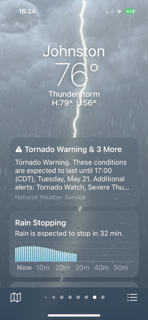
The skies went from blue, to ashen, to gray, to steel, to almost black. Rain blew sideways. Cars began pulling off the roadways and under concrete awnings of hotels and lodging businesses.

I wish I could say that I prayed highly sophisticated, articulate prayers. I didn’t. I seemed to hear myself mumble like a child: O God. Please. I have so much I still need to do. Lord, watch over my family. But, please, make this pass over me.

Nothing sophisticated about my mutterings, that was for sure. I was simply scared. I felt my finitude. I understood viscerally what Scripture means when it says “you are a mist that appears for a little time and then vanishes” (James 4:14, ESV). That’s what I knew in my bones. I was nothing compared to this. A drop, a fearful drop, amidst this massive storm above and around me. I was utterly at the mercy of the storm and the God of the storm.

The Alternative

Illustration: In a book I recently reread, the author penned this zinger:

In courtrooms, classrooms, operating rooms, board rooms, churches, and even airplanes, Americans no longer talk to each other, they entertain each other. They do not exchange ideas; they exchange images. They do not argue with propositions; they argue with good looks, celebrities, and commercials (Neil Postman, Amusing Ourselves to Death, pp. 92-93). 

Postman’s right of course. We’re living amidst idiot culture wherein the instancy and pervasiveness of images flows incessantly from every social media portal imaginable and reasoned dialogue is largely overrun by ad hominem attacks, shallow talking points, and barbed labels aimed at humiliating the enemies of one’s position. Kindness and common courtesy have been replaced by shock jocks and over-the-top antics. One of the most obvious effects is a coarsening of the culture and loss of respect and respectfulness. But there is another way. 

Encouragement and Application:  In the Christian worldview, however, we see the alternative: 

Walk in wisdom toward outsiders, making the best use of the time. Let your speech always be gracious, seasoned with salt, so that you may know how you ought to answer each person (Colossians 4:5-6, ESV). 

We cannot fully escape the endless rivers of images and videos assaulting our senses. But we can deal with one another respectfully and model what it means to be a people characterized by quality of speech and character rather than crudity and coarseness, but it will not happen from the top down but from the bottom up, with each of us in our daily obedience doing the small but right things towards each other and towards God. 

Words with Annie

Despite her mixed messaging regarding her theism (or denial thereof) I nonetheless adore Annie Dillard’s writing. After all, if one writes well, so be it. And she does more than write well.

Here’s just one illustration:

What blood was this, and what roses? It could have been the rose of union, the blood of murder, or the rose of beauty bare and the blood of some unspeakable sacrifice or birth. The sign on my body could have been an emblem or a stain, the keys to the kingdom or the mark of Cain (Dillard, Annie. Three by Annie Dillard. [New York: Harper Perennial, 2001], 9).

You’ve led a tinctured, word-bloody life, Annie; salute. May you be graced into the Word of all words.

An Acronym (with theological spine)

Illustration: In some of the courses I teach students online, one of the models I use as an icebreaker each week as a kind of buddy check is the acronym P.I.E.S. I check to see how each student is doing P(hysically), I(ntellectually), E(motionally), and S(piritually) each week. It gets us all caught up with one another and I gain a reading of the room.

During a deployment in Iraq, my commander was among the finest leaders I’ve ever had. He was a bottom line, up front, no-nonsense, serious but personable commander. You never had to wonder where you stood with him. He was honest, consistent, and straightforward. I liked and respected him from day one. He used to tell us in staff meetings that each day he committed to feeding himself physically, spiritually, professionally, and emotionally. I have not forgotten that. I don’t know if he was familiar with P.I.E.S. in theological circles in which I traffic, but he was spot-on as usual.

Connection: In Scripture, God speaks to these same themes. In Army parlance, we might term it holistic fitness. But God is eternal and the fountain of all wisdom, and as much I love Army life, God’s ways predate the U.S. Army. Here’s what God says about each area:

Physically: Or do you not know that your body is a temple of the Holy Spirit within you, whom you have from God? You are not your own, for you were bought with a price. So glorify God in your body (1 Cor 9:19-20, ESV).

Intellectually: Do not be conformed to this world, but be transformed by the renewal of your mind, that by testing you may discern what is the will of God, what is good and acceptable and perfect (Rom 12:2, ESV).

Emotionally: Rejoice with those who rejoice, weep with those who weep (Rom 12:15, ESV).

Spiritually: Beloved, do not believe every spirit, but test the spirits to see whether they are from God, for many false prophets have gone out into the world (1 Jn 4:1, ESV).

Encouragement: The God who formed us knows what we need and what leads to human flourishing. May we have the wisdom and courage to follow His way.

Everyone Who Thirsts

Isaiah was God’s poet. When you slow down and focus on the formidable beauty of Isaiah’s lines, they’re rivers of honey and drippings of the honeycomb.

Hear the heart of God for redeeming people:

Come, everyone who thirsts, come to the waters; and he who has no money, come, buy and eat! Come, buy wine and milk without money and without price. Why do you spend your money for that which is not bread, and your labor for that which does not satisfy? Listen diligently to me, and eat what is good, and delight yourselves in rich food. Incline your ear, and come to me; hear, that your soul may live; and I will make with you an everlasting covenant, my steadfast, sure love for David (Isaiah 55:1-3, ESV).

What do you see here? Several things are overt; they leap off the page:

  • God’s seeking all who will come/His invitation
  • What’s needed is not stuff but simple repentance and faith in God
  • God’s delight in providing lavish blessings upon His people
  • God’s unending covenant/faithfulness

Again and again, God seeks sinners who will forsake their folly and flee to His good news. And it hinges upon God’s grace, God’s covenant faithfulness, and God’s love for repentant people.

Learning from “The Egg”

Illustration: One of my favorite short stories is “The Egg” by Sherwood Anderson. It’s about the recurring failures of a ne’er-do-well father, a man who goes from chicken farming to restaurant proprietor, to a balding poor man married to a small-town schoolteacher, to ambitious but naif performer of tricks and gimmicks involving deformed chickens and eggs. It’s a 10-page gem of a story about one’s spiritual blindness. The father does not understand what his son does, namely, the folly of his (the father’s) silly undertakings and ambitions. The father’s hands of ambition far exceed their grasp. And what ensues is just one humiliation after another. The son, an astute observer and seer of ultimate matters, is embarrassed for his father. The son, in short, both loves his father and is embarrassed by him. The father is a fool. He tries to be something he is not and is thwarted at every turn by forces arrayed against him. He is a man who kicks against the goads of design that God has written into the world. Rather than embracing reality and recognizing reality, he tries again and again to live in a made-up world where he is the creator and has power over others and the world, but he is frustrated at every turn.

Text: It reminds me very much of Solomon’s words in Ecclesiastes:

Vanity of vanities, says the Preacher, vanity of vanities! All is vanity. What does man gain by all the toil at which he toils under the sun? A generation goes, and a generation comes, but the earth remains forever. The sun rises, and the sun goes down, and hastens to the place where it rises . . . What has been is what will be, and what has been done is what will be done, and there is nothing new under the sun (Eccl 1:2-5, 9 ESV).

Encouragement: When Paul was near concluding his letter to the Romans, he penned this:

For whatever was written in former days was written for our instruction, that through endurance and through the encouragement of the Scriptures we might have hope (Rom 15:4 ESV). Anderson’s masterful story “The Egg” is about those who refuse to admit the obvious and the tragedy that follows such refusal. There is, however, another way, but it calls for humility, repentance, and faith in the Father who knows best.

Does Anti-Intellectualism Triumph?

The heart cannot love what the mind does not know.

It is a cliche, of course, because it remains true.

I cannot explain it adequately to myself, the shallowness of things. When one reads ‘the news’ it’s like watching pubescent children hurl pebbles and sling mud. To alter Arnold’s phrase, armies of intellectual urchins clash both day and night. Arguments are gone; now, it’s ad hominem attacks, ‘mostly peaceful protests’ by mobs, cancel culture, and the alphabet mafia.

In teaching my students, I continue to find they don’t read. They just scroll, scroll, scroll–video after video. An endless internet river of images devoid of substance.

The Scriptures say, “In the beginning was the Word . . .” (Jn 1:1a ESV). That’s John’s opening salvo about the logos, the Christ of God. It is to remind hearers of the centrality of the speaking/communicating/word-driven God who is, and who communicates primarily through a book. The sixty-six books of Scripture are there in countless languages, but we must open them, read them, study them, show ourselves approved as those who rightly understand and apply them to ourselves and to all who will hear and obey.

I read a story today on a news site where a man married an ashtray. Before that, he had married a mannequin. Yes, it’s true. It didn’t work out. Shocker. This is where we are.

https://theweek.com/news/world-news/954014/man-who-married-sex-doll-dumps-her-for-an-ashtray

It’s Romans 1:22-23 in Technicolor.

I’m going back to my novel now. The ship of fools left the port some time ago.

God’s Double-edged Covenant/Faithfulness: Reflections Upon Ministry

Today a flood of memories came back to me via pictures that social media had picked up of my career in military chaplaincy. I saw pictures of leading fellow soldiers in the Lord’s Supper at Abraham’s Well in Iraq and of preaching a year’s worth of services in Afghanistan. I saw pictures from invocations and benedictions at events honoring veterans of America’s wars and rumors of wars. I saw pictures of times at my state’s capitol building under the golden dome. I saw pictures of times visiting with soldiers in hospitals and physical rehabilitation facilities where soldiers were to convalesce via physical and occupational therapy regimens. On and on it went.

And I was reading Isaiah today, too, and was in some of the most beautiful poetic language in Scripture:

[N]o weapon that is fashioned against you shall succeed, and you shall refute every tongue that rises against you in judgment. This is the heritage of the servants of the LORD and their vindication from me, declares the LORD (Isaiah 54:17 ESV).

It’s remarkable how quickly time passes, how quickly the miles add up, how the trips around the globe accumulate. I am unbelievably thankful to be able to minister to those who probably will never darken the doors of a church. They’ll probably never read a Bible very much or with much hermeneutical acumen.

But God has been gracious to allow me years to pursue this calling, to try and reach those who are often physically tough but spiritually broken. God and His gospel are the only redeeming answers, but they are building a heritage of the servants of the LORD, and God knows them by name.

The Gospel in Numbers 14

Text: Numbers 14

Context: The setting is 15th B.C. in the ancient Near East. Israel is again demonstrating weak, anemic faith in God, and they largely turn upon their human leader Moses who–yet again–intercedes before God on their behalf.

Numbers 14 is the historical account of yet another dramatic unfolding of the gospel in the Old Testament. It’s the story of God’s unchanging word; of sinful humanity; of God’s prophetic mediator and leader; of sacrifice; and judgment. All of this is in Numbers 14. 

The chapter opens with the people of Israel whining about having it better in captivity in Egypt. Why all this struggle, Moses? Why not let us be like the rest of the nations—relatively comfortable slaves to pagan rulers: “Would that we had died in the land of Egypt! Or would that we had died in this wilderness! Why is the LORD bringing us into this land, to fall by the sword? Our wives and our little ones will become a prey. Would it not be better for us to go back to Egypt?” And they said to one another, “Let us choose a leader and go back to Egypt” (Num 14:1-4 ESV). 

And what does God do? Does He immediately judge the people for their hardheartedness? Does He vanquish them? No. He has a mediator, Moses, who intercedes on behalf of a sinful people. Why? Because the “LORD is slow to anger and abounding in steadfast love, forgiving iniquity and transgression” (Num 14:18a ESV). 

Connection to Our Day: God’s people are to live by God’s words, by His covenant promises, but we are just like unbelieving Israel. We demand the comforts of this world. We don’t want to walk by faith in God but by sight upon the lures of today.

And yet God has His one and only ultimate prophet, priest, and king, and His name is not Moses or David or Caleb or any military or political leader, but rather Jesus. He’s the only fully faithful One. Will we look to Him, or will we perish in the wildernesses of this world? 

Encouragement: “Let us therefore strive to enter that rest, so that no one may fall by the same sort disobedience” (Heb 4:11 ESV). That rest, that land of promise, that milk and honey imagery that Scripture uses throughout to teach, points to Christ. He’s the One to whom the wandering soul is to look, because He alone has conquered and is the installed King of kings and Lord of lords. 

Which Will It Be, eh?

Text: “Whoever walks with the wise becomes wise, but the companion of fools will suffer harm.”

God has been gracious to me over the years by placing wise people in my life, especially at opportune times. Our paths have crossed at times when I needed to learn something, needed to see something, perhaps as a confirmation of a suspicion or hunch I had. I’m a big believer in the providence of God and the sovereignty of God.

I cannot say that I actually believe there is such a thing as an accident. Because if one admits the category of  accident in one’s thinking, he is necessarily admitting that there is no superintending guidance or overarching purpose in events, but instead randomness. I don’t think that at all.

Even with tragedy, I think God’s hand superintends all things. In short, I don’t think there are any rogue molecules or atoms outside of God’s control. Either God is sovereign, or all is randomness. As one of my favorite books has it, it’s either chance or the dance. Christ says, not even a sparrow falls to the ground apart from God’s decree (Mt 10:29).

Encouragement: It can be discouraging if we look out upon the cultural landscape and throw up our hands and say, “Ah, it’s all lost. The fools have won.” They demand we save the turtles but abort the children. They demand men are now ‘birthing persons’ but they cannot tell you what a woman is. It’s madness at such a level that it’s not even parody anymore. It’s just pure silliness and utter folly.

Therefore, thoughtful Christian, cultivate relationships with the few, the wise, and pour into those who have the wisdom to know the difference between the sage and the fool. Folly is not a winning strategy. He who captures souls is wise (Pr 11:30). And wisdom is known by her children (Lk 7:35).