Scriptural Foundations (Part 4/10)

Scriptural Foundations (Part 4/10): Chronological Snobbery

Introduction: In one of his many wise writings, G.K. Chesterton wrote, “Real development is not leaving things behind, as on a road, but drawing life from them, as from a root.” 

And C.S. Lewis penned this wisdom which runs in similar grooves: “It’s a good rule after reading a new book never to allow yourself another new one till you have read an old one in between. If that is too much for you, you should at least read one old one to three new ones . . . . Every age has its own outlook. It is especially good at seeing certain truths and especially liable to make certain mistakes. We all therefore need the books that will correct the characteristic mistakes of our own period . . . . None of us can fully escape this blindness, but we shall certainly increase it, and weaken our guard against it, if we read only modern books . . . . The only palliative is to keep the clean sea breeze of the centuries blowing through our minds and this can only be done by reading old books.”

Connection to Our Day: Sometimes I look around at churches and I am so encouraged because I see seasoned saints whose Bibles are worn out. Their pages are thin and supple from years and years of reading, writing, and the turning of their leaves. It is dangerous of course to assume that just because someone reads her Bible a lot that he/she has an accurate understanding of its contents. I grew up hearing “Where two or three are gathered in my name” passage was a palliative for slim attendance at Wednesday night prayer meeting. But of course that passage has nothing to do with that, but it is rather about church discipline (Mt 18:15-20). 

This is why it’s so important to keep the main things the main things. In other words, it’s the theme I’m laboring through this 10-part series on foundations. We need to get back to the basics and not get sidetracked and derailed via tangents. Wisdom demands discerning what’s most important and what is less important, and knowing how to divide one’s limited energies. 

Just two passages for today

First is Hebrews 6:17-18, “So when God desired to show more convincingly to the heirs of the promise the unchangeable character of his purpose, he guaranteed it with an oath, 18 so that by two unchangeable things, in which it is impossible for God to lie, we who have fled for refuge might have strong encouragement to hold fast to the hope set before us.”

Second is James 1:17, Every good gift and every perfect gift is from above, coming down from the Father of lights with whom there is no variation or shadow due to change.” 

Encouragement: An essential part of getting one’s worldview right is getting God right. There is—in every worldview—a God of the system. But in the biblical worldview alone, you have a God is both transcendent, holy, unchanging, and relational. He is both “holy, holy, holy,” steadfast, and is trinitarian/relational, not a God in need who has to create out of some want or lack. 

The fact that God who needs nothing, lacks nothing, and is nothing other than perfection in and of Himself, but has both made Himself known and has come to save sinners is inexhaustibly good news (εὐαγγέλιον, euaggelion). This is why we need to go back, read the old saints, learn the Patristics, study history, so that we don’t run afoul and become chronological snobs who neglect the wisdom of the past. God is unchangingly perfect and loving and just. He does not “evolve on any issue.” He is fixed, steadfast, and is the only Anchor for objective rationality and human flourishing. 

Scriptural Foundations (Part 3/10)

Few lessons I have learned remain as ingrained as lessons learned via construction. I remember watching Granddaddy (my stepfather’s father) known to most by his nickname ‘Frog’ (he was short and squat) and to us as Papa, lay block. He had arthritic but strong hands with large, sunburned knuckles. Though a small man by stature, he and his sons hefted cinder blocks like they were loaves of bread, right into place, as he’d eyeball the line, and we’d pop chalk lines and lay a 2X4 down and check for plumb, and he’d lay block till the sun set. I can still see him sitting on an upside-down 5-gallon bucket, chewing his Levi Garrett chewing tobacco, hefting silver concrete blocks with his short Popeye muscular arms with freckles on them from too much time laboring in Dixie’s relentless sun.

I never knew then that I was storing up backaches and blisters that I’d give anything now to recapture, because as he laid that block, and I hauled studs from the driveway to the foundation, and we built floor joists, and I imbibed the smells of pine and cedar, and learned about pine knots, and warped vs. straight boards, and learned how to hammer well, and how my stepfather seemed to understand wood craftsmanship in ways that were almost mystical to me, it was magical to me. I was enchanted. Because it enraptured the senses.

We’d peel off our shirts of the evening, and they’d be salty with sweat, and we’d sometimes get burgers from the Dairy Queen in the summer evenings, or we’d get a BBQ sandwich from Scott’s, our local BBQ place, and drink sweet tea amidst the evening abuzz with mosquitoes and fireflies.

But what was happening, I now see, was that a foundation was being laid. I learned the smell of toil, love, hard work, and of what it meant to craft a home from hands that cared. It was not secondhand life, but firsthand. And that made all the difference.

What does this have to do with Scriptural foundations? Much, at least in my view. In the biblical worldview, Scripture directs the people of God in how we are to glorify and enjoy God. (Matthew 19:4-5, Genesis 2:24; Luke 24:27, 44, and 1 Corinthians 2:13, and Deuteronomy 4:2, e.g. speak to this.)

Scripture, God’s words to His people, tells us not only what to believe (i.e., what is true) but what we’re to do:

(John 5:39 and 20:31, for example, speak to this, as does 2 Timothy 3:15. Deuteronomy 10:12-13 applies here, too.)

Encouragement: Foundations are just that–foundational. We are to build upon them. Why? Because they’re fixed. There’s a cornerstone. There’s ‘square’ and ‘plumb’ and ‘straight’–and all of it coheres to build the greatest of homes for those who know these are but foretastes.

But How Will I Know?

Like many believers through church history, I go through Scripture a couple of times each year. No matter how much one reads Scripture, one is always discovering the Bible’s endless riches. The reason is obvious: God is wisdom; ergo, His revealed Word is endlessly profitable. 

Some people may be intimidated by the prospect of the Bible, of reading Scripture’s sixty-six books, of trying to figure out what all the language about bloody sacrifices, days of purification, priests, tabernacles, holy and unholy places, love, biblical marriage, etc. is all about and how it coheres.

What does all that have to do with being a believer today? Must one be a historian first? Be encouraged; no, you don’t have to be a historian.

I thought it might be helpful to provide ten verses/passages (one a day) as an intro into the Christian worldview, followed by a very brief running commentary:

Question/Issue: Has God spoken? That is, does God leave His creation to guess/surmise/wonder around blindly, searching the creation for evidence of design or God’s will for our lives? 

Answer: No; God is not silent. Exactly the opposite. He has spoken creation into existence, formed man, then the woman from man, and has told them His will. In addition to that, He has superintended sixty-six authoritative books by which His people endlessly learn of Him, His wisdom, and His gospel of grace. 

Below are three fundamental passages for the people of God:

  1. Luke 24:27 & 44 read, “And beginning with Moses and all the Prophets, he interpreted to them in all the Scriptures the things concerning himself” and “Then he said to them, These are my words that I spoke to you while I was still with you, that everything written about me in the Law of Moses and the Prophets and the Psalms must be fulfilled.” 
  1. Psalm 19:7-11 reads, “The law of the Lord is perfect,/reviving the soul;/the testimony of the Lord is sure,/making wise the simple;/the precepts of the Lord are right,/rejoicing the heart;/the commandment of the Lord is pure,/enlightening the eyes;/the fear of the Lord is clean,/enduring forever;/the rules of the Lord are true,/and righteous altogether./More to be desired are they than gold,/even much fine gold;/sweeter also than honey/and drippings of the honeycomb./Moreover, by them is your servant warned;/in keeping them there is great reward.”
  1. Micah 6:8 reads, “He has told you, O man, what is good;/and what does the Lord require of you/but to do justice, and to love kindness,/and to walk humbly with your God?”

Encouragement: Be not discouraged, Christian. God is not silent. He has spoken—through creation, through conscience, through Christ, and through His sixty-six books of sacred Scripture. 

Nonnegotiables & Expectations (Part 4/4)

Intro: If we are myopic in our understanding, we can tend to think things have never been as difficult when trying to bear witness to the truth, as stacked against Christian witness, as biased against any biblical witness towards culture as what we are seeing nowadays. 

Things are, one must admit, devolving rapidly. I read yesterday Massachusetts may activate the National Guard to go to high schools in order to establish some measure of law, order, and safety. The students, far from learning English, math, and history, are instead making a mockery of what government schools were ostensibly created for, namely, a very basic education in civics, self-discipline, and some grasp that the world has in fact before Taylor Swift and Instagram. But the students are having sex, running amok, ordering DoorDash to the school, are often truant, and the teachers have long lost control and hope. Things are continuing to spiral out of control, of course, but what invariably happens is order will be established but it will involve violence and/or the threat of it. When you have a culture that cannot control itself, a means of control will step in and assume control. When God’s common grace is thwarted, jettisoned, mocked, and rejected, in other words, chaos ensues because everyone does what is right in his/her own eyes. There is no transcendent unifying anchor to which all are subject, in other words, so pandemonium is the result. This is what we see unfolding on a daily basis. At its root is the abandonment of God.

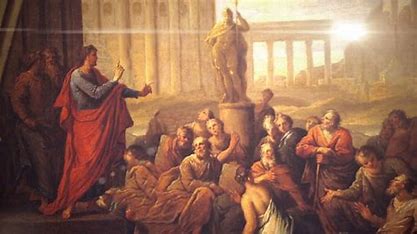
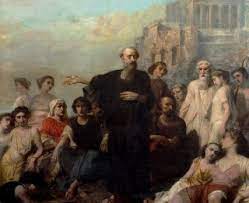
Connection to Scripture: In Acts 17 Paul, too, understood this. He tries to reason with the people in Athens: 

Paul Addresses the Areopagus

So Paul, standing in the midst of the Areopagus, said: “Men of Athens, I perceive that in every way you are very religious. For as I passed along and observed the objects of your worship, I found also an altar with this inscription: ‘To the unknown god.’ What therefore you worship as unknown, this I proclaim to you. The God who made the world and everything in it, being Lord of heaven and earth, does not live in temples made by man, nor is he served by human hands, as though he needed anything, since he himself gives to all mankind life and breath and everything. And he made from one man every nation of mankind to live on all the face of the earth, having determined allotted periods and the boundaries of their dwelling place, that they should seek God, and perhaps feel their way toward him and find him. Yet he is actually not far from each one of us, for “‘In him we live and move and have our being’; as even some of your own poets have said, “‘For we are indeed his offspring.’ Being then God’s offspring, we ought not to think that the divine being is like gold or silver or stone, an image formed by the art and imagination of man. The times of ignorance God overlooked, but now he commands all people everywhere to repent, because he has fixed a day on which he will judge the world in righteousness by a man whom he has appointed; and of this he has given assurance to all by raising him from the dead.” Now when they heard of the resurrection of the dead, some mocked. But others said, “We will hear you again about this.” So Paul went out from their midst. But some men joined him and believed, among whom also were Dionysius the Areopagite and a woman named Damaris and others with them. (Acts 17:-22-34)

Encouragement & Application: Paul’s nonnegotiable remained the historical bodily resurrection of Jesus from the dead. And the responses to Paul’s trying to reason with the people are exactly the same ones we see today. Some mocked (Acts 17:32). Others said, “We will hear you again about this” (Acts 17:32). And some believed and were saved (Acts 17:34).

Pagan chaos brought civilizations to their knees before; empires thinking the sun would never set upon them due to their expansiveness have come and gone, Rome is now a footnote in most people’s history textbooks; Athens, Greece’s money comes from tourism of their once great culture, the Third Reich is just a historical shame which gets brought up in arguments when the other side cannot think of a greater insult than to call someone a Nazi; and on and on it goes. 

But if we truly care about people, we will try to tell them the truth. And when we do that, some will mock; others may give us a second hearing; and, to God be the glory, some will believe and be saved. Our job is to be faithful. 

Nonnegotiables & Expectations (Part 3/4)

Have you ever watched a movie or read a book or seen a play and come away with this thought: O my goodness! That is exactly the way I feel. It’s like the person knows me!

I certainly have. I’ve seen The Shawshank Redemption, Cool Hand Luke, Death of a Salesman, and a few other films so often that I can just about quote every line. (Most of today’s movies just don’t have the caliber of storyline and character development that older ones do, in my view. I mean, after you’ve seen 666 explosions and car chases, you grow bored rather easily. At least I do.)

What does this have to do with Acts 17 and nonnegotiables and expectations for Christians who are trying to bear faithful witness to the truth in a culture that is drunk on lies and stupidity?

Notice was Paul did. In Acts 17 as Paul was in Athens, Greece, he knew the stories the culture had imbibed. That is, he knew what they were filling their time with. My all-time favorite quote from folksy wisdom is this: What’s down in the well comes up in the bucket.

Yes and amen. What does that mean? It means that a person will show you what he/she is made of by way of his/her behavior and speech.

When Paul began to argue for the Christian faith, he let his hearers know that he understood them: “Men of Athens, I perceive that in every way you are very religious. For as I passed along and observed the objects of your worship, I found also an altar with this inscription, “To the unknown god.’ What therefore you worshp as unknown, this I proclaim to you” (Acts 17:22-23).

Here’s the nonnegotiable: It is not hard to discern people’s “god of the system.” Look what they fill their time with. Look what stirs their emotions. Look how they spend their money. Do they read books or do they only watch videos on their gadgets? Do they take their worldview from social media? Do they think or only emote? The questions could go on.

Encouragement: Paul studied and knew his audience. He knew their assumptions. He saw their religiosity. Oh, they were very religious, be assured of that. They simply worshiped false gods, which is to say, they worshiped idols. But Paul “got them,” to use saccharine Super Bowl-laden sentimentality to dupe the vulnerable.

Paul got them, to be sure, but he let them know that he got them in order that he might love them enough to tell them the truth. We don’t need more entertainment, folks; we need wisdom and the courage to herald it.

Nonnegotiables & Expectations (Part 2/4)

In Acts 17 as Paul entered Athens he was burdened by the formidable pagan idolatry assaulting his eyes. There were temples and statuary to gods and goddesses everywhere throughout the city. His spirit was “provoked.” That is, because he knew the damning results of lies and false worship, and because he loved the truth, his spirit was both tender towards those he longed to reach with the truth, but he was likewise saddened by the overwhelming nature of false religion.

But here was his nonnegotiable: Christ had been bodily raised from the dead. He had been seen for days and days post-resurrection by disciples, by skeptics, by women, etc. 1 Corinthians 15 and John 21 are historical accounts, among many others, of Jesus’ resurrection and post-resurrection appearances to both individuals and to crowds.

Because Christ had been bodily raised from the dead, it was proof of his divinity, of his power over the grave, of all his promises that he was who he said he was. All of the promises of God, in other words, found their Yes in Christ (2 Corinthians 1:20).

And here’s a second expectation that you and I can count on if we’re laboring to be faithful: Expect your bearing witness to the truth to be perverted and/or twisted in ways that distort its truth and your character.

In short, audiences will slander you as the messenger (they called Paul a ‘babbler’ in Acts 17:18, e.g.) and they scoffed at the message of the gospel as “some strange thing[s]” (Acts 17:20), as if it were something to be cavalierly tossed aside, something all but irrelevant. That is the nature of the scornful, of mockers, of fools professing that they’re wise (Romans 1:22).

Encouragement: Be of good courage, Christian soldier. Paul endured it. Peter endured it. John endured it. Esther endured it. Joseph endured it. David endured it. Elijah endured it. But most of all, the Lord Jesus endured it infinitely and fully.

Why? Not just to serve as the perfect example of faithfulness, but to encourage all who will hear and attend–to teach us that we might have hope, that we might press on, that we might not grow weary in doing good, that we might be made like him through the things we suffer for his glory.

You’re Following a Story … Always

Was doing some reading tonight and came across an arrestingly true sentence:

There have been great societies that did not use the wheel, but there have been no societies that did not tell stories (Ursula K. Le Guin, The Language of the Night: Essay on Fantasy and Science Fiction (London: Women’s Press, 1989), 25.

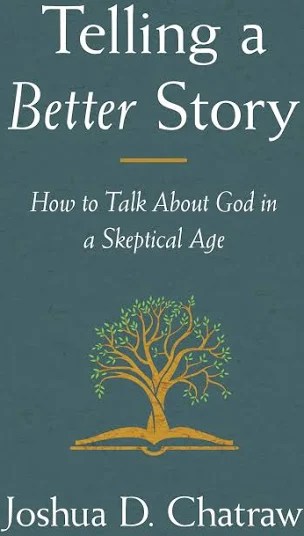
I was reading J. Chatraw’s Telling a Better Story (highly recommended) and am indebted to him for the reference.

Nonnegotiables & Expectations (Part 1/4)

In the following installments I explore some nonnegotiables of faithful Christian witness and some of the results one should anticipate. The nonnegotiables and expectations are both rooted in the historical account of Paul’s reasoned defense of the Christian faith in Acts 17 when he welcomed any and all skeptics, naysayers, intellectually honest, and others to deal with the facts.

It should go without saying but I will write it nevertheless. We are living in a largely post-truth era. The ultimate reason is simple. We have jettisoned God, the author of truth, and God’s revelation. We have done exactly what David in Psalms poetically reveals is the folly of the foolish:

The fool says in his heart, “There is no God” (Psalm 14:1).

Paul teaches the exact same principle in the New Testament:

For although they knew God, they did not honor him as God or give thanks to him, but they became futile in their thinking, and their foolish hearts were darkened. Claiming to be wise, they became fools, and exchanged the glory of the immortal God for images resembling mortal man and birds and animals and creeping things . . . . because they exchanged the truth about God for a lie and worshiped and served the creature rather than the Creator, who is blessed forever! Amen. (Romans 1:21-23, 25)

Three principles leap out at all with ears to hear and eyes to see:

  1. The folly of the fool
  2. The fool’s suppression of truth
  3. The pride of the fool

The very nature of the fool is his folly. He refuses to acknowledge truth, even to his own destruction. It’s not that he does not see; it’s that he refuses to see. It’s a spiritual hardness, not a physical hardness. He suppresses what is clear and obvious. But not only does he persist in his folly by way of suppressing what he knows to be true, but he boasts in his arrogance, deeming himself wise.

I remember watching countless boxing matches with my stepfather as a boy. And every once in a while we would witness a boxer who was over-the-top brash, full of himself, hubris in boxing shorts, etc. He’d preen for the cameras, flex his muscles for the crowds, and appear to be invincible. And I’ve lost count of how many times that young man was flat on his face on the canvas a few minutes or even seconds later, unconscious, because his opponent had the power of reality and truth. That’s the way truth works. You can deny it but it hits you in the face nonetheless.

Nonnegotiable # 1:

In Acts 17 when Paul was in Athens, Greece, he was bearing witness to the Christian faith in a culture replete with pagan idolatry. I have walked and stood in the same places Paul walked on trips to Athens. It is still moving when you feel the weight of history and precedent wash over you.

But here’s all I want to leave you with today (this is just installment one of perhaps five, after all): Expect resistance.

That sounds simple but I, for one, have underestimated it in my ministry. There is no paucity of resistance to truth. So, be patient. Expect tribulation. Expect folks to scoff, to mock. But just give it time. Time has a way of revealing things.

Here’s the way Luke describes Paul in Acts 17:

Now while Paul was waiting for them in Athens, his spirit was provoked within him as he saw that the city was full of idols (Acts 17:16).

Paul, the super-credentialed Pharisee of Pharisees, a man of staggering intellect and personal testimony, was nonetheless provoked. Why? Because he cared? Yes. Because he saw the folly of the Greek culture? Yes. But most of all, I think, it was because he knew what he was up against. He was up against lies and the father of lies. He expected the resistance.

Encouragement: I am certainly no apostle Paul. But I do try to reach those who will listen. But if we underestimate the vitriol of the enemies of truth, we can grow weary in doing good (Galatians 6:9). Be encouraged, pilgrim. Expect resistance. But remember who sustains you and that even the grave could not suppress the truth that triumphs.