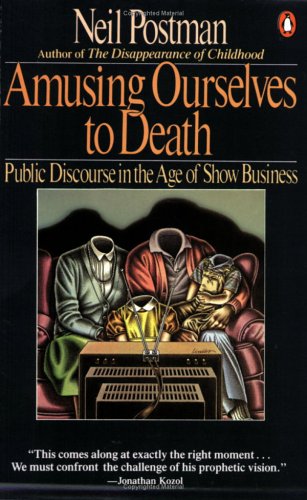
“Americans no longer talk to each other, they entertain each other. They do not exchange ideas; they exchange images. They do not argue with propositions; they argue with good looks, celebrities and commercials.”
When I read this the first time, I was in my twenties. When I read it again, I was in my thirties. When I read it again, another decade had come and gone.
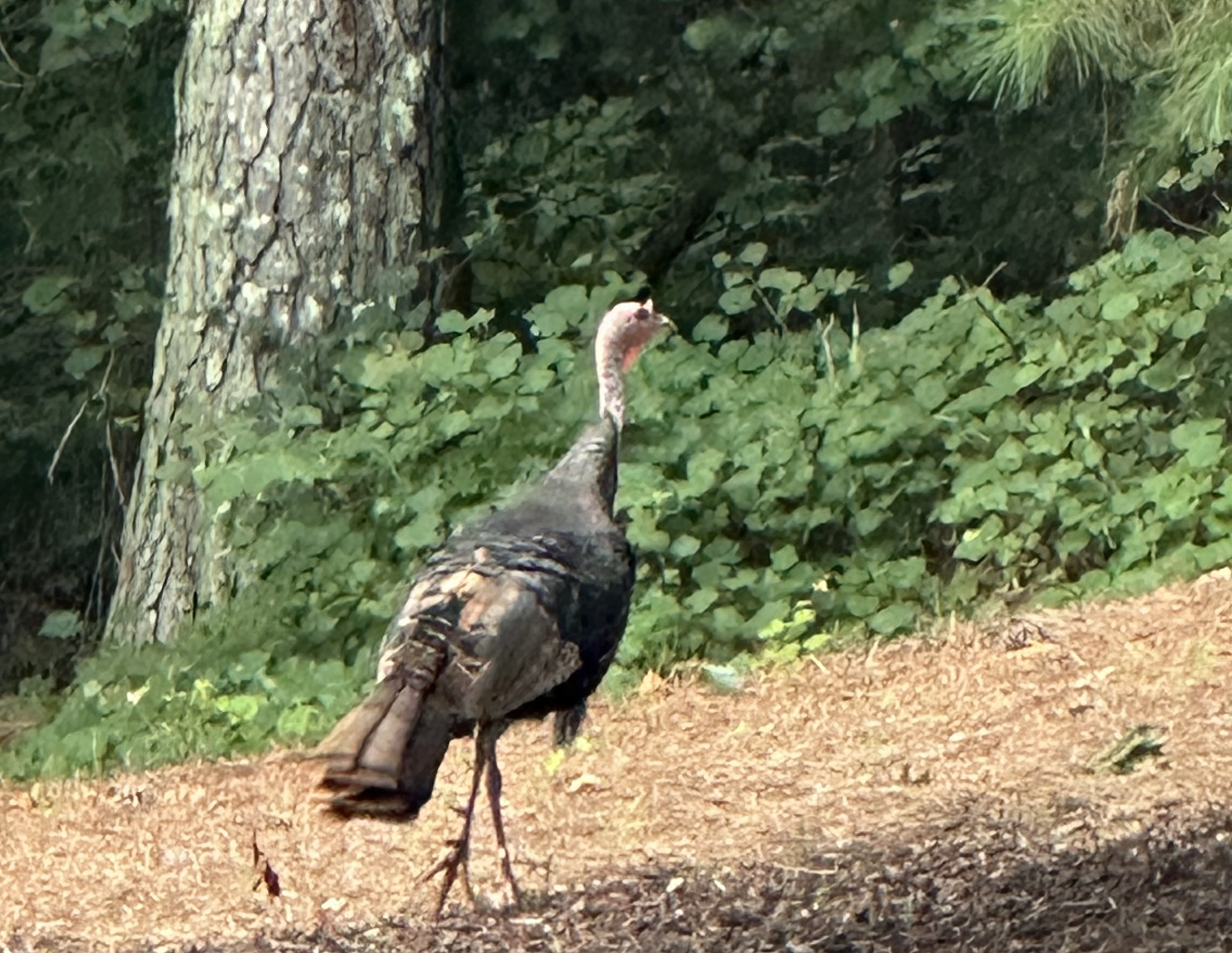
Some of the boys came out during the daytime recently.
They are still in velvet and ‘friends’ for the moment.
But autumn is coming, and changes in hormones, and girls. And, well, things will change.
How anyone can watch nature’s cycles and say, “Yep, just random. No order. Accidental unguided matter in motion” is both intellectually dishonest and blind to what is plain and incontrovertible.
I love watching these creatures. They, like the rest of creation, have an author.
At a military observance today in honor of veterans of the Korean War.
It was 70 years ago that the Korean War Armistice was signed under Eisenhower, and the 38th parallel and the DMZ became (for those who pay attention to history) markers of yet another war.
While in NGA, I was also able to watch the turkeys strut their stuff for a bit, too, prior to the observance.
To the Marine who spoke at the observance, to the hosting organization, to the Patriot Guard Riders, and more, salute.
Question: Have you ever heard or uttered the phrase, “Stand in the gap”? Most of us have, I should think. The meaning is straightforward, but I looked at some defintions online, too, just to see. Here was the first one: “To assume a position of active, resolute defense (for or against something).” I appreciated that, especially the part about standing in the gap “for or against something.” In other words, there should be reasons–good solid defensible reasons–for standing in the gap.
As a soldier of more than two decades now, and of many many days spent in military settings across the globe, I have seen and been part of no small amount of standing in the gap for America. But my concern here is not about military operations, per se. My concern is for the Christian church that is so often anemic, vanilla, and irrelevant. Why? Because the unspoken assumption in so many professing Christian communities is, “Be nice. Don’t raise your voice. Don’t be political. Just love people. And above all, be nice.”
Of course there is no command in the Bible to be unnecessarily fractious. However, do you think Jesus was crucified for not being nice? Did the Bible record how the Pharisees opined, “You have declared yourself to be a meanie; therefore, let’s call the Romans and have you crucified on Friday.” Um, no.
Was Paul stoned, whipped, tortured, imprisoned, run out of town, and eventually martyred under Nero because he was not nice? Again, no. Read his letters for yourself.
Was Peter crucified for not being nice? How about Thomas? How about James? Again, no.
Connection: I am indebted to some new friends who have united with our Sunday school class. Recently they introduced me to Larry Alex Taunton. He is a Christian intellectual, writer, and thinker. And here (it is linked below for you) is what he does in this (and other) podcasts/videos he puts out: He calls on true Christians to actually connect what they say they believe to how they actually behave. What a concept, right? Who knew that orthodoxy is to shape orthopraxy? Belief shapes behavior. In other words, he reminds us to stand in the gap.
Takeaway: This Sunday as we gather, I am teacing on Psalm 22, one of the most quoted and crucial and Christocentric psalms in all of the Old Testament. But when David penned that, he penned it from a position of a man standing in the gap.
He was a real man, speaking to real people, in a real zip code, on a real day, about real suffering and combat and hope and redemption.
It wasn’t fortune cookie bromides. It wasn’t, “Just be nice.”
It was (and is) about standing in the gap, how he did it as a king in his day, and about the ultimate King, who endured the wrath for his people, so that they would not lose hope, so that they would stand in the gap in their day, too.
Stand in the gap, dear Christian. Don’t retreat into pietism and cowardice by telling yourself (or by believing others when they tell you) that Christianity is “Just be nice.” That’s sentimentalism and moralism and not the message of the prophesied, sent, crucified, risen Savior. If you are a believer, you are to stand in the gap and so be found faithful. Connect the gospel to your daily life. Live it out. Yes, this brings conflict. But that is inseparable from the Christian life. You were told that you would “meet trials of various kinds” (James 1:3, ESV).
And why must it be that way? Listen to Peter: “so that the tested genuineness of your faith–more precious than gold that perishes though it is tested by fire–may be found to result in praise and glory and honor at the revelation of Jesus Christ” (1 Peter 1:7, ESV).
Stand in the gap, dear ones. Stand in the gap.
A Plea to Pastors:Connect the Word to the events of the world; show the people how the Word of God explains the world. That is the way to equip the saints. Stop prostrating yourself before the “Idol of Nice” and connect the true church to the true God through his true Word. That is equipping the saints for battle. If you don’t do that, you’re just nice and altogether irrelevant.
Introduction: If you know anything about me, you are likely to know that I cherish few things more than reading. I read primarily deeply, but try to also read widely.
That was not always the case. I used to focus nearly exclusively on theology, history, and literature–especially on accounts of Vietnam. I read Tim O’Brien, Caputo, and Del Vecchio, and more novels and accounts of Soldiers, Sailors, Airmen, Marines, and Coast Guardsmen than you are likely to imagine. I just could not get enough. So much shifted in the 1960s and 1970s. Assassinations, drugs, corruptions, politics, secularism, feminism, more corruption, scandals, Vietnam, hippies, rock-n-roll, LSD, cover-ups, more corruption, more reports and scenes of Hueys in SE Asia, of Walter Cronkite, of Mike Wallace, of Simon and Garfunkel, of burning draft cards, of race riots, of Selma, AL, and Atlanta, GA, and of Oxford, MS, etc.
Multiple worn, worn-out, marginalia-ridden novels and memoirs of tunnel rats in Cambodia, and reconnaissance troops in the Balkans, and nested scouts in NE Europe in the Great War, fill my shelves. More, probably, than is psychologically healthy.
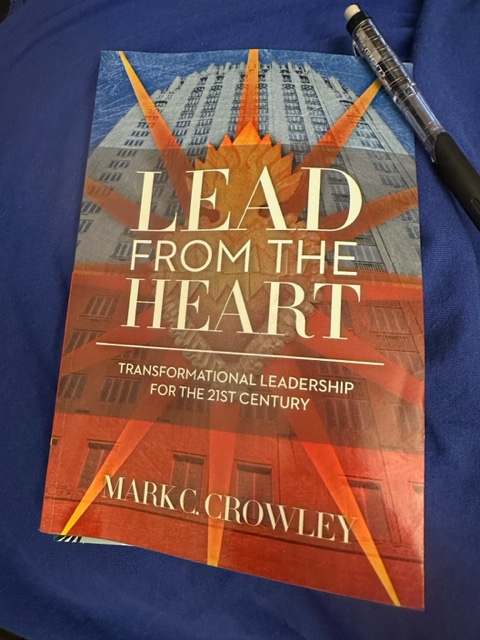
And that’s what leads me, among other things, to some of this week’s reading:
A Book:
This is where the breadth part enters. Crowley is a businessman. I am not; I’m in Christian ministry. I am in the people business. Soul business. Eternity business.
I’ve never been wealthy and don’t aim to be. But I do labor hard and (I hope) wisely. I try to focus on nothing less than what endures. It may sound pompous but here it goes: I try to labor for eternity. For that which endures. What endures are people. People’s souls. Their lives. What made them who they were and are.
I was blessed in certain ways to be not unfamiliar with many of the comforts that lucre can bring. I had a blended upbringing where some of wealth’s comforts were sometimes clear.
I know what it’s like to have more forks at the table than are necessary to eat. I know what it’s like to be on sailboats. I know what it’s like to use a driver and watch men drink a Bloody Mary or Gin & Tonic, and tap their gold-bedecked smooth hands upon the oak table at the country club, while the Jaguars and BMWs are pulled to the front door, and the young man with white gloves dons a smile as perfect as Brad Pitt’s, and opens the door for you and extends his fingers for the understood transaction.
But is there more? Is it possible that one could be quite dissatisfied, even empty, with the aforementioned? For literary types, is it possible Jay Gatsby was quite the fool, along with Daisy Buchanan? Mark 8:36 is not just a nice story in the Bible but a warning to search our souls and be honest about who and what we really worship.
Jaguars and BMWs are absolutely gorgeous, but I’ve never owned them. I have had Jeeps and Chevrolets and Fords and Hondas and Subarus and Nissans, however. No one has ever accused me of being showy via vehicles.
I know, I know, the book …
So Crowley cites another author’s 6 questions about how and why so many folks are dissatisfied in their jobs. The bottom line is, the jobs don’t reach them, not at their core.
And here are the (6):
Six Questions:
Do you get a sense of pride out of associating with the organization where you work?
Do you enjoy the relationships you have at work?
Do you get a sense of fulfillment from your work?
Because of these cognitive and emotional attachments, do you intend to behave in a different way?
Are you more inclined to apply discretionary effort at work?
Are you inclined to stay working at your job even if you may have opportunities outside the organization as attractive as what you have today?
An Unscientific Concluding Postscript:
Kierkegaard notwithstanding, one of the best bosses I ever had was the one who recognized what fed my soul, and he let me pursue it to the best of my ability, and it served the organization. He benefited, too. Often. From my efforts. But I did not mind. Why? Because I was allowed to do what I was gifted in.
Then I have had other bosses, and they trusted me to work hard and make them even more successful. I think I have done that. I am forever grateful for the opportunities I’ve been given and I have tried to work quite hard to demonstrate excellence and show what faithful ministry can do.
And I’ve had the micro-managers, too, who want to look over my shoulder, read my emails, and know what I’m doing at every second of every hour. I absolutlely shut down under those types. Zero. They sabotage all joy, all motivation, all love of the job.
My Takeaway? Know your people. Entrust them to do well. If they don’t, talk to them and find out why. And if necessary, let them go.
But if you listen, and care, and are not stuck on yourself, it is possible God has given you someone special, one who can make you and the organization better.
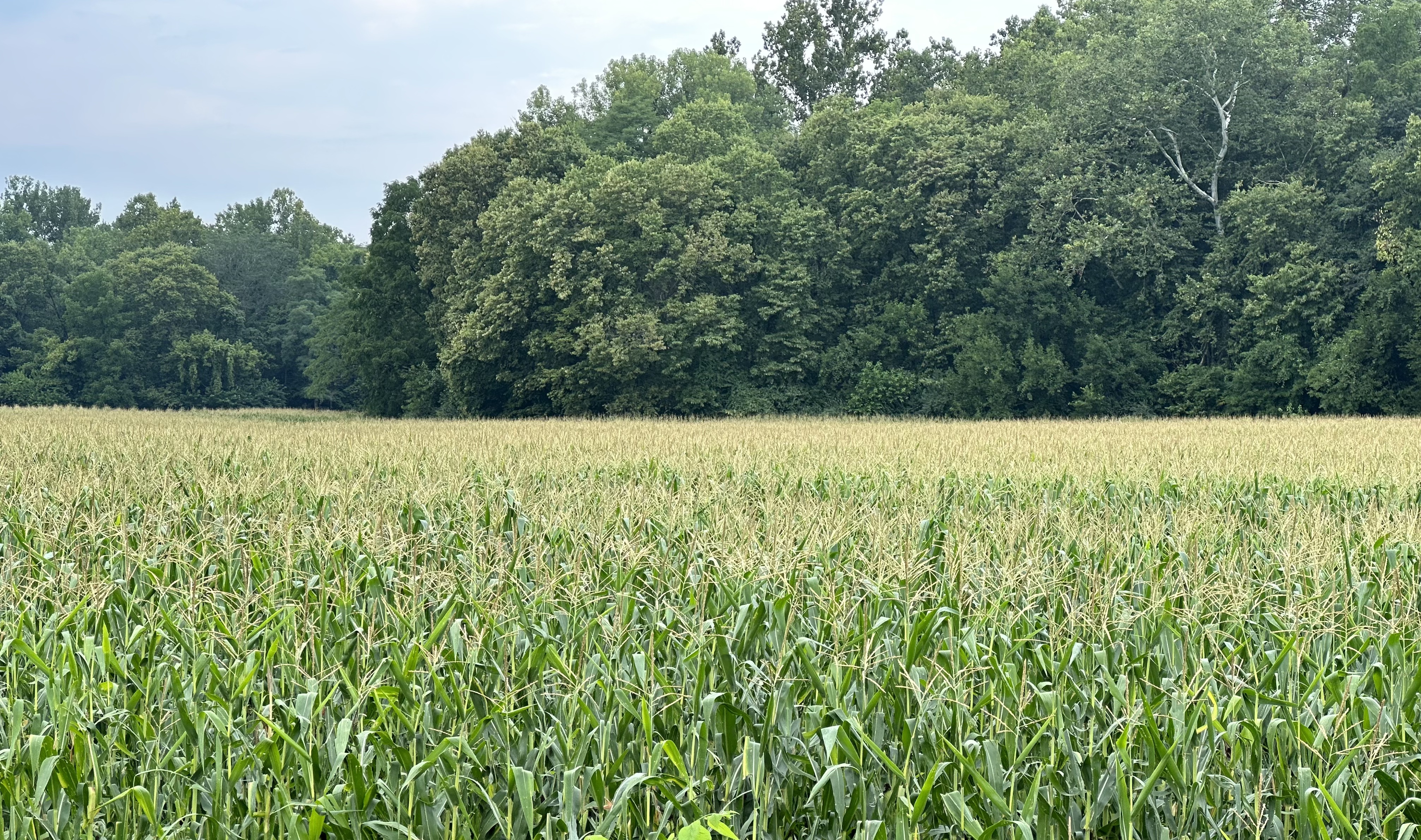
I have been in the American Midwest recently where the earth is flat, fertile, and often furrowed. Rows of corn and green acres of soybeans capet the checkerboard land, often as far as eye can see. Irrigation pumps spray water in arcs over fields in the afternoons. Fingers of hardwood stands and small copses hold deer that emerge at dusk and before dawn. As the sun arises, silos and barns could serve as sextants to measure one’s place since all else seems stillness.
I was able to minister to fellow soldiers and even reconnect with some peers from my education side of the house. We ate supper and chatted about how we all came to ministry. I loved hearing their stories. One of the overlapping themes was how the Spirit moved upon each person, alerting her or him to the needs that were all around. It just took eyes to see. And God granted eyes to see as well as the heart, mind, and hands to do the labor to which each was called.
One story was of how she started a soup kitchen in her own community for the needy. With what did she start? A conviction from God, the gift of faith, and a willing spirit. She picked up the phone. She coordinated with her local sheriff’s office. She prayed. Soon churches were reaching out and helping coordinate. For years, she did this ministry. And God sent the people–those in need and those who volunteered and served.
Another story was of how she saw a prisoner reading Our Daily Bread and struck up a conversation with the inmate. Soon, other prisoners overheard their conversation and joined in. Why? Because she had cared enough to reach out in faith and goodwill. And the Lord blessed that spirit. Soon she had more education and eventually became a chaplain to prisoners.
The stories continued. I listened. And tried to learn from the stories.
To learn that God allows particular people to see amidst the sameness. What most folks might miss, some are given eyes to see. How? I think it is by the sovereign work of God. It’s not a humanistic accomplishment.
I was encouraged. Again. To pay attention. To attend. To be faithful to one’s calling and hone one’s gifts in service of the truth and for people. God honors that. He is glorified by how we treat the least of these–the invisible, the downtrodden, the straying, the hopeless, the rejected, fellow sinners.
The fields of Indiana and Iowa stretch on and on and on. And if you don’t pay attention, one stalk of corn may appear no different from another. But if you pay attention, if you walk in the field, if you smell the soybeans in the morning when the mist hangs motionless as the first rays of sun slice the motes, you see things, beautiful and broken things, things in need of shepherding and stewarding, and someone to care enough to labor. The harvest only comes much later.
Carrie Jane cooked steaks for us today and we had a delicious supper and when I went outside to play with the dogs for a bit, these fellas were out back, and quickly let me know that they knew we were interrupting their supper.
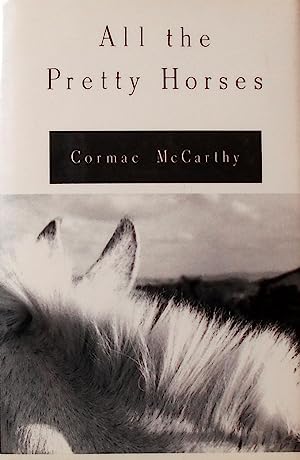
Introduction: I discovered the writing of Cormac McCarthy in the 1990s. I was on a deployment in the Balkans during the Clinton administration. While the world was fascinated with Clinton’s doings with Monica and adulteries in the Oval Office, I was reading the works of Cormac McCarthy when I wasn’t on duty with my fellow soldiers in the Army, as the Serbs, Croats, Bosnians, Muslims, professing Christians, and others raged over the ethnic cleansing and crimes that characterized the former Yugoslavia. I read All the Pretty Horses first, and I was immediately and permanently hooked on McCarthy. That was nearly 25 years ago now, and I’m still reading him.
McCarthy died a few weeks ago, and there is now a new interest in him, but I’ve been with him all along. In English, other than Shakespeare, Dickens, Milton, Faulkner, Hemingway (in his best early stories), and Flannery O’Connor, McCarthy’s tops for me. I’ve found no one who crafts sentences in English with such pathos, power, and soul-wrenching beauty. What Dante is to Italian, McCarthy is to American English. What Cervantes is to Spanish, McCarthy is to American English.
I read Horses again recently as well as several books of McCarthy scholarship, and again I was ridden across the bloodred ranges of sage, arroyos, and dry winds, where desert prophets expostulate under lightning storms, and Mexican beauties elicit knife fights, and the roasting of venison over the campfire draws wolves down from the hills.
Reasons I Read McCarthy:
The beauty of language. Here is one example from when John Grady Cole reflects upon a girl:
“ . . . and the sadness he’d first seen in the slope of her shoulders which he’d presumed to understand and of which he knew nothing and he felt a loneliness he’d not known since he was a child and he felt wholly alien to the world although he loved it still. He thought that in the beauty of the world were hid a secret. He thought the world’s heart beat at some terrible cost and that the world’s pain and its beauty moved in a relationship of diverging equity and that in this headlong deficit the blood of multitudes might ultimately be exacted for the vision of a single flower” (282).
If you’ve a soul, if you’re not dead to beauty, if you’ve ever loved and admitted it to yourself, and felt your heart long to utter that beauty is the voice of God to wrestle the souls of men from slumber, those words from McCarthy will speak to you. What does it reveal if they do not?
2. His assessment of man’s destruction of creation. Whether it’s McCarthy’s Border Trilogy, or The Road, or earlier masterpieces like Suttree, The Orchard Keeper, and Outer Dark, McCarthy’s important because he understands the distinction between stewardship and rapacity. Man is brutal, and McCarthy dramatizes said brutality beautifully.
Some Concluding Thoughts: I have my own contribution to McCarthy coming soon, but if nothing else, I invite readers to try McCarthy if you’ve not before. And if you have and found him tough, well, he is. He’s not for the bottom shelf; he never settled for that. But if you’ll do the work, slow down and think of what he’s saying (and saying beautifully), you will discover what great literature does: it moves souls, speaks the unspeakable, and reminds you of mystery and of what matters.
A buddy of mine sent me a couple of pictures that I had to share. If these are not visual homilies I don’t know what would qualify as such.
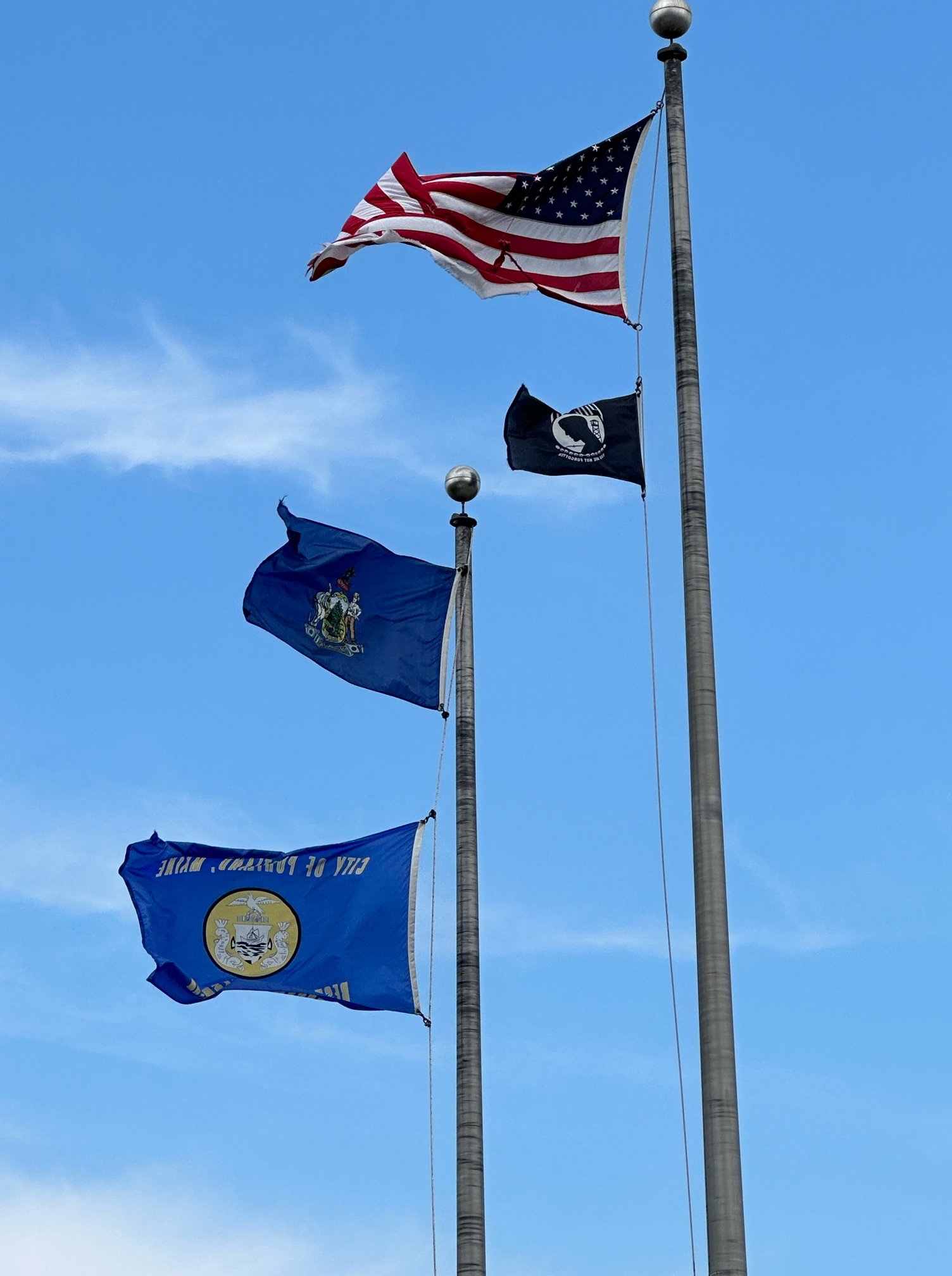
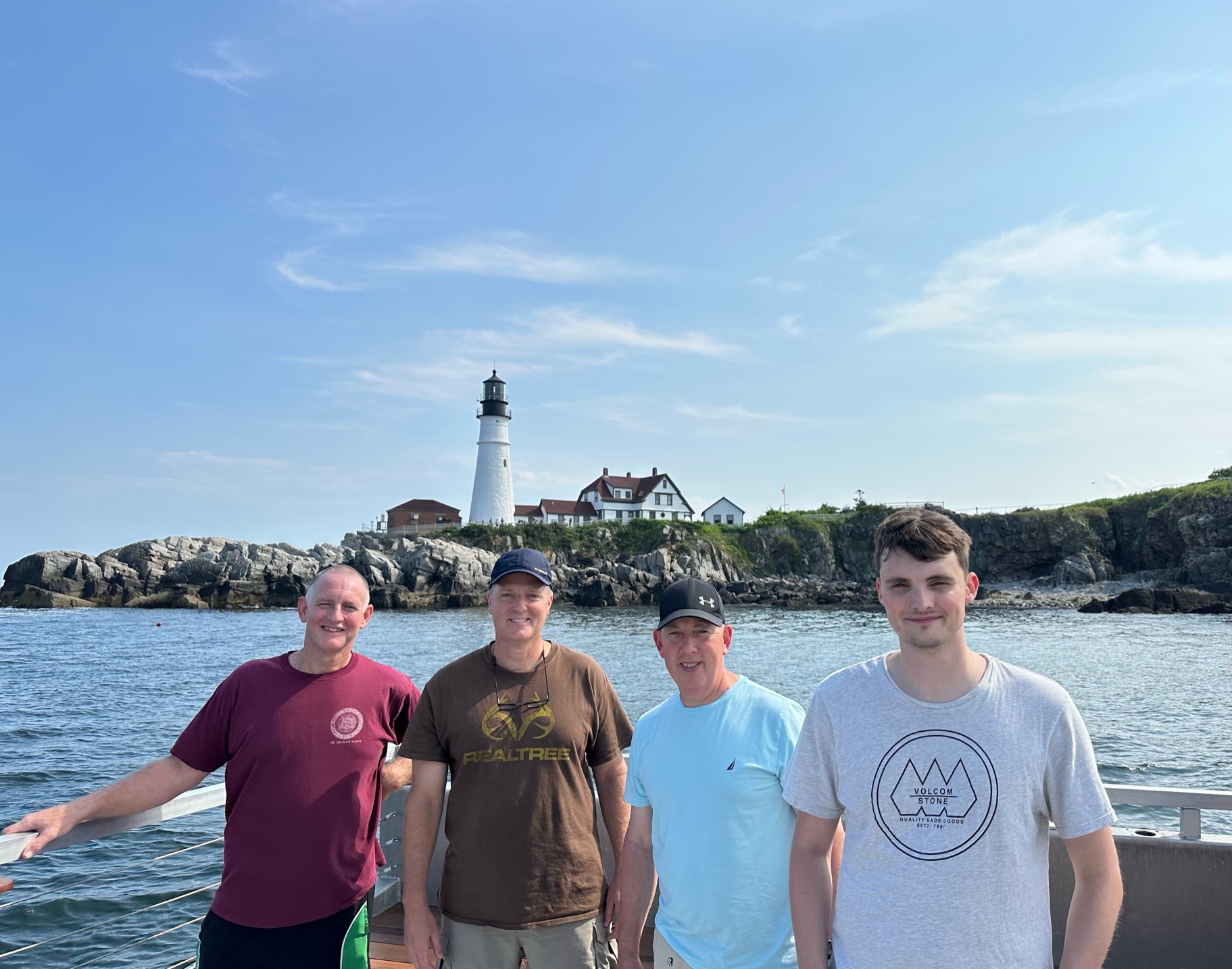
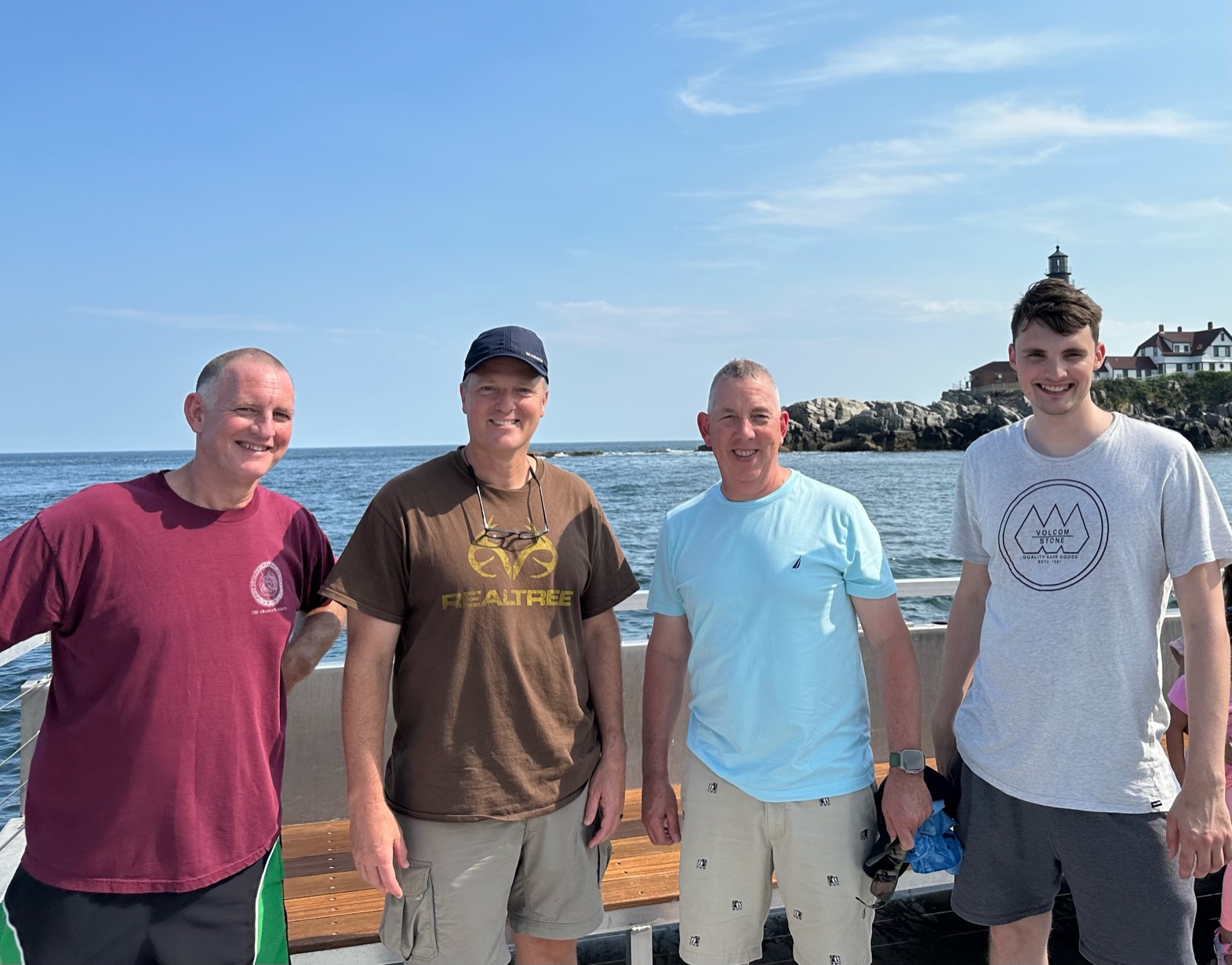
I was in Maine recently and was educated by lobster fishermen on their way of life. What a great trip. I am so grateful to have been able to attend and to get to reconnect with an old friend and some fellow chaplains.
It was rough to reenter the heat and humidity of Georgia after enjoying the temperatures of Maine, but as the flight descended into Atlanta, the heat and haze of July in GA came on like a wet wool blanket even as the quartz dome of ATL (Stone Mountain) came into view, and the city of Atlanta stood steaming in the morning haze.
When I got home, one of the girls was watching me.
And later one of the boys was lying down in the back, too, in the shade on these hot hazy days.
Thankful to have been part of some excellent training and equipping of chaplains for the Army and Air Force over recent days in Maine. I was able to reconnect with some buddies from the past and meet some new ones. And we were able to explore some of beautiful Maine, where it’s all-things-lobster here, or as it sounds to the ears when locals speak, “lobsta.”
Maine folks, you have a beautiful section of creation you get to call home. Steward well. It’s certainly blessed by powerful hands and abundant with beautiful and abundant resources.


























 MIND & MATTERS