Questions: When you hear the word prophet, what comes to your mind? Does it usher in thoughts of ease and comfort? When you study the lives of men like Jeremiah, Ezekiel, and Daniel, are ease and comfort what you find with those men? Or is it more accurate to say that God’s prophets meet with resistance from forces hostile to God and God’s ways? The questions answer themselves, of course.
Text:
When the people of Israel cried out to the Lord on account of the Midianites, the Lord sent a prophet to the people of Israel. And he said to them, “Thus says the Lord, the God of Israel: I led you up from Egypt and brought you out of the house of slavery. And I delivered you from the hand of the Egyptians and from the hand of all who oppressed you, and drove them out before you and gave you their land. And I said to you, ‘I am the Lord your God; you shall not fear the gods of the Amorites in whose land you dwell.’ But you have not obeyed my voice.” (Judges 6:7-10)
Teaching: In Judges 6, as in sundry other passages from Judges, God sends prophetic voices to wake the people up from spiritual slumber and apostasy. The prophetic voice is a gift of God’s grace.
Verse 7 of Judges 6 records that “the people of Israel cried out to the LORD . . .” Why? Because they were being overrun by the Midianites. And what did God do in his grace? He sent them a prophet. The truth-telling prophet called the people back to God, to the history of God’s fidelity, to God’s providential hand, and the prophet called the people to trust. He didn’t call them to trust wicked leaders; he called them to trust God and God’s messenger.
Encouragement: May God grant hearts and minds that discern God’s truth-telling prophets. Why? Because the prophetic voice is a gift of God’s grace.
This evening after a supper with my bride, I sat down in my library to read and study. I was in Joshua. The passage I focus upon herein is found in Joshua 5:
13 When Joshua was by Jericho, he lifted up his eyes and looked, and behold, a man was standing before him with his drawn sword in his hand. And Joshua went to him and said to him, “Are you for us, or for our adversaries?” 14 And he said, “No; but I am the commander of the army of the Lord. Now I have come.” And Joshua fell on his face to the earth and worshiped[c] and said to him, “What does my lord say to his servant?” 15 And the commander of the Lord’s army said to Joshua, “Take off your sandals from your feet, for the place where you are standing is holy.” And Joshua did so. (Joshua 5:13-15)
Context, Context, Context: Of the 24 chapters in Joshua, this is chapter 5. This is a subsection of the book of Joshua that recounts Joshua leading Israel and crossing into the land promised to them by the Lord. As in any conquest, one is sure to meet friends and foes. The issue? How was Joshua to know which was which? Who was a friend and who was a foe?
When you examine the story, you discover that this event precedes the Fall of Jericho. But before the Lord gives Jericho into the hands of God’s people, the leader (Joshua) is confronted. He is confronted by a man standing before him and that man stood “with his drawn sword in his hand” (v. 13). That’s a posture for battle, for warfare, for blood.
And what does Joshua do? He asks the man a question: “Are you for us, or four our adversaries?” (v. 13). In other words, Joshua wants to know if the armed man is on God’s side or on the side of God’s enemies. And the response Joshua received could be viewed as cryptic: “No; but I am the commander of the army of the LORD. Now I have come” (v. 14).
That “No” the man answered was emphatic. He was revealing to Joshua that he was bigger than Joshua, Israel, and the enemy pagans into whose territory Joshua was leading God’s people. Now, the text says, the man was here. Not later, but now. At the right time. In the fullness of time.
Teaching: After studying this passage, and Scripture as a whole, for years now, it is my belief that this event was a Christophany, an event of the preincarnate Christ appearing in the Old Testament. God is omnipresent, of course. There is no place God is not. However, God makes special entrances at times of particular importance in salvation history.
When Joshua was about to lead his people into Jericho, it was an important time in salvation history. Why? Because God was continuing to reveal his covenantal promises to his people, that he would never leave them or forsake them.
Encouragement: I do not know where you are spiritually today. But this is one more example in Scripture of God demonstrating in real space-time history that he is in the midst of his people. Our job is to do as Joshua did–fall on our faces before the Lord. Why? Because he wields a drawn sword, and victory belongs to the Lord of hosts.
Jericho would be given to God’s people. God’s covenantal promises to his people would continue. And so should believers’ faith in the God who cannot lie.
Issue: The fundamental issue in the book of Joshua centers around the theme of the promise of God to conquer his enemies. Any organization must have a clear and defined leader, and that leader is to be a godly man, a man of God’s own choosing. Why? Because if unregenerate sinners choose the leader, disaster will be the result. And the books of Joshua and Judges demonstrate again and again what choosing the wrong leader leads to, and it’s not pretty.
Questions:
Would the nation of Israel keep its promise to obey God?
Would the nation of Israel step out in faith in God?
Would the nation of Israel enter the Promised Land with an undivided heart?
In short, would the nation of Israel be faithful?
Context, Context, Context: The historical account is found in Joshua 2. Joshua, Moses’ successor, was God’s appointed leader of the nation of Israel. Remember God’s words to the people: “No man shall be able to stand before you all the days of your life. Just as I was with Moses, so I will be with you. I will not leave you or forsake you. Be strong and courageous, for you shall cause this people to inherit the land that I swore to their father to give them” (Joshua 1:5-6).
Joshua, God’s appointed leader, sends out two men as spies. To do what? A reconnaissance mission. He sends them to spy out the land, to get a snapshot of the geography and people. They were what we might term “scouts.”
Rahab Enters the Story: The prostitute Rahab was just that—a prostitute. But God was at work in her life. He was calling her to himself. How do we know this? Follow the story:
Before the menlay down, she came up to them on the roof and said to the men, “I know that the Lord has given you the land, and that the fear of you has fallen upon us, and that all the inhabitants of the land melt away before you. For we have heard how the Lord dried up the water of the Red Sea before you when you came out of Egypt, and what you did to the two kings of the Amorites who were beyond the Jordan, to Sihon and Og, whom you devoted to destruction. And as soon as we heard it, our hearts melted, and there was no spirit left in any man because of you, for the Lord your God, he is God in the heavens above and on the earth beneath. Now then, please swear to me by the Lord that, as I have dealt kindly with you, you also will deal kindly with my father’s house, and give me a sure sign that you will save alive my father and mother, my brothers and sisters, and all who belong to them, and deliver our lives from death.” And the men said to her, “Our life for yours even to death! If you do not tell this business of ours, then when the Lord gives us the land we will deal kindly and faithfully with you.”
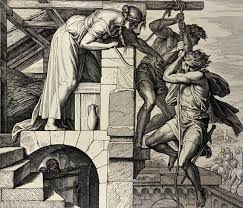
Then she let them down by a rope through the window, for her house was built into the city wall, so that she lived in the wall. And she said to them, “Go into the hills, or the pursuers will encounter you, and hide there three days until the pursuers have returned. Then afterward you may go your way.” The men said to her, “We will be guiltless with respect to this oath of yours that you have made us swear. Behold, when we come into the land, you shall tie this scarlet cord in the window through which you let us down, and you shall gather into your house your father and mother, your brothers, and all your father’s household. Then if anyone goes out of the doors of your house into the street, his blood shall be on his own head, and we shall be guiltless. But if a hand is laid on anyone who is with you in the house, his blood shall be on our head. But if you tell this business of ours, then we shall be guiltless with respect to your oath that you have made us swear.” And she said, “According to your words, so be it.” Then she sent them away, and they departed. And she tied the scarlet cord in the window(Joshua 2:9-21).
Teaching: In short, Rahab believed God, and her actions demonstrated genuine saving faith in the person and work of God.
Encouragement: Look back at the (4) questions I asked above. Sadly, the answer to all (4) questions is a resounding no. The nation of Israel fell short. They doubted. They were cowardly. They did not trust the Lord fully. They were half-hearted at best and deeply idolatrous. Joshua and Judges provide myriad examples of some of the practices of child sacrifice, bestiality, and sexual perversions that boggle a good person’s mind. Yet God saved Rahab and her family. How? Be granting repentance and faith to her. It’s that simple and that profound: God came to save sinners. Prostitutes like Rahab were not outside of God’s reach. There’s hope for us, dear ones. There is hope. How? Be turning to God and his saving gospel.
After a day of work, I met my wife and son for an early supper at our Mexican restaurant we patronize with regularity. CJ and I split a plate of fajitas. Our son got his usual, too. We talked during our time together and drove home afterwards. I drank a cup of coffee, played with Ladybug, our dog, for a bit, and then sat down to study a bit more for teaching our congregation through 1 Peter.
This coming Lord’s Day we are in the first few verses of 1 Peter 2. Verse 1 of that text reads thus: “So put away all malice and all deceit and hypocrisy and envy and all slander.” There is so much practical Christian wisdom in that one sentence.
Context, Context, Context: Peter was writing to what he termed “elect exiles.” That is, his initial audience was Christians who were enduring some level of persecution. Peter knew they were feeling pressures to chuck their faith, to give up, to give in, to doubt God and God’s providence.
Thus Peter, “the apostle of hope,” as he is known in church history, wrote to encourage the saints. And how did Peter do that? By reminding Christians of the fundamentals. And what were some of those fundamentals of what not to do? Just in verse 1, Peter names five specific things Christians are not to do:
Be malicious
Be deceitful
Be hypocrites
Be envious
Be slanderous
All that is just in verse 1.
Encouragement: Have you ever noticed the amount of damage inflicted by just these five things? Malice, deceit, hypocrisy, envy, and slander undermine Christian witness. Folks, we can learn from all examples, especially bad ones. Let God’s people come to terms with the high calling of being salt and light in a sin-saturated world.
What lessons should Christians learn from Moses’ life?
Text:
Moses was 120 years old when he died. His eye was undimmed, and his vigor unabated. And the people of Israel wept for Moses in the plains of Moab thirty days. Then the days of weeping and mourning for Moses were ended.
And Joshua the son of Nun was full of the spirit of wisdom, for Moses had laid his hands on him. So the people of Israel obeyed him and did as the Lord had commanded Moses. And there has not arisen a prophet since in Israel like Moses, whom the Lord knew face to face, none like him for all the signs and the wonders that the Lord sent him to do in the land of Egypt, to Pharaoh and to all his servants and to all his land, and for all the mighty power and all the great deeds of terror that Moses did in the sight of all Israel (Dt 34:7-12).
Teaching: Regardless of how many times I read the Bible, this writing about the end of Moses’ earthly life moves me viscerally. Why? I think it’s because there are some people with whom we strongly identify.
Moses was a shepherd. He truly cared for his people and endured vast amounts of suffering on their behalf. He led them like a biblical shepherd leads a flock—selflessly and sometimes with great private pain. He worked hard on their behalf.
Moses was godly. He was certainly a sinner. That is clear from his not giving God the glory when he (Moses) struck the rock at Meribah (Num 20:8). Moses was also a murderer (Ex 2:11-15). And yet God expresses unique love for Moses (Dt 34:10-11).
Moses was a fallen man, and yet God used him centrally as part of Israel’s deliverance and future conquering of Canaan.
Moses was not allowed by God to enter the Promised Land. Why? Because of his own sin. It moves me viscerally when I think upon this judgment of Moses. Moses did not have to answer for the sins and recalcitrance of the sins of those he led. He had to answer for his own sin.
What should Christians learn from Moses’ life?
God judges us individually.
God pronounces benediction upon godly leaders.
God welcomes intimacy with himself and that hinges upon God’s immanence and believers’ lives of spiritual obedience to God’s revelation.
Encouragement: When you have a moment, read Deuteronomy 34 again and again. Then read it again. It is only twelve verses, but those few sentences are among the most laudatory and tender verses in all of Scripture, and they are a master study in the life of Moses, a man “the LORD knew face to face” (Dt 34:10).
When you go out to war against your enemies, and see horses and chariots and an army larger than your own, you shall not be afraid of them, for the Lord your God is with you, who brought you up out of the land of Egypt. And when you draw near to the battle, the priest shall come forward and speak to the people and shall say to them, ‘Hear, O Israel, today you are drawing near for battle against your enemies: let not your heart faint. Do not fear or panic or be in dread of them, for the Lord your God is he who goes with you to fight for you against your enemies, to give you the victory.’ (Deuteronomy 20:1-4)
Questions:
What’s your initial reaction/gut instinct when you have a battle on your hands?
What does Scripture say about where the Christian’s reliance should be?
Context, Context, Context: In the passage above from Deuteronomy 20, God is instructing Moses. About what? Warfare. God, knowing all things and knowing how people instinctively react, teaches Moses some fundamentals about whom and what to rely upon when facing battles.
First, fear not. That comes straight from verse 1: “. . . you shall not be afraid of them”
Second, God teaches Moses why he is not to fear. It comes right there in verse 1, too: “. . . for the LORD your God is with you.” God is there–always.
Third, know that it is God who grants the victory. Deuteronomy 20:4 reads, “for the LORD your God is he who goes with you to fight for you against your enemies, to give you the victory.”
Encouragement: I have no idea where you are today in terms of spiritual warfare. What I do know, however, is that spiritual warfare is inevitable: “For we do not wrestle against flesh and blood, but against the rulers, against the authorities, against the cosmic powers over the present darkness, against the spiritual forces of evil in the heavenly places” (Ephesians 6:12). But if you are in Christ, dear ones, victory belongs to the Lord. Keep short accounts with the Lord, work hard, and trust God for the results.
When you come to the land that the Lord your God is giving you, and you possess it and dwell in it and then say, ‘I will set a king over me, like all the nations that are around me,’ you may indeed set a king over you whom the Lord your God will choose. One from among your brothers you shall set as king over you. You may not put a foreigner over you, who is not your brother. Only he must not acquire many horses for himself or cause the people to return to Egypt in order to acquire many horses, since the Lord has said to you, ‘You shall never return that way again.’ And he shall not acquire many wives for himself, lest his heart turn away, nor shall he acquire for himself excessive silver and gold (Deuteronomy 17:14-17).
Questions:
What does the Bible teach about the importance of godly leaders?
What traits should be present?
What traits should be absent?
What possible dangers lurk when people have wicked rulers?
What blessings come via godly leaders?
Teaching: In the text above from Deuteronomy 17, God instructs Moses in all these issues so that he would model godly leadership. Peruse the text and see if you don’t see all of these things:
God blesses godly leadership. Leadership is inevitable. Someone will always take charge. The only question is, What kind of leader will he be?
The leader is to be “whom the Lord your God will choose” (Dt 17:15).
The leader is to be out for the team rather than out for self. The leader “must not acquire many horses for himself,” the text says in verse 16. In other words, if you see the leader using his position for his own agrandizement, “Houston, we have a problem.”
The leader is to be modest rather than self-absorbed. That’s what verse 17 teaches, namely, that the leader shall not “acquire for himself excessive silver and gold.”
Encouragement: It’s cliche for a reason: Organizations rise or fall based upon the quality of their leadership. “[I]f the foundations are destroyed, what can the righteous do?” (Ps 11:3). Let us be a discerning people who inculcate godly leadership.
And now, Israel, what does the Lord your God require of you, but to fear the Lord your God, to walk in all his ways, to love him, to serve the Lord your God with all your heart and with all your soul, and to keep the commandments and statutes of the Lord, which I am commanding you today for your good? (Deuteronomy 10:12-13)
Moses was summarizing the main points of God’s covenantal nature for Israel’s hearing. As the shepherd of the flock, a picture of Christ and his church, Moses shouldered an immense responsibility. He was charged with leading a people but to lead them in God’s ways. Why? For their good.
That’s the phrasing that Scripture uses in Deuteronomy 10:13. God does what he does for our good, for the good of his people, because God is good, and what God does is good.
But did you notice how the first section of the text above begins? Did you catch the first requirement God has for his people? We are to fear the Lord. Why? Because that is the beginning of wisdom. “The fear of the LORD is the beginning of wisdom” (Pr 9:10a).
It’s when we don’t revere the Lord that we fall into sin. Sin festers, infects, and destroys when we fear men as ultimate rather than fearing God.
But God is not a cosmic killjoy. That is the opposite of what Scripture reveals. For God’s people, Scripture teaches that in God’s presence is fullness of joy (Ps 16:11). That’s the way the human story began. We had fellowship with God. We walked with God. Eden was not just a real geographical location in the ancient Near East but it was a picture of what man was created for–fellowship with God and a creation fit for him that he was to steward. God had provided everything and pronounced it good. Moreover, God had created for man a helper suitable/fit for him, namely, the woman. And there you have the paradigm: a husband and wife, commanded to be fruitful and multiply, and to fill the earth as stewards responsible to God. And it was done for their good.
Encouragement: But the nature of sin is to thumb one’s nose at the wisdom of God’s ways and to believe the liar and father of lies. Yet God, being rich in mercy, has determined to save a people for himself: “even when we were dead in our trespasses, made us alive together with Christ—by grace you have been saved—” (Eph 2:5). God is the great rescuer of us spiritual rebels. And he does it all for our good and his glory. Those two things–our good and his glory–are inextricable.
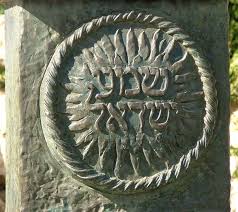
Hear, O Israel: The Lord our God, the Lord is one. You shall love the Lord your God with all your heart and with all your soul and with all your might. And these words that I command you today shall be on your heart. You shall teach them diligently to your children, and shall talk of them when you sit in your house, and when you walk by the way, and when you lie down, and when you rise. You shall bind them as a sign on your hand, and they shall be as frontlets between your eyes. You shall write them on the doorposts of your house and on your gates (Dt 6:4-9)
This was one of the first passages I committed to memory in my years of studying Scripture. It’s the Shema. That is from the Hebrew word for “Hear.” The emphasis here (pun intended) is upon hearing the Word of God and doing it. It’s the same principle Paul labors in Romans 10 where he writes, “So faith comes from hearing, and hearing through the word of Christ” (Rom 10:17).
Hear the Word and do the Word. The principle recurs in James’ letter, too: “But be doers of the word, and not hearers only, deceiving yourselves” (Jas 1:22). Hear but then do.
The Shema matters because it is the map for discipleship.
And the Lord teaches his people why this hearing and doing of the Word is crucial: “for the LORD your God [is] in your midst” (Dt 6:15). God is always present. When we experience that reality in our bones, it changes our heart, nature, mind, will, and affections.
Oftentimes I think we suppress that knowledge, just as Paul teaches in Romans 1: “For the wrath of God is revealed from heaven against all ungodliness and unrighteousness of men, who by their unrighteousness suppress the truth” (Rom 1:18). That’s the default position of the rebel: suppression of the truth of God.
Encouragement: God is “in the midst,” dear ones. Wherever you are, God is there. He is inescapable. Therefore, let God’s people both hear his Word and do his Word. Trust God with the results, because we will give an account (Rom 14:12).
“For the Lord your God has blessed you in all the work of your hands. He knows your going through this great wilderness. These forty years the Lord your God has been with you. You have lacked nothing” (Deuteronomy 2:7).
Context, Context, Context: Moses is leading the people “into the wilderness in the direction of the Red Sea” (Dt 2:1). He reminds Israel of the basics–God’s nature, God’s attributes regarding his steadfastness, his providence, his care, his being with them, his sovereignty. (The basics are called that for a reason; they’re the foundation upon which God’s people are to build and live. If we have wrong ideas about God, we invariably will have wrong ideas about people.) So Moses reminds the people constantly of basic theology–the fundamentals of God and his attributes.
And then Moses unpacks it for them even more by reminding them that God “knows your going through this great wilderness” (v. 7a). Let’s unpack that. In short, Moses reminds them that nothing escapes God’s knowledge. He is, after all, omniscient. He knows the people are in the wilderness. They are there because of their sin and recalcitrance, but also because God is teaching them about himself via his servant Moses.
Then in the second half of verse 7, Moses reminds them, “These forty years the LORD your God has been with you.” See the pattern? The immanence of God. All that means is that God has dwelled in the midst of his people. They’ve not been alone or just stuck with each other. God has been there all along, laboring to teach them via his servant Moses.
And then in the last clause of verse 7, Moses reminds them that they have “lacked nothing.”
Encouragement: Ever felt like you were in a spiritual wilderness? Ever felt caught between Migdol and the sea? Of course; we all have. Therefore, let us return to this basic and fundamental truth: We lack nothing because God is in the midst.






 MIND & MATTERS