Chaplain Daily Touchpoint #324: Tested Genuineness (Lessons from Peter, Part 3)

Bottom line up front: Tested Genuineness

Historical Context: Part of the reason I love Peter’s two New Testament letters is because Peter was so very human and yet God used him mightily. Peter was the apostle who denied the Lord Jesus three times on the night of His betrayal by Judas and arrest by the Sanhedrin and Roman soldiers. I am teaching through that passage currently to a group of believers each Sunday. It’s heartbreaking to see how fickle the crowds were in Jesus’s day. People have not changed, of course. Human nature’s a constant. Jesus told Peter to his face that he would deny the Lord Jesus three times before the rooster crowed and that is exactly what happened. Peter denied the Lord three times, the rooster crowed, and Peter wept. Bitterly (see Mt 26, e.g.).

Segue: But Peter was the real deal, nonetheless. Did he fail that night and at other times? Yes, absolutely. But he repented and was restored. He kept short accounts with God. And Peter made his theology visible by enduring, by sticking with it, by persevering in the faith. That’s why Peter wrote in the style he did in his two New Testament letters. When the various Ceasars and emperors persecuted Christians for their witness, Peter says it was “so that the tested genuineness of your faith—more precious than gold that perishes though it is tested by fire—may be found to result in praise and glory and honor at the revelation of Jesus Christ” (1 Pt 1:7).

Connection to Our Day: I had a mentor and professor way back in my seminary days who taught me often about the disappointments and ups and downs in ministry. When I would go to him about people whom I thought were Christians who ended up being fakes, he’d tell me again and again in his gentle way, “Jon, there will be surprises. Not all who said they were believers are. And many we may’ve thought were genuine were in fact unbelievers. Again, there will be surprises. Just be faithful. Leave the results to God.” Yes and amen, Dr. C., you were so right.

Encouragement: I’ve been in ministry a long time now. My hair’s now gray. I’ve seen some people that I’ve mentored, purchased books for, discipled, and even baptized seemingly fall away. Perhaps they were not believers after all. I’ve seen still others blossom and stick and persevere in the truth. Some have even gone on to enter the ministry themselves. It is a special joy when that has happened. I thank God for it. And I think that’s what Peter is driving at when he writes of “tested genuineness.” It will be tested; that’s the thing. Pressures come and we learn who the real are and who the pretenders were, eventually. So, be encouraged, Christian pilgrim. Learn to embrace the challenges as they are part of revealing our tested genuineness that is “more precious than gold.”

Chaplain Daily Touchpoint #323: A Living Hope (Lessons from Peter, Part 2)

Bottom line up front: A Living Hope

Introduction: When Peter opens his first letter, by the third verse of the very first chapter he has stressed that the Christian faith, because it is rooted in the personal, transcendent, living God, is a living hope. It’s not some pie-in-the-sky, hope-so theology. No, it is anchored in the God who is. This is no fairy tale bromide stuff.

Peter writes, “According to his great mercy, he has caused us to be born again to a living hope through the resurrection of Jesus Christ from the dead” (1 Peter 1:3). That’s as plain as day. Why is anyone who is born again in fact redeemed? Because God did it. It’s not something any of us decided for ourselves or worked ourselves into or up to. Peter makes that clear: He [God] has caused us to be born again. To what, exactly? To a living hope. Why? Because Christ has been raised. He is the “firstfruits of those who have fallen asleep” (1 Corinthians 15:20).

A living hope. That’s vital for us to remember. Why? Well, because if you look at the 50-meter target only, you’ll be tempted to give in to despair. When you see mobs overrun Boston, it’s sad. When you see Antifa continually destroy Portland, it’s sad. When you see murder after murder after murder in Chicago, it’s sad. Yet people don’t learn the lesson. The mobs continue to do what mobs do. They cannot do anything but steal, kill, and destroy—just like their commander: “The thief comes only to steal and kill and destroy” (John 10:10a).

Encouragement: Peter, in writing to believers enduring persecution, then and now, stresses this: yours is a living hope. He who began a good work in you will bring it to completion (Philippians 1:6). Our job is fidelity and courage in the interim.

Chaplain Daily Touchpoint #322: Lessons from Peter (Part 1)

Introduction: I love church history. That is, I love studying the history of Christian believers through the centuries. Why? Well, it’s easy to become myopic. That is, it’s easy just to be so self-absorbed that one only sees the immediate. To use a shooting analogy, it’s easy to just focus on the 50-meter target and discount all the other targets. It’s easy to miss the forest for the trees. For many folks in our day, God has been banished, and politics is their religion. It consumes them. They wake up craving the latest breaking news. They’re glued to what’s ‘happening now.’ They want to be tracking the latest posts or tweets or whatever they’re called now. They crave the latest gossip. They live lives perched on the limbs of the immediate. But they miss the historic, the enduring, and the true. Here’s what I mean. Follow me . . .

Scriptural Connection: In coming weeks, I will begin teaching through Peter’s two New Testament letters. Why? One reason is straightforward: I’ve taught line-by-line through Matthew for over a year now, and we’re nearing chapter 28 next week, Matthew’s ending chapter. The ‘Great Commission’ passage is there, and it’s often quoted but less often understood and lived out. Christians are to go out proclaiming Jesus as Lord because death could not and did not hold him. He walked out of the tomb, was seen by hundreds, was touched, spoke, ate, and taught. In other words, empirical evidence undergirds all of Christ’s earthly ministry. We Christians welcome honest investigation. Bring it.

And Peter, a pillar of the 1st century Christian church, opens his first letter by writing to persecuted, dispersed Christians scattered across the Roman Empire. Due to persecution by Rome, he encouraged them with this opening salvo:

“Peter, an apostle of Jesus Christ, To those who are elect exiles of the Dispersion in Pontus, Galatia, Cappadocia, Asia, and Bithynia, according to the foreknowledge of God the Father, in the sanctification of the Spirit, for obedience to Jesus Christ and for sprinkling with his blood: May grace and peace be multiplied to you” (1 Pt 1:1-2).

Questions: Do you see what all Peter’s introducing? First, he’s an apostle, an eyewitness of the Lord Jesus. Second, he’s writing to Christians (“elect exiles”) scattered across the region. Third, it’s all known to the omniscient God of Scripture. Fourth, he tells us why—“for obedience to Jesus Christ.” It’s all right there. Peter was an eyewitness and friend of the Lord Jesus; Christians are persecuted by their plights but are known to the all-good and all-wise God; and we’re to labor to be obedient witnesses.

Encouragement: Is the world a mess? Yes. It has been before. Just ask Peter. Just ask the 1st century Christians/elect exiles dispersed across the Roman Empire, being persecuted for being Christians. Nothing’s new, folks. Be of good courage. There’s a long line of saints who came before you and me. We’re not special. Our job, like theirs, is to be faithful in our time.

Chaplain Daily Touchpoint #321: Uncertainty?

The Issue: Uncertainty

Context: Ever had one of those moments when a topic was lingering in the air unspoken but you felt it in your bones? It was perhaps as real as anything you could weigh and measure. That’s what’s going on with this government shutdown. It hit me, too, like a punch in the gut when my paycheck showed up for this pay cycle, but it was filled with all zeros. That’ll get your attention, I assure you, when it happens to you. You work, you serve, you still do your duty, and the political leadership repays you with zeros. It can alter your perspective. It can make you question things. It can shake your confidence. It can rattle you. Moments like this can make you step back and think. I mean, what does it reveal about a nation that is not paying its military? That’s pretty scary, right? If one has skin in the game, it is indeed scary.

Question: Where does one turn in times of uncertainty? I try to put myself in other people’s shoes in order to see things from opposing viewpoints when thinking through an issue. If I were secular, there’s no one to pray to, no one listening, and we are just cosmic accidents, random atoms without intention or design, origin, transcendent meaning, or teleology. If I were like that, I would indeed despair. There are only the human machinations to remedy what human folly has wrought.

But for the Christian, he/she knows that all events in heaven, on earth, and under the earth are under the sovereignty of God. As one of our historic confessions reads,

God the great Creator of all things doth uphold, direct, dispose, and govern all creatures, actions, and things, from the greatest even to the least, by his most wise and holy providence, according to his infallible foreknowledge, and the free and immutable counsel of his own will, to the praise of the glory of his wisdom, power, justice, goodness, and mercy. (WCF 5.1)

Encouragement/takeaway: This Sunday I will again stand before the saints and open the Scriptures and labor to teach faithfully the Word of God. I, too, submit to their authority. I do not trust in chariots or horses but in the God who rules them and all things. We can learn from this moment to stay close to the Lord, to look to Him in all things, not just in the bad times or lean times. For the secularist, he/she has nothing and no one but the very people who got us into this mess. For the Christian pilgrim, however, he confesses this great verity: “For from him and through him and to him are all things. To him be glory forever. Amen” (Romans 11:36).

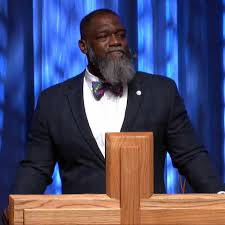
Chaplain Daily Touchpoint #319: A Few Reflections on the Legacy of Voddie Baucham (1969-2025)

Introduction: I think the Lord may be trying to get His people’s attention.

John MacArthur died in July of 2025. Now Voddie has died in September of 2025. R.C. Sproul died in December of 2014. Charlie Kirk was murdered in September of 2025, on live TV. These men were giants of Christian witness in their lifetimes.

Question: Who will fill their shoes? Or if you’ll old enough to remember George Jones’ great song in his plaintive cry, “Who’s Gonna’ Fill Their Shoes?”

Possible Answers: There are several ways this could shake out, of course.

First, maybe no one will rise to carry on the mantle of Christian witness, but I have serious doubts about that. Elijah felt that way, too, in his day, but God had a word: “Yet I will leave seven thousand in Israel, all the knees that have not bowed to Baal, and every mouth that has not kissed him” (1 Kings 19:18, ESV).

Second, maybe there’ll be some heel-grabbers who’ll try to slither their way to evangelical prominence. There’s no paucity of such characters. Wicked King Saul was such a character (1 Samuel 19), as is the devil himself: “I will ascend above the heights of the clouds; I will make myself like the Most High.’ (Isaiah 14:14, ESV).

Third, maybe some Christians are waking up because they’re being stirred by the Holy Spirit to do God’s will God’s way. That may take the form of finding and/or building a biblical body of believers in a home somewhere or starting a house-church. Maybe it’ll take the form of a revivial in Scripture reading and not just Sunday morning notetaking. Maybe there’ll be a groundswell of repentance. Maybe new biblical seminaries will be formed to train men for biblical depth and not corporation-building.

It Bears Asking Again: “Who’s Gonna’ Fill Their Shoes?” I tend to believe it’ll look something like a combination of traits in the third course of action listed above, but I’m just one man among what I hope is a Christian army, one who longs for God to use me and this generation to show forth His saving sovereignty.

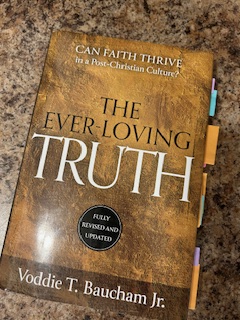
Voddie, I finished reading another of your books this a.m., and I miss you already, dear brother. You have come into your reward now, but I just want to say what many are feeling: Thank you for your courage and commitment. It was all more than worth it, wasn’t it? Tell R.C., Johnny Mac, and Charlie, we’re pressing on.

Here’s a YouTube link wherein I speak on this theme:

https://youtu.be/d0qiD9cgkk0

Chaplain Daily Touchpoint #318: Spiritual Wonderclout

Questions: Ever purchased something that appeared desirable but you later discovered it was rotten? Perhaps it was a bag of apples from the produce market. Perhaps it was a ‘lemon’ of a vehicle. The list is perhaps long.

How much more dangerous is it when it happens in our spiritual lives. That is why there are countless warnings in Scripture about having biblically qualified leaders rather than wonderclouts.

Here are just a few examples of some whose appearance was that of righteousness but whose reality was wickedness:

  • Pharisees and Scribes
  • Judas Iscariot
  • Cain
  • King Saul

First, in Matthew 23:1-12 (ESV), Jesus shines His divine spotlight on the hypocrisy and spiritual bankruptcy of the religious leaders:

Then Jesus said to the crowds and to his disciples, “The scribes and the Pharisees sit on Moses’ seat, so do and observe whatever they tell you, but not the works they do. For they preach, but do not practice. They tie up heavy burdens, hard to bear, and lay them on people’s shoulders, but they themselves are not willing to move them with their finger. They do all their deeds to be seen by others. For they make their phylacteries broad and their fringes long, and they love the place of honor at feasts and the best seats in the synagogues and greetings in the marketplaces and being called rabbi by others. But you are not to be called rabbi, for you have one teacher, and you are all brothers. And call no man your father on earth, for you have one Father, who is in heaven. Neither be called instructors, for you have one instructor, the Christ. The greatest among you shall be your servant. Whoever exalts himself will be humbled, and whoever humbles himself will be exalted.

Second, in Mattew 26:14-16 (ESV), Judas Iscariot is revealed to be a child of Satan. Yet he’d worn the appearance of being a Christian for years before:

Then one of the twelve, whose name was Judas Iscariot, went to the chief priests and said, “What will you give me if I deliver him over to you?” And they paid him thirty pieces of silver. And from that moment he sought an opportunity to betray him.”

Third, the first murderer in the Bible is Cain. He murdered his brother Abel. Fratricide in Genesis 4:8-11 (ESV):

Cain spoke to Abel his brother. And when they were in the field, Cain rose up against his brother Abel and killed him. Then the Lord said to Cain, “Where is Abel your brother?” He said, “I do not know; am I my brother’s keeper?” And the Lord said, “What have you done? The voice of your brother’s blood is crying to me from the ground. And now you are cursed from the ground, which has opened its mouth to receive your brother’s blood from your hand.

Fourth, King Saul. He was a liar from the beginning. He was insecure, cunning, and narcissistic. Just listen to God’s words to the Godly Samuel about how God was going to give the people what they wanted as a judgment for their lack of discernment:

And the Lord said to Samuel, “Obey the voice of the people in all that they say to you, for they have not rejected you, but they have rejected me from being king over them” (1 Samuel 8:7, ESV).

Will we notice the pattern? What do the scribes, Pharisees, Judas Iscariot, Cain, and wicked King Saul all have in common? They loved not the people; they loved themselves. They coveted the applause of men. They sought power over people. They were manipulators. They were narcissists. They were crafty. And they ruined others. Why? Because their love was self. They were self-involved, self-absorbed, self-centered people.

Encouragement/takeaway: Appearance vs. Reality is perhaps the greatest and oldest of themes. But what’s down in the well invariably comes up in the bucket. May the Lord grant discernment to His true sheep. Why? Because a wonderclout in the spiritual life is cancerous for all involved.

Here’s a link to the YouTube video of my addressing the same theme:

In Appreciation for the Failures

Failure-1640s, failer, “a failing, deficiency,” also “act of failing,” from Anglo-French failer, Old French falir “be lacking; not succeed” (see fail (v.)). The verb in Anglo-French used as a noun; ending altered 17c. in English to conform with words in -ure. Meaning “thing or person considered as a failure” is from 1837.

Introduction: Last week in my Sunday school class with the saints, a friend from class said something that struck me and the rest of the class because of its insight. His remarks came on the heels of my teaching from Matthew 26:30-46. This is the passage in Matthew’s Gospel where Jesus told His disciples that they would all bail at the moment of greatest testing. Here’s the text:

And when they had sung a hymn, they went out to the Mount of Olives. Then Jesus said to them, “You will all fall away because of me this night. For it is written, ‘I will strike the shepherd, and the sheep of the flock will be scattered.’ But after I am raised up, I will go before you to Galilee.” Peter answered him, “Though they all fall away because of you, I will never fall away.” Jesus said to him, “Truly, I tell you, this very night, before the rooster crows, you will deny me three times.” Peter said to him, “Even if I must die with you, I will not deny you!” And all the disciples said the same.

Then Jesus went with them to a place called Gethsemane, and he said to his disciples, “Sit here, while I go over there and pray.” And taking with him Peter and the two sons of Zebedee, he began to be sorrowful and troubled. Then he said to them, “My soul is very sorrowful, even to death; remain here, and watch with me.” And going a little farther he fell on his face and prayed, saying, “My Father, if it be possible, let this cup pass from me; nevertheless, not as I will, but as you will.” And he came to the disciples and found them sleeping. And he said to Peter, “So, could you not watch with me one hour? Watch and pray that you may not enter into temptation. The spirit indeed is willing, but the flesh is weak.” Again, for the second time, he went away and prayed, “My Father, if this cannot pass unless I drink it, your will be done.” And again he came and found them sleeping, for their eyes were heavy. So, leaving them again, he went away and prayed for the third time, saying the same words again. Then he came to the disciples and said to them, “Sleep and take your rest later on. See, the hour is at hand, and the Son of Man is betrayed into the hands of sinners. Rise, let us be going; see, my betrayer is at hand.” (Mt 26:30-46, ESV)

The remark was something along these lines. This is not a direct quote, mind you, but this was the gist of his insight: “This is one more piece of evidence for the divine origin of Scripture. The Bible is filled with examples like this of people in their failures. Peter swore he would not fall away, and he did. Three times in one night, even. It’s the same with others. David, great as he was, sinned grievously. Solomon, wise as he was at times, blew it. Moses, gentle and patient as he was at times, was also a murderer and had a serious anger problem.” You get the idea, I hope.

Jesus’ disciples all said they’d be faithful. And yet, that very night, Judas would betray Him into the hands of the Sanhedrin and other wicked men. Peter would deny Him three times and the prophesied rooster did indeed crow. And Peter wept. Bitterly. Peter was learning about Peter, and it broke his heart.

Encouragement/takeaway: Were the Bible a made-up book of tales, a concoction of moralism and/or fables, men would be portrayed as heroic. Instead, we get the truth. We men are much more often failures. We’re a lot more like Moses and David and Judas and Peter on their bad days than we are like Christ on any of His days.

We need to be careful about adopting a position of being anointed or special or above others; we’re the sinners. Christ came for those of us who are broken over what we are. We need redemption, and Christ is the Redeemer and Hero.

Let us be appreciative of the failures given to us in the pages of sacred Scripture. We’re much more like them than we might care to admit.

(Credit goes to D.D. in class for inspiring this piece. Thank you, brother.)

A Matter of Division?

Introduction: I was studying in Luke 12, the last section. The tension between Jesus and His haters was palpable. It is easy to understand why. Just listen to Jesus’ words:

Do you think that I have come to give peace on earth? No, I tell you, but rather division” (Lk 12:51, ESV).

When’s the last time you heard that verse taught in context?

Odds are you have heard lots of talks on Jesus as our peace, and references to Jesus’ words from John 14 about His peace being given to His people. Folks just love that passage. Why? Well, it’s not offensive. It’s what almost anyone would want, right? Who wouldn’t want peace?

It turns out that lots of people don’t want peace. They want murder; they want hate; they want destruction; they want to cancel any who dare speak up for light and truth. Tyler Robinson is just one of countless examples.

Today, it’s Tyler Robinson, the alleged murderer of Charlie Kirk. But he’s symptomatic of apparently millions of people calling for celebrations of Charlie’s murder. Some TV personalities and entertainers of the sheeple are even losing their jobs now because, finally, it seems, some folks are waking up to the hatred by the Leftists.

Charlie’s constant pattern was one wherein he welcomed open and respectful debate. And he was met with what exactly? A round of .30-06 to the throat. He’s now going down as a martyr for Christian witness and conservatism and open debate in a world that largely hates Christ, Christianity, reason, and open debate. Instead, the mobs resort to violence. Rather than trying to reason with folks via respectful dialogue, they take up arms and murder.

Now we’re being bombarded with coverage of text messages between homosexual young men referring to one another as “furries,” in the same sentences about assassinating Kirk. It is all vomit-inducing.

This is where we are as a culture, where men are being surgically mutilated and denying biology in hopes of altering what cannot be altered, one’s DNA. You can remove parts and/or add parts, but the genes remain. It’s ghastly and tragic what’s happening.

And it reminds me of how Christ spoke to the crowds and taught (very similar to the way Charlie emulated, mind you):

He also said to the crowds, “When you see a cloud rising in the west, you say at once, ‘A shower is coming.’ And so it happens. And when you see the south wind blowing, you say, ‘There will be scorching heat,’ and it happens. You hypocrites! You know how to interpret the appearance of earth and sky, but why do you not know how to interpret the present time?” (Lk 12:54-56, ESV)

Jesus rebuked the people because they did not know how to interpret the times. They were undiscerning. They were recalcitrant. They largely not only rejected Him and His message, but they hated Him, too.

Question: Sound familiar to today’s culture when truth-tellers arise?

Chaplain Daily Touchpoint #317: Leadership Lessons via Tychicus

Introduction: I was concentrating once again upon some of the most profound verses ever penned in the New Testament, Paul’s last words in Ephesians 6. They were not Paul’s last words, mind you, but they were the last ones in this particular New Testament letter. You perhaps know of the passage. It’s where Paul describes man’s battle as primarily spiritual. And because man’s primary battle is spiritual (we’re not just molecules in motion or meat puppets, as the secularists would have us believe), the Christian man or woman to is to don, or put on, “the whole armor of God.”

But what gripped me so powerfully in my studies today was the appearance–once again–of this man Tychicus. Here’s the way Paul ends this letter. Notice his commendation of Tychicus:

So that you also may know how I am and what I am doing, Tychicus the beloved brother and faithful minister in the Lord will tell you everything. I have sent him to you for this very purpose, that you may know how we are, and that he may encourage your hearts (Eph 6:21-22, ESV).

Setting: Remember where Paul was when he wrote this letter? Yes, once again he was incarcerated.

After penning this salvo about spiritual warfare (Eph 6:10-20), Paul commends Tychicus. Why?

Here are (4) leadership lessons we learn about Tychicus from here in Ephesians and other NT passages:

  • He was faithful (Eph 6:21; Col 4:7)
  • He encouraged the saints (Eph 6:22)
  • He suffered for the sake of the gospel (Acts 20:4)
  • He served the body rather than himself (2 Tim 4:12; Titus 3:12)

Questions:

  • Do we see this level of faithfulness in our day?
  • Do you think our generation of Christians will go down in church history as an age of faithful soldiers? If so, why? If not, why not?
  • Is our ministry characterized by our encouragement of the saints and equipping them for spiritual battles?
  • Do we teach how to suffer for the sake of the gospel, or do we perhaps proffer a sub-biblical message designed to keep money coming in so we can be comfortable, and none of the wrong people get offended?
  • Do we serve the body of saints? Do we deny ourselves for the sake of the sheep? Or do we design structures to feather our own nests?
  • Do we in many ways resemble New Testament believers like Paul’s friend Tychicus?

Chaplain Daily Touchpoint #316: Internals Before Externals

Introduction: Internals long before externals. Ever heard someone say, “I hate hypocrites!”? Of course. We all have. Maybe we’ve said it ourselves. There is something viscerally repulsive about hypocrisy. Spiritual hypocrisy may be the most distasteful. I think that’s why Satan loves it when so-called pastors or spiritual leaders fall. The enemy of truth goes, “See? I told you they were fakes. Just in it for money, fame, and power.” I remember how crestfallen I was when Ravi Zacharias was exposed. It hurt me deeply. I felt the same way again when Steve Lawson was exposed. I had read all the books of both men and had contributed financially to their ministries and even purchased their books to give to others I was trying to reach for Christ. But it all blew up in my face when the truth was exposed.

Connection to Scripture: In Luke 11, Jesus rebukes hypocrites to their faces.

Follow me in the text:

37 While Jesus was speaking, a Pharisee asked him to dine with him, so he went in and reclined at table. 38 The Pharisee was astonished to see that he did not first wash before dinner. 39 And the Lord said to him, “Now you Pharisees cleanse the outside of the cup and of the dish, but inside you are full of greed and wickedness. 40 You fools! Did not he who made the outside make the inside also? 41 But give as alms those things that are within, and behold, everything is clean for you” (Lk 11:37-41, ESV).

Encouragement/takeaway: In the above passage, the legalistic Pharisee purported to judge the Lord Jesus for not washing His hands before eating. (Just let that sink in: the Pharisee purported to judge God.) But Jesus gently rebuked the Pharisee by reminding him of a fundamental truth: God assesses our hearts long before He’s concerned with our handwashing. In other words, internals long before externals. If our heart is changed, the effects will show. Our theology will be made visible. But if we’re consumed with posturing and externals, that, too, is known to God. And there, too, our theology is made visible. May we have teachable spirits, hearts intent upon internal obedience and not concerned with appearances that fool neither God nor the discerning.