Christmas Eve Reflections

“Do you want to push her in the stroller?” my wife asked.

Unhesitatingly, I put down John Irving’s novel, Last Night in Twisted River, that I was reading on the rear patio and hopped up, smiling.

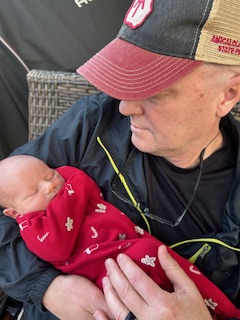
CJ placed Lennon in her new black stroller. Lennon squirmed and cooed, and sucked on her blue pacifier.

It is moments like this when I hear Jim Croce’s “Time in a Bottle” lyrics in my mind’s ear:

If I could save time in a bottle
The first thing that I’d like to do
Is to save every day
‘Til eternity passes away
Just to spend them with you

If I could make days last forever
If words could make wishes come true
I’d save every day like a treasure and then
Again, I would spend them with you

But there never seems to be enough time
To do the things you want to do
Once you find them
I’ve looked around enough to know
That you’re the one I want to go
Through time with

If I had a box just for wishes
And dreams that had never come true
The box would be empty
Except for the memory
Of how they were answered by you

But there never seems to be enough time
To do the things you want to do
Once you find them
I’ve looked around enough to know
That you’re the one I want to go
Through time with

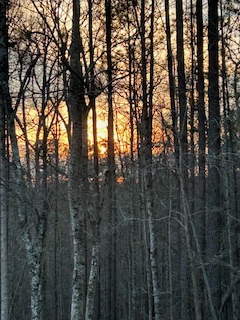
The sun was going down through the pines. Some of the neighborhood dogs barked in the distance at deer down in the branch behind the houses.

I pushed the stroller, Lennon asleep and rocking, as we walked the nighborhood streets. Three kids at the end of the cul-de-sac were playing basketball. A girl skated down the street in what appeared to be new rollerblades. They were a bright pink, matching the ribbons she had in her hair.

I could hear traffic in the distance, the sounds of wheels rolling down I-20. CJ and I found ourselves wordlessly joyful. We just looked at Lennon Ray in her red onesie as she lay in her black stroller, as she nodded to sleep and then would briefly open her eyes as she felt the macadam beneath her stroller’s wheels.

We strolled and strolled. When we came back to our daugher and son-in-law’s home, CJ began cooking fajitas for the adults.

Taylor Ray put Lennon in a bouncing seat on the counter as CJ prepared supper, and I chatted with our son-in-law and played with his dogs.

I sat down again in the wicker chair on the back patio and picked up the Irving novel again, but then put it back down in order to write this. I know what Croce meant in his beautiful song. If I, too, could save time in a bottle, this would be one of those times. Maybe this little writing will preserve it in a small way. Merry Christmas, everyone.

Tribute to CJ (yes, another one)

Context: Here we are in yet another week with no paycheck. I’m a soldier, an officer in the U.S. Army, sworn to defend the Constitution against all enemies . . . those foreign and domestic. We have both. In abundance.

Slice of Life: I drove home after work. I like few things quite as much as coming home, having CJ come out of the downstairs door, barefoot, greeting me. I wrap my arms around her waist, she turns her head, I smell her skin and kiss her, ask her how her day was, and I reach down to pet our dog, Lady(bug), a Cavalier King Charles, the other ‘lady’ in my life. (CJ somehow puts up with my love affair with dogs; I cannot imagine life without at least one [dog] at all times.)

Upon Entering: We walk upstairs. CJ has baked fresh homemade bread. The kitchen’s aromas fill the middle floor. I watch her. She’s labored all day–in the kitchen, with Lady (she groomed her), with laundry, with my schedule, with our son, with bill-paying, with all things . . . for us. She’s incessant.

Once again, she gave up her time outside in the sun. She loves to sit in the sun for a few moments each day. And I love her doing it. (She inherited the SGA pigmentation of the Creeks; she turns bronze or brown in just a few hours.) We chuckle. (I’m about as tanned as Macbeth after Duncan’s slaying.)

But Here’s the Deal: After she’d labored all day, she fed me fresh-baked bread, told me, “Go walk Lady; that’ll be good for you,” and then said, “Go read; that’s what you need.” And I did all of the above. I read my favorite writer; I walked Lady, I ‘piddled’ in the yard, etc.

Where would I be without her? She’s a better person. She labors, often thanklessly and invisibly. I wear a uniform, go to work with fellow soldiers, play a role, etc. But yet here she is–pressing on in with fidelity but without publicity. I just want to say to you, if you’re like my CJ, I thank God for you. You’re the better people. You matter. You make it all work. And I’m grateful for you.

Johnny Cash, October Sands, and Family

There’s a line in Moby Dick that sticks with me. No, it’s not “Call me Ishmael.” It’s this one: “Yes, as every one knows, meditation and water are wedded forever.” Why? Short answer: I have found it to be true. Something there is about the sounds of waves meeting shore; something about the way moonshine bathes the sea’s surface in white, and you can see the dark below and the light above, and you seek to discover some truth therein.

Perhaps it’s something about the strands of white and the impressions they hold for a moment: footprints of walkers, runners, kite fliers and tan seekers, young and old, working and retired—all there until the next wave or footprint or toddler with an orange shovel and matching pail.

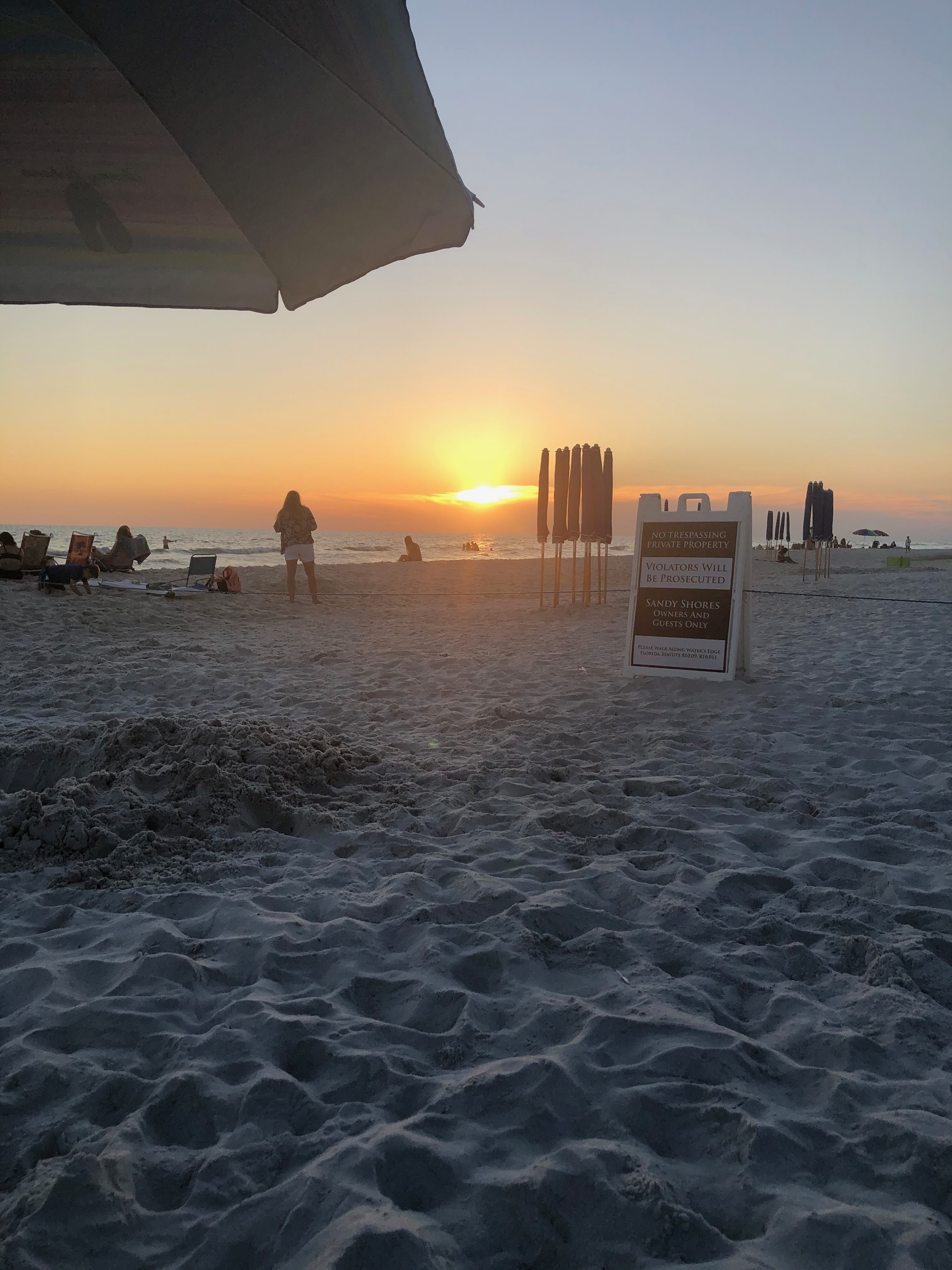
I had my family, Johnny Cash’s autobiography, and a week of sun-drenched days and moonlit nights. Tonight is the full moon but it was nearly impossible to tell it was not full already, it was that bright.

Sitting on the balcony looking down towards the pool, I watched a gray squirrel climb a palm tree. Until he spotted me watching him, he seemed on a mission. I watched children play in the Gulf of Mexico while Zac Brown’s “Free” poured from a Bose Wave Music System, and many of us sang along, even if to ourselves.

I swam with my son and rode the waves in from the sandbar. I heard his boyish voice say, “Hey Dad, watch this!” wave after wave, afraid I’d miss seeing him.

I watched my wife’s skin absorb the sun and turn brown almost immediately. I read my Johnny Cash autobiography and listened to his last album filled with gospel songs about hurt and redemption and heard his voice say, “The Man Comes Around,” in a voice like no one else’s.

I watched my immediate and extended family work to provide and continue to make memories. And it’s all so simple: sunlight, water, sand, each other, music, ice cream, walking at night with headlamps on our foreheads, chasing the crabs on shore, their black eyes glowing in our beams of light. And still, the moon above. The sand like a white ribbon. The sounds of the water lapping at your ankles and retreating. Children’s voices. An occasional firecracker. The silhouette of lovers walking beside one another.

Melville was right; meditation and water are forever wed in a dance. And it is a good thing to be able to participate, to wade in and belong.

Battle at Sauder Hill

My family and I were thrilled about moving into our new home. Tucked in the hills of hardwoods, a lake below promising days of fun, and woods where deer and turkeys are more common than people, all seemed right. If things went according to plan, this was to be the next to last trip up. “Just let me get this load done, and then one more trip up with friends in a couple of days, and we’ll be in,” I thought.

I was driving my midsize Nissan pickup, and pulling a 14’ trailer with a sofa, a rocking chair, and various other belongings. My daughter was in the front seat; my wife and son were in the backseats.

It had recently started to rain. The road was blacktop. The sky was gray and solid, in a way that December seems to specialize in.

imagesUp ahead I saw the sign: Sauder Hill. Hill, I suppose, defies precise geometric qualification. But this hill was at least a 50-degree incline. As we started up, I put my truck in low gear and flipped on the tow switch. I hoped for the best.

The battle began within seconds. We ascended 100 meters or so, and my right rear tire began to spin. Soon it was buzzing on top of the pavement, but no longer pushing the truck and trailer uphill. All tire traction broke loose from the asphalt, and we started sliding backwards.

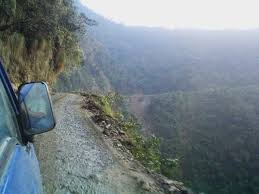
Out of the right side of my truck, I saw a laurel canyon of hardwood trees, and a menacing ravine eyeing my family. It struck me as some yawning beast set on our destruction—a maw ready to swallow my whole family.

My wife screamed, “Pirtle, stop!” (She’s almost never called me by my first name. Too many Jons in the family.) Well, telling me to stop my truck from sliding down Sauder Hill was, shall we say, a bit obvious. “If I could, I would!” I said, in a voice that likely sounded less than kind.

The weight in the trailer was now likely all towards the back, behind the axle. Because I’d not packed the trailer correctly (I was just ready to be done moving), the contents had shifted to the rear during the ascent. The tongue of the trailer was pulling up on the ball of my hitch, and the bed of my truck was now too light for traction. On the slide backwards and down Sauder Hill, the trailer slid off the asphalt and perched on the lip of the remaining road, just above the ravine.

Our daughter, the calmest of the four of us, said, “Dad, maybe we three should get out.”

“Yes,” I said, “you’re right. Go ahead, you guys get out and walk down to the bottom.”

As my daughter, wife, and son opened the truck doors, I looked down at my left leg. It was shaking. Visibly. I could see it bouncing like I was keeping time to electronic dance music. Dada, dada, dada, dada… I begged God not to let us slide another inch, at least not while they were trying to get out and away from the truck and trailer.

They made it to the bottom of the hill.

By now, several drivers had stopped their cars and trucks to watch. Several men in large 4-wheel drive trucks and/or Jeeps offered to pull me up the hill. One elderly gentleman stopped in his Ford F-350 and said, “Hey, I’ve got a chain and we can hook it up to your tow hook on the front of your truck, and we’ll get you up.”

But I thought better of it and asked my wife to go to the security gate and tell them what had happened. She did, and called me on my cell phone a few minutes later. “The security guard says you can get a tow truck from Jasper for seventy-five dollars.”

About forty-five minutes later, the prettiest truck I’d ever seen showed up. At least it seemed pretty at the time. Beautiful, in fact. A deliverer. A truck and crew who reclaim life. It was a four-wheel drive Dodge dually. The driver’s name was Billy. How appropriate, I thought. Billy, the tow truck driver. His demure wife sat in the front passenger seat. They could have been angels!

He said, “Just hook this cable to your tow hook, put your truck in neutral, and release your emergency break.” I obeyed him like I was a little child.

My wife, daughter, and son got into Billy’s tow truck, and sat in the rear seats. Billy mashed the switch on the back of the tow equipment, pulling the steel cable taut. He got back in his truck and pulled me up.

Just a couple of minutes later, we were all at the top of Sauder Hill. We paid the man with a debit card that he swiped on his phone. It was all in a day’s work for Billy, it seemed. But for my family, we’d done battle. We’d escaped from a yawning ravine that snarled at us, as if to devour us whole. We’d battled with Sauder Hill—and lost. I’d lost presumption. I’d been borne up by others.

It’s now two days after the battle, and my left leg has almost ceased to tremble.