The Serpent of Syncretism

Solomon was great in some ways. In other ways, however, he failed profoundly. Towards the end of his reign, Solomon’s heart strayed from the Lord. He became idolatrous. He gave in to his flesh. He built altars to idols. He had multiple wives and concubines. Solomon became a syncretist and he sullied much of his legacy.

Text:

11 Now King Solomon loved many foreign women, along with the daughter of Pharaoh: Moabite, Ammonite, Edomite, Sidonian, and Hittite women, from the nations concerning which the Lord had said to the people of Israel, “You shall not enter into marriage with them, neither shall they with you, for surely they will turn away your heart after their gods.” Solomon clung to these in love. He had 700 wives, who were princesses, and 300 concubines. And his wives turned away his heart. For when Solomon was old his wives turned away his heart after other gods, and his heart was not wholly true to the Lord his God, as was the heart of David his father. For Solomon went after Ashtoreth the goddess of the Sidonians, and after Milcom the abomination of the Ammonites. So Solomon did what was evil in the sight of the Lord and did not wholly follow the Lord, as David his father had done. Then Solomon built a high place for Chemosh the abomination of Moab, and for Molech the abomination of the Ammonites, on the mountain east of Jerusalem. And so he did for all his foreign wives, who made offerings and sacrificed to their gods. (1 Kings 11:1-8)

Context, Context, Context: Syncretism is the blending and/or combination of opposing worldviews. For example, if I said that as a Christian, one of the core beliefs is that Jesus rose bodily from the tomb in Jerusalem on a Sunday and was seen by hundreds of people afterwards, and even ate with them. That is a truth claim. It’s either true or it isn’t.

But let’s say Joe Snuffy claims he’s a Christian, too, but that he believes that Krishna, an avatar of Vishnu, Sun Myung Moon, and Joseph Smith are just like Jesus, prophets of God and ‘good’ men. Well, Houston, we have a problem. Because both claims cannot be simultaneously true. I could be right or wrong. The second guy could be right or wrong. We could both be wrong. But we cannot both be right. This is where apologetics can be helpful.

Well, think of Solomon. He’d earlier prayed for wisdom and God granted him that. Solomon’s wisdom was world-famous. As was his wealth. But Solomon got too big for his britches, we might say. He grew proud. He grew increasingly prurient. He grew self-absorbed. And syncretism crept in. He tried to blend or combine contradictions, but reality is not a contradiction. Either God is who he says he is and has revealed himself to be, or idolatry is just fine and dandy. But idolatry is not just fine and dandy, of course. God calls his people to genuine holiness and devotion to the truth, not to play around with erecting statues, poles, Asherah, or high places for Chemosh (1 Kings 11:7). God will not share his glory with idols.


God’s Response: “And the LORD was angry with Solomon, because his heart had turned away from the LORD, the God of Israel, who had appeared to him twice, and had commanded him concerning this thing, that he should not go after other gods. But he did not keep what the LORD commanded” (1 Kings 11:9-10).

Encouragement/teaching: The chastisement of the Lord among his people is demonstration of God’s love for his sheep. Divine discipline is indicative of the heavenly Father’s love of his people. “For the Lord disciplines the one he loves, and chastises every son whom he receives” (Hebrews 12:6). Trying to blend contradictory allegiances is at the heart of syncretism and it is nothing short of idolatry. Keep short accounts with God, the only living and true God, because all else is wood, hay, and stubble.


It’s Not About Real Estate, but About God

Introduction: Theology is unavoidable. What a man believes about God shapes his life. It is unavoidable.

Theology, simply defined, is the study of God. Does God exist? Yes or no? If God doesn’t exist, morality is reduced to moral relativism, human assertions, and the will to power. But if God does exist, what is his nature? Has he spoken/revealed himself? Yes or no? If he has spoken/revealed himself in words, in history, in creation, and in conscience, how should we then live?

These are some of the fundamental questions and issues addressed in theology.

Connections to Current Events: If you take some time and think through what is happening currently in the Middle East, a person’s theological beliefs/worldview shape his understanding.

I had the misfortune of viewing Greg Locke’s screed recently (linked below for you) of why I call it a misfortune. This level of theological muddleheadedness is replete with problems. Christians worship Christ, not a temple. This should be so basic. Christians do not worsip real estate, be that a former temple (Solomon’s) or a city (Jerusalem) or a race (Jews, e.g.). Christians worship the Lord who was “born of the Virgin Mary; suffered under Pontius Pilate; was crucified, dead, and buried; he descended into hell; the third day he rose again from the dead; he ascended into heaven, and sits at the right hand of God the Father Almighty; from there he shall come to judge the living and the dead” (from the Apostles’ Creed).

But there is a push among many influential people who claim to be Christian who are calling for race wars, blowing entire countries to smithereens, and for rebuilding the very temple that was destroyed in A.D. 70.

Will folks even take the time to read Scripture’s own testimony of why the temple was destroyed? It was in direct fulfillment of 1 Kings 9:

And as for you, if you will walk before me, as David your father walked, with integrity of heart and uprightness, doing according to all that I have commanded you, and keeping my statutes and my rules, then I will establish your royal throne over Israel forever, as I promised David your father, saying, ‘You shall not lack a man on the throne of Israel.’ But if you turn aside from following me, you or your children, and do not keep my commandments and my statutes that I have set before you, but go and serve other gods and worship them, then I will cut off Israel from the land that I have given them, and the house that I have consecrated for my name I will cast out of my sight, and Israel will become a proverb and a byword among all peoples. And this house will become a heap of ruins. Everyone passing by it will be astonished and will hiss, and they will say, ‘Why has the Lord done thus to this land and to this house?’ Then they will say, ‘Because they abandoned the Lord their God who brought their fathers out of the land of Egypt and laid hold on other gods and worshiped them and served them. Therefore the Lord has brought all this disaster on them.’” (1 Kings 9:4-9)

In short, the destruction of the temple by the Romans in A.D. 70 was a direct result of unbelievers rejecting Jesus. Unbelievers, Jews and Gentiles, hated Christ, who put an end to repeated ineffectual sacrifices and ritual days of atonement. That’s what the book of Hebrews is all about.

Concluding Thoughts: I write as a Christian. These shallow and immature calls for levelling real estate (a la Greg Locke and other loud Christian Zionists), of rebuilding a temple, of racial wars upon entire demographics, etc. are not biblically, theologically mature worldviews or Christian. They are, in fact, completely opposed to Christ. Christians are to preach the gospel, to plant churches, to shepherd well, and to pray for those who persecute us.

The Son on the Throne

Text:

11 Then Nathan said to Bathsheba the mother of Solomon, “Have you not heard that Adonijah the son of Haggith has become king and David our lord does not know it? 12 Now therefore come, let me give you advice, that you may save your own life and the life of your son Solomon. 13 Go in at once to King David, and say to him, ‘Did you not, my lord the king, swear to your servant, saying, “Solomon your son shall reign after me, and he shall sit on my throne”? Why then is Adonijah king?’ 14 Then while you are still speaking with the king, I also will come in after you and confirm your words.” (1 Kings 1:11-14)

Context, Context, Context: King David was now an old man. He had been a man of war for years. The consequences of his sin against Uriah and his (David’s) adultery with Bathseba, as well as his (David’s) disastrous relationship with his son Absalom were coming full circle. David was still king, yes, but his power was weakening in myriad ways. He was physically diminished; he was old (1 Kings 1:1), etc. And David’s enemies thought it was the time to strike, the time to assert themselves to gain power, and to install themselves as king in David’s stead. Adonijah saw himself as that man, as one willing to try and replace David and David’s son, Solomon.

Teaching: And yet God had his servant, Nathan. Nathan was a phenomenal prophet. He was a truth-teller. He was God’s man for David, just as David was God’s man. So Nathan goes to David’s now-wife Bathsheba and explains to her Adonijah’s wicked plan to replace David as king. Bathsheba lets David in on Adonijah’s plot. God was determined, you see, to bring about the immediate son (Solomon) as king, but ultimately God the Son as king. That’s what this is all about.

No powers of hell or schemes of man can topple God’s plan for Christ as king. As Psalm 2 phrases it, “The kings of the earth set themselves, and the rulers take counsel together, against the LORD and against his Anointed, saying, “Let us burst their bonds apart and cast away their cords from us.” But then you get to verse 4: “He who sits in the heavens laughs; the Lord holds them in derision.”

Encouragement: Folks can and do try to outsmart God. That is clear. But what should be even more obvious is this: that’s a fool’s errand. You can deny reality but reality still wins. You can mock God, but God still is. You can plot and scheme and lie, but God still sees and God is holy. You can take counsel together against the Lord, but God laughs at you. There’s no outsmarting God’s plan, and his plan was and is and ever shall be this: Christ is king.

Servant Leadership

Servant leadership. The phrase is so often used that it has perhaps suffered from overuse as a term. There is nothing wrong with the phrase but it perhaps needs a bit of clarification.

Questions:

  • How many of us know people in positions of leadership but who fail at serving people?
  • How many of us know people who covet the title of “leader” but fall short of leading selflessly?

Connection: At the church I’m privileged to pastor, we are currently going verse be verse through 1 Peter. The apostle of hope ends the second chapter of that epistle by going in-depth on what it means to serve people well. In verses 18-19, for example, he writes, “Servants, be subject to your masters with all respect, not only to the good and gentle but also to the unjust. For this is a gracious thing, when, mindful of God, one endures sorrows while suffering unjustly” (1 Peter 2:18-19).

A key phrase in that passage is “mindful of God.” What Peter means there is this: biblical leaders are to lead well because they live out a life that demonstrates reverence for God. God is the leader’s commander, if you will. And the leader is mindful of that. That cognizance shapes the trajectory of his leading the people God has sent him to shepherd. That awareness of God’s evaluation of his leadership leads him into humble servant leadership of people God has ransomed by his own blood.

Encouragement: Like all things in Scripture, Christ is the supreme model. He is to be the biblical leader’s perfect paradigm. He’s the model. Do we men fall short of that standard? Of course. But that is not reason to not aim for that standard. Servant leadership is a fine phrase; it’s living that out before God and his people that tests one’s mettle.

On the Turning Away

Text:

14 Do not enter the path of the wicked,
    and do not walk in the way of the evil.
15 Avoid it; do not go on it;
    turn away from it and pass on.
16 For they cannot sleep unless they have done wrong;
    they are robbed of sleep unless they have made someone stumble.
17 For they eat the bread of wickedness
    and drink the wine of violence.
18 But the path of the righteous is like the light of dawn,
    which shines brighter and brighter until full day. (Pr 4:14-18)

Teaching: Solomon instructs his son in wisdom. The father teaches the son the ungliness of folly and the beauty of wisdom. Solomon provides the imagery of two different paths. One path is trod by the wicked. The wicked “walk in the way of evil” (v. 14b). And Solomon instructs his son plainly: “Avoid it [the path of the wicked]; do not go on it; turn away from it and pass on” (v. 15). Walk the beautiful path, the path of wisdom.

Then Solomon describes the moral character of those who trod the path of evil. He tells his son that those who trod that path “cannot sleep unless they have done wrong; they are robbed of sleep unless they have made someone stumble” (v. 16). There are some folks whose lives are restless; therefore, they meddle in other people’s lives. They stir the pot, we might say. They are nosy people. They insert themselves into our lives without invitation. They “eat the bread of wickedness,” (v. 17), Solomon writes.

That’s a pretty unsavory individual, the one who refuses to stay in his lane. He just cannot be content; therefore, he meddles. He intrudes. He is nosy. And he’s an irritant.

Encouragement: We’re to turn away from such people and walk the path of the righteous. Why? Because that path “shines brighter and brighter until full day” (v. 18b). We’re to keep our hearts “with all vigilance, for from it flow the springs of life” (v. 23).

Take a Knee

Introduction: “Take a knee.” It’s a welcome phrase we hear sometimes as soldiers, especially when we’re physically exhausted, spent, and our gas tank is running on empty. (Yes, I’m hearing Jackson Browne’s song in my head, too, now.) Here’s the way Browne wrote about this feeling:

runnin’ on empty
(Runnin’ on) runnin’ blind
(Runnin’ on) runnin’ into the sun
But I’m runnin’ behind

Regardless of our stations in life, I would think all of us have experienced seasons when we knew that we were running on empty and that we needed to take a knee.

Connection to Scripture: In 1 Samuel 30, it’s a low time in the life of David. His wives had been captured by the wicked pagans, the Amalekites. Much of the territory had been reduced to scorched earth. The invaders had taken captives. And the word on the street got back to David that he was a wanted man (1 Samuel 30:5). David was running on empty. David very much needed to take a knee.

Text and Teaching: But listen to what Scripture records about this incident and learn what it has to teach all of us who have found ourselves running on empty and in need of taking a knee: “And David was greatly distressed, for the people spoke of stoning him, because all the people were bitter in soul, each for his sons and daughters. But David strengthened himself in the LORD his God” (1 Samuel 30:6).

Encouragement: First, David was self-aware. Second, because David was self-aware, he turned to God. David knew the situation was too much for human effort to conquer. He knew where he needed to look for strength, and he did it. He strengthened himself “in the LORD his God.” There’s much wisdom here, dear ones. Some battles are too big for us. If we think they’re not, that may be a sign of our hubris. Let us be self-aware and turn to the One whose strength is all-powerful and holy and not delude ourselves into webs of entrapment woven by human vanity.

Not Title but Character

Not title but character.

Introduction: I am currently reading through some of my favorite books of the Bible. The books of 1 and 2 Samuel are about the necessity of having God as king. They are simultaneously about what happens to people when hirelings and false shepherds are at the helm. When there are godless leaders at the top of any organization, spiritual scorched earth will be the result.

When 1 Samuel opens, it begins by introducing several characters that embody the apostasy of some spiritual leaders. Eli’s two sons, Hophni and Phinehas, were two of those men. They had the title of priests (1 Samuel 1:3). But they were wicked to the core. And God would deal with them in short order. They had the titles of spiritual leaders, but their character was wanting. God put it plainly: “Now the sons of Eli were worthless men. They did not know the LORD” (1 Samuel 1:12).

Is that unclear? They were godless priests. They were unsaved men. They hated God. They just wanted the benefits of being priests, but their hearts were not in it. They were hirelings. And God was using them as examples of corruption to teach the people that we get the leadership we deserve. If we are a wicked people, we should not be surprised that many spiritual leaders are not any different.

And yet God still had his people. Amidst all the evil, noble people emerged. Hannah is one example. Samuel is another. And on and on it goes.

Hophni and Phinehas were killed when the Philistines defeated Israel: “And there was a very great slaughter, for thirty thousand foot soldiers of Israel fell. And the ark of God was captured, and the two sons of Eli, Hophni and Phinehas, died” (1 Samuel 4:10b-11).

Encouragement: Titles don’t make the man, dear ones. What’s down in the well comes up in the bucket. Therefore, drink from wells of righteousness, and drink deeply. It’s not about titles but about character.

God’s Prophets

The prophetic voice is a gift of God’s grace.

Questions: When you hear the word prophet, what comes to your mind? Does it usher in thoughts of ease and comfort? When you study the lives of men like Jeremiah, Ezekiel, and Daniel, are ease and comfort what you find with those men? Or is it more accurate to say that God’s prophets meet with resistance from forces hostile to God and God’s ways? The questions answer themselves, of course.

Text:

When the people of Israel cried out to the Lord on account of the Midianites, the Lord sent a prophet to the people of Israel. And he said to them, “Thus says the Lord, the God of Israel: I led you up from Egypt and brought you out of the house of slavery. And I delivered you from the hand of the Egyptians and from the hand of all who oppressed you, and drove them out before you and gave you their land. And I said to you, ‘I am the Lord your God; you shall not fear the gods of the Amorites in whose land you dwell.’ But you have not obeyed my voice.” (Judges 6:7-10)

Teaching: In Judges 6, as in sundry other passages from Judges, God sends prophetic voices to wake the people up from spiritual slumber and apostasy. The prophetic voice is a gift of God’s grace.

Verse 7 of Judges 6 records that “the people of Israel cried out to the LORD . . .”
Why? Because they were being overrun by the Midianites. And what did God do in his grace? He sent them a prophet. The truth-telling prophet called the people back to God, to the history of God’s fidelity, to God’s providential hand, and the prophet called the people to trust. He didn’t call them to trust wicked leaders; he called them to trust God and God’s messenger.

Encouragement: May God grant hearts and minds that discern God’s truth-telling prophets. Why? Because the prophetic voice is a gift of God’s grace.

Chaplain Daily Touchpoint #407: With His Drawn Sword

This evening after a supper with my bride, I sat down in my library to read and study. I was in Joshua. The passage I focus upon herein is found in Joshua 5:

13 When Joshua was by Jericho, he lifted up his eyes and looked, and behold, a man was standing before him with his drawn sword in his hand. And Joshua went to him and said to him, “Are you for us, or for our adversaries?” 14 And he said, “No; but I am the commander of the army of the Lord. Now I have come.” And Joshua fell on his face to the earth and worshiped[c] and said to him, “What does my lord say to his servant?” 15 And the commander of the Lord’s army said to Joshua, “Take off your sandals from your feet, for the place where you are standing is holy.” And Joshua did so. (Joshua 5:13-15)

Context, Context, Context: Of the 24 chapters in Joshua, this is chapter 5. This is a subsection of the book of Joshua that recounts Joshua leading Israel and crossing into the land promised to them by the Lord. As in any conquest, one is sure to meet friends and foes. The issue? How was Joshua to know which was which? Who was a friend and who was a foe?

When you examine the story, you discover that this event precedes the Fall of Jericho. But before the Lord gives Jericho into the hands of God’s people, the leader (Joshua) is confronted. He is confronted by a man standing before him and that man stood “with his drawn sword in his hand” (v. 13). That’s a posture for battle, for warfare, for blood.

And what does Joshua do? He asks the man a question: “Are you for us, or four our adversaries?” (v. 13). In other words, Joshua wants to know if the armed man is on God’s side or on the side of God’s enemies. And the response Joshua received could be viewed as cryptic: “No; but I am the commander of the army of the LORD. Now I have come” (v. 14).

That “No” the man answered was emphatic. He was revealing to Joshua that he was bigger than Joshua, Israel, and the enemy pagans into whose territory Joshua was leading God’s people. Now, the text says, the man was here. Not later, but now. At the right time. In the fullness of time.

Teaching: After studying this passage, and Scripture as a whole, for years now, it is my belief that this event was a Christophany, an event of the preincarnate Christ appearing in the Old Testament. God is omnipresent, of course. There is no place God is not. However, God makes special entrances at times of particular importance in salvation history.

When Joshua was about to lead his people into Jericho, it was an important time in salvation history. Why? Because God was continuing to reveal his covenantal promises to his people, that he would never leave them or forsake them.

Encouragement: I do not know where you are spiritually today. But this is one more example in Scripture of God demonstrating in real space-time history that he is in the midst of his people. Our job is to do as Joshua did–fall on our faces before the Lord. Why? Because he wields a drawn sword, and victory belongs to the Lord of hosts.

Jericho would be given to God’s people. God’s covenantal promises to his people would continue. And so should believers’ faith in the God who cannot lie.

Chaplain Daily Touchpoint #406: Rahab’s True Confession

Rahab’s True Confession.

Issue: The fundamental issue in the book of Joshua centers around the theme of the promise of God to conquer his enemies. Any organization must have a clear and defined leader, and that leader is to be a godly man, a man of God’s own choosing. Why? Because if unregenerate sinners choose the leader, disaster will be the result. And the books of Joshua and Judges demonstrate again and again what choosing the wrong leader leads to, and it’s not pretty.

Questions:

  • Would the nation of Israel keep its promise to obey God?
  • Would the nation of Israel step out in faith in God?
  • Would the nation of Israel enter the Promised Land with an undivided heart?
  • In short, would the nation of Israel be faithful?

Context, Context, Context: The historical account is found in Joshua 2. Joshua, Moses’ successor, was God’s appointed leader of the nation of Israel. Remember God’s words to the people: “No man shall be able to stand before you all the days of your life. Just as I was with Moses, so I will be with you. I will not leave you or forsake you. Be strong and courageous, for you shall cause this people to inherit the land that I swore to their father to give them” (Joshua 1:5-6).

Joshua, God’s appointed leader, sends out two men as spies. To do what? A reconnaissance mission. He sends them to spy out the land, to get a snapshot of the geography and people. They were what we might term “scouts.”

Rahab Enters the Story: The prostitute Rahab was just that—a prostitute. But God was at work in her life. He was calling her to himself. How do we know this? Follow the story:

Before the men lay down, she came up to them on the roof and said to the men, “I know that the Lord has given you the land, and that the fear of you has fallen upon us, and that all the inhabitants of the land melt away before you. For we have heard how the Lord dried up the water of the Red Sea before you when you came out of Egypt, and what you did to the two kings of the Amorites who were beyond the Jordan, to Sihon and Og, whom you devoted to destruction. And as soon as we heard it, our hearts melted, and there was no spirit left in any man because of you, for the Lord your God, he is God in the heavens above and on the earth beneath. Now then, please swear to me by the Lord that, as I have dealt kindly with you, you also will deal kindly with my father’s house, and give me a sure sign that you will save alive my father and mother, my brothers and sisters, and all who belong to them, and deliver our lives from death.” And the men said to her, “Our life for yours even to death! If you do not tell this business of ours, then when the Lord gives us the land we will deal kindly and faithfully with you.”

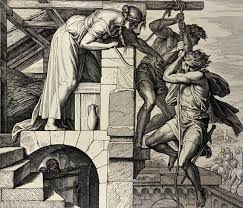
   Then she let them down by a rope through the window, for her house was built into the city wall, so that she lived in the wall. And she said to them, “Go into the hills, or the pursuers will encounter you, and hide there three days until the pursuers have returned. Then afterward you may go your way.” The men said to her, “We will be guiltless with respect to this oath of yours that you have made us swear. Behold, when we come into the land, you shall tie this scarlet cord in the window through which you let us down, and you shall gather into your house your father and mother, your brothers, and all your father’s household. Then if anyone goes out of the doors of your house into the street, his blood shall be on his own head, and we shall be guiltless. But if a hand is laid on anyone who is with you in the house, his blood shall be on our head. But if you tell this business of ours, then we shall be guiltless with respect to your oath that you have made us swear.” And she said, “According to your words, so be it.” Then she sent them away, and they departed. And she tied the scarlet cord in the window (Joshua 2:9-21).

Teaching: In short, Rahab believed God, and her actions demonstrated genuine saving faith in the person and work of God.

Encouragement: Look back at the (4) questions I asked above. Sadly, the answer to all (4) questions is a resounding no. The nation of Israel fell short. They doubted. They were cowardly. They did not trust the Lord fully. They were half-hearted at best and deeply idolatrous. Joshua and Judges provide myriad examples of some of the practices of child sacrifice, bestiality, and sexual perversions that boggle a good person’s mind. Yet God saved Rahab and her family. How? Be granting repentance and faith to her. It’s that simple and that profound: God came to save sinners. Prostitutes like Rahab were not outside of God’s reach. There’s hope for us, dear ones. There is hope. How? Be turning to God and his saving gospel.