Chaplain Daily Touchpoint #327: Battling Bitterness?

Topic: Morale and the Dollar

Introduction: I won’t speak for others, but I’m concerned about this government shutdown. I’ve not been paid for a month now, and I can feel the pinch. When I might before swing by the QT for a Gatorade or stick of beef jerky after PT, well, no more of that. It’s water only and I pack a sandwich.

I jumped online this morning to read the latest news regarding the shutdown. The articles were not encouraging. One article predicted this would be the longest shutdown in American history. I’m a soldier, so I cannot comment on my political leanings. But regardless of one’s political leanings, this is not good for our morale as soldiers. Through the week, I’m working for free. And on drill weekends, I’m working for free. At least so far. So, it gets in your head.

We went over to some friends’ house this weekend for chili and to watch football and found out that firemen and first responders weren’t getting paid either. Congress is still getting paid to do whatever they do each day, but somehow, I as a soldier am not worthy of pay. That’s the message. To borrow a phrase from Hamlet, something’s rotten in the state of Denmark. It’s bad for morale. It’s sunshine and rainbows for some, perhaps. Perhaps there are those out there who say, “Good, let’em go without pay.” Okay, I hear you. But when it comes to your doorstep, you might change your tune. Be careful of pontificating; life has a way of coming back around.

Encouragement for Us: Have others faced this or similar situations before? Yes. I think of the story of Naomi and Ruth from Scripture, set in the 1000s B.C. during the period of the judges. There was a famine in Judah. It was so severe that Naomi and her husband had to flee the region in search of provision. But it got even worse for Naomi. Her husband died. Her sons even died. More losses, in other words. Where was provision going to come from? Naomi, for a season, even grew bitter and perhaps even resentful: “. . . for it is exceedingly bitter to me for your [Ruth’s and Orpah’s] sake that the hand of the LORD has gone out against me” (Ruth 1:13). See that word there—bitter? That’s the perfect term to capture what many of us are trying not to give in to—bitterness and resentment. We soldiers did not cause the problem, but we are left to suffer the consequences of bureaucrats’ politics. Again, this is not a political screed against any one party or politician. But they’re all still getting paid. Is that cognitive dissonance not apparent to anyone else?

Naomi was in the spiritual valley for quite some time. She thought that the Lord was indeed against her. She felt bitter rather than grateful. She felt like she was the problem, that God was against her. Her situation would eventually change, however, but not until there was a season of privation. Naomi even said, “call me Mara, for the Almighty has dealt very bitterly with me” (Ruth 1:20). That’s a dark place to be, folks.

But here’s where I take encouragement: Naomi’s story did not end there. God was indeed intimately familiar with Naomi’s privation, and He was there, involved, and working towards a better end than Naomi understood. In sum, God was seemingly ‘behind the scene’ working things together for good for those that love and trust Him.

“But Ruth Clung”: Studies in Hope (Part III)

Bottom line up front: Faithfulness in the ‘small’ things is rewarded by God. In short, God sees all, not just what we sinners tend to think of as the big-ticket items.

Historical context: Ruth continued to glean the field faithfully: “So she gleaned in the field until evening. Then she beat out what she had gleaned, and it was about an ephah of barley” (Ruth 2:17, ESV).The last verse of chapter two is crucial: “So she kept close to the young women of Boaz, gleaning until the end of the barley and wheat harvest. And she lived withher mother-in-law” (Ruth 2:23, ESV).

***In other words, Ruth demonstrated a pattern of consistent humility, hard work, loyalty, and trust. She was as good as her word. There was nothing secretive, hidden, or clandestine about Ruth. Everything about her was open to review. And the kinsman-redeemer Boaz was taking notice.

Ruth’s obedience: Naomi, Ruth’s mother-in-law, had instrutcted her (Ruth) in the proper protocol, namely, lie down beside Boaz at the proper time, and listen for instructions:

“But when he lies down, observed the place where he lies. Then go and uncover his feet and lied down, and he will tell you what to do” (Ruth 3:4-5, ESV).

I love Ruth’s words here: “All that you say I will do” (Ruth 3:5, ESV). In other words, Ruth faithfully discharged her duties. She kept the faith. She was finishing her course faithfully.

Boaz’s response: The kinsman-redeemer continued to take notice, and he would both show grace and marry this widow: “May you be blessed by the LORD, my daughter. You have made this last kindness greater than the first in that you have not gone after young men, whether poor or rich” (Ruth 3:10, ESV).

Boaz tells Ruth that he is indeed a redeemer. Just let that sink in. This story that began in famine, death, widowhood, lack, etc. is now turning to a story of harvest, life, marriage, and progeny.

This paragraph is so beautiful:

Ruth and Boaz Marry

13 So Boaz took Ruth, and she became his wife. And he went in to her, and the Lord gave her conception, and she bore a son. 14 Then the women said to Naomi, “Blessed be the Lord, who has not left you this day without a redeemer, and may his name be renowned in Israel! 15 He shall be to you a restorer of life and a nourisher of your old age, for your daughter-in-law who loves you, who is more to you than seven sons, has given birth to him.” 16 Then Naomi took the child and laid him on her lap and became his nurse. 17 And the women of the neighborhood gave him a name, saying, “A son has been born to Naomi.” They named him Obed. He was the father of Jesse, the father of David. (Ruth 4:13-17, ESV)

Encouragement: Naomi went from spiritual bitterness to sweetness. Ruth went from abandonment and widowhood to adoption and marriage. From childlessness to fertility. The line of the ultimate Redeemer (Christ) was continually unfolding through the likes of Boaz. What do we see through it all? We see God take notice of the small daily steps of obedience to the revealed will of God. We see God bless faithfulness in the end. We see God continue to unfold His covenant mercies to His people. Be encouraged, Christian pilgrim: God sees you and He loves you and He uses our sufferings to draw you to Himself.

Studies in Hope (Part II)

Reminder: Naomi was stuck in a foreign land. She was now a widow, and a mother-in-law to two women. One of those women (Orpah) left. But one remained (Ruth). Both Naomi and her daughter-in-law were women of courage, of endurance, of tried faith.

Follow Me: Ruth did not rest; she was industrious. She asked her mother-in-law Naomi, “Let me go to the field and glean among the ears of grain” (Ruth 2:2 ESV). Why? Enduring faith in the providence and goodness of God.

And what do you know? A character of redemption, a man who came from Bethlehem, owned the field. Boaz was his name. He took notice of Ruth’s industriousness (Ruth 2:5-7). In short, he saw. This character of redemption (Boaz) took notice of the faithful servant (Ruth). That’s rather important.

Ruth’s Response:

10 Then she fell on her face, bowing to the ground, and said to him, “Why have I found favor in your eyes, that you should take notice of me, since I am a foreigner?” 11 But Boaz answered her, “All that you have done for your mother-in-law since the death of your husband has been fully told to me, and how you left your father and mother and your native land and came to a people that you did not know before. 12 The Lord repay you for what you have done, and a full reward be given you by the Lord, the God of Israel, under whose wings you have come to take refuge!” 13 Then she said, “I have found favor in your eyes, my lord, for you have comforted me and spoken kindly to your servant, though I am not one of your servants.” (Ruh 2:10-13, ESV)

Humility Precedes Honor: This widow, Ruth, was not only noticed by the character of redemption (Boaz) but also provided for.

But in the bigger picture, the humble servant of God is being provided for by the ultimate Redeeemer (the Lord).

Ruth knew herself to be a nobody. She described herself as “a foreigner” (v. 10), a “servant” (v. 13).

Encouragement: God delights in exalting the broken and humble.

“But Ruth Clung”: Studies in Hope (Part I)

Introduction: There are a few books I would argue are perfect. Scripture is the Book of books, of course. But in terms of delivering a story perfectly, I don’t know how one might improve upon the book of Ruth. It goes from emptiness to fulfillment, deprivation to blessing, and from want to plenty. It begins in barrenness and ends in fruitfulness and rejoicing at a birth.

But what I would like to do here in brief is explore one idea–namely, how believers are to persevere in the Lord when spiritual darkness and the devil appear to be winning.

Historical Context: 1000s-900s B.C. A dark time in Judah. This was the time of the judges, i.e., before wicked Saul and King David were the nation’s monarchs. There was a “famine in the land” (Ruth 1:1, ESV). So a family from Bethlehem in Judah fled to Moab. The family consisted of Elimelech, his wife Naomi, and their two sons Mahlon and Chilion. The boys married Moabite women, Orpah and Ruth. But eventually the two sons died and Naomi’s husband all died. Naomi was left with only her two daughters-in-law, in the foreign land of Moab.

This was quite the predicament–a widowed woman, stuck in a region that was not her own because there was famine in her own land for a season, and now she has two daughters-in-law whose husbands have died. Naomi is indeed a woman in want. She’s lost both her own husband and her two sons.

Who would provide? Where was God in all this? Who would provide? Why this series of misfortunes piled one upon another? Naomi became bitter, convinced that the Lord was against her. Otherwise, this suffering would not have been so devastating. She even told Orpah and Ruth, “Do not call me Naomi; call me Mara, for the Almighty has dealt very bitterly with me” (Ruth 1:20, ESV). From pleasantness to bitterness, that’s what Naomi was teaching. She believed that God had brought this suffering upon her (v. 21).

Questions for Us: Have you ever experienced feelings and/or thoughts like that? Have you ever thought that the Lord was against you? Have you ever been tempted to give in to the idea that all is lost, that things will not improve, and that you’re now given over to bitterness rather than blessing? Have you ever been tempted to think (even if you would not say it out loud) that the forces of spiritual darkness have won?

If we are honest, probably most of us can identify with Naomi in her state of suffering as revealed in Ruth 1.

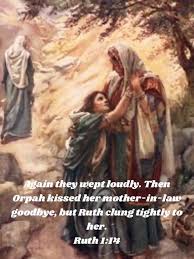
Don’t Miss This: My favorite lines in the first chapter of Ruth are these two: “Then they [Orpah and Ruth] lifted up their voices and wept again. Orpah kissed her mother-in-law, but Ruth clung to her” (Ruth 1:14, ESV).

But Ruth clung. Orpah, for reasons Scripture does not reveal explicitly, returned to find another husband, so she could become a wife and mother. Orpah, in other words, departed. But Ruth clung. Ruth was, to be cliche, in it for the long haul. She was, to use one of my favorite thinker’s verbs, “resolved.” Ruth was going to see it all through with her mother-in-law Naomi, come what will.

Encouragement: But Ruth clung. That short phrase is packed with theology about enduring, about not losing faith in the God of providence, about trusting in the goodness of God. Maybe this is only for me, I don’t know, but I long to be Ruth-like in at least this respect. When all seemed lost, she clung–not just to her mother-in-law whom she loved, but to the Lord over all of it.