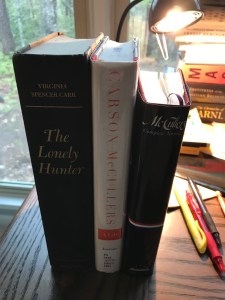
 Biography is defined as the story of a person’s life, either in whole or in part. A few years ago I discovered that I was reading a lot of biographies. Certain authors and thinkers intrigue me. It’s seldom I agree with all of what they write and/or create, but because I fear superficial knowledge, I try to read all of a writer’s works. It seems only fair to do so in order to evaluate his/her worldview.
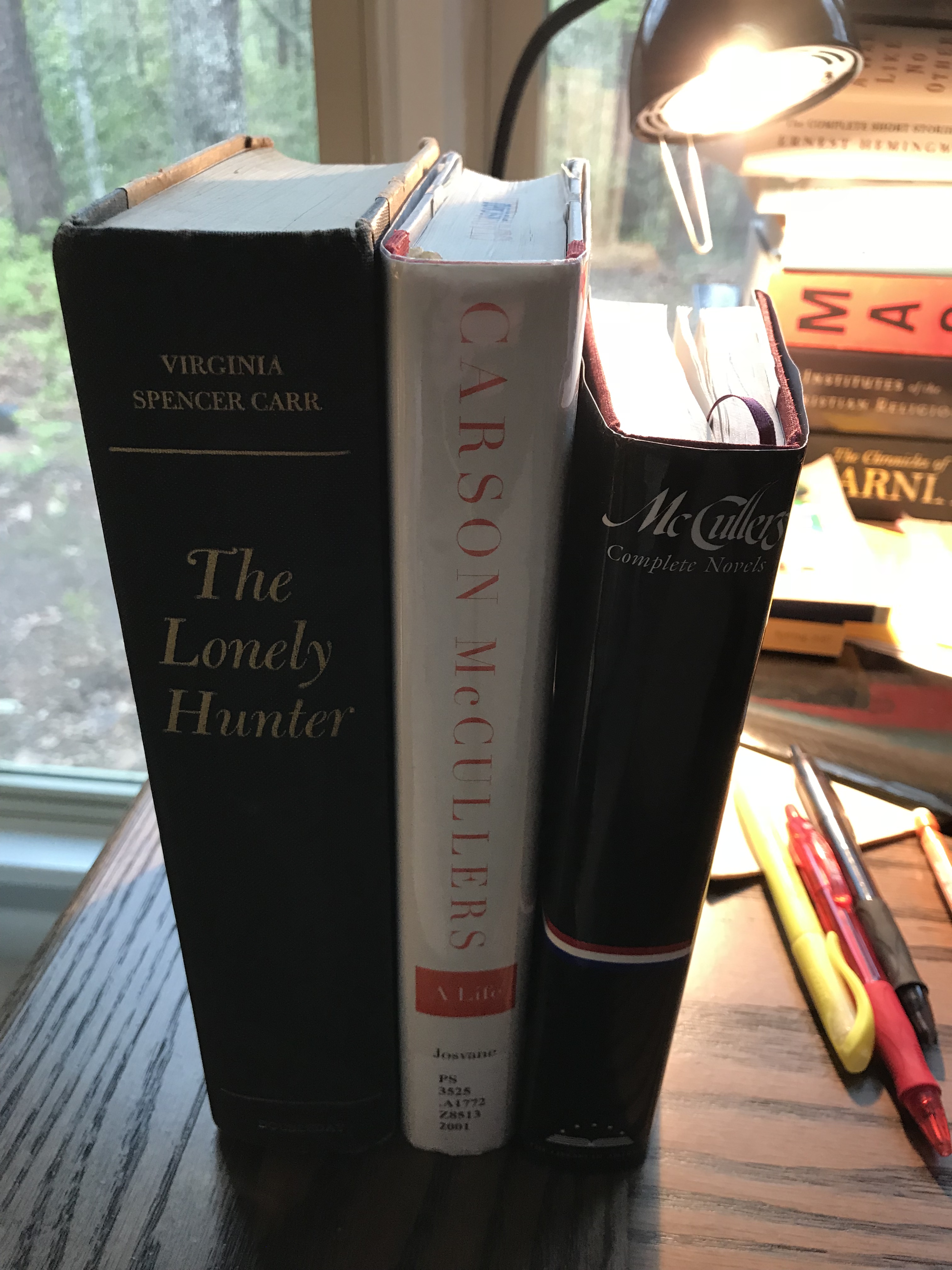
Recently I read several bios of Winston Churchill, Katherine Anne Porter, and Emily Dickinson. Each led me into deeper appreciation for those writers’ lives and accomplishments. Over the last several weeks I have been rereading the works of Carson McCullers and two biographies of her, too. One is by Savigneau and another is by Carr.
Readers, if they have heard of McCullers at all, tend to know of her novel The Heart Is a Lonely Hunter. That was the first of her works I read, too. When I was seventeen and a freshman in college, I read that novel over the course of a few all-nighters. Back then, I kept vampire hours and would read until dawn, then go to classes pale and sleepy for having been up all night reading. Now I go to sleep early and rise early, and I still like The Heart Is a Lonely Hunter–several decades later.
What’s more, I reread novels, plays, and poems that resonate with me. Certain books shape me more than others. I’ve read hundreds, perhaps thousands, of novels and or pieces of literary fiction, but a dozen or so pieces abide. Several Faulkner novels and pieces of his short fiction move me so powerfully that I find myself an apologist for the potency of literature. Dostoyevsky’s grasp of man’s psychology is staggeringly profound. The works of Flannery O’Connor and Cormac McCarthy seem to me so magnificently crafted I marvel at the literary gifts of their creators. Certain Dickens characters cause me to wonder at his panoramic imagination. Here was a man who created David Copperfield, Pip, Joe, Sydney Carton, and Scrooge, among scores of others.
Literature, the best of it, moves the soul, the mind, the imagination; it makes us see ourselves as creatures wonderful and yet fallen, noble in our capacities to sacrifice and endure, compassionate and yet terrifyingly cruel, as exiles from Eden, poor players in search of (and often in rebellion against) ultimate reality.
Faulkner wrote of this power of great literature in his Nobel Prize Address. He wrote of what the serious writer/poet does and why he does it:
“I believe that man will not merely endure: he will prevail. He is immortal, not because he alone among creatures has an inexhaustible voice, but because he has a soul, a spirit capable of compassion and sacrifice and endurance. The poet’s, the writer’s, duty is to write about these things. It is his privilege to help man endure by lifting his heart, by reminding him of the courage and honor and hope and pride and compassion and pity and sacrifice which have been the glory of his past. The poet’s voice need not merely be the record of man, it can be one of the props, the pillars to help him endure and prevail.”
In her novel The Heart Is a Lonely Hunter McCullers has a character named Doctor Copeland. He is a black doctor in the South (Georgia) in 1930s and 40s. He is an intellectual. He’s introverted, a reader of philosophy, and a good man. But he is lonesome. His heart is a lonely one. He, like the friend whose death he mourns, longs for connection. His friend had been Mr. John Singer, a Jew living in the South, another exile and stranger, who had committed suicide after his (Singer’s) friend had died. Listen to how McCullers suggests what her novel explores—namely, man’s isolation from man, and a longing to reconnect what has often fallen apart (spiritual fellowship):
“But truly with the death of that white man a dark sorrow had lain down in his heart. He had talked to him as to no other white man and had trusted him. And the mystery of his suicide had left him baffled and without support. There was neither beginning nor end to this sorrow. Nor understanding. Always he would return in his thoughts to this white man who was not insolent or scornful but who was just. And how can the dead be truly dead when they still live in the souls of those who are left behind?”
Death teaches us—if we will listen—that this universe is not the way it was originally. To use biblical language, the universe is under a curse. God told our first parents, “[C]ursed is the ground because of you; in pain you shall eat of it all the days of your life;” (Gen 3:17). Why? Because of our sin. And Paul, thousands of years later, continued that theme in Romans 8: “For we know that the whole creation has been groaning together in the pains of childbirth until now. And not only the creation, but we ourselves, who have the firstfruits of the Spirit, groan inwardly as we wait eagerly for adoption as sons, the redemption of our bodies” (8:22-23).
Carson McCullers’ The Heart Is a Lonely Hunter explores this idea of being cursed with groanings/longings/yearnings impossible to satisfy just by way of our fellow men. Instead we see characters take their own lives. We see characters that are deaf and mute—symbolic conditions for man’s inability to communicate sufficiently, his inability to cure his spiritual loneliness.
This brings me to what I relearned in reading McCullers’ work, and reading bios of her life as an artist. We do long for fellowship; we do labor under a curse; we do long for redemption. We do long to have our hearts satisfied. And great literature can call attention to these great themes. But what if it is true what Solomon wrote? In Ecclesiastes, Solomon wrote, “he [God] has put eternity into man’s heart” (Eccl 3:11a).
When I read wonderfully talented writers like McCullers, very often they’re adept at seeing the tragedies in life. For McCullers, she spent her short lifetime writing about the loneliness that plagues mankind, whether we admit it to others or not. But what she and few other wonderfully talented writers less often embrace, however, is the One who came so that all that was cursed because of sin and the first Adam will be made right through the second Adam: Jesus. He knows the longing for eternity in our hearts because he placed it there.

 MIND & MATTERS