
Introduction: It has been said that “Our lives begin to end the day we become silent about things that matter.” I appreciate that insight. Speaking truth is a dangerous undertaking. It is much easier to just go along to get along or to seek distraction endlessly. We have substituted entertainment and distraction for depth of meaning. The means of entertainment are endless. As Neil Postman wrote, we are amusing ourselves to death. Critical thinking is about as common as an Apatosaurus excelsus dinosaur in your town square.
Loss of Transcendence: This week I have been with fellow soldiers in the Midwest. One of the tasks I am able to do as a chaplain is equip soldiers with means of preventing, or at least reducing, suicide in the military. It is a tragedy how many Soldiers, Sailors, Airmen, Marines, and Coast Guardsmen take their own lives. The military sees the statistics, professes to want to prevent suicides, but seems powerless oftentimes to reduce and/or eliminate suicide. Why? At the risk of being too reductionistic, I think it’s the loss of the transcendent.
Many soldiers don’t know who they are or why they are or why there is anything that matters because they deny the Author of life. That is, if you raise a generation to believe that they are only so much cosmic dust, it should not surprise us when suicide is an epidemic. Again, “Our lives begin to end the day we become silent about things that matter.”

My Favorite Book: Like many other believers I read the Bible several times through a year. But my favorite book of the Bible has remained for many years the same: Ecclesiastes. Why? Well, it is literary in nature, that’s one reason. I relish literature and my mind naturally runs in literary grooves. But another reason is that Solomon’s Ecclesiastes is a masterful case study in meaning vs. meaninglessness. Solomon had it all, so to speak, at least in a worldly sense. He gained the whole world. He had looks, wealth, health, wine, women, and song. He was the envy of the world. He was wise, but he became oftentimes the fool.
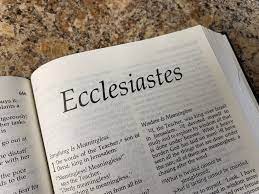
Why? Because he lost, at least at times, the transcendent. He suppressed God. He wrote, in just one of his refrains, “Then I considered all that my hands had done and the toil I had expended in doing it, and behold, all was vanity and a striving after wind, and there was nothing to be gained under the sun” (Ecclesiastes 2:11 ESV).
Perhaps his most well-known line is found in Ecclesiastes 1:9, “What has been done is what will be, and what has been done is what will be done, and there is nothing new under the sun.”
The refrain of “under the sun” runs through Ecclesiastes. It’s the secular life. It’s life without God. It’s a life given over to entertainment. It’s a life of distraction. It’s a life of “Eat, drink, and be merry; for tomorrow we die” thinking (Luke 12:19-20).
Segue: When we abandon the transcendent, we lose. We cut ourselves off from the very source of wisdom. We deny the Author of life (Acts 3:15). We reveal ourselves to be living lives of hebel. That’s the Hebrew word for vanity or vapor or mere breath. We are here, but like a mist, a vapor that vanishes. No impact.
See why suicide is rampant in the ranks? Because we’ve lost the transcendent. But (and here’s where the danger of truth-telling surfaces), I don’t know that is that we have lost truth so much as we have suppressed it.
Solomon’s Wisdom: I return to the magnificent book of Ecclesiastes. When you study Solomon, you see a man of extremes: wisdom and folly; not just one wife but scores of wives, and concubines, too (1 Kings 11:3); mirth and madness. Here was a man who gained the whole world and arguably often lost his soul. He penned that even for him, “All things are full of weariness; a man cannot utter it; the eye is not satisfied with seeing, nor the ear with hearing” (Ecclesiastes 1:8). He felt that all his accomplishments were just hebel, mere mists of nothingness, vapors. There was to be no remembrance of former things (Ecclesiastes 1:11). But he did not end this wonderful book with dourness. No, he summoned us back to the good news, the truth of redemption, the way back to transcendence:
Besides being wise, the Preacher also taught the people knowledge, weighing and studying and arranging many proverbs with great care. The Preacher sought to find words of delight, and uprightly he wrote words of truth.
The words of the wise are like goads, and like nails firmly fixed are the collected sayings; they are given by one Shepherd. My son, beware of anything beyond these. Of making many books there is no end, and much study is a weariness of the flesh. The end of the matter; all has been heard. Fear God and keep his commandments, for this is the whole duty of man. For God will bring every deed into judgment, with every secret thing, whether good or evil. (Ecclesiastes 12:9-14 ESV)

Encouragement: I love teaching my fellow soldiers, absolutely love it. However, what would happen, I wonder, if we simply read and implemented Solomon’s book Ecclesiastes? What might happen if we equipped soldiers and civilians with the truth of God? What if we reintroduced them to the truth that gets so often excluded from discussion and replaced by groupthink and moralistic bromides? What if we allowed them to study the actual history of Solomon, a king and ruler, who lived to tell the tales about the costs–the devastating costs–of secularism? What if, in sum, we abandoned the age of folly and sought to be a people of wisdom?
 MIND & MATTERS
Beautiful words. I often find myself thirsty for more knowledge. In my mind, constantly educating myself is acceptable, maybe even admirable because our society condones hard work. However, as you mentioned, Ecclesiastes warns us that vanity is not only about mere material objects but also about worldly knowledge. It is a rather humbling experience to accept that there is a limit to my intellectual knowledge and that there are certain things that are beyond human comprehension.
LikeLike
Well said.
LikeLike