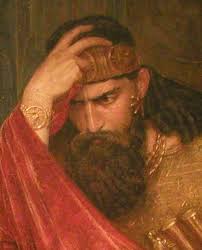
Bottom line up front: Learning from a Bad Example
Text: 1 Samuel 15
Context: Wicked King Saul Is Rejected by God
Overview: Wicked King Saul continued to reveal his true colors. God commanded Saul via the prophet Samuel to “devote to destruction all” that the Amalekites had. Saul was to lead Israel and not spare any of the wicked Amalekites. God was calling Israel’s king (Saul) to be a people set apart unto God, and for the people he represented (Israel) to be a light amongst the fellow nations. Would Saul succeed? Would Israel succeed? Would either be faithful to execute God’s word to them? That’s the issue.
We only get to v. 9 before we see Saul’s true colors: “But Saul and the people spared Agag and the best of the sheep and of the oxen and of the fattened calves and the lambs, and all that was good, and would not utterly destroy them.” And just like that, the Lord speaks again to Samuel, the prophet and truth-teller: “I regret that I have made Saul king, for he has turned back from following me and has not performed my commandments” (1 Sam.15:11a, ESV).
Saul had “turned back” from following God’s word. And the people who followed (like undiscerning sheep) wicked King Saul, were likewise being judged. That’s the key issue here—the turning back/turning away from God’s word. “To obey is better than sacrifice” (1 Sam. 15:22b, ESV). It doesn’t matter how many oxen, sheep, or rams we sacrifice if our heart is not one of obedience to the Lord, the Commander. We can get all puffed up with pride if we point to ourselves and say, “See how much I’ve done? See how much I’ve sacrificed? See how many successes I’ve accrued to my credit?” That is pride – plain and simple –and it is damning.
Learning from Saul’s Failures: We can learn from anyone if we’ll but pay attention. That is, we should learn, even from bad examples. Saul is an example of a failed leader. Saul’s favorite person in the world was Saul. He wasn’t out for the good of his people. He failed his nation. He failed in God’s eyes, too. God was going to seek a king after His own heart, a true shepherd. In the immediate context, that man was going to be David. In the greater sense, however, that Shepherd is the Lord Jesus. But for now, let us learn from Saul.
 MIND & MATTERS
How can , God regret , He knows what Saul is going to do ?Maybe no other way to express it?David
Sent from the all new AOL app for iOS
LikeLiked by 1 person
I think it’s wise to read it in light of similar passages like Genesis 6:6 and Isaiah 46:9-10. It seems to indicate not any limit on God’s knowledge (God knows all things) but that God does indeed sorrow in the sense that He sees, knows Saul’s (and our) sins and their damage. It’s akin to our seeing our children or grandchildren do self-destructive/sinful things, but we grieve over that reality. We see it, we know it, we see where it leads, etc. and we regret/feel compassion over the destruction wrought by sin. God uses even Saul’s sin to bring about the greater kings (David in the immediate sense and Jesus in the ultimate), as part of the providential plan that, for those who love God and are called according to His purpose, all things work together for good. “All things” is crucial to understand. Saul is part of all things; David is part of all things, etc. I hope that helps.
LikeLike
You explain well grasshopper Many thanks
Sent from the all new AOL app for iOS
LikeLiked by 1 person
Agree with your explanation However, I don’t think we have the words to express what an infinite God thinks and plans with our finite minds and understanding.
Sent from the all new AOL app for iOS
LikeLiked by 1 person