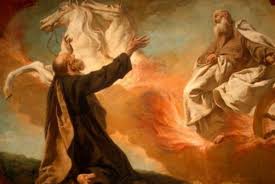
Text: When they had crossed, Elijah said to Elisha, “Ask what I shall do for you, before I am taken from you.” And Elisha said, “Please let there be a double portion of your spirit on me.” 10 And he said, “You have asked a hard thing; yet, if you see me as I am being taken from you, it shall be so for you, but if you do not see me, it shall not be so.” 11 And as they still went on and talked, behold, chariots of fire and horses of fire separated the two of them. And Elijah went up by a whirlwind into heaven. 12 And Elisha saw it and he cried, “My father, my father! The chariots of Israel and its horsemen!” And he saw him no more. (2 Kings 2:9-12)
Many folks would be familiar with the film version Chariots of Fire about Eric Liddell, the runner and Scottish Christian missionary, but fewer perhaps are familiar with Scripture’s historical account of Elijah and Elisha, two prophets of God in the Old Testament.
Context, Context, Context: Elisha was the younger of the two prophets. Elisha looked up to Elijah and longed to emulate him vis-à-vis service for the Lord. Elijah had been used by God in the utter humiliation of idolatrous Baal worship at Mount Carmel earlier (1 Kings 18). Elisha longed for moments like that, too, where God would utterly humiliate false religion in all its forms. Elisha asked his mentor Elijah, “Please let there be a double portion of your spirit on me” (2 Kings 2:9b). But what’s so interesting is the lesson God was teaching Elisha. It was the lesson of believing God’s word. Why do I say that? Because the conversation between the two men was still going on when chariots of fire and horses of fire appeared, separated the two prophets, and the senior prophet Elijah was removed to heaven via a whirlwind.
Let that sink in from Elisha’s perspective: the man you’ve been looking to, learning from, emulating, and from whom you’ve gained wisdom has been removed from your sight. What now? And here it is: believing God’s word, God’s covenantal promise, even when the visual has been removed for a time.
Connection: Don’t you remember Acts 1? The resurrection of Christ has occurred. He had appeared to hundreds of people. He had eaten with them. He had spoken with them. Then in v. 8 of Acts 1, when the disciples are peppering Jesus with questions about the timeline and calendar of events, Jesus teaches them: “But you will receive power when the Holy Spirit has come upon you, and you will be my witnesses in Jerusalem and in all Judea and Samaria, and to the end of the earth.” And in v. 9, “a cloud took him out of their sight.” The same pattern, you see. Just as Elisha was looking to Elijah, the disciples were looking to Jesus. That’s all well and good and wise.
The hard part, however, comes when the visible leader is removed. What do the troops do then? That’s when you find out if you’ve taught them well. Can they function in your absence? If so, how well and/or how poorly?
Encouragement: Elijah’s removal from Elisha’s sight was a foreshadowing of Jesus’ resurrection and his commissioning Christians to press on and go out with the gospel. That’s why the ‘Great Commission,’ as it’s called in church history, has that label. Christians are commissioned as officers to go out and expand the King’s kingdom by proclaiming the good news of what Christ has accomplished via his birth, life, death, crucifixion, and resurrection, and of his bride, the true church. But it entails walking by faith in the covenant promises of God. Elijah knew it. Elisha was learning it. As were the disciples then. As are disciples now. The same pattern, you see. Trust the Lord and his revealed words.
 MIND & MATTERS