The Wisdom of “Taking a Knee”

Questions: Ever known of someone diagnosed with PTSD? Ever known of someone who failed to address trauma in a healthy way? Ever known of someone you could see was struggling to find productive ways to process events? 

It is likely you answered yes to at least one of those questions. Perhaps you answered yes to all three. If we are honest, all of us likely know of at least one person who battles this. Perhaps it’s even you. 

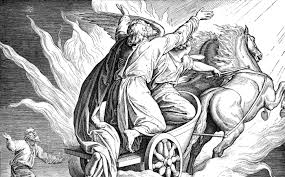
Connection to Scripture: In 1 Kings 19, we have the account of Elijah (God’s prophet, God’s man) fleeing. Yes, you read that correctly. He fled from wicked Jezebel. Why? I mean, wasn’t Elijah literally just coming down from a mountaintop experience where he was used by God in a miraculous way? God utterly devastated false religion. The pagans were slaughtered. God’s holiness was vindicated. And Elijah was used by God in ways that rivaled and perhaps surpassed even the events in which God used Moses earlier. By all accounts, we would think that Elijah would have renewed faith, that he’d be riding high in his spiritual walk with the Lord. But instead we find a man who is utterly spent, exhausted, and emotionally wrung out. He has PTSD. He flees when he should ostensibly be feeling invincible and at peace. 

Scripture: 

19 Ahab told Jezebel all that Elijah had done, and how he had killed all the prophets with the sword. 2 Then Jezebel sent a messenger to Elijah, saying, “So may the gods do to me and more also, if I do not make your life as the life of one of them by this time tomorrow.” 3 Then he was afraid, and he arose and ran for his life and came to Beersheba, which belongs to Judah, and left his servant there.

4 But he himself went a day’s journey into the wilderness and came and sat down under a broom tree. And he asked that he might die, saying, “It is enough; now, O Lord, take away my life, for I am no better than my fathers.” 5 And he lay down and slept under a broom tree. And behold, an angel touched him and said to him, “Arise and eat.” 6 And he looked, and behold, there was at his head a cake baked on hot stones and a jar of water. And he ate and drank and lay down again. 7 And the angel of the Lord came again a second time and touched him and said, “Arise and eat, for the journey is too great for you.” 8 And he arose and ate and drank, and went in the strength of that food forty days and forty nights to Horeb, the mount of God.

The Lord Speaks to Elijah
9 There he came to a cave and lodged in it. And behold, the word of the Lord came to him, and he said to him, “What are you doing here, Elijah?” 10 He said, “I have been very jealous for the Lord, the God of hosts. For the people of Israel have forsaken your covenant, thrown down your altars, and killed your prophets with the sword, and I, even I only, am left, and they seek my life, to take it away.” 11 And he said, “Go out and stand on the mount before the Lord.” And behold, the Lord passed by, and a great and strong wind tore the mountains and broke in pieces the rocks before the Lord, but the Lord was not in the wind. And after the wind an earthquake, but the Lord was not in the earthquake. 12 And after the earthquake a fire, but the Lord was not in the fire. And after the fire the sound of a low whisper.[a] 13 And when Elijah heard it, he wrapped his face in his cloak and went out and stood at the entrance of the cave. And behold, there came a voice to him and said, “What are you doing here, Elijah?” 14 He said, “I have been very jealous for the Lord, the God of hosts. For the people of Israel have forsaken your covenant, thrown down your altars, and killed your prophets with the sword, and I, even I only, am left, and they seek my life, to take it away.” 15 And the Lord said to him, “Go, return on your way to the wilderness of Damascus. And when you arrive, you shall anoint Hazael to be king over Syria. 16 And Jehu the son of Nimshi you shall anoint to be king over Israel, and Elisha the son of Shaphat of Abel-meholah you shall anoint to be prophet in your place. 17 And the one who escapes from the sword of Hazael shall Jehu put to death, and the one who escapes from the sword of Jehu shall Elisha put to death. 18 Yet I will leave seven thousand in Israel, all the knees that have not bowed to Baal, and every mouth that has not kissed him.
” (1 Kings 19:1-18, ESV)

Encouragement: Sometimes after intense emotional highs and/or lows, we need to remember something: decompression and rest are essential. Do we know how to switch off and just rest? Really rest. For me, I hike, or read, or fish, or kayak. For Elijah, he needed to be reminded that he wasn’t alone, that God had his people then. And he has his people still today. “Taking a knee” is a spiritual discipline we need as soldiers in uniform and as soldiers of God. 
Learning with Elisha

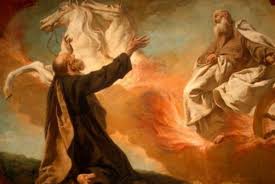
Text: When they had crossed, Elijah said to Elisha, “Ask what I shall do for you, before I am taken from you.” And Elisha said, “Please let there be a double portion of your spirit on me.” 10 And he said, “You have asked a hard thing; yet, if you see me as I am being taken from you, it shall be so for you, but if you do not see me, it shall not be so.” 11 And as they still went on and talked, behold, chariots of fire and horses of fire separated the two of them. And Elijah went up by a whirlwind into heaven. 12 And Elisha saw it and he cried, “My father, my father! The chariots of Israel and its horsemen!” And he saw him no more. (2 Kings 2:9-12)

Many folks would be familiar with the film version Chariots of Fire about Eric Liddell, the runner and Scottish Christian missionary, but fewer perhaps are familiar with Scripture’s historical account of Elijah and Elisha, two prophets of God in the Old Testament.

Context, Context, Context: Elisha was the younger of the two prophets. Elisha looked up to Elijah and longed to emulate him vis-à-vis service for the Lord. Elijah had been used by God in the utter humiliation of idolatrous Baal worship at Mount Carmel earlier (1 Kings 18). Elisha longed for moments like that, too, where God would utterly humiliate false religion in all its forms. Elisha asked his mentor Elijah, “Please let there be a double portion of your spirit on me” (2 Kings 2:9b). But what’s so interesting is the lesson God was teaching Elisha. It was the lesson of believing God’s word. Why do I say that? Because the conversation between the two men was still going on when chariots of fire and horses of fire appeared, separated the two prophets, and the senior prophet Elijah was removed to heaven via a whirlwind.

Let that sink in from Elisha’s perspective: the man you’ve been looking to, learning from, emulating, and from whom you’ve gained wisdom has been removed from your sight. What now? And here it is: believing God’s word, God’s covenantal promise, even when the visual has been removed for a time.

Connection: Don’t you remember Acts 1? The resurrection of Christ has occurred. He had appeared to hundreds of people. He had eaten with them. He had spoken with them. Then in v. 8 of Acts 1, when the disciples are peppering Jesus with questions about the timeline and calendar of events, Jesus teaches them: “But you will receive power when the Holy Spirit has come upon you, and you will be my witnesses in Jerusalem and in all Judea and Samaria, and to the end of the earth.” And in v. 9, “a cloud took him out of their sight.” The same pattern, you see. Just as Elisha was looking to Elijah, the disciples were looking to Jesus. That’s all well and good and wise.

The hard part, however, comes when the visible leader is removed. What do the troops do then? That’s when you find out if you’ve taught them well. Can they function in your absence? If so, how well and/or how poorly?

Encouragement: Elijah’s removal from Elisha’s sight was a foreshadowing of Jesus’ resurrection and his commissioning Christians to press on and go out with the gospel. That’s why the ‘Great Commission,’ as it’s called in church history, has that label. Christians are commissioned as officers to go out and expand the King’s kingdom by proclaiming the good news of what Christ has accomplished via his birth, life, death, crucifixion, and resurrection, and of his bride, the true church. But it entails walking by faith in the covenant promises of God. Elijah knew it. Elisha was learning it. As were the disciples then. As are disciples now. The same pattern, you see. Trust the Lord and his revealed words.

Chaplain Daily Touchpoint #330: Knees that Have Not Bowed to Baal

Introduction: This morning I was in one of my favorite passages of Scripture; it’s 1 Kings 19 where the Lord speaks to Elijah to remind him that God still has His people and that His work will go on.

Questions: Why might it be that God includes episodes like this from redemptive history? Why include slice-of-life stories about a prophet like Elijah, (who is indubitably one of the most prominent prophets in the Old Testament), but include episodes like 1 Kings 19 wherein Elijah is at a low point existentially? Why expose the low points of the prophet’s life? Follow me . . .

Historical context: Some folks are hopefully at least a but familiar with 1 Kings 18. That’s where the prophets of Baal are humiliated by the Lord. They had been dancing around carved idols like the pagans they were; they were cutting themselves and making blood oblations, and more. Yet the idols didn’t respond to their petitions. Shocker. But the Lord responded to the truth-telling prophet Elijah. Holy fire fell from heaven; the wood, stones, dust, and water were all consumed by the flames of God and Elijah slaughtered the false prophets by the river (1 Kings 18:38-40). By all accounts, it is one of the most dramatic events in the Old Testament.

But then we get to 1 Kings 19 and we discover a very different side of Elijah wherein he has gone from a mountaintop experience to a spiritual valley. Wicked Queen Jezebel essentially put a bounty out for Elijah’s head. And rather than welcoming the fight, Elijah was ready to toss in the towel: “But he [Elijah] himself went a day’s journey into the wilderness and came and sat down under a broom tree. And he asked that he might die, saying, “It is enough; now, O LORD, take away my life, for I am no better than my fathers” (1 Kings 19:4).

How’s that for going from zenith to nadir, from mountaintop to deepest valley? But isn’t that the way we are so often?

But God. God wasn’t going to abandon His prophet. God asked Eljah, “What are doing here, Elijah?” (1 Kings 19:9, 13b). God asked him that at least twice. Why? The answer is obvious, of course–to teach Elijah.

And God’s audible response came too: “Yet I [God] will leave seven thousand in Israel, all the knees that have not bowed to Baal, and every mouth that has not kissed him” (1 Kings 19:18).

Encouragement: God was raising up His army of faithful warriors for the gospel amidst hostile environs in demonstration that God’s will prevails through all obstacles, but it does so God’s way. 7,000 pairs of knees had not caved to idolatry, but were stalwart and steadfast. That’s good news, folks. God has His people, at all times, and His army marches on. Let us trust Him.